Original Article Vol. 5 No. 1 (2021): International J Health Systems and Implementation Research
Computer Vision Syndrome and its Risk Factors among Medical Students of a Tertiary Care Centre in Odisha: A Cross-Sectional Study
Downloads
Topics
Keywords:
- Digital eye syndrome, CVS, vision, medical students, Risk factors
Abstract
Background: The enormous use of digital device like Computer, tablets and android mobiles though making our lifestyle much easier, but leading to many physical ailments like Computer Vision Syndrome(CVS) . The young generation is more addicted to this digital world, hence affected a lot from this CVS. Objective: To determine the prevalence of CVS, associated risk factors and to assess the preventive measures taken by undergraduate medical students while using computers. Methodology: A cross-sectional descriptive study was conducted among 477 undergraduate medical students in IMS & SUM Hospital, Bhubaneswar, Odisha, India. The data were collected by Epicollect-5 and analysed by using SPSS v21 software. Appropriate statistical tests were applied for observing the significant associations with p value <0.05. Results: The prevalence of CVS was found to be 83.2% among the undergraduate students. The final year students(49.8%) reported more symptoms of asthenopia as compared to 2nd year(15.6%) and 3rd year(34.5%) MBBS students. The most significant risk factors related to excessive computer use were online classes, high brightness of the screen and very close sitting before computer. Conclusion: It is a necessity to create awareness regarding computer vision syndrome and its preventive measures among all healthcare personnel.
Full text
This web version was prepared from the published PDF, which is the version of record. Please cite and quote from the PDF.
Introduction
Today the entire world is going through a computer era [1]. The massive use of digital devices such as personal computers, tablets and android mobiles has increased substantially in recent years across the world [2]. Though it makes our lifestyle much easier, on the other hand it is a major driver in disrupting human life, and its excessive use may prove extremely dangerous. In each and every field, starting from the government to private sector, in trades and commerce, banks, factories, educational institutions, for research and development, and healthcare setup, the role of computer is indescribable [3].
The term Computer vision syndrome (CVS) came into notice when people were complaining of uncomfortable, painful, and irritable vision. It is one of the alarming public health issues related to digital technology that is – android cell phones, tablets and computers. Symptoms regarding our vision and visual disabilities are very common nowadays because of higher requirement of computer use in all fields [4]. Using computers has become a necessity of 21st century. However, this usage, even for 3 hour per day, leads to risk of developing computer vision syndrome (CVS), low back pain, tension headaches, and other forms of psychosocial stress [5].
Computer operators are reporting more vision problems as compared to those whose work is not computer dependent. The prevalence of CVS ranges from 64% to 90% among computer users. It is recorded around 60 million people suffer from CVS globally. A number of investigators have reported that in India, visual symptoms occur in 75% to 90% of computer workers. A survey released by the National Institute for Occupational Safety and Health (NIOSH) showed that nearly 22% of computer workers have been facing the problems of musculoskeletal disorders [6].
These days, university students especially medical students are spending more time on digital devices such as computers, laptops, and android cell-phones, from studying online to conducting web-based research. There have been several studies reporting an increased prevalence of CVS among computer users, specifically medical students [7].
Little research has been performed to document the effects of computer use on the physical health of Indian users especially college students and young generation employees. Hence, this study aims to assess the prevalence of CVS, associated risk factors and preventive measures taken by undergraduate medical students while using computers.
Materials and Methods
This was a cross-sectional study conducted among a total of 477 undergraduate MBBS students of a medical college of Bhubaneswar, Odisha, a state situated eastern part of India. The study was approved by institutional ethical committee. The study was carried out in January 2021, when the lockdown was over and students came to hostel for appearing university exam. The students of second, third and final year were interviewed in their hostel premises through one-to-one questionnaire method by using Epicollect5. Their participation was voluntary. All those students who used computer in last 1 month preceding the date of interview were included in the study. Those who were absent on the day of data collection and those who did not give consent to participate were excluded. The questionnaires developed by the investigators were internally validated by 2 ophthalmologists, 1 General Medicine, and 1 Community Medicine professor. The validate questionnaire was pretested on 15 students.
The pre-tested structured questionnaire tool included the demographic profile of participant, duration of computer use per day, symptoms faced during past 1 month, type of refractive error present in each individual and frequency of breaks taken by participants while working on computers. The authors defined the outcome variable CVS as “ the complex of eye and vision problems arise due to the close contact of computer for a longer time period.” The eye symptoms were considered as redness, burning sensation, headache, blurring vision, dry eyes and musculoskeletal pain. The symptoms experienced by the participants were categorised into mild (transient symptoms remain for few minutes to hours), moderate (persist for few hours and subside after taking rest), and severe (needs ophthalmic consultation) visual problems as per the computer use.
The data were analysed using the standard statistical software package version 20(SPSS v21). All the descriptive data were presented as percentages. The categorical variables were analysed by applying chi-square test for observing the significant association between each variable and outcome.
Results
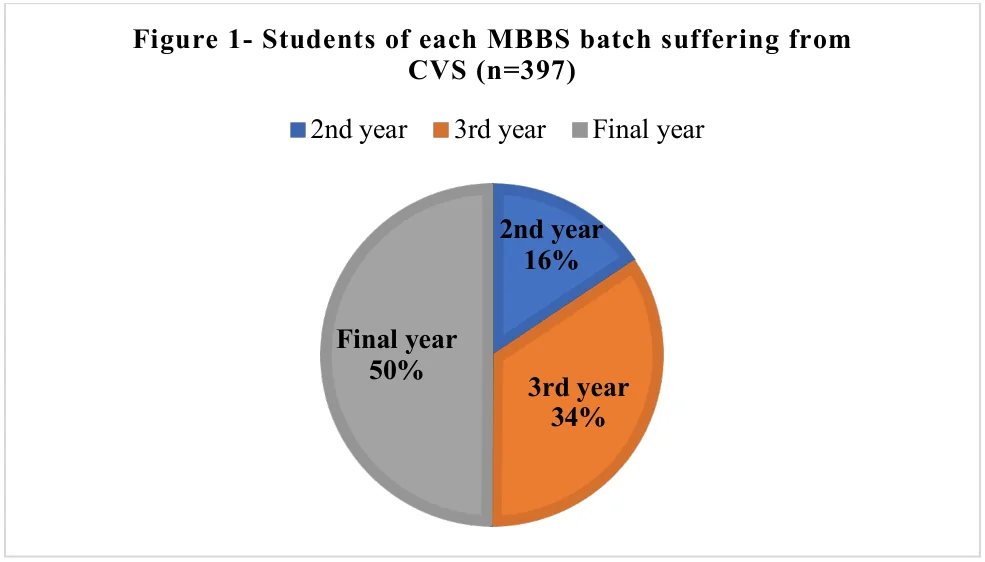
A total of 477 participants were interviewed, of which 57.2% were female, while rest 42.7% were males. The mean age was 23.5 years, ranging between 18 to 30 years. Almost all students reported use of computers daily for the purpose of studying. The mean duration of computer use per day was 5.5 hours. Around 83.22% (397) students reported at least one symptom of CVS. Final year students (49.87%) reported more symptoms of asthenopia as compare to 2nd year (15.61%) and 3rd year (34.50%) MBBS students. (see Figure 1)
Female participants 244 (61.4%) were observed to have higher risk of CVS as compare to male participants i.e., 153 (38.5%). Out of 397 students who had symptoms of CVS, 248 (62.4%) were myopic, 23 (5.7%) were hypermetropic, and 14 (3.5%) were astigmatic. A total of 112 (28.2%) students did not have any type of refractive error. The presence of refractive errors such as myopia and astigmatism showed significant association with CVS ( p=0.003, and p=0.04 respectively). However, hyperopia was not associated with CVS.
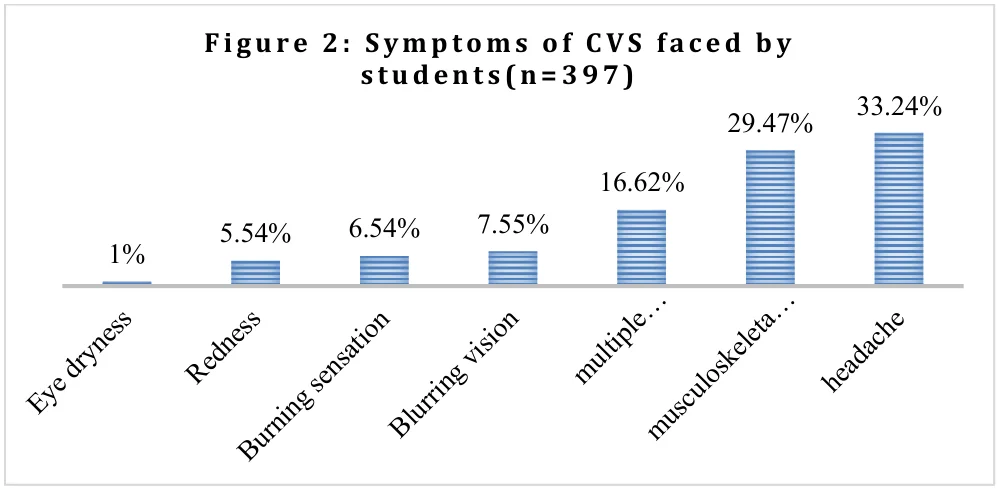
The most frequently reported symptoms were headache 132 (33.24%), pain in neck and shoulder 117 (29.47%), blurring of vision 30 (7.55%), burning sensation 26 (6.54%), and redness of eyes 22 (5.54%). The rest 66 (16.62%) students suffered from more than one symptoms. (see Figure 2) Around 276 (69.52%) students suffered from mild CVS, while 102 (25.69%) faced moderate symptoms and the remaining 19 (4.78%) were having severe symptoms. Almost all participants used computer for daily online classes, as a complete shutdown of colleges was strictly followed by the university. The association between the presence of CVS and each risk factor was analysed [Table 1].
| Variables | Groups | Computer vision syndrome | |||
|---|---|---|---|---|---|
| Positive | Negative | Total | p value | ||
| Duration of studying | 3-5 hours/day | 68(17.12%) | 48(60%) | 296(62.05%) | 0.00001* |
| 5-7 hours/day | 81(20.40%) | 22(27.5%) | 103(21.59%) | ||
| >7 hours/day | 248(62.4%) | 10(12.5%) | 78(16.35%) | ||
| Taking breaks | Yes | 294(74.05%) | 63(78.75%) | 357(74.84%) | 0.377 |
| No | 103(25.94%) | 17(21.25%) | 120(25.15%) | ||
| Frequency of taking breaks | Every 20 minutes or less | 97(24.43%) | 27(33.75%) | 124(25.99%) | <0.08 |
| Every 20-40 minutes | 219(55.16%) | 38(47.5%) | 257(53.87%) | ||
| >40 minutes | 81(20.40%) | 15(18.75%) | 96(20.12%) | ||
| Brightness of the screen | Dull | 158(39.79%) | 29(36.25%) | 187(39.20%) | 0.001* |
| Bright | 202(50.88%) | 46(57.5%) | 248(51.99%) | ||
| Very bright | 37(9.31%) | 5(6.25%) | 42(8.80%) | ||
| Distance from the screen | < 45cm | 366(92.19%) | 56(70%) | 422(88.46%) | 0.00001* |
| >45cm | 31(7.80%) | 24(30%) | 55(11.53%) | ||
*p value statistically significant
Discussion
The study reveals very high prevalence (83.22%) of computer vision syndrome among a total of 477 medical students. Such high prevalence of CVS among medical and engineering students were depicted by M. Logaraj et al, in Chennai [8]. Abdullah et al, mentioned of 95% prevalence of CVS among medical students in Saudi Arabia [9]. Another study carried out in Pakistan and Malaysia reported the prevalence rate as 90.5% and 89.9%, respectively [10,11]. Female students were observed to have more risk of CVS as compared to male students. This association between gender and CVS symptoms agrees with the findings by Straker et al and other studies conducted in Sri Lanka, Chennai and United Arab Emirates [8,12,13].
The above study reported a mean age of 23.5 years and no association of age with CVS. Similar findings were found by a few studies [13,14]. However the study conducted by Ranasinghe et al, found a significantly higher prevalence of CVS among above 40 years population as compared with those aged less than 20 years [12].
Refractive errors such as myopia and astigmatism significantly aggravate the symptoms of computer vision syndrome. In contrast, a study conducted by Ghufran A. Abudawood showed no significant association between refractive errors such as myopia and hypermetropia with CVS, however there was an association between astigmatism and CVS symptoms (<0.001) [7]. Other experimental studies showed a significant increase in symptoms with uncorrected residual astigmatism [14,15]. If refractive errors are not corrected they contribute to the symptoms of CVS.
The most frequently reported ocular symptoms were headache in 33.24% followed by musculoskeletal pain in neck and shoulder (29.47%). Other symptoms included redness, burning sensation, blurring of vision, and dryness of eyes (5.54%, 6.54%, 7.55%, and 1%, respectively). Other studies report frequency of burning sensation in 33% of medical and dental students, 54.8% of university students, and 32.3% of medical students [8,10,14]. Headache in CVS is explained by the constant need to adjust the eyes by contracting the extraocular muscles and ciliary muscles to maintain the lens in the accommodating phase.
Focusing and refocusing are required throughout the time, repeatedly to see in different distances from the screen to the keyboard and to work documents, leading to eye muscle fatigue causing headache. Eye strain was experienced by 14% of students and blurred vision in 11.4%, both are associated significantly with dim room lightning [7]. Increased sensitivity to light was observed in 60.2%, specifically and significantly among students using higher screen brightness [16].
The result showed highly statistically significant risk factors – duration of studying, distance from the screen as well as brightness of the screen with p value <0.001. Duration of studying using computers was the most significant risk factor, in which the longer time exposure to computer more extent of symptoms [8,10]. Consistency with the similar results seen in another study conducted by Hassan et al and a report by the American Optometric Association. Furthermore, authors reported that among CVS-positive group, students who spent more than four hours were at significantly at higher risk of CVS than who spent less than four hours. The fact was strengthened by Reddy et al, who found a significantly higher CVS among students who used computers for more than two hours. Hence longer the duration, the longer the discomfort lasts even after work [11].
There is no association between frequency of taking breaks and symptoms of CVS, which is supported by the same finding in previous studies. However, visual discomfort can be reduced by taking short breaks every 30 minutes of using computer [17]. Not taking breaks at all during studying (8.8%) was found significantly associated with CVS [18]. In accordance to this finding, in previous studies also, visual symptoms were reported significantly among computer users who were not taking frequent breaks [19].
Most of the students (92.19%) viewed computers at a distance of less than 45 cm which resulted significantly in more CVS symptoms. Similarly, Hassan et al found that students who used computers at a distance of less than 50 cm were prone to higher risk of CVS [20]. According to American Optometric Association, the recommended viewing distance was suggested to be 20–28 inches [19].
There is are a few limitations in this single-centre study. There is a reporting bias as CVS is diagnosed based on self-reported symptoms without ophthalmic examination. Pre-existing medical or ocular conditions were not mentioned separately hence overestimation of CVS prevalence may have contaminated the results.
Conclusion
The prevalence of computer vision syndrome (CVS) is alarming among undergraduate medical students, with excessive headache, musculoskeletal pain, blurring of vision, burning sensation, tearing, and dryness of eyes being the most common symptoms. The study shows higher prevalence of CVS is associated with female gender, refractive errors such as myopia and astigmatism, long duration of exposure to computers, using bright screen and close proximity to computer screen.
The students used to take preventive measures such as taking breaks for few minutes between sessions of using computer. The instigators thus recommend use of 20-20-20 rule should be followed by all students that means all students should take a break after 20 minutes of using the screen and they should look away at something that is 20 feet away from them for a total time of 20 seconds. There is severe risk of vision loss due to CVS if not treated in time or precautions are not followed timely. It has been proved that CVS-related symptoms lessen the productivity of work. There is a need to create awareness among students regarding health effects specially about the adverse effect of prolonged computer use and the preventive measures in order to reduce CVS symptoms.
References
- The Industrial Era Ended, and So Will the Digital Era [Internet]. [cited 2021 Jun 20]. Available from: https://hbr.org/2018/07/the-industrial-era-ended-and-so-will-the-digital-era
- Sheppard AL, Wolffsohn JS. Digital eye strain: prevalence, measurement and amelioration. BMJ open Ophthalmol [Internet]. 2018 Apr 16;3(1):e000146–e000146. Available from: https://pubmed.ncbi.nlm.nih.gov/29963645
- Uses of computer in our daily life - Klient Solutech [Internet]. [cited 2021 Jun 20]. Available from: https://www.klientsolutech.com/top-10-uses-of-computer-in-our-daily-life/
- VISUAL ERGONOMICS HANDBOOK. [Google Scholar]
- Mowatt L, Gordon C, Santosh ABR, Jones T. Computer vision syndrome and ergonomic practices among undergraduate university students. Int J Clin Pract. 2018 Jan 1;72(1). [Google Scholar]
- Bali J, Neeraj N, Bali R. Computer vision syndrome: A review. J Clin Ophthalmol Res [Internet]. 2014 [cited 2021 Jan 2];2(1):61. Available from: http://www.jcor.in/text.asp?2014/2/1/61/122661
- Abudawood GA, Ashi HM, Almarzouki NK. Computer Vision Syndrome among Undergraduate Medical Students in King Abdulaziz University, Jeddah, Saudi Arabia. J Ophthalmol. 2020;2020. [doi:10.1155/2020/2789376]
- Logaraj M, Madhupriya V, Hegde S. Computer vision syndrome and associated factors among medical and engineering students in Chennai. Ann Med Health Sci Res [Internet]. 2014 [cited 2021 Jun 20];4(2):179. Available from: https://pubmed.ncbi.nlm.nih.gov/24761234/
- Altalhi A, Khayyat W [Internet]. 2013 [cited 2021 Jun 20];5(2):161–8. Available from: https://pubmed.ncbi.nlm.nih.gov/24172549/
- , Khojah O, Alsalmi M, Almarzouki H. Computer Vision Syndrome Among Health Sciences Students in Saudi Arabia: Prevalence and Risk Factors. Cureus [Internet]. 2020 Feb 20;12(2):e7060–e7060. Available from: https://pubmed.ncbi.nlm.nih.gov/32226662
- (PDF) Prevalence of computer vision syndrome and its associated risk factors among under graduate medical students of Urban Karachi [Internet]. [cited 2021 Jun 20]. Available from: https://www.researchgate.net/publication/317552204_Prevalence_of_computer_vision_syndrome_and_its_associated_risk_factors_among_under_graduate_medical_students_of_Urban_Karachi
- Reddy SC, Low CK, Lim YP, Low LL, Mardina F, Nursaleha MP. Computer vision syndrome: a study of knowledge and practices in university students. Nepal J Ophthalmol [doi:10.3126/nepjoph.v5i2.8707]
- Ranasinghe P, Wathurapatha WS, Perera YS, Lamabadusuriya DA, Kulatunga S, Jayawardana N, et al. Computer vision syndrome among computer office workers in a developing country: an evaluation of prevalence and risk factors. BMC Res Notes [Internet]. 2016 Mar 9;9:150. Available from: https://pubmed.ncbi.nlm.nih.gov/26956624
- Shantakumari N, Eldeeb R, Sreedharan J, Gopal K. Computer use and vision-related problems among university students in Ajman, United Arab Emirate. Ann Med Health Sci Res [Internet]. 2014 [cited 2021 Jun 20];4(2):258. Available from: https://pubmed.ncbi.nlm.nih.gov/24761249/
- Computer Monitors and Eye Problems [Internet]. [cited 2021 Jun 20]. Available from: https://youreyesite.com/computer-monitors-eye-problems/
- Effects of residual astigmatism in contact lens wear on visual discomfort in VDT use - PubMed [Internet]. [cited 2021 Jun 20]. Available from: https://pubmed.ncbi.nlm.nih.gov/1583277/
- Katabaro JM, Yan Y. Effects of Lighting Quality on Working Efficiency of Workers in Office Building in Tanzania. J Environ Public Health. 2019;2019. [doi:10.1155/2019/3476490]
- Preventing Occupational Disease and Injury, Second Edition [Internet]. [cited 2021 Jun 20]. Available from: https://www.medscape.com/viewarticle/510597
- Straker LM, Smitha AJ, Bear N, O’Sullivan PB, de Klerk NH. Neck/shoulder pain, habitual spinal posture and computer use in adolescents: The importance of gender. Ergonomics. 2011 Jun;54(6):539–46. [doi:10.1080/00140139.2011.576777]
- Computer vision syndrome | AOA [Internet]. [cited 2021 Jun 20]. Available from: https://www.aoa.org/healthy-eyes/eye-and-vision-conditions/computer-vision-syndrome?sso=y
- (No Title) [Internet]. [cited 2021 Jun 20]. Available from: https://www.ophthalmologyupdate.com/issue-archive/April-June-2017/14

Published
Article metrics
- Views
- 973
- Downloads
- 1,074
Based on this site's usage statistics.
Issue
Section
How to Cite
More in this topic: NCDs & mental health
View Point · 2025
From Screens to Sips: Social Media's Impact on Adolescent Alcohol Use