Original Article Vol. 6 No. 1 (2022): International J Health Systems and Implementation Research
Evaluation of District Early Intervention Centers under Child Health Screening and Early Intervention Services in Garhwal Region of Uttarakhand, India
Downloads
Topics
Keywords:
- DEIC, Child health screening, RBSK
Abstract
Background- ‘Child Health Screening and Early Intervention Services’ Program or Rashtriya Bal Swasthya Karyakram is an effort under the National Health Mission to improve survival and decrease morbidity among under 18 year children.
Methods- A checklist was prepared for on-site observation of the DEICs. Records of the referral were collected from the state authorities for the period April 2019 to March 2020 to assess the process of referral.
Results – Out of four DEICs present in Uttarakhand, two DEICs of the Garhwal region were evaluated. DEICs were found deficient in manpower. Maximum beneficiaries (14.35%) were registered for the treatment of Congenital Heart Disease (CHD). Facilities like ECG cum Echo room and sensory integration room were absent in both the DEICs. 20.1% of the referred cases had health conditions that were not covered under the program. 73.4% of referred cases were under treatment at DEICs and the empaneled hospitals.
Conclusion- Shortage of infrastructure, equipment, and manpower at the point of implementation acts as a roadblock for the provision of services. The absence of these facilities defeats the purpose of DEIC as a one-stop center.
Full text
This web version was prepared from the published PDF, which is the version of record. Please cite and quote from the PDF.
Introduction
The National Health Mission (NHM) was launched in 2013 to achieve universal access to equitable, affordable & quality health care services that are accountable and responsive to people’s needs. The enormous effort of NHM in areas of newborn and child health has significantly reduced mortality rates at birth, infancy, and under the age of 5 years. Evidence suggests that 6% of babies are born with birth defects in India, which accounts for 9.6% of total newborn deaths [1]. 45% of child mortality is attributed to malnutrition in India. Undernutrition creates a lethal cycle of increased susceptibility to common infections and deteriorating nutritional status. Development delays affect at least 10% of preschool children, preventing them from reaching their full development potential. Diseases like dental caries, otitis media, rheumatic heart disease, and reactive airways have a high prevalence in children. Early intervention and management can prevent all these conditions from progressing into more severe and debilitating forms, thereby reducing hospitalization and improving school attendance [2]. District Early Intervention Center (DEIC) at the district level is the first referral point for confirming the diagnosis, management, referral, follow-up. The idea of this center is to bring all necessary facilities for diagnosis under a single roof. RBSK services were initiated in Uttarakhand from the year 2012-13. There are four functional DEICs (Dehradun, Haridwar, Nainital, and Almora) in the state, and empanelled hospitals are centralized in the capital city Dehradun. Infrastructure and implementation mechanisms are critical factors for the success of any program. No evaluation has been done in Uttarakhand since the inception of the program to the best of our knowledge. This study assessed the adequacy of infrastructure (Manpower, equipment, infrastructure) of DEICs in the Garhwal region and the process of referral and treatment provided under RBSK.
Methodology
Study Setting – We carried out a cross-sectional study for the period of 2 months (August 2020 to September 2020) in the DEICs of the Garhwal region as per convenience during COVID-times.
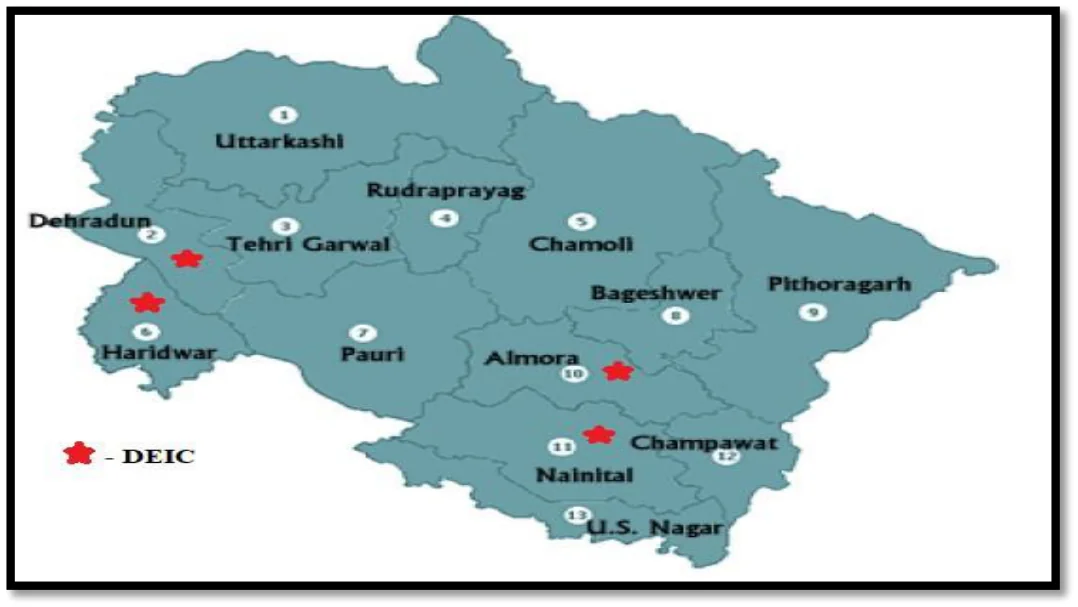
We evaluated input (manpower, infrastructure, equipment), process (source of referral, profile of health conditions of the registered beneficiaries), and output (Beneficiaries treated/ waiting for treatment) indicators. We prepared the observational checklist with the help of ‘Operational Guidelines (2013) on setting up the DEIC [3]. After obtaining permission from the State authorities, we assessed the adequacy of manpower, equipment, and infrastructure at DEIC Roorkee and DEIC Dehradun on pre-decided dates.
To understand the referral process we retrieved the record of DEICs of the Garhwal region from April 2019 to March 2020. We entered the data in MS Excel version 2016 and exported it to IBM SPSS version 23 for descriptive analysis.
Findings
This study included two DEICs of the Garhwal region -DEIC Dehradun and DEIC Roorkee.
We found a shortage of Manpower at DEIC. In DEIC Dehradun, Medical Officer and Dental Officer positions were vacant. Whereas in DEIC Roorkee, there was a vacancy of Pediatrician, Dental officer, and dental technician. There was a lack of infrastructure as per the guidelines in the DEICs under study. Both the DEICs did not have a nutrition cum feeding room, ECG cum Echo room, sensory integration room, and sensory garden.
Out of all the recommended equipment, a few vital equipment was not available at DEICs. (Table 1)
| DEIC Dehradun | DEIC Roorkee |
|---|---|
|
|
ECG machine and other related equipment, Linguist probe test for age above 3 years and National Institute of Mental Health & Neuro Sciences (NIMHANS) battery were not available at both the DEICs. For assessment of autism M-CHAT test is used in DEIC Dehradun and Autism diagnostic checklist in DEIC Roorkee, other recommended tests were not available. For BERA (brainstem evoked response audiometry) testing, patients were referred from DEIC Dehradun to DEIC Roorkee or other multispecialty hospitals
Referral at DEIC
According to the DEIC records (April 2019 - March 2020), 1378 beneficiaries were referred to DEIC Dehradun, and 684 beneficiaries to DEIC Roorkee.
MHTs referred the majority of the beneficiary who reached DEIC after the screening process. The number of referrals from Health facilities (government and private) was 432 (31.3%) and 13(2%) at DEIC Dehradun and Roorkee, respectively. Twenty-one beneficiaries were referred from other DEICs to DEIC Roorkee for the BERA test. 368 (26.7%) reached on their own without any referral to DEIC Dehradun and 26 (3.8%) at DEIC Roorkee.
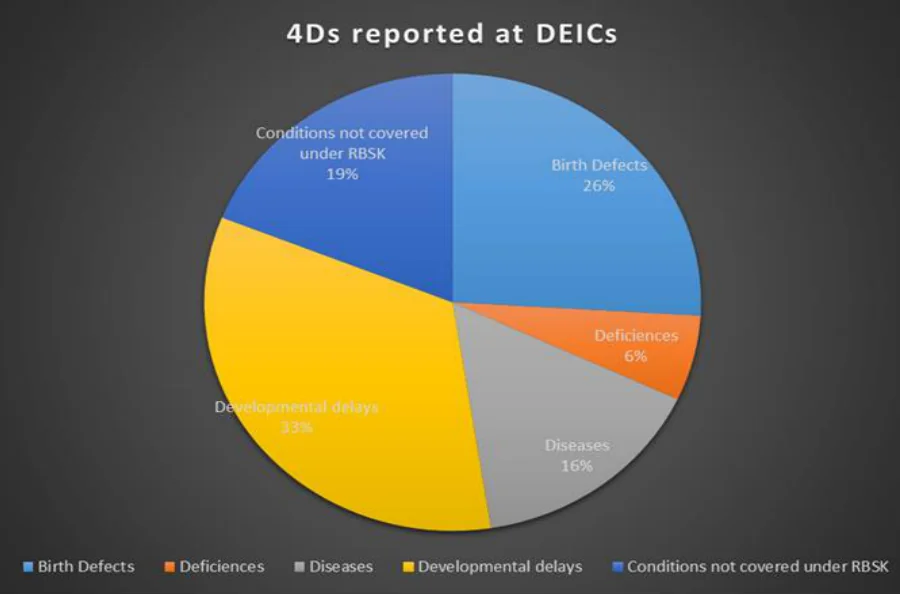
Figure 2 shows the total 4Ds reported at both the DEICs. Out of all those who reported to DEIC, top ten reasons for referral were Congenital Heart Disease (296,14.35%), Visual Impairment (204,9.9%), Otitis media (150,7.3%), Neuromotor impairment (117,5.7%), Language delay (114,5.52%), Hearing Impairment (102,4.94%), Motor delay (92,4.46%), Neural tube defect (89,4.32%), Convulsive disorders (86,4.2%) and anemia (81,3.93%)
Current status of the referral
| Status of referral | DEIC Dehradun (n=1070) | DEIC Roorkee (n=577) | Total (n=1647) |
|---|---|---|---|
| Drop out | 27 (2.5%) | 56(9.71%) | 83 (5.04%) |
| Expired | 2 (0.2%) | 17(2.94%) | 19 (1.15%) |
| Treated | 57 (5.9%) | 226(39.2%) | 283 (17.2%) |
| Under treatment | 964 (90.1%) | 245(42.5%) | 1209 (73.41%) |
| Referred to higher centers | 12 (1.1%) | 5(0.86%) | 17 (1.03%) |
| Waiting | 8 (0.75%) | 28(4.9%) | 36 (2.2%) |
Table 2 shows that 73.41% of beneficiaries were undergoing treatment at DEICs or the empaneled hospitals. The beneficiaries who were waiting for the surgical procedure were underweight or could not be treated at the empaneled hospitals due to complications of the disease or lack of specialized equipment. They were referred to the apex institutions.
Discussion
Two DEICs in the Garhwal region were found to be deficient in staff. The post of Dental officer was vacant at both the DEICs since the inception of the program. It may be due to difficulty in carrying out the recruitment process for one or two vacancies. Studies conducted in Madhya Pradesh, Odisha, Vishakhapatnam, and Tamil Nadu also reported that DEICs were short of the recommended manpower [4,5,6,7]. The shortage of manpower defeats the main purpose of establishing DEIC in the districts.
As per the recommended infrastructure of DEIC, some vital facilities like ECG cum Echo room and sensory integration room were absent in both the DEICs under study. The dental room was non-functional in both the DEICs. Most of the recommended equipment was present in the DEICs under study. However, a few equipment necessary for hearing assessment were absent in DEIC Dehradun. Maximum referred cases among birth defects were Congenital Heart Disease (CHD) but ECG machines and related equipment were not available at the DEICs under study. All the children who require BERA testing were referred to DEIC Roorkee from Dehradun. Few tests for psychological assessment were absent in both the DEICs. Bijaya Kumar Panigrahy conducted a similar study in Odisha (Koraput district) where they found all the recommended equipment. Other studies reported that the infrastructure and equipment were not adequate at the DEIC as per the guidelines [4,5,6].
The minimal referral was done by community health workers indicating that the home-based screening till the age of 6 weeks is not being conducted properly. In both the DEICs the treatment was sought mainly for birth defects and developmental delay whereas data analysis of DEIC records conducted in Vishakhapatnam, Tamil Nadu, and Madhya Pradesh showed that the maximum referred patients were of developmental delay and childhood diseases [4,5,6]. Considering the reported incidence of congenital heart disease as 8-10 per 1000 live births and the prevalence of neural tube defects is 4.1 per 1000, the referral for CHD and neural defects seems to be minimal. Among deficiencies majority of beneficiaries were undernourished and anemic, which is in line with the studies conducted in other states [6,7]. According to NFHS-4, among under-five children, 38% of children are chronically malnourished and 58 % are anemic in India. Despite the high prevalence of nutritional deficiencies, the beneficiaries who were registered at the DEICs were few. Children who reported diseases at both DEICs were majorly suffering from Otitis media, Convulsive disorders, and skin conditions. Dental caries were found to be prevalent in children, followed by skin diseases at DEIC Vishakhapatnam. Similar trends were observed in Tamil Nadu [6,7]. In various studies, it was found that 50-60% of primary school children suffer from dental caries. Minimum number of beneficiaries reported at DEICs for the treatment of dental caries in this study. This may be due to the lack of dental services at both the DEICs under study or the lack of focus on oral health screening by the MHTs. Another reason can be ignorance of the caregivers to dental-related problems. Madhusudhan HN et al also reported in their study that among the children who didn’t utilize referral services maximum were suffering from Dental caries [8]. The majority of the beneficiaries reached both the DEICs for vision impairment followed by conditions like neuromotor impairment, hearing impairment and motor delay. Approximately 3/4th of the children enrolled received treatment at the DEICs and empanelled hospitals with 2% waiting for treatment.
Conclusion
Manpower at the DEICs under study was not adequate as per the guidelines. Most of the infrastructure was available at the DEICs, but a few essential equipment was not available. Among the birth defects treatment for Congenital Heart disease (CHD) was most availed, while DEICs lack the necessary diagnostic equipment for the same suggesting need for urgent attention. A large amount of unnecessary referrals suggests that the RBSK guidelines for referral are not being followed by the service providers. 73.41% cases are under treatment indicating good performance of DEIC for management of referred cases. RBSK is a remarkable initiative for reducing morbidity and mortality among children. Deficiency of infrastructure, equipment and manpower at the point of implementation acts as a roadblock for provision of services.
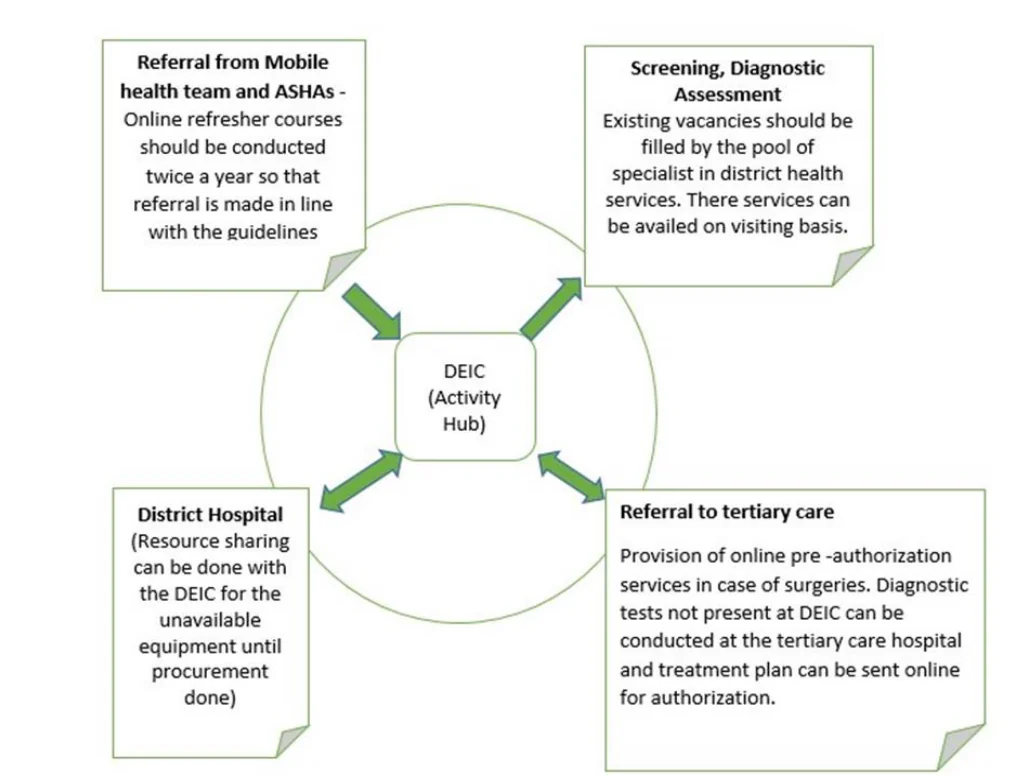
Way Forward (Figure-3)
Evaluation of MHTs and DEIC in the Kumaon region will further provide insight into the status of implementation of the program in the state.
Ethical Approvals
Ethical approval was obtained from institutional ethics committee AIIMS Rishikesh.
Conflict of Interest
Conflicts of Interest of each author/ contributor- None.
Acknowledgements
The authors would like to acknowledge all the staff members of DEIC Roorkee and Dehradun who have contributed for the collection of data.
References
- Christianson AL, Howson CP, Modell B. White Plains. New York, USA: March of Dimes Birth Defects Foundation; 2006.[Internet] Marchofdimes.org [Cited on 2021 Feb 10]. March of dimes global report on birth defects: The hidden toll of dying and disabled children. Available from: https://www.marchofdimes.org/global-report-on-birth-defects-the-hiddentoll-of-dying-and-disabled-children-full-report.pdf
- Gupta A, Kumar R, Khera A, Sankar S, Khurmi M, Srivastava A. (2012). Operational Guidelines Rashtriya Bal Swasthya Karyakram(RBSK). Child Health Screening and Early Intervention Services under NRHM [Internet]. Nhm.gov.in [cited 11 Febuary 2021]. Available from:https://nhm.gov.in/images/pdf/programmes/RBSK/Operational_Guidelines/Operational%20Guidelines_RBSK.pdf
- Gupta A, Kumar R, Khera A, Sankar S, Khurmi M, Srivastava A, Singh AK. Operational Guidelines - Setting Up District Early Intervention Centres Ministry of Health & Family Welfare Government of India (May 2014). [Internet] nhm.gov.in [cited 2021 May11]. Availablefrom:https://nhm.gov.in/images/pdf/programmes/RBSK/Operational_Guidelines/Operational-Guidelines-DEIC-RBSK.pdf8.
- Parmar S, Raghunath D, Dixit S, Bansal SB, Patidar A. A cross-sectional study to evaluate the functioning and infrastructure of DEIC, and client satisfaction Ujjain and Indore districts established under RBSK. IOSR J Dent Med Sci. 2016 Sep 1;15:92–4 [doi:10.9790/0853-1509119294]
- Panigrahy BK, Swain A. A cross-sectional study to evaluate the functioning and infrastructure of mobile health teams and DEIC (district early intervention centre) at koraput district of odisha under rastriya balswasthya karyakram (RBSK). [Internet]. wjpmr.com. 2019 [cited 29 September 2020]. Available from:https://www.wjpmr.com/download/article/42122018/1546508159.pdf
- PAGOLU KR, RAO TR. Assessment of Institutional and management capacities against health conditions in District Early Intervention Centre (DEIC), Visakhapatnam. Research Square; 2020. DOI: 10.21203/rs.3.rs-44265/v1
- Rameshbabu B, Kumaravel K, Balaji J, Sathya P, Shobia N. Health Conditions screened by the 4D`s approach in a District Early Intervention Centre (DEIC) under Rashtriya Bal SwasthyaKaryakram (RBSK) Program. PediatrOncall J. 2019;16: 73-78. doi: 10.7199/ped.oncall.2019.48
- Madhusudhan HN, kumar S, Ranganath TS, Ravish, Vishwanatha. Review of Rashtriya Bala Swastha Karyakrama and Utilization of Referral Services in Urban Field Practice area of Bangalore Medical College. RGUHS National Journal of Public Health .2016;93-100 [doi:10.26463/rnjph.1_3_3]

Published
Article metrics
- Views
- 864
- Downloads
- 1,195
Based on this site's usage statistics.