Case Studies Vol. 6 No. 2 (2022): International J Health Systems and Implementation Research
Management of Schizophrenia in COVID-19 Pandemic via Telepsychiatry
Community Level Management of Mental Illness Using Telemedicine.
Downloads
Topics
Keywords:
- Schizophrenia, Telepsychiatry, Barriers in healthcare, COVID-19
Abstract
Schizophrenia is a lifelong brain disorder leading to disability, poor quality of life and mortality. The risk factors of schizophrenia appear in early adolescence. Poor awareness about the symptoms, availability of treatment and potential benefits of seeking care are the important barriers. We are presenting a case of schizophrenia in a rural village of Haryana, India. The patient was taken to a health facility after few months of the onset of symptoms. After the initiation of treatment for the mental illness, she was not taken for regular follow up due to various reasons. She took medicines only for few months and then discontinued them. Due to the COVID-19 pandemic, the treatment gap widened which may have led to adverse events in the absence of intervention by the community physicians. We discuss the barriers, gaps in the health system and potential channels to overcome them. We highlight the potential of telepsychiatry in improving the access to care and the importance of follow-up for such patients in a rural setting.
Full text
This web version was prepared from the published PDF, which is the version of record. Please cite and quote from the PDF.
Introduction
Globally mental, neurological and substance abuse disorders (MNSUD) are a major public health problem accounting for the great burden of disease and disability. About 10-20% of adolescents are suffering from mental health disorders worldwide [1]. Schizophrenia is a severe mental disease affecting 20 million people globally [2]. About 69% of people suffering from schizophrenia are not receiving treatment and 89% of them are residing in lower-middle-income countries [3]. In India, mental disorders are the leading cause of the non-fatal disease burden. One in seven Indians were suffering from mental disorders of varying severity in 2017 [4]. The lifetime prevalence of schizophrenia and other psychotic disorders in the Indian population is 1.4% [5]. Urban adolescents have higher mental morbidity than their rural counterparts [5]. The symptoms of half of the mental disorders appear among teenagers by fourteen years of age [6]. The usual age of onset of schizophrenia is 15-35 years [7]. It affects the ability of adolescents to learn and reach their full potential. It causes disability and affects both educational and occupational performance. They are at risk for many other health problems and are 2-3 times more likely to die early [8]. These adolescents face discrimination, marginalization and social exclusion.
Mental disorders are often hidden by society due to stigma which hampers the person with ill mental health to seek care. In India, a wide treatment gap exists for various mental disorders, e.g., tobacco use - 91.8%, common mental disorders - 85% and psychotic disorders including schizophrenia -75.5% [5]. The majority of the patients with schizophrenia go to government facilities (60.9%) for treatment [5]. The median duration for seeking care from the onset of symptoms for schizophrenia is 4 months and patients may travel up to 30 km for consultation [5]. The long distance from the health facility and associated travelling costs put a burden on the family. A study reported that patients with schizophrenia who live far away from the medical facility were more likely to have longer hospital stays than those living closer [9]. The family bears the social, economic and emotional burden of treatment and caring for the adolescent with a mental disorder. The COVID-19 pandemic has widened the gaps and increased the barriers. Telehealth can address the unique challenges posed by the pandemic [10]. Teleconsultation services may help to bridge the treatment gap and improve adherence.
Study setting
The department of Community Medicine and School of Public Health, Post Graduate Institute of Medical Education and Research (PGIMER), Chandigarh, India has a rural health post at a village in Haryana to provide ambulatory promotive, preventive and curative health services The multipurpose health workers (MPHW) provide domiciliary care through home visits and organisation of health post based and community based activities. The junior resident doctors pursuing their postgraduate course in Community Medicine and senior resident doctors (those who have joined after passing their MD Community Medicine) visit the problem families as identified by the health worker to assess and provide solutions to improve the health problem under discussion with the concerned faculty. During one problem house visit, the resident doctors came across an adult female with a history of mental illness having symptoms of disoriented behaviour, muttering and smiling to herself.
Introduction of the Case
A 22 years old female, Shankari (name changed) was apparently alright 5 years ago. She was studying in 12th standard at a government school. She was good at studies and was preparing for board exams. She liked singing devotional songs (bhajan). Suddenly, she developed sleep disturbances and began smiling to herself without any reason. She appeared indifferent to her family and surroundings. Her interest in studies declined. Her friends in the school avoided talking to her. She stopped showing interest in going to school and skipped classes. Within a few weeks, her symptoms worsened. She became suspicious about her family members and that they would harm her. She had a low appetite and skipped meals. She stopped interacting with her family and appeared aloof. On asking the reason, she did not reply with any low mood or negative thoughts. She spoke very little but irrelevant stuff. The symptoms continued for two months.
Family History
She lived in a seven-membered joint family. Her Grandfather was a priest (purohit) and her father is a farmer. The grandmother and mother were homemakers. She had two younger brothers who attended school with her. Her 15-year-old brother was rude, short-tempered and used to quarrel with the neighbours. He fought with a local man and caused grievous bodily injuries to him. He was arrested by the police and sent to a juvenile home. Within a few days, Shankari developed the symptoms of her illness.
Her youngest brother was suffering from epilepsy since the age of 6 years. He was on treatment from Civil Hospital and was taking a tablet of phenytoin and folic acid daily. Her grandmother was a known patient of coronary artery disease and was on follow-up in the non-communicable disease (NCD) OPD of our rural health post. The mother was diagnosed with extrapulmonary tuberculosis and was taking treatment at the Civil Hospital, Panchkula.
Birth and development history
There was no history of any prenatal exposures or obstetrics complications. She was born via normal vaginal delivery in a government hospital. She received breastfeeding for 6 months and was completely immunized. Her growth and developmental milestones were on par with her peers.
Personal history
She had good personal hygiene. She brushed her teeth and took bath daily. Self-care was adequate. As per 24 hours recall method, the patient was taking a vegetarian diet deficit in both calories (46%) and protein (30%), against the recommended calories and proteins for her age and weight.
Socio-economic status and environmental history
She belonged to a middle-class family according to the Udai Pareek Scale. They had a refrigerator, motorcycle and one-acre land. She lived in a kutcha pucca house with a sanitary latrine. There were three bedrooms with inadequate ventilation. The kitchen was separate. The cowshed was adjacent to their home. They had four cows and two buffaloes. Fly infestation was present in the environment.
Treatment seeking behaviour
She was taken to a local registered medical practitioner (RMP) who referred her to a psychiatrist in Civil Hospital. They went to Civil Hospital, Panchkula which is 35 km away from the village. The psychiatrist assessed her and told them that she was suffering from mental illness. She was diagnosed with schizophrenia and started on medication. The psychiatrist told them that the medicine needed to be continued for many months. After the initiation of treatment, her symptoms improved within a few weeks. She became interactive and went back to school. The teacher motivated her to appear for the 12th standard board exams. She appeared for the exam but could not pass it.
Problems in follow-up
They went to the civil hospital for follow-up regularly for four months. Later they discontinued the follow-up visits as the hospital was far away and had a long waiting period. For the next 12-15 months, they bought medicine from the local pharmacy without a prescription and then discontinued it. At that time, she had no difficulty in sleep or loss of appetite.
Impact of discontinuation
Over the next few months, her interaction with the family members declined. She showed no interest in continuing school. She stayed at home and helped with household work. When MPHW, went to their house, the family said that Shankari was fine. Slowly she withdrew socially, spent most of the time in her room and spoke very little. She wandered away from the house 2-3 times and was brought back. She maintained this pattern till 2 months ago when she started having sleep disturbances. She developed symptoms of muttering and smiling to herself. She would appear aloof and stop interacting with family members. She did mistakes in the household work and threw utensils. She ran away from the home again and was brought back by her family members.
Examination
She was thin-built and had mild pallor. Her weight was 48 kg, height was 158 cm and body mass index was 19.2 kg/m2. She was wearing clean clothes. In the mental status examination, eye contact was present. She was smiling for no reason. Anxiety and persecutory ideas towards the family members were present. Her speech was reduced. There was an abnormal flow of thought and the connection between statements was difficult to follow. Visual hallucinations were present. She had poor judgement and insight i.e.; she did not understand the outcome of her behaviour and was not aware of her illness. However, the cognitive functions were within normal limits.
Management
An appointment for teleconsultation was made in the department of Psychiatry at PGIMER with the help of resident doctors and MPHW. As the family was not comfortable using a smartphone, the MPHW assisted them during teleconsultation. A video call was conducted via WhatsApp. A detailed history was taken and a mental assessment was done by the psychiatrist at PGIMER Chandigarh. She was prescribed the atypical antipsychotic tablet risperidone 2mg/day. The family was counselled about the diagnosis and lifelong treatment. They were told about the side effects of the medicine. The resident doctors highlighted the importance of daily medication and regular follow-ups. They asked her grandmother to supervise the intake of medicine by Shankari. The family was asked to encourage and train her to do daily activities and household work.
Follow-up
After 3 weeks of treatment, Shankari’s interaction with the family members improved. She was taking medication on time and slowly started doing household work. She stopped running away from home. Over the next five months, three more teleconsultation appointments were arranged by the MPHW. But the family attended only one of them. The resident doctors of community medicine visited her home to assess her health status. She conversed with the resident doctors and maintained eye contact while talking. She was taking medicine regularly. The family was encouraged by resident doctors for psychiatry follow-up. After seven months, the family decided to visit a private psychiatrist in Yamunanagar. The psychiatrist started her on olanzapine 10 mg, trihexyphenidyl hydrochloride 2 mg and minocycline 100 mg. They visit the private clinic monthly for follow-up.
Discussion
Schizophrenia is a chronic mental illness. It has multiple risk factors viz. prenatal exposure to infection, stress, nutrition, obstetric complications, childhood trauma, urban birth, migrants, adolescent, cannabis use etc [11]. Certain events can trigger the development of schizophrenia in people at risk. Here, we are presenting the potential risk factors that may have contributed to the development of the illness.
First trigger - the arrest of the younger brother and social stigma
The family faced great embarrassment and turmoil after the arrest of Shankari’s younger brother. Their neighbours and friends started avoiding them. The family’s name and prestige got spoiled in the community. Her symptoms began within a few weeks of arrest but went unnoticed by the family for some time.
Second Trigger – financial and family problems
The family had to sell a part of their land to cover the fees of the lawyer. They borrowed some money from the moneylender. Due to this, there was a lack of money for household and medical expenses. The relationship between mother and father was strained. The mother started to spend more time at her maternal home and stayed there for months. The family was busy with her brother’s court case and did not pay much attention to her.
Third trigger - ill health of the mother
Her mother developed severe weakness, pain abdomen and low appetite two months ago. She was diagnosed with extra-pulmonary tuberculosis and hospitalized. This caused Shankari to worry about her mother and the subsequent deterioration of symptoms.
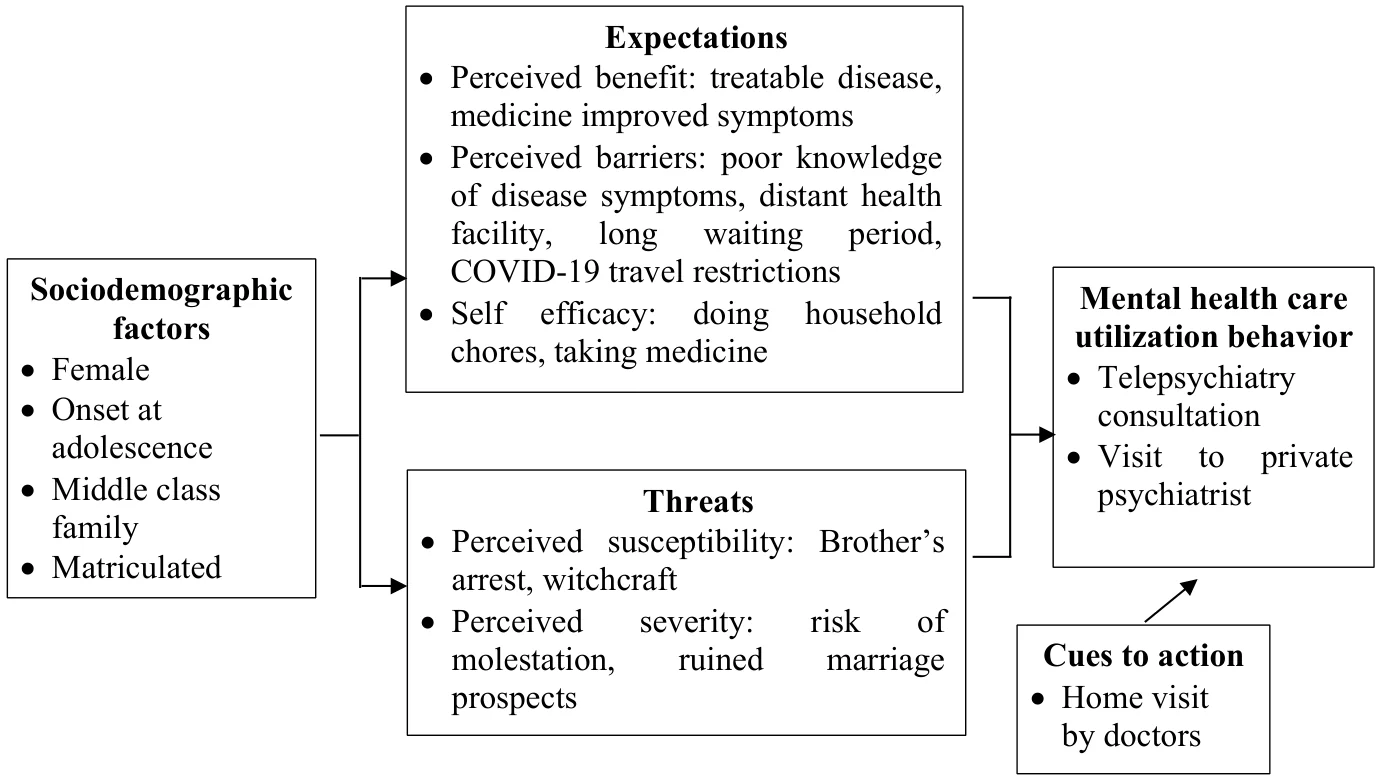
We have applied the Health Belief Model (HBM) to understand the perceptions of the family regarding her mental illness and mental healthcare services utilization behaviour (Figure 1) [12]. This model is based on a socio-cognitive perspective that proposes that people are likely to follow a health-related behaviour when they believe that disease will have serious consequences, the intervention will be effective and there are few barriers to taking action.
Perceived susceptibility
The family thinks that she developed the disease as her younger brother was arrested. She was worried about the problems in the family. Her mother repeatedly told her that she won’t have a good future and no one will marry her. She might have come in contact with a bad spirit and somebody had done witchcraft against the family.
Perceived severity
She made mistakes while performing household chores and ran away from home. The family frets that someone may molest or kidnap her. The grandmother is worried about her future. Her mental illness can ruin her marriage prospects.
“Ladki paraya dhan hai. Hame iski shadi bhi karni hai. Aaj hum baithe hain, kal kaun dekhega. (Girl is someone else’s money. We have to get her married. Today we are alive but who will take care of her later?)”
Perceived barriers to treatment
There were many barriers to accessing health care in this case. Due to a lack of knowledge about the symptoms of mental illness and treatment, there was a delay in approaching the healthcare provider, schizophrenia diagnosis and initiation of treatment. The hospital was distant from home and crowded. They had to start from home by 6 am, travel to the hospital by bus and then return home in the evening. The father who is the only breadwinner had to accompany her. The patient was not willing to go to the hospital. She tried to jump from the motorcycle when taken forcibly.
The girl child faces discrimination in India, especially in rural areas. Being a female, she was not given much-needed attention by her family members. This led to discontinuation of treatment which caused worsening of symptoms. Due to the stigma associated with mental disorders, the family considers their jailed son as the only hope and tries hard to bail him out of prison. They are not aware of the ill effects of irregular treatment.
According to the MPHW, the family did not cooperate due to stigma and discrimination.
“Ye OPD me aate hi nahi. Wahan gaon ke log hote hain jo ajeeb ajeeb bate karte hain. Shayad inferiority complex ki vajah se nahi aate. Jab maine ghar pe psychiatrist se baat karwai thi to kar li thi. Par baad me OPD nahi aaye aur apna phone nahi uthya. (They do not come to the OPD. The villagers are there and talk weird stuff. Maybe they do not come due to an inferiority complex. When I helped them talk to the psychiatrist at home, they consulted. But later they neither came to OPD nor picked their call.)”
Perceived benefits
The family thinks that the disease can be treated with medicines. Her symptoms and interaction with the family improved after the intake of medicines. Hence, the family decided to take her for follow-up and continued medication. According to the grandmother, she is doing household chores and no longer runs away.
“Ab hamare ko iski rakhi nahi karni padti. Khana bana leti hai, bartan aur kapde dho leti hai. Main bas dawai khane ko bol deti hun. (Now we don’t have to guard her. She can cook food and wash utensils and clothes. I just tell her to take the medicine.)”
The Mental Healthcare Act, 2017 mandates the provision of setting up mental facilities across the country to ensure that no person with mental illness will have to travel far for treatment.[13] PGIMER ran a weekly psychiatry OPD at CHC, Raipur rani where the patients with mental illnesses referred from our health post were diagnosed and treated. Due to the COVID-19 pandemic, India was under lockdown for over 3 months. The physical OPDs were affected at the major hospitals including the weekly psychiatry OPD and only emergency services were available. The lack of public transport made it difficult to access mental health care for people in rural areas. Many hospitals started teleconsultation services for patients including PGIMER. Telepsychiatry services have been included under the eSanjivani OPD under the National Teleconsultation Services by the Ministry of Health and Family Welfare. The patient can register and consult the doctor via audio or video mode [14]. A recent survey reported about 66% of the patients receiving telehealth consultations were satisfied while 67% of the providers wanted a hybrid model of care in psychiatry clinics [15]. This service was particularly helpful in this case due to COVID-19 travel restrictions, the severity of symptoms and the lack of money to hire a four-wheeler. The family found it risky to take her forcibly on their two-wheeler. Telepsychiatry consultation provided at the doorstep proved beneficial, bridged the gap in providing adequate care and enhanced the stability of treatment.
The median amount spent on treatment and care for schizophrenia is Rs. 1000 per month in India [5]. In this case, the family spent around Rs. 100 per month for medicines after teleconsultation. The family went to a private clinic as it has a lower waiting time than the government facility and more personal attention. The expenditure was increased to Rs. 2400 per month after shifting to the private sector. Any financial problems may lead to discontinuation of treatment in future.
Telehealth services are a feasible care modality for people with schizophrenia and other mental disorders. It reduces stigma, increases the engagement of patients and may improve adherence. The district mental health programme can be further strengthened by telepsychiatry services.
Acknowledgements
We would like to thank Mrs. Jagdeep Rana, Multipurpose Health Worker, Department of Community Medicine and School of Public Health, PGIMER, Chandigarh for her help in the teleconsultation services and follow-up with the patient.
References
- World Health Organization. Adolescent mental health. WHO 2020:1. Available From: https://www.who.int/news-room/fact-sheets/detail/adolescent-mental-health (accessed July 5, 2021).
- James SL, Abate D, Abate KH, Abay SM, Abbafati C, Abbasi N, et al. Global, regional, and national incidence, prevalence, and years lived with disability for 354 diseases and injuries for 195 countries and territories, 1990–2017: a systematic analysis for the Global Burden of Disease Study 2017. Lancet 2018;392:1789–858. [Google Scholar]
- Lora A, Kohn R, Levav I, McBain R, Morris J, Saxena S. Service availability and utilization and treatment gap for schizophrenic disorders: a survey in 50 low- and middle-income countries. Bull World Health Organ 2012;90:47. [Google Scholar]
- Sagar R, Dandona R, Gururaj G, Dhaliwal RS, Singh A, Ferrari A, et al. The burden of mental disorders across the states of India: the Global Burden of Disease Study 1990–2017. The Lancet Psychiatry 2020;7:148–61. [doi:10.1016/s2215-0366(19)30475-4]
- Gururaj G, Varghese M, Benegal V, Rao G, Pathak K, Singh L, et al. National Mental Health Survey of India, 2015-16: Prevalence, patterns and outcomes. Bengaluru: 2016. [Google Scholar]
- Kessler RC, Angermeyer M, Anthony JC, DE Graaf R, Demyttenaere K, Gasquet I, et al. Lifetime prevalence and age-of-onset distributions of mental disorders in the World Health Organization’s World Mental Health Survey Initiative. World Psychiatry 2007;6:168–76. [Google Scholar]
- Sadock BJ, Ahmad S, Sadock VA. Kaplan & Sadock’s pocket handbook of clinical psychiatry. 6th ed. Philadelphia: Wolters Kluwer; 2019. [Google Scholar]
- Laursen TM, Nordentoft M, Mortensen PB. Excess Early Mortality in Schizophrenia. Annu Rev Clin Psychol 2014;10:425–48. [doi:10.1146/annurev-clinpsy-032813-153657]
- Tseng KC, Hemenway D, Kawachi I, Subramanian SV, Chen WJ. Travel distance and the use of inpatient care among patients with schizophrenia. Adm Policy Ment Health 2008;35:346–56. [doi:10.1007/s10488-008-0175-x]
- Kasckow J, Felmet K, Appelt C, Thompson R, Rotondi A, Haas G. Telepsychiatry in the Assessment and Treatment of Schizophrenia. Clin Schizophr Relat Psychoses 2014;8:21. [doi:10.3371/csrp.kafe.021513]
- Clarke MC, Kelleher I, Clancy M, Cannon M. Predicting Risk and the Emergence of Schizophrenia. Psychiatr Clin North Am 2012;35:585–612.. [doi:10.1016/j.psc.2012.06.003]
- Henshaw EJ, Freedman-Doan CR. Conceptualizing mental health care utilization using the health belief model. Clin Psychol Sci Pract 2009;16:420–39. [doi:10.1111/j.1468-2850.2009.01181.x]
- Ministry of Law and Justice. The Gazette of India Extraordinary. The Mental Healthcare Act 2017. New Delhi: 2017. [Google Scholar]
- Ministry of Health and Family Welfare. eSanjeevaniOPD -SAFE HOME OPD National Teleconsultation Service-MoHFW 2020. https://esanjeevaniopd.in/ (accessed July 12, 2021).
- Casares M, Wombles C, Skinner HJ, Westerveld M, Gireesh ED. Telehealth perceptions in patients with epilepsy and providers during the COVID-19 pandemic. Epilepsy Behav 2020;112:107394. [doi:10.1016/j.yebeh.2020.107394]
Published
Article metrics
- Views
- 732
- Downloads
- 425
Based on this site's usage statistics.
Issue
Section
How to Cite
More in this topic: NCDs & mental health
View Point · 2025
From Screens to Sips: Social Media's Impact on Adolescent Alcohol Use