Original Article Vol. 6 No. 2 (2022): International J Health Systems and Implementation Research
Pattern of Puberty Related Health Problems in the Adolescent Girls Consulting Physicians
Downloads
Topics
Keywords:
- Adolescence
- Puberty
- PCOD
- Girls
- Health
Abstract
Introduction: At adolescence the girls may face many health problems such as irregular menstruation, dysmenorrhea, obesity, acne, hair fall etc. The present study aims to deal with the puberty related health problems of the adolescent girls.
Objectives: To ascertain the prevalence and pattern of puberty related health problems among the adolescent girls consulting physicians and to assess the self made efforts and practices done by the adolescent girls consulting physicians to resolve their puberty related health problems.
Methodology: It was a hospital based cross sectional study carried out among 100 adolescent girl patients reported at gynecology OPD, PGIMER, Chandigarh recruited through purposive sampling concurrently over a period of one year (Jan 2018 to Dec 2018). The data collection was done through a self-administered, semi-structured questionnaire and data analysis was done in MS Excel and Epidata statistical software.
Results: The mean age at menarche of the respondents was 12.62 years. Majority (84%) of the respondents came with the problem of PCOS and irregular periods accompanied with acne and hirsutism. Only 44 girls used to practice some sort of physical activity in the form of P.T, stretching exercises, yoga and meditation. 67% of the respondents did not ever try to modify their diet.
Conclusion: PCOS was the major problem reported by the adolescent girl patients visiting gynecology OPD. It is a lifestyle disease which can be resolved by following appropriate self-managing lifestyle modification measures. Hence, there is a need to evolve effective strategies to inculcate self management skills in the girls.
Full text
This web version was prepared from the published PDF, which is the version of record. Please cite and quote from the PDF.
Introduction
Adolescents constitute about 22.8% (232 million) of India’s population. Adolescent girls between 10-19 years constitute close to half (111 million) of this population group [1]. The girls may face many health problems at this stage of life. The present study aims to deal with the puberty related health problems of the adolescent girls. Various puberty related health problems that girls might be facing could be related to menstruation, self-image, Polycystic Ovary Syndrome (PCOS), obesity, acne, anemia, stress, vision changes, hair loss and excess facial hair growth, halitosis and gingival bleeding, excessive sweating etc.
Menstruation is the milestone of puberty in girls. It is associated with many other problems such as irregular menses, dysmenorrhea, and reproductive tract infections. More than 90% girls suffer from pain during menses [2]. Of these, many do not get any treatment either due to lack of knowledge, shyness or influence from mother/ grandmother. The other problem is of irregular menses [3]. There could be a variety of reasons for this such as improper eating habits, unhealthy lifestyle or any other underlying disorder. One major reason could be PCOS. It affects almost 9-10% of Indian adolescents [4]. It is a set of symptoms due to hormonal imbalance in a woman or a girl of child bearing age [5]. Obesity can also be the symptom and cause of PCOS.
Acne could be one of the major self-image related issue [6]. Some girls face the problem of hair loss as well due to hormonal imbalance. Apart from this, there are many hygiene related issues [7]. Poor oral hygiene results in halitosis and gingival bleeding. Poor menstrual hygiene results in reproductive tract infections. Poor general hygiene results in bad smell due to excessive sweating, infections and unsightly appearance [8].Psychological or mental health issues are also on the rise these days in girls such as stress. At this age, they start comparing themselves with each other or celebrities. They might suffer from low self esteem.
All these problems listed above could be due to bad lifestyle and eating habits. Now-a-days, much awareness has been provided to the youth through various media channels. Parents are also much sensitized these days about the health of their children. That’s why there are many health care related efforts and practices done by the girls and their parents. Hence, the present study is executed to ascertain the pattern of various puberty related health problems in the school going adolescent girls and the extent of health care related efforts and practices done by the respondents.
Objectives
- To ascertain the prevalence and pattern of puberty related health problems among the adolescent girls consulting physicians.
- To assess the self made efforts and practices done by the adolescent girls consulting physicians to resolve their puberty related health problems.
Methodology
It was a hospital based cross sectional study carried out among the adolescent girl patients reported at gynecology OPD, PGIMER, Chandigarh.
Sample size: n=100 Patients reported at gynecology OPD, PGIMER, Chandigarh had been recruited in the study through purposive sampling concurrently over a period of one year (Jan 2018 to Dec 2018).
Inclusion criteria: The adolescent female patients of 10-19 years of age reported at gynecology OPD, PGIMER, Chandigarh with the puberty related health problems were included in the study.
Exclusion criteria: All the patients other than 10-19 years of age and with other health problems were excluded from the study.
Study tools: A self-administered, semi-structured questionnaire was used. It was pre-tested among 5 adolescent girls attending OPD. After revision, the tool had been circulated among the concerned experts (public health, obstetrics and gynecology, skin, endocrinology, anthropology, etc.) for obtaining face and content validity. Based on their feedback, the tool was modified. Then the final version of the tool was prepared for use in the study.
Outcome variables: Prevalence and pattern of puberty related health problems in the patients who had consulted physician.
Efforts and practices made by the girls to maintain their health and hygiene.
Data Analysis: It was done in MS Excel, 2019 and Epidata statistical software. Descriptive statistical measures along with graphical representations were employed.
Ethical considerations: The ethical approval to conduct this study had been sought from the Institutional Ethics Committee, PGIMER, Chandigarh. Assent from the participants and informed consent from their parents was taken after assuring them that all information collected would be kept confidential
Results
The mean age of the adolescent girls who consulted physicians for their puberty related health problems came out to be 16.9 years (17-19 years). The mean age at menarche of the respondents was 12.62 years.
| Education status | Father (n=100) | Mother (n=100) | Occupational status | Father (n=100) | Mother (n=100) |
|---|---|---|---|---|---|
| Less than graduate | 52 | 55 | Housewife/unemployed | 0 | 71 |
| Labourer/maid | 8 | 1 | |||
| Graduate | 37 | 28 | Class 4 employee | 10 | 2 |
| Class 3 employee | 9 | 1 | |||
| Post graduate and others | 11 | 17 | Business | 26 | 4 |
| Class 2 employee | 22 | 17 | |||
| Class 1 employee | 6 | 2 | |||
| Others | 15 | 1 |
The table 1 shows that approximately 50% of the respondent’s parents had not done their graduation. The fathers of 26% of the respondents had their own business and mothers of majority of the respondents (71%) were housewives. The maximum family size of majority of the respondents was of 4 persons.
Majority (84%) of the respondents came with the problem of PCOS and irregular periods. Some of the girls had more than 1 condition such as acne and hirsutism were present together in PCOS patients.
| Condition/problem | Prevalence (n=100) | Condition/problem | Prevalence (n=100) |
|---|---|---|---|
| Irregular menses/PCOS | 84 | Acne | 65 |
| Anemia | 55 | Stress | 53 |
| Poor oral hygiene | 19 | Poor scholastic performance | 47 |
| Overweight/obesity | 49 | Hair fall | 64 |
| Underweight | 10 | Itching in genital area | 49 |
| Dysmenorrhea | 45 | White fluid discharge | 58 |
| Excessive sweating | 30 | Foul smelling discharge | 35 |
| Very low self esteem | 33 | Pain in genital area | 19 |
| Hirsutism | 69 | Burning micturition | 22 |
The table 2 shows that the irregular periods, hirsutism, acne and hair fall were prevalent in more than 60% of the subjects. These are the symptoms of PCOS. So we can say that PCOS was the major problem reported by the adolescent girl patients visiting PGI OPD.
The study shows that only 34% girls used to take adequate sleep at night and also majority i.e. >50% had sedentary lifestyle.
| 91% girls disposed their used pads in the dustbin. | 58% girls used paper as a mode of wrapping used pad and 18% used polythene bag. | 80% of the girls used to carry extra pads with them in their bags. |
|---|
The study shows that the majority (84% of the girls) used sanitary pads as the absorbent material and 13% used both cloth and sanitary pad. Majority (78%) used to change their pads 2-3 times a day.
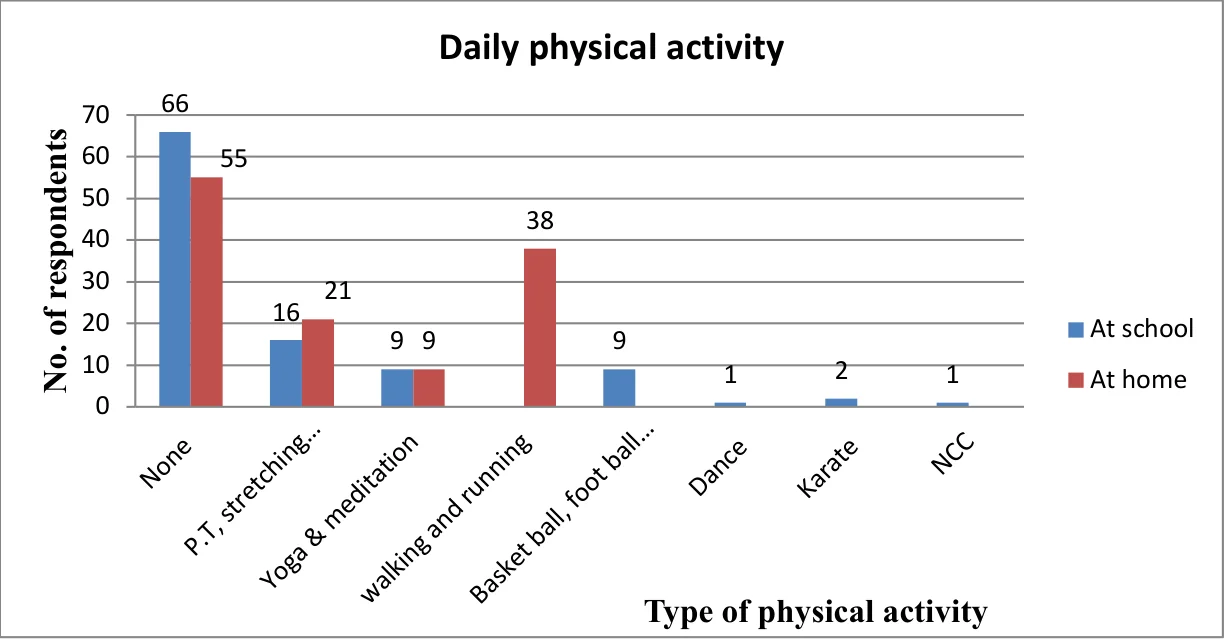
The figure 1 shows that only 44 girls used to practice some sort of physical activity in the form of P.T, stretching exercises, yoga and meditation. The mean duration of physical activity of the respondents per day was 22.94 ± 32.28 minutes. Some girls (24%) had also joined fitness club/ gym and 12% had joined dance classes to maintain their fitness.
| Hygienic practices | N (n=100) |
|---|---|
| Taking bath at least once daily | 99 |
| Washing face daily more than one time | 100 |
| Washing of genitalia while changing sanitary pad | 79 |
| Frequency of washing hands every time while going to toilet and eating food | 89 |
| Frequency of washing genital area | |
| Once a day during bathing | 27 |
| 2 times a day | 24 |
| Every time while going to toilet | 45 |
| Usage of soap or detergent to wash genitalia | 44 |
| Status of nails | |
| Trimmed + cleaned | 62 |
The table 4 shows that basic hygienic practices were found to be adequate in majority of the girls. The status of genital hygiene needs to be improved in many girls; many (44) girls were using soap or detergent to wash their genitalia.
| Changes in diet plan to maintain health | N |
|---|---|
| None | 67 |
| Fruits | 15 |
| Gym diet plan, salad | 4 |
| Green vegetables, green tea | 3 |
| Juices, almond, milk | 2 |
| Reduced fatty and fried food | 1 |
The table 5 shows that 67% of the respondents did not ever try to modify their diet. Others had tried to include fruits, salad, green vegetables, dry fruits, milk etc. in their daily diet.
Discussion
Adolescent girls account for 20% of the world’s population of adolescent girls in India [9]. In India, the adolescent girls are doubly marginalized in terms of their health and well being. First, they have limited access to safe and good health care services. Secondly, the persistence of “culture of silence, hesitation, tolerance and gender discrimination” in our Indian society has led many young girls to face numerous problems. They face many problems after the onset of puberty. These include various physical, mental, social, psychological and health problems. They have changes in their body shape and size, start of menstruation, weight fluctuations, acne, and changes in behavior etc [10].
Some girls attain menarche as early as 9 years and some get it at about 15-16 years of age. Also there is a lot of change in the trend of onset of menarche. In the study done by Biro et al [11] (2012) it has been stated that the age at menarche dropped in the first half of 20th century. They said this might be due to the changing nutritional and environmental effects. In our study, the mean age at menarche was found to be approximately 12.6 years.
It has also been seen that fathers of many respondents (26%) had their own business and mothers of majority of the respondents (71%) were housewives. And also >50% respondents’ parents had not done their graduation. Now-a-days, the trend is of nuclear families. This is shown in our study also as the family size of more than 70% of the respondents was up to 4 persons. This could be the reason for more sitting and less recreational activities of children. Also, in a study by Allendorf (2013) [12], it has been found that young women living in joint extended families suffered less of the health problems as compared to those living in nuclear families.
The majority of the respondents (84%) came with the clinical diagnosis of PCOS and irregular periods accompanied with acne and hirsutism (table II). Chandrakala et al (2020) [13] in their study listed the problems reported by girls in Gynecology OPDs at a tertiary care institute in Telangana; 22% of girls had menorrhagia, 16% had irregular cycles, Dysmenorrhea (8%), and PID (6%). Omidwar et al (2018) [14] reported that 24.3% of participants in the early adolescent group (10–15 years of age) experienced frequent irregular menstruation. This could be associated with the problem of acne, hair fall, facial hairs, obesity etc. All these features are commonly seen in a condition called PCOS as also revealed by Ishwarpreet et al [15].
More than 50% of the respondents were found to be obese and had sedentary lifestyle. In a similar study done by Sharma et al (2017) [16], it has been seen that overweight and obesity are the problems prevalent in communities where sedentary lifestyle is followed. Stress was present in 53% of the respondents. “Puberty: A stressful phase of transition for girls” is a study done by Rawat (2015) [17]. The study concluded that more than 50% of female adolescents had mild to severe stress due to pubertal changes.
The practices related to use of sanitary pads were found to be adequate in more than 90% girls. It may be due to various awareness campaigns run by the govt. or NGOs. Menstrual Hygiene Day [18] (MH Day) is organized all over the nation on May 28 to raise awareness of the challenges women and girls worldwide face due to their menstruation and to highlight solutions that address these challenges. The Indian Bollywood industry also came forward in making aware the girls about the use of sanitary pads through popular movies [19].
Second major problem girls might face during their periods is dysmenorrhea. Many (39%) respondents from gynecology OPD were suffering from mild pain and 33% from severe pain during their periods. Other studies reported prevalence of dysmenorrhea to be 84.2%; 65%; 79.67% and 68.1% in adolescent girls in different settings [20]. Due to increase in the number of sweat glands in the body at puberty, there may be a problem of excessive sweating. In our study also, few girls (30%) reported the problem of excessive sweating that was not tolerable and frequently interfered with daily activities. The study by Muthuswamy et al (2016) [21] revealed that overall, 38% of the students were suffering from somewhat bothersome to extremely bothersome hyperhidrosis (excessive sweating). Due to increase in the number of sebaceous glands, another problem of acne happens in many girls. In this study, 65% girls had acne. The prevalence of acne ranged from 14.3% to 85.9% in various other studies [22]. Excess facial hair growth was another problem reported by many girls. This is a symptom generally reported in girls with PCOS. In our study, facial hairs were found to be present in 69% of the girls. The study done by Chhabra et al (2012) [23] revealed that PCOS was found to be the underlying cause of hirsutism in 70% cases. Approximately 50% of the respondents reported itching and white discharge from their genital area.
Any attempt to address these issues should involve a multi-sectoral and multi-stakeholders approach e.g. girls themselves, family, society, social environment, schools, doctors and the government (for example, release of booklets, videos etc. to raise awareness among the girls as done by Gupta R et al (2018) [24]. Our role as a researcher lies in providing evidence about various issues. This research gave us an overall picture of the various health problems the girls might face after the onset of puberty. We also evaluated self care practices already done by the respondents to maintain their health and hygiene. We have seen that few (44%) girls used to practice some sort of physical activity in the form of P.T., stretching exercises, yoga and meditation at school. Only one-third of the respondents used to prefer walking and running at their home to maintain their health. Only few girls (24%) had joined fitness club/ gym and very few (12%) had joined dance classes to maintain their fitness. A focus group study by Whitehead et al (2008) [25] evaluated the perceptions of adolescent girls about physical activity. They de-prioritized the physical activity stating that they are not bothered to take part in it.
Majority (67%) of the respondents did not ever try to modify their diet. This shows that majority of the girls were unaware of the self management practices to resolve various puberty related health problems. This emerges a need to evolve effective strategies to inculcate self management skills in the girls.
Conclusion
The irregular periods, hirsutism, acne and hair fall were prevalent in more than 60% of the subjects. These all are the symptoms of PCOS. So, we can say that PCOS was the major problem reported by the adolescent girl patients visiting gynecology OPD. It is a lifestyle disease which can be resolved by following appropriate self-managing lifestyle modification measures. Hence, there is a need to evolve effective strategies to inculcate self management skills in the girls.
References
- Nanda P, Das P, Singh A, Negi R. Addressing Comprehensive Needs of Adolescent Girls in India: A Potential for Creating Livelihoods, New Delhi. International Centre for Research on Women. 2013. [Google Scholar]
- Chaudhuri A, Singh A, Dhaliwal L. A randomized control trial of exercise and hot water bottle in management of dysmenorrhea in school girls of Chandigarh. Indian J Physiol Pharmacol. 2013; 57(2): 114-22. [Google Scholar]
- Browner-Elhanan KJ, Epstein J, Alderman EM. Evaluation of irregular menses in perimenarcheal girls: a pilot study. J Pediatr Adolesc Gynecol. 2003; 16(6): 365-8. [doi:10.1016/j.jpag.2003.09.004]
- Choudhary N, Padmalatha V, Nagarathna R, Ram A. Prevalence of Polycystic Ovarian Syndrome in Indian Adolescents. J Pediatr Adolesc Gynecol. 2011; 24(4):223-7. [doi:10.1016/j.jpag.2011.03.002]
- Pubmed Health Glossary. Available at http://www.ncbi.nlm.nih.gov/pubmedhealth/PMHT0024506/.
- Geller L, Rosen J, Frankel A, Goldenberg G. Peri-menstrual flare of adult acne. J Clin Aesthet Dermatol. 2014; 7(8): 30-34. [Google Scholar]
- Dasgupta A, Sarkar M. Menstrual hygiene: How hygienic is the adolescent girl. Indian J Community Med. 2008; 33(2): 77-80. [doi:10.4103/0970-0218.40872]
- Dorri M, Sheiham A, Watt RG. Relationship between general hygiene behaviours and oral hygiene behaviours in Iranian adolescents. Eur J Oral Sci. 2009; 117(4): 407-12. [doi:10.1111/j.1600-0722.2009.00657.x]
- Investing in adolescent girls in India: a critical need. September 2019. Available at https://www.c3india.org/uploads/news/Policy_Brief_Adolescent_girl_website_final.pdf.
- Kollur LR, Pratinidhi AK, Kakade SV. Pubertal changes in adolescent girls: a community based cross-sectional study. Natl J Community Med. 2013; 4(4): 640-3. [Google Scholar]
- Biro FM, Greenspan LC, Galvez MP. Puberty in girls of the 21st century. J Pediatr Adolesc Gynecol. 2012; 25(5):289-294. [doi:10.1016/j.jpag.2012.05.009]
- Allendorf K. Going nuclear? Family structure and young women’s health in India, 1992–2006. Demography. 2013; 50 (3): 853–880. [Google Scholar]
- Chandrakala G, Patruni M. Study to access gynecological problems in adolescent girls attending the gynecology OPD at a private teaching institute, Telangana state, South India. Int J Clin Obstet Gynaecol. 2020; 4(2): 221-224. [Google Scholar]
- Omidvar S, Amiri FN, Bakhtiari A, Begum K. A study on menstruation of Indian adolescent girls in an urban area of South India. J Family Med Prim Care. 2018; 7(4):698-702. [doi:10.4103/jfmpc.jfmpc_258_17]
- Kaur I, Suri V, Sachdeva N et al. Efficacy of multi-strain probiotic along with dietary and lifestyle modifications on polycystic ovary syndrome: a randomised, double-blind placebo-controlled study. Euro J Nutrn. 2022; 61: 1-10. [doi:10.1007/s00394-022-02959-z]
- Sharma SJ, Muzammil K, Singh JV, Alvi MT, Singh RS, Siddiqui S. Assessment and comparison of nutritional status of government and private secondary school children of Muzaffarnagar. Indian J Comm Health. 2017; 29 (3): 264-270. [doi:10.47203/ijch.2017.v29i03.009]
- Rawat R, Sagar R, Khakha DC. Puberty: A stressful phase of transition for girls. IOSR Journal of Nursing and Health Science (IOSR-JNHS). 2015; 4(5): 7-12. [Google Scholar]
- Menstrual Hygiene day. Available at https://menstrualhygieneday.org/.
- Padman movie (2018). Available at https://economictimes.indiatimes.com/topic/padman.
- Kural M, Noor NN, Pandit D, Joshi T, Patil A. Menstrual characteristics and prevalence of dysmenorrhea in college going girls. J Family Med Prim Care. 2015; 4(3):426-431. [doi:10.4103/2249-4863.161345]
- Muthusamy A, Gajendran R, Ponnan S, Thangavel D, Rangan V. A study on the impact of hyperhidrosis on the quality of life among college students. J Clin Diagn Res. 2016; 10(6):CC08-CC10. [doi:10.7860/jcdr/2016/19495.8061]
- Alanazi MS, Hammad SM, Mohamed AE. Prevalence and psychological impact of acne vulgaris among female secondary school students in Arar city, Saudi Arabia, in 2018. Electron Physician. 2018; 10(8):7224-7229. [doi:10.19082/7224]
- Chhabra S, Gautam RK, Kulshreshtha B, Prasad A, Sharma N. Hirsutism: A Clinico-investigative Study. Int J Trichology. 2012; 4(4):246-250. [doi:10.4103/0974-7753.111204]
- Gupta R, Sinha AK, Chopra S, Kishore J, Singh AJ; Managing common problems at puberty: A guide for Adolescent girls (Booklet); 2017, Century Publications, New Delhi. [Google Scholar]
- Whitehead S, Stuart B. Adolescent girls’ perceptions of physical activity: A focus group study. Eur Phy Educ Rev. 2008; 14(2): 243-262. [doi:10.1177/1356336x08090708]
Published
Article metrics
- Views
- 630
- Downloads
- 567
Based on this site's usage statistics.