Short Review Vol. 8 No. 1 (2024): International J Health Systems and Implementation Research
Conflict Management in Healthcare Setting – An Essential Public Health Skill
Conflict Management in Healthcare Setting
Downloads
Topics
Keywords:
- Conflict Management, Pubic Health Management, Public Health Skills
Abstract
Health system is one of the most human resource intensive organizations. The scope, dimensions of work in any health system and the interdependence of each compartment of health system makes it even more complex. The complexity of health system coupled with the inadequacy, unequal distribution and incompetency of human resources make it vulnerable to conflicts at workplace which further plagues the performance. Addition of new cadres of human resources to increase the efficiency also creates opportunity for new conflicts at workplace. We enumerate conflict management skills which are essential skills to be practiced by public health practitioners to identify conflicts early and resolve them using appropriate methods.
Full text
This web version was prepared from the published PDF, which is the version of record. Please cite and quote from the PDF.
Background
Case vignette 1
In 2018, the Government of India, under the Ayushman Bharat Programme, introduced the cadre of Community Health officers (CHOs) as Mid-Level Health Providers (MLHPs) for providing Comprehensive Primary Healthcare (CPHC) through the Health and Wellness Centres (HWCs). Before the introduction, the Multipurpose workers (MPWs)/ Auxiliary Nurse Midwives (ANMs) headed the health team at the sub-centres and reported to the Medical Officer at the Primary Health Centre (MO-PHC). Even after the introduction of the CHOs as the team leader at the sub-centre/health and wellness centre, the MPWs expressed resistance to comply with them and continued to report directly to the MO-PHC. They perceived the CHOs to be a threat to their power and authority, causing them to come into conflict with the newly introduced CHOs.
Case vignette 2
The Village Health Sanitation and Nutrition Committees (VHSNCs) integrate health and its social determinants at the village level and comprise elected members of the Panchayat, members from health and other health-related service sectors, community members/ beneficiaries, and representatives from all community sub-groups. The community health team, comprising the CHOs, MPWs, ANMs, health workers – male and female, and ASHAs also form a part of the VHSNCs. These committees provide platforms for various diverse groups to come together and communicate their needs and interests. This, by its very design, provides ample opportunities for conflicts, which, if not resolved, can defeat the purpose of these committees.
Introduction
These are just a few circumstances that can incite conflict within the health system. The health sector is highly human resource-intensive and presents an amalgamation of various departments and cadres of the workforce. Each carries out vital yet often interdependent roles. With such diversity in the workforce and activities under one roof, enough opportunities exist for conflict. Conflicts can arise between the hospital administration and the doctors, doctors and nurses, laboratory technicians, pharmacists, and other paramedical and allied health staff in a hospital setting. Conflict can also arise between seniors and juniors within the same cadre or between individuals at the same level of the same work cadre. At the community/ primary healthcare level, a conflict can often arise involving doctors, nurses, other hospital staff, different cadres of community health workers, local self-government, and the community itself.
With the introduction of new cadres of workforce, the chances of conflicts further increase. The boundaries of roles and responsibilities often must be clarified in the initial introduction phases. Such was the case with the CHO programme in India (Case vignette 1) [1]. The Auxiliary Nurse Midwives (ANMs)/ Health Workers Male and Female, enjoyed functional freedom at the sub-health centre until the introduction of the CHO programme. The CHOs faced resistance from the ANMs/Health Workers due to their sudden introduction into the system as reporting supervisors while being a primarily contractual position (against the permanent position of the ANMs/ Health Workers). Such situations are bound to arise repeatedly each time a new cadre is introduced or the roles and responsibilities of an existing cadre are changed. With the increase in the healthcare workforce, the introduction of new cadres, the increase in complexity of workplace interactions, the increase in the number of health-related activities, patient load, and documentation, the increase in commercialization of the healthcare industry, and increasing attempts at public-private partnerships, and increasing interactions with other sectors (e.g., One Health approach), such conflicts are inevitable and is expected to increase in the days to come. This underscores the need to focus on conflict management as a technique to recognize potential conflicts early and deal with them effectively and promptly to avoid untoward occurrences and thereby increase the efficiency of the health system.
There is ample evidence that soft skills such as conflict management are especially relevant for healthcare workers, considering the importance of interpersonal relationships in their workspace [2]. As a public health physician and manager, one should be equipped with skills in recognizing and addressing the type of conflict using proven strategies that can smooth day-to-day functioning and improve the overall organizational performance. Sadly, conflict-related issues and their handling-related training are not mentioned in the current curriculum of most of the healthcare streams.
We describe here the role, types, and genesis of conflict in any organization and the conflict management techniques that every public health practitioner can practice to improve the organization's performance.
Are Conflicts always bad?
Conflict is any disagreement or difference of opinions between or among individuals that can be potentially harmful to any organization. Conflict can be best defined as “a process that begins when one party perceives that another party has or is about to negatively affect something the first party cares about” [3]. It implies that perception is essential for the existence of a conflict.
There has been a long-standing debate on whether conflict within an organization is good or bad. The traditional view of conflict opines that all conflicts indicate malfunctioning within a group and should be avoided. The interactionist view, on the other hand, argues that not all conflicts are bad and that some amount of conflict is essential for the efficient functioning of an organization. This view defines two types of conflicts–functional conflicts, which support the group's goals and improve its performance, and dysfunctional conflicts, which hinder group performance. Functional conflicts within an organization help generate new ideas, increase creativity, and reach consensus, and therefore, are constructive in nature, while dysfunctional conflicts have the opposite effect on the organization. The recent school of thought is that naturally occurring conflicts should be managed productively. The negative effects of conflicts can be minimized by focusing on preparing people for conflicts, developing conflict resolution strategies, and facilitating open discussion. This is known as the managed conflict view [3].
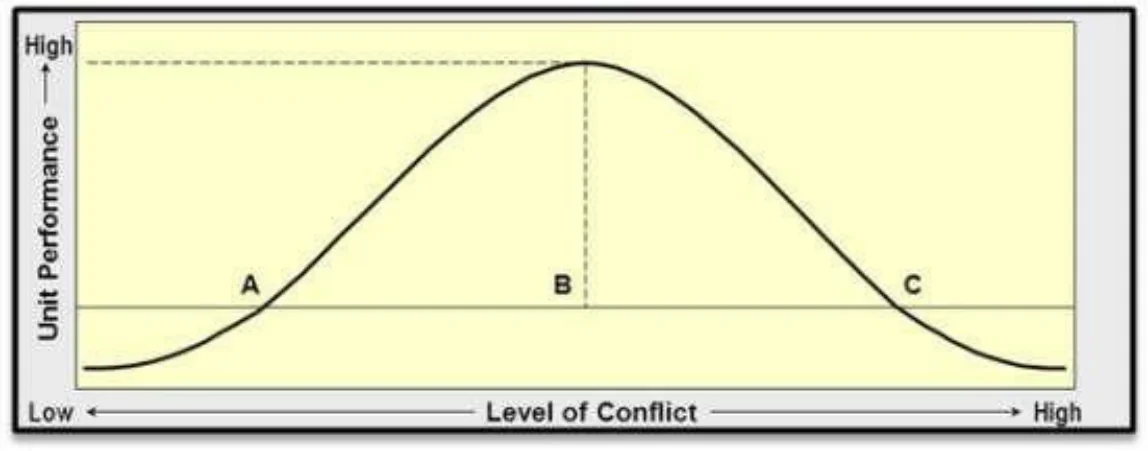
When conflict is absent or at very low levels, as well as when the level of conflict is high, the performance of the organization stays at a sub-optimal level. At low levels of conflict, it is due to stagnation, lack of new ideas, and non-responsiveness to change (Point A, Figure 1); while at high levels of conflict, it is due to disruptive, chaotic, and uncooperative work patterns and interactions (Point C, Figure 1). Optimal levels of conflict within an organization keep it viable and at high-performance levels due to self-critique and innovation (Point B, Figure 1).
The Conflict Process
A conflict consists of a conflict process and a structure within which that process occurs [4,5]. The process aspect refers to the temporal sequence of events that occur as the system operates. It provides a way of understanding the mental and interpersonal events that lead to different conflict-handling intentions and their consequences (Figure 2). Whereas, the structural aspect of a system refers to broad system parameters that shape the conflict process, including the characteristics of the conflicting parties and the characteristics of the context within which the parties interact.
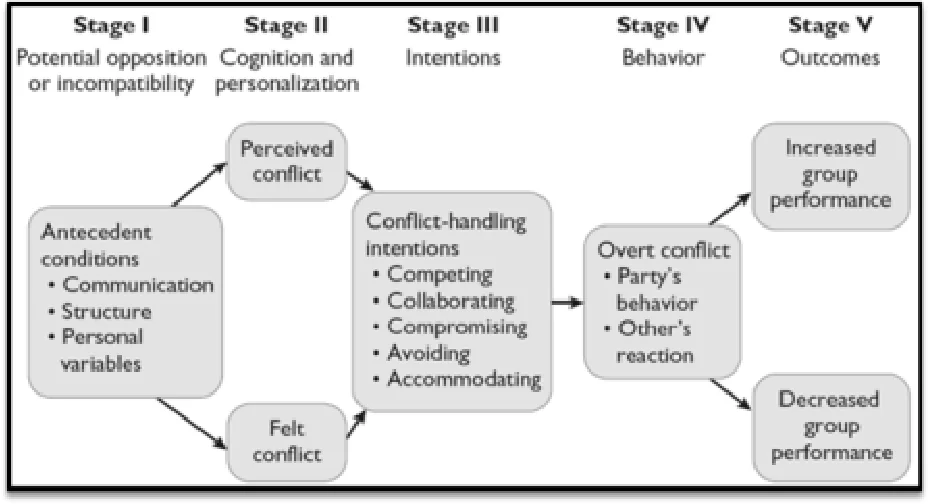
For conflict to arise, the existence of conditions that create opportunities for disagreement is necessary. Communication, structure, and personal variables can give rise to such antecedent conditions. Improper or insufficient exchange of information, different word connotations, and noise in the communication channel are some barriers to effective communication. Both ineffective vertical and horizontal communication can result in conflict. The size of the group, the degree of specialization of its members, the diversity of goals within the group, jurisdictional clarity, leadership styles, reward systems, and degree of inter- group dependence are some of the structural variables that create conditions favourable for conflict. The individual group members' personalities, emotions, and values can also determine the possibility of a conflict.
Another established way of classifying conflicts by the source of conflicts was given by Katz, which refers to structural conflicts, role conflicts, and resource conflicts. While structural conflicts arise due to interdependence between different organizational structures/sub-units, role conflicts arise from sets of prescribed behaviour and resource conflicts from people competing for organizational resources.
Most conflicts in healthcare settings are either role or identity conflicts, or a combination of the two [6,7]. Performance, functions, and processes are often the basis of role conflicts, whereas identity conflict arises when there is a mismatch in the importance a person feels about themselves and others, and vice versa. In the case vignettes described in the earlier part of this paper, lack of jurisdictional clarity and ill-defined roles and functions among CHOs and ANMs may have incited the conflict situation. As for the conflict within VHSNCs, the relative importance and values each member of the committee attaches to different health needs may be different and can take the form of a resource conflict. Inadequate or improper communication and personal variables may also have contributed to both scenarios.
The perception of one or both parties of the existence of a conflict is essential. When there is emotional involvement in the conflict, the perceived conflict becomes a felt conflict. Emotional involvement can take the form of anxiety, tension, frustration, or hostility. At this stage, the intention of the parties involved in the conflict determines the outcome of the conflict process.
Conflict Resolution Strategies
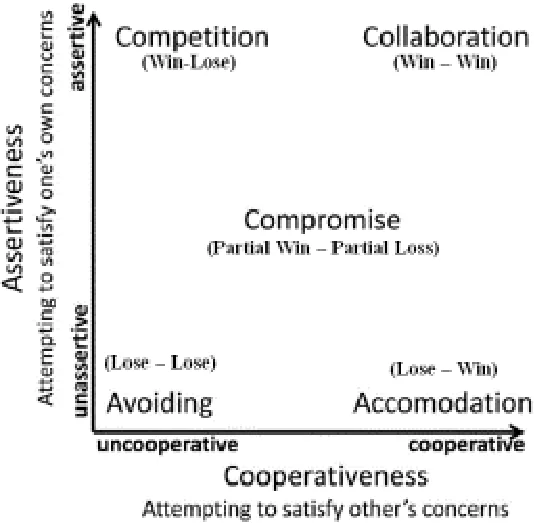
The intention/ behaviour of each party in the conflict is classified according to two underlying dimensions – assertiveness (attempting to satisfy own concerns) and cooperativeness (attempting to satisfy other's concerns) [4,8]. Based on these dimensions, the Thomas– Kilmann Conflict Model proposed five conflict-handing modes of an individual in conflict situations – competing (assertive, uncooperative), collaborating (assertive, cooperative), accommodating (unassertive cooperative), avoiding (unassertive uncooperative compromising (intermediate in both assertiveness and cooperativeness) (Figure 3) [9]. In the competing conflict-handling mode, an individual pursues his/ her interest at the expense of the other, while in the accommodating mode, the individual neglects interests to satisfy the needs of the other. In the collaborating mode, the individual attempts to work with the other person to find a solution that fully satisfies both, while in the avoiding mode, he does not attempt to address the conflict at all. Compromising refers to the middle ground where the mutually acceptable solutions only partially satisfy both parties [10].
No one conflict-handling method is suitable for all situations. The choice of the conflict handling method depends primarily on two factors – the choice of beneficiary and the time frame [5]. For beneficiaries, the choice varies when one tries to prioritize the welfare of one party (partisan choice), both parties (joint welfare choice), or the larger system (systemic choice). With respect to time frame, collaborative methods are preferred for long-term goals and contingency theories for short-term goals. If the situation demands immediate action, collaborative methods are often not feasible. Other factors like the importance of the issue and that of the relationship, and the relative power of the two parties also determine the choice of the conflict handling method used (Figure 4).
| Considerations | Competing | Accommodating | Compromising | Collaborating | Avoiding |
|---|---|---|---|---|---|
| Issue Importance | High | Low | Medium | High | Low |
| Relationship Importance | Low | High | Medium | High | Low |
| Relative Power | High | Low | Equal | Low-High | Equal |
| Time Constraints | Med-High | Med-High | Low | Low | Med-High |
Runde and Flanagan define five levels of conflict intensity on a conflict-intensity continuum [11]. The first level of differences occurs when two people see the situation differently and understand each other's interests, but feel no discomfort regarding the differences. In the second level, the misunderstandings arise due to differences in the understanding of the situation by the two parties. The conflict progresses into the third level of disagreement when either or both parties feel discomfort with the differences. The situation further escalates into discord when the relationship between the parties involved is strained even when they are not dealing with the original conflict. The final level of conflict intensity, polarization, is characterized by severe negative emotions and behavior with little hope for reconciliation. Conflicts of higher levels of intensity are easy to identify, but often difficult to resolve. So, it is important to be able to identify conflicts in the early stages and effectively deal with them.
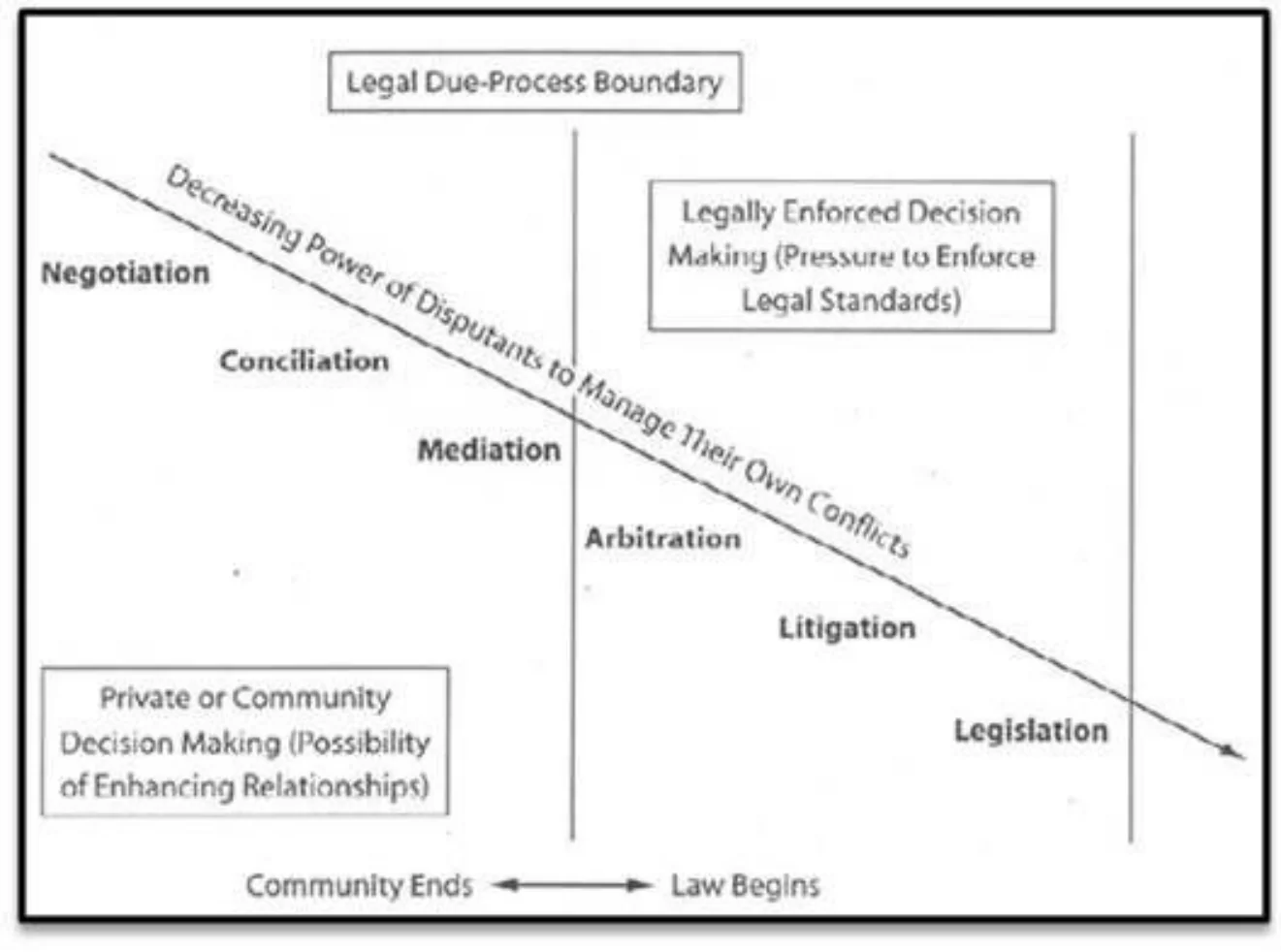
Different levels of conflict intensity demand different strategies for its resolution (Figure 5). Conflict resolution must involve analysis of the beliefs and attitudes towards the other party, improving the communication, and facilitating the re-establishment of trust and cooperation between the hostile parties. In the early stages of a conflict, the conflicting parties may attempt to resolve the conflict by discussion between themselves. If discussion fails to resolve the conflict, they may resort to one-to-one negotiation. If the conflicting parties are unable to work out a solution on their own, they may then decide to involve an intermediary. Intermediaries/ third parties are people or organizations who enter a conflict to try to help the parties de-escalate or resolve it [12]. The intermediary may initially focus on conciliation in which his role is limited to reducing hostilities between the parties. The facilitator in this case is responsible only for the process, and not for the content. He then moves to the process of mediation, where he is actively involved in the conflict resolution process by exploring options and negotiating a settlement. But the final responsibility of decision-making lies with the conflicting parties. Third-party conflict resolution can further take the form of arbitration, where the arbitrator acts like a judge deciding on solutions and making decisions. Adjudication is a form of arbitration where the arbitrator is an actual judge. Arbitration/ adjudication takes the power of decision-making away from the disputants and places it in the hands of the arbitrator. If all the above methods fail to resolve the conflict, the disputants can go in for litigation. Negotiation, mediation, and facilitation provide opportunities for individual and community decision-making and aim at enhancing relationships between the parties. Whereas arbitration, adjudication, and litigation involve legally enforced decision-making, and the conflicting parties have less control over the solutions [13,14,15].
Conflict, when dealt with appropriately, can improve performance, leading to functional outcomes. However, any lapse in the management of conflicts can be off-putting and hinder performance, leading to dysfunctional consequences.
Training in conflict management is especially important at the community level due to the complex interactions involving directly the community and community leaders. At this level, interactions with other sectors become imperative in an attempt to address other social determinants of health. Doctors, as well as frontline health workers like ASHAs, ANMs, and CHOs, act as a link connecting all these diverse groups and interests. Different cadres of health staff assume leadership roles at different levels in the community, sub-centres, and primary health centres/ Health and Wellness Centres. So, equipping them with skills in conflict management may be necessary to improve the overall performance of the health system.
Conclusion
As discussed earlier, conflicts are likely to happen in healthcare settings where many different individuals with different views, interests, goals, and ambitions interact and engage in patientcare. Though some conflicts and differences of opinion may prove beneficial in improving the overall performance of the healthcare facility, more often than not, they threaten the peace and smooth functioning of the institution. A good leader must recognize these conflicts well in time and navigate these differences by seeking grounds for common interests like good patientcare. For this, he needs to be equipped with conflict anticipation skills, controlled conflict reactions, and skills in conflict management. Conflicts, when resolved effectively, can improve performance, and increase the public's trust in the institution.
References
- Kotwani P, Pandya AK, Saha S. Community Health Officers: key players in the delivery of comprehensive primary healthcare under the Ayushman Bharat Programme. Curr Sci. 2021 Feb 25; 120(4):607–8. https://www.researchgate.net/publication/350849792
- Sancho-Cantus D, Cubero-Plazas L, Botella Navas M, Castellano-Rioja E, Cañabate Ros M. Importance of soft skills in health sciences students and their repercussion after the COVID- 19 epidemic: Scoping review. Int J Environ Res Public Health . 2023 10 ; 20 ( 6 ) [Google Scholar]
- Robbins SP, Judge TA. Organizational behavior 15th Ed. Pearson Education. United States of America. 2013; 445–470. [Google Scholar]
- Thomas, KW. Conflict and conflict management. Handbook of industrial and organizational psychology. Rand McNally. Chicago. 1976; 889-935. [Google Scholar]
- Thomas KW. Conflict and conflict management: Reflections and update. JOrgan Behav. 1992;13(3):265–74. https://doi.org/10.1002/job.4030130307
- Saltman DC, O'Dea NA, Kidd MR. Conflict management: a primer for doctors in training. Postgrad Med J. 2006;82(963):9–12. https://doi.org/10.1136/pgmj.2005.034306
- Porter-O'Grady T. Embracing conflict: Building a healthy community. Health Care Manage Rev. 2004 Sep;29(3):181. https://doi.org/10.1097/00004010-200407000-00003
- Ruble TL, Thomas KW. Support for a two-dimensional model of conflict behavior. Organ Behav Hum Perform. 1976;16(1):143–55. https://doi.org/10.1016/0030-5073(76)90010-6
- Thomas K, Kilmann R. Thomas-Kilmann Conflict Mode Instrument. Tuxedo NY: XICOM; 1974. https://www.researchgate.net/publication/265565339/
- Kilmann RH, Thomas KW. Interpersonal conflict-handling behavior as reflections of Jungian personality dimensions. Psychol Rep. 1975;37(3 Pt 1):971–80. https://doi.org/10.2466/pr0.1975.37.3.971
- Runde Craig, Tim Flanagan. Becoming a Conflict-Competent Leader. 2nd ed. Wiley, 2012. [Google Scholar]
- Burgess, Heidi. Intermediaries. Beyond Intractability. Conflict Information Consortium, University of Colorado, Boulder. 2004 Jan. Available from: http://www.beyondintractability.org/essay/intermediary-roles
- Fisher S, Abdi DI, Williams S. Working with conflict - Skills and strategies for action. New York. Zed Books. 2000, p.18. [Google Scholar]
- School of Social Sciences. Unit-6 Approaches to conflict resolution. Block-2 Gandhian Approach to Conflict Resolution IGNOU. 2017. [Google Scholar]
- Glasl F. The Process of Conflict Escalation and Roles of Third Parties. In: Bomers GBJ, Peterson RB, editors. Conflict Management and Industrial Relations [Internet]. Dordrecht: Springer Netherlands; 1982. p. 119–40. Available from: https://doi.org/10.1007/978-94-017-1132-6_6.

Published
Article metrics
- Views
- 1,624
- Downloads
- 639
Based on this site's usage statistics.