Original Article Vol. 8 No. 1 (2024): International J Health Systems and Implementation Research
The Needs Assessment of Trolleys for Optimized Patient Flow in the Outpatient Department of a Tertiary Care Hospital
Needs Assessment of Trolleys for Optimized Patient Flow
Downloads
Topics
Keywords:
- Patient Experience, Patient Stretcher, Patient Trolley
Abstract
Background: Stretcher trolleys are very important support structures for patients, especially for outpatient department care. Often patients and attendants are found struggling to get the trolleys. Although hospitals keep on purchasing new ones, this equipment gets damaged very fast. Therefore, to assess the current situation a student project was assigned. Objective: To do an exploratory study and gauze the requirement for trolleys in the Outpatient Department at a tertiary care hospital in North India. Methodology: A descriptive exploratory research design was used to conduct the study at the OPD Complex at a tertiary care hospital over seven weeks from July 4, 2022, to August 20, 2022. Data was collected through direct observation using non- participant observation and a structured questionnaire. The video recording by CCTV Cameras at the entrance and exit was also reviewed to observe the movement and use of trolleys. Key Informant Interviews were conducted regarding the requirements of the trolleys in the New OPD Complex. Findings: 76% of the participants faced some sort of difficulty in getting the trolleys. Only 7% got from the waiting areas. Others got either from the road near the OPD (23%), from parking areas (16%), from different floors/levels of the OPD Complex(6%), from the nearby Centre (9%),or the emergency area (8%). A large number (31%) of patients received trolleys from other patients after their usage. Around 80 trolleys were available in the morning per day and the demand was about 103 trolleys. So, 23 more trolleys were required to fill the gap between the demand and supply of patient trolleys for a better patient experience. CCTV footage was able to find the location of the trolleys. Recommendation: Hospitals need to put in place better tracking mechanisms with the use of CCTV and artificial intelligence so that the availability of existing trolleys can be tracked. The system of maintenance can be strengthened to undertake repairs. Alternate trolley storage spaces and distribution mechanisms may be explored.
Full text
This web version was prepared from the published PDF, which is the version of record. Please cite and quote from the PDF.
Introduction
A patient visits the outpatient department of the hospital for various healthcare needs. The patients visit outpatient departments for many facilities like consultation, treatment, tests, health education, etc. [1]. Patients who cannot walk often require stretcher trolleys to carry them through the outpatient department [2]. A large volume of internal traffic in hospitals involves the use of patient trolleys [2]. There should be a trolley bay having an adequate number of trolleys along with dedicated trolley men to help the relatives in loading and unloading the patients from ambulance/ personal vehicles[2][3]. The number of such trolleys depends on the number of patients visiting OPD and the type of specialty services required like Orthopedics, Neurology, and so on[4]. A proportion of patients in the radiologydepartment come on trolleys [2].
An adequate space to park trolleys should be provided at the entrance to the outpatient department near the reception and inquiry room. The issue and replenishment of trolleys can be organized under the overall control of the outpatient department coordinator /administrator [2]. Accessibility to OPD is essential in providing medical care topeople with disabilities[5]. A system of connected driverless transport media that can receive transport requests directly from the hospital information management system canbe used to autonomously navigate the OPD[6]. A checklist can be used to increase the safety of intra-hospital transport [7].
About 10% of the global population has disabilities (2003) and 10 % of the disabled require media for transport. As such, 1% of the total population – or 10% of the disabled population – needs help in ambulation [8]. The Global Survey on Persons with Disabilities and Disasters in 2023 reported that about 16% of the world’s population has certain disabilities [9]. Thus, by corollary, about 1.6% of the total population requires wheelchairs/trolleys. The Census of India 2011 and 76th round of the National Sample Survey (NSS) estimated the prevalence of disability in India to be 2.2% [10]. While estimates vary, there is growing evidence that people with disabilities comprise between 5 and 8 percent of the Indian population (around 55-90 million individuals) [11].
An extensive search was carried out in different databases like Google Scholar, Medline, etc. with different keywords, and no data related to the requirement of the trolleys for the outpatient services was found. An exploratory study for need assessment was undertaken to gauze the requirement for trolleys in the Outpatient Department.
Methodology
A descriptive exploratory research design was used to conduct the study at the OPD Complex at a tertiary care hospital. The study was conducted over seven weeks from July 4 ,2022 to August 20, 2022 and one week (from 21 August to 27 August 2022) was devoted to the analysis of data and preparation of the report. The data was collected using Convenience sampling. Studies have shown that about 1% of the general population needs help in ambulation. The OPD attendance was about 5540 per day in the last year. A total of 100 patients and 34 hospital staff members were interviewed for the study. Data was collected through direct observation using non-participant observation and a structured questionnaire. The video recording by CCTV Cameras at the entrance and exit was also reviewed to observe the movement and use of trolleys. Key Informant Interviews were conducted regarding the requirements of the trolleys in the New OPD Complex. Data was collected from July 11, 2022 to 30 July, 2022 from 8:00 AM to 11:00 AM. In addition to direct non-participant observation, the data was collected from key informants like patients/patient attendants and hospital staff through structured questionnaires and face-to-face interviews. The CCTV footage from cameras at the point of entry and exit was also reviewed to see the status of trolleys in OPD. As this was a student project with a focus on assessing the needs of trolleys, there was no ethical issue involved.
OPD Setup: The OPD complex of the hospital consists of five levels. The first level has numerous registration counters where registration for OPD services is done. After completing their registration process, the patients are guided to the various specific OPDs situated at different levels of the OPD complex. The Reception at OPD ensured that a sufficient number of trolleys were available. The receptionists supervise the contractual hospital attendants deputed as call men, trolley men, patient helpers, and trolley washers.
Findings
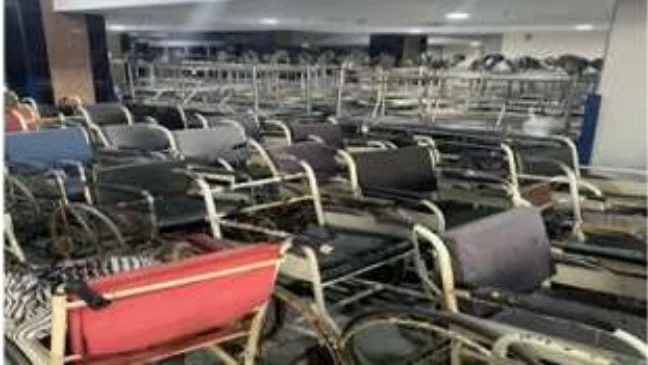
The hospital had an average footfall of more than 5000 patients per day in the OPD Complex. Around 80 to 90 trolleys were available in the morning at OPD (Figure 1 and Table 1). It was observed that a few patients who require trolleys were not able to get the trolleys on time leading to delays in getting the registration and OPD consultation. All the trolleys were taken away by 9:40 AM and the patients faced problems in getting trolleys after that. Some patients return the trolleys after using them whereas most of them left trolleys in different corridors after use.
Following were the salient observations:
- Trolleys were occupied from 9:30 AM to 9:40 AM.
- Many a time, patients or their relatives leave the trolleys at the departments they visit, making it inconvenient for others to locate them. Many patients had left the trolleys on the way after using them. These trolleys were collected by the trolley men in and around PGIMER around the clock.
- None of the participants was asked to keep the trolley back after using it.
- Sometimes, these are found lying in places away from the main building.
- The trolleys were segregated based on the need for repair. Trolleys that needed major repair were sent to the workshop; minor repair of trolleys was done at the location. Some trolleys were in very bad condition.
- On one day of observation, the trolleys lying outside the OPD Complex were wet due to the rain and patients still used them as all the other trolleys were occupied.
- On-duty trolley men used to collect the trolleys from different areas of the OPD Complex and arrange them at the entrance every evening. All the collected trolleys were counted and entered into a register.
- There was no dedicated trolley bay outside the OPD Complex and sufficient space was not available to add more trolleys. Some officials say that due to paucity of space, increasing the number of trolleys may not be feasible as they end up congesting the already overcrowded corridors.
- Another reason for patients facing trouble in getting the trolleys was lack of space. The trolleys were available at the entrance of OPD and there was no other space available where more trolleys could be kept.
- After a survey of different departments in the New OPD, it was observed that there were more patients with trolleys in the Neurology & Neurosurgery department as compared to other departments.
| Date | No. of trolleys in OPD | No. of trolleys observed by CCTV Cameras |
|---|---|---|
| 11-07-22 | 56 | 110 |
| 12-07-22 | 89 | 112 |
| 13-07-22 | 84 | 119 |
| 14-07-22 | 75 | 99 |
| 15-07-22 | 69 | 83 |
| 16-07-22 | 82 | 83 |
| 18-07-22 | 84 | 114 |
| 19-07-22 | 81 | 107 |
| 20-07-22 | 75 | 103 |
| 21-07-22 | 80 | 108 |
| 22-07-22 | 86 | 98 |
| 23-07-22 | 91 | 91 |
Patient Interviews:
About half patients (48%) had come from Punjab. About 30% were young in the 26-35 years age group, there was not much of a gender difference, and 48% were from Orthopedics and Neurosurgery (Table 2). There was no gender-based differentiation in getting the trolleys at OPD. (Table 3). No patient received any help in getting the trolleys issued at the reception counter as there was no such system for issuing the trolleys to the patients. Most of the participants received trolleys from other patients after their usage (Table 4).
| Characteristic | Number of patients | Percent | |
|---|---|---|---|
| Region | Haryana | 14 | 14% |
| Himachal Pradesh | 19 | 19% | |
| Punjab | 48 | 48% | |
| Other states | 19 | 19% | |
| Total | 100 | 100% | |
| Age | 10-25 | 15 | 15% |
| 26-35 | 30 | 30% | |
| 36-45 | 22 | 22% | |
| 46-55 | 13 | 13% | |
| 56-65 | 13 | 13% | |
| >65 | 7 | 7% | |
| Total | 100 | 100% | |
| Gender | Male | 44 | 44% |
| Female | 56 | 56% | |
| Total | 100 | 100% | |
| Department | ENT | 21 | 21% |
| Gastroenterology | 1 | 1% | |
| Gynecology | 16 | 16% | |
| Internal Medicine | 3 | 3% | |
| Neurosurgery | 20 | 20% | |
| Neurology | 11 | 11% | |
| Orthopedics | 28 | 28% | |
| Total | 100 | 100% | |
| Gender | Faced problems in getting the trolleys N (%) | Did not face problems in getting the trolleys N (%) | Total |
|---|---|---|---|
| Male | 33 (75%) | 11 (25%) | 44 (44%) |
| Female | 43 (76.8%) | 13 (23.2%) | 56 (56%) |
| Total | 76 (76%) | 24 (24%) | 100 (100%) |
| Location | Frequency | Percentage |
|---|---|---|
| Emergency area | 8 | 8% |
| Nehru Hospital Extension | 9 | 9% |
| Different floors/levels of the OPD | 6 | 6% |
| OPD Parking area | 16 | 1.% |
| Received from other patients after their usage | 31 | 31% |
| Road near the OPD | 23 | 23% |
| Waiting Area | 7 | 7% |
| Total | 100 | 100% |
88 % of participants received some help and 12% of participants did not receive any help after all the trolleys were occupied. According to the majority (74%) of participants trolleys were not in good condition.
Hospital Staff Interviews: A total of 34 hospital staff were interviewed, of which 28 (82%) were receptionists, one was a reception in charge, 2 were trolley in charge and 3 were security guards. Eighteen (52%) were females and 16 were males.
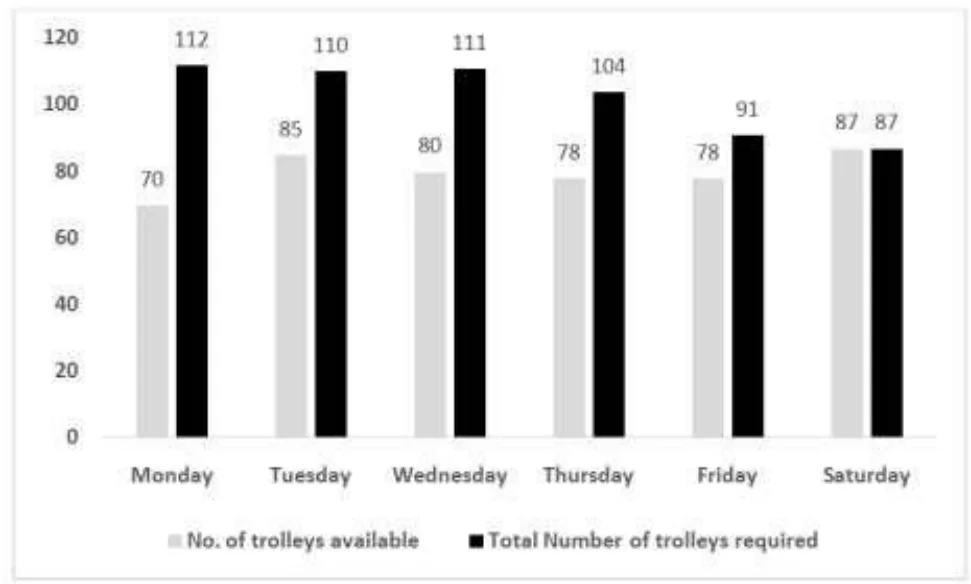
When hospital staff was asked whether patients approach them for trolleys, 22 (64%) responded positively they patients always approach them, and 11 (32%) said that patients approach them sometimes. One said that patients never approach them. Staff was further asked to ascertain the volume of complaints and any trend as per different weekdays. Twenty-six (76%) members said that most complaints are received on Mondays, Tuesdays, and Wednesdays. Whereas, other 8 said, that complaints come throughout the week. Required trolleys were calculated based on the daily patient footfall and the need for trolleys as compared to trolleys available each day. The gap between required and available was maximum during the first four days of the week. (Figure 2). The Security Guards received most of the complaints about the trolleys.
Discussion
The study was done to understand the gaps in the availability and requirement of trolleys and the possible reasons for the same. We got some valuable insights. The absolute gap was up to 30% on the peak days. The first four days of the week had high requirements. The gap was more due to a lack of instructions to the patients to park the trolleys at proper places after use. The gap was also more due to the inability to repair the trolleys at the rate, these are getting damaged. Although receptionists, dedicated trolley staff, and security staff are approached to get the trolleys, this is not sufficient. It was observed that 76% of the participants faced some sort of difficulty in getting the trolleys. No help was available at the time of issuing the trolleys in the outpatient department. The patients/attendants had to go to different locations in search of trolleys after all the trolleys were occupied.
It was noticed that none of the participants were instructed to keep the trolley back after using it. Many of the patients left the trolleys on the way (in the corridor) after using them. Trolley men in the hospital collected the trolleys from different areas inside and outside the OPD Complex from time to time so that patients/patients’ attendants do not have to go around in search of trolleys.
On average 5000 patients visited OPD Complex per day. It was observed that around 80 trolleys were available in the morning every day. It was found that there was a demand for about 103 trolleys per day. Thus, there was a deficit of around 23 trolleys and 23 more trolleys are required to fill the gap between the demand and supply for increased patient satisfaction. The inventory of trolleys could be increased by this number or a better tracking system (RFID-based) could be used to make the trolleys available whenever needed by the patients.
Conclusion and Recommendations
The collection and allocation of trolleys need to be streamlined for a better patient experience. Further studies can be done to ascertain the use of CCTV linked with Artificial intelligence to track the trolleys scattered over the hospital and send signals to dedicated staff to collect these. On every floor of the hospital, dedicated parking spaces can be created, and instructions can be displayed to inform patients to park trolleys after use. The repair and maintenance system should be strengthened to minimize downtime and have the required number of trolleys as a buffer. Vigilance should be increased from Monday to Thursday.
Limitation
The institute provides Outpatient Services at multiple locations and this study was undertaken at one such location.
Acknowledgments
The authors want to acknowledge the contribution of the staff posted at Reception, Security Staff, and Housekeeping Staff at the Outpatient Department of the hospital.
References
- Al-Zain Y, Al-Fandi L, Arafeh M, Salim S, Al-Quraini S, Al-Yaseen A, et al. Implementing Lean Six Sigma in a Kuwaiti private hospital. Int J Health Care Qual Assur [Internet]. 2019 Mar 11 [cited 2024 May 26];32(2):431–46. Available from: https://pubmed.ncbi.nlm.nih.gov/31017052/
- Sakharkar B. Principles of Hospital Administration and Planning, 2nd Edition. [doi:10.5005/jp/books/10677]
- Goel S, Gupta A, Singh A. Hospital Administration: A Problem-solving Approach. 1st ed. New Delhi: Elsevier India; 2014. 88 p. [Google Scholar]
- Outpatient Services.IGNOU- The People’s University. In [cited 2024 May 24]. [Google Scholar]
- Access to Medical Care for Individuals with Mobility Disabilities | ADA.gov [Internet]. [cited 2024 May 25]. Available from: https://www.ada.gov/resources/medical-care-mobility/#part-4--accessible-medical-equipment
- Baltazar AR, Petry MR, Silva MF, Moreira AP. Autonomous wheelchair for patient’s transportation on healthcare institutions. SN Appl Sci. 2021 Mar 1;3(3). [doi:10.1007/s42452-021-04304-1]
- Brunsveld-Reinders AH, Arbous MS, Kuiper SG, de Jonge E. A comprehensive method to develop a checklist to increase safety of intra-hospital transport of critically ill patients. Crit Care. 2015 May 7;19(1). [doi:10.1186/s13054-015-0938-1]
- World Health Organization. Guidelines on the provision of manual wheelchairs in less resourced settings. 2008th ed. Borg J, Khasnabis C, editors. Geneva, Switzerland: World Health Organization; 127 p. [Google Scholar]
- 2023 Global Survey Report on Persons with Disabilities and Disasters | UNDRR [Internet]. [cited 2024 May 25]. [doi:10.18356/9789213585795]
- Persons with Disabilities (Divyangjan) in India-A Statistical Profile : 2021. [cited 2024 May 27]; Available from: https://www.nhfdc.nic.in/upload/nhfdc/Persons_Disabilities_31mar21.pdf
- People with disabilities in India: From commitments to outcomes [Internet]. The World Bank; 2009 [cited 2024 May 27]. Available from: https://documents1.worldbank.org/curated/en/577801468259486686/pdf/502090WP0Peopl1Box0342042B01PUBLIC1.pdf

Published
Article metrics
- Views
- 602
- Downloads
- 433
Based on this site's usage statistics.