Original Article Vol. 8 No. 1 (2024): International J Health Systems and Implementation Research
Stakeholders' Perception of Digital Payment in a Public Hospital in India
Digital Payment in an Indian Public Hospital
Downloads
Topics
Keywords:
- Digitalization, Economy, Finance, Hospital, KAP, Online Payment
Abstract
Background & Objectives: An important aspect of digital technology is the advent of new payment methods. Digital transformations can impact poverty alleviation, financial inclusion, and resource utilization. India is predominantly a cash-based economy. The government of India has taken several steps to facilitate digital payments, yet most of the financial transactions are cash-based. Methods: We have carried out a study in tertiary care hospitals to understand the factors behind the utilization of digital payment or lack of it. It is a cross- sectional and questionnaire-based study aimed to explore the knowledge, attitudes, and practices of patients as well as fee collectors. Results: We found variable knowledge about different modes of online payment but many patients are aware of one or the other modality. People tend to use cash more frequently for transactions less than INR 1000. Conclusion: Even though there is awareness regarding digital payment there is a hesitancy in using the digital payment methods and certain factors have been highlighted. There are challenges in the adoption of digital payment in our country. We must take steps to overcome these if we want to reap the purported benefits of digitalization fully.
Full text
This web version was prepared from the published PDF, which is the version of record. Please cite and quote from the PDF.
Introduction
Digital finance is financial services provided through personal computers, mobile phones, the Internet, or cards linked to a digital payment system[1]. In digital payments, transactions are accomplished through technologies where physical cash is not used in the process, resulting in a prompt and convenient system. A few of these methods are:
- Bank Cards: Issued by a bank, it may be a debit card or a credit card, used at the point of sale for making payments towards the purchase of goods or services.
- Internet Banking: Online payments are made over the Internet through the banking website.
- Mobile Banking: Payments are made using cellular devices through software, called an App (application), provided by the financial institution for the purpose.
- AePS (Aadhaar-enabled Payment System): A service provided by the National Payments Corporation to empower a bank customer to use an Aadhaar(A Unique Identification Number) as his/her identity to access his/her respective Aadhaar-enabled bank account and perform basic banking transactions like cash deposit, cash withdrawal[2–3].
- UPI (United Payments Interface): Unified Payments Interface is a system that powers multiple bank accounts into a single mobile application (of any participating bank), merging several banking features, seamless fund routing & merchant payments into one hood[2].
- USSD (Unstructured Supplementary Service Data): Also referred to as "Quick Codes" or "Feature Codes," it is used by GSM cellular phones to communicate with the computers of the mobile network operator. It can be used for payments ranging up to INR 5,000 per day per customer.
Digital finance has a beneficial impact on an individual, business, and country [1]. It can lead to better financial inclusion, alleviate poverty, and provide secure and convenient banking services to the poor in developing countries. India is predominantly a cash-based economy despite the availability of a plethora of digital financial products [4]. According to the Reserve Bank of India, the demand for banknotes and coins remained high despite an increase in non-cash transactions in the year 2015-16 [5]. On 8th November 2016, the Government of India announced demonetization whereby notes of denominations 500 and 1000 ceased to be legal tender. It created a significant flutter in the economy and gave impetus to digital payments with a massive increase in payments through cards and other electronic means[6]. However, over the next two years, the situation reverted to pre-demonetization levels in terms of circulation of cash [7].
With the above information in the background, we decided to conduct a study to assess patients' familiarity, tendencies, and behaviors when making digital payments. It is of particular interest due to the focus of the Government of India and the Ministry of Health and Family Welfare in the adoption of digital payments in all the central government hospitals [8].
Background description: The Institute, a tertiary care hospital with close to 2000 beds in North India, caters to approximately 2.8 million outpatients and 1,00,000 inpatients annually. Patients with vast differences in educational qualifications, occupation, and income avail of the services at the Institute. During the study period, 7000 to 8000 financial transactions were made on an average day (the COVID-19 pandemic altered the ordinary course of events). They were generally payments made for admissions, discharges, and diagnostic investigations. There were 24 fee counters in total at various locations in the Institute. Depending upon the location, the counters were operational for varying periods of a day. Currently, the Institute accepts banking cards and UPI-linked payments through a PoS (Point of Sale) machine as a digital payment option.
Materials and Methods
The cross-sectional study was conducted over one year, from April 2018 to June 2019, after obtaining ethical clearance from the Institute Ethics Committee. Written informed consent was obtained from all the participants, who were also provided with the participant information sheet, explaining the details of the study. Study tool: Since the literature search did not reveal much information on this aspect, especially in the context of Indian healthcare settings, a questionnaire was framed based on the inputs given by the authors and the limited available literature. The framed questionnaire was reviewed and modified based on a pilot test on a small sample of patients/attendants (to check for consistency) and obtaining feedback from an expert with domain expertise. Study Sample: The sample size was determined assuming a precision level of ± 10%, with a confidence level of 95% and variability proportion to be 0.5, and a sample size of 100 was considered adequate [9]. Data Collection and Analysis: The fee counters at the Institute operate for twelve hours a day i.e. 9 AM to 9 PM barring two which operate round the clock. The first author went to all the counters in the morning and evening and administered the questionnaire to the willing participants among the patients/attendants (convenience sampling). The collected data was analyzed using SPSS version 21 (IBM Corp).
Results
The questionnaire was given to the willing participants, yet a few have chosen not to answer a question or two. Such questions have not been considered while calculating the response percentage for those questions only. Table I depicts the demographic details of the respondents. 47% were in the 31-50 years age group, with equal representation of each gender, only 12% were up to 10th standard rest were educated above this level, 68% were urban, and only 15% had income up to INR 5000/- per month.
| Variable | Characteristics | No. | % |
|---|---|---|---|
| Age (N=100) | < 30 Years | 27 | 27 |
| 31 – 50 Years | 47 | 47 | |
| > 50 Years | 26 | 26 | |
| Gender (N=100) | Male | 50 | 50 |
| Female | 50 | 50 | |
| Education(N=89) | Up to 10th standard | 11 | 12.3 |
| 10th to 12th standard | 27 | 30.3 | |
| Graduates | 37 | 41.6 | |
| Postgraduates | 14 | 15.7 | |
| Location(N=96) | Rural | 30 | 31.2 |
| Urban | 66 | 68.7 | |
| Income(N=97) | Cat A (< INR 5000/month) | 15 | 15.5 |
| Cat B (INR 5000 – 10,000/month) | 35 | 36 | |
| Cat C (INR 10,000 – 50,000/month) | 32 | 33 | |
| Cat D (> INR 50,000/month) | 15 | 15.5 |
Knowledge regarding digital payment: 70% of the respondents were aware of banking cards, while almost half knew about Internet banking and mobile apps. There was poor knowledge about other methods, i.e., smart cards, AEPS, UPI, and USSD ranging between 9-24%. Overall, 60% of respondents were aware of the Government's schemes for digitalization. Only 37 patients/respondents acknowledged that the Institute accepts card payments. 27 (73%) of those came to know about it from staff and friends while remaining through signage and media.
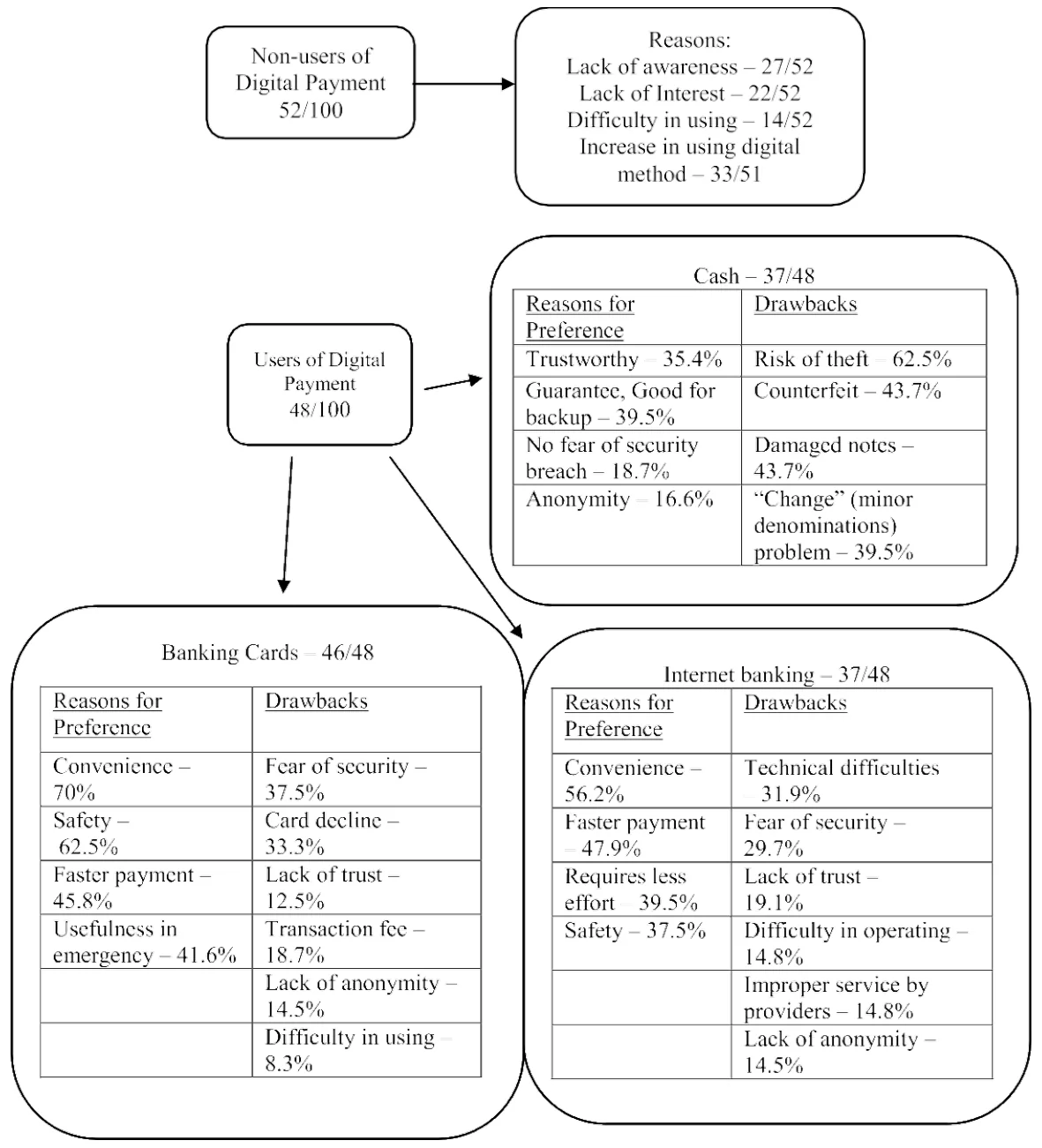
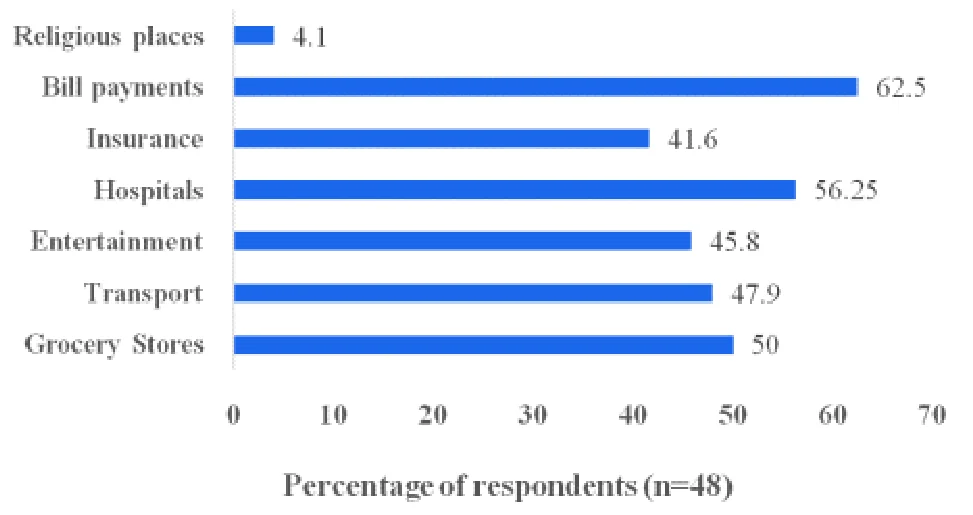
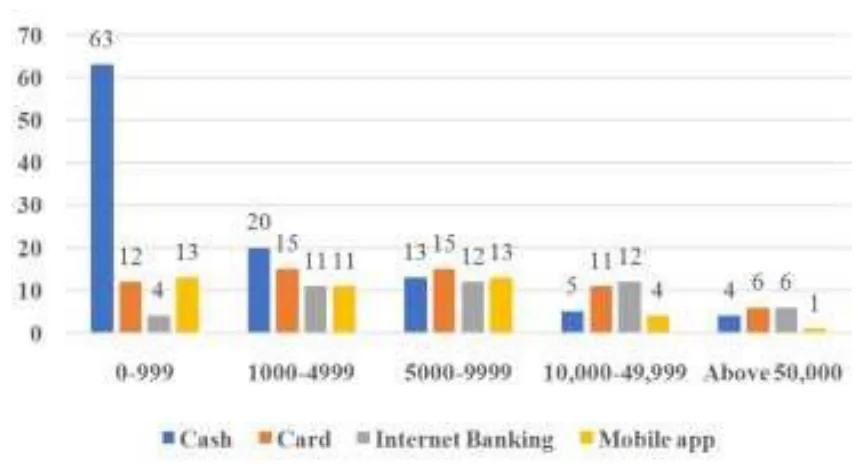
Attitude of Participants regarding Digital Payment: The data about patients vis-à-vis digital payment is given in Figure 1. The respondents were asked their preferred mode of payment, and given a choice. Practices of respondents about digital payment: Figure 2 depicts the avenues where the respondents use digital payment. An overwhelming 68.7% (33/48) opted for the card while 16.6% opted for cash, followed by mobile apps (10.4%) and internet banking (2%), respectively. 68.7% of respondents rated digital payment as safe, while 14.5% termed it risky. The remaining had no opinion about it. Interestingly, 8.3% of participants reported that they had been cheated while making digital transactions, and 56.2% mentioned that they had heard of cheating incidents with others. 31.6% of respondents (n=98) have used a Point-of-Sale machine to make payments through the Institute's card. 92% of digital payment users would recommend others to use the same. Figure 3 presents the payment modality pattern based on the amount. A large number of cash transactions occur for amounts up to INR 1000.
Data on digital and cash transactions in the institute over four time periods from 2016-19 were analyzed to understand the trend in transactions. In our Institute too, although predominant transactions are cash-based, as shown in Figure 4, there is a steady increase in the use of digital payments as depicted in Figure 5. This is an encouraging trend and should increase further as people become more adept at using digital technology.
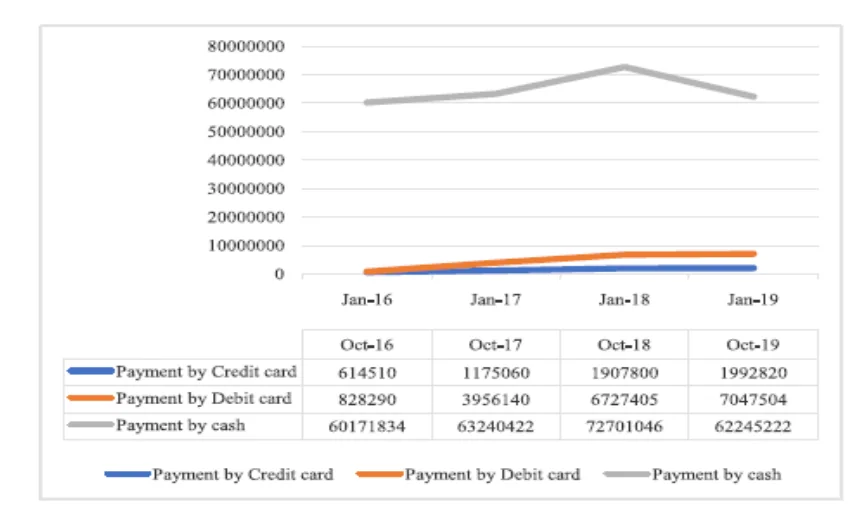
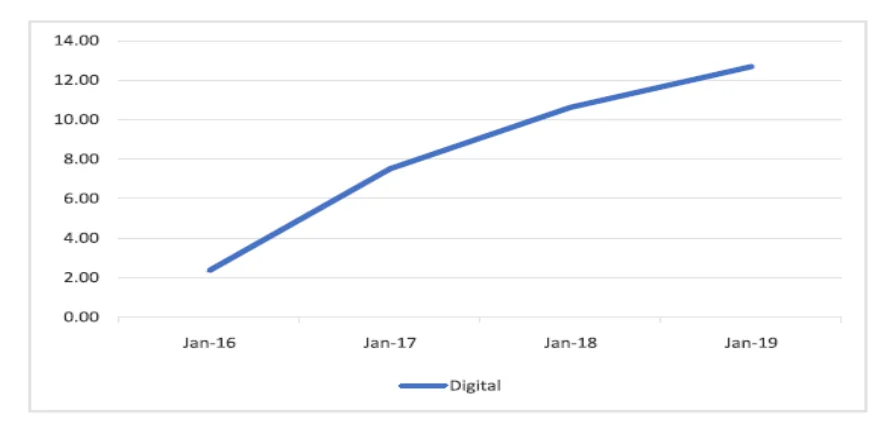
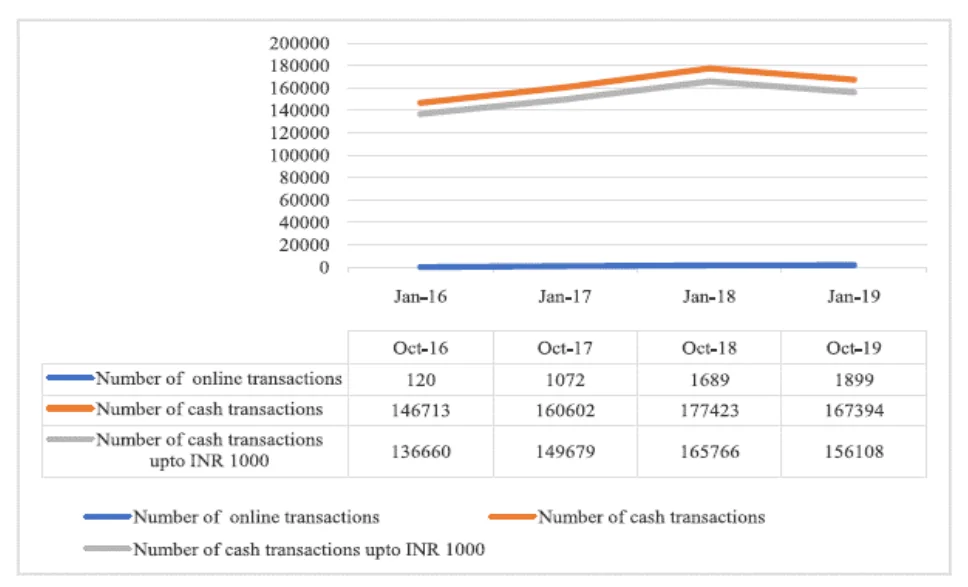
Figure 6 depicts the number of transactions in online and cash modes. It also shows that the number of digital transactions is increasing. We explored the usage practices of participants. It was found that cash was used overwhelmingly while making petty payments of less than INR 1000. The use of cash decreases as the amount of payment increases. In our public health facilities, a large number of day-to-day transactions may be less than INR 1000, explaining the fewer digital transactions.
Discussion
Demonetization was a significant event that took out cash from the economy. The Government of India and the Reserve Bank of India (RBI) have initiated several steps to promote "less cash" and digital finance. Although digital transactions in the country have increased, India is predominantly a cash-based economy[10]. Our study also showed an increasing trend in the use of digital transactions, although cash transactions are still the predominant mode.
Our study is unique since a similar study in the Indian healthcare scenario could not be found, and very few studies have been done otherwise. The data shows that cards are the most known method of the various digital payment modalities. It may be because people have been aware of ATM cards for a long, while the other methods are relatively new. The knowledge of patients/attendants regarding the Government's initiatives on digitalization can be considered satisfactory; however, two-thirds of them were not aware that the Institute accepts cards as a mode of payment. It may be because of inadequate marketing or the common perception of public hospitals. Additionally, hospitals are not associated with the typical shopping experience.
Nearly half of the respondents have used digital payment. Amongst the non-users, lack of awareness and interest were the most often cited factors. Amongst the users of digital payment, the reasons for preference and drawbacks of using different modes; cards, internet banking, and cash, were asked to explore the attitude towards payment methods. The participants had the option of choosing multiple reasons for their responses. Convenience, safety, and faster payment were the common reasons for using cards or internet banking.
This also calls for strategically focusing on smaller value transactions to increase digital payments. Transactions, big or small consumers equal amount of effort and operational time. Therefore, there is a need to work up strategies to promote smaller transactions as well. These may be outside the realm of the Institute's jurisdiction and may include incentives, e.g., waiving of transaction charges, cashback of a nominal value, gift vouchers, or working up some prepaid model of debit cards. However, the introduction of UPI-based payment in the current year (2024) may overcome this challenge as it has been commonly seen that people use UPI payment methods for making petty payments at various outlets.
An important issue that emerges from the information gathered is the challenge regarding the refund. If a patient makes payment through a card and for some reason seeks a refund, it poses a challenge to the fee clerk and the patient. The receipt of the amount is first verified, and then the process for crediting the amount in the patient's account is initiated. Additionally, the fee handler punches the card multiple times for a single patient based on the department-wise grouping of investigations. This is done to facilitate reconciliation in case the need arises. This may cause apprehension to the payer and may demotivate repeat digital transactions. Operational efficiency can be improved by redesigning the accounting system such that all payments and refunds are clustered around the registration number and not as per the department.
The safety of digital payment has emerged as a concern with patients, who have first-hand experience and knowledge of fraud happening to others. The incidents reported in the newspapers may contribute to their perceptions regarding safety and prevent them from making payments digitally. The recent penal action by RBI on a UPI-based payment portal may cause mistrust among users regarding the safety of the digital economy per se [11].
Limitations: The study is exploratory since decent literature is not available on the topic. The Institute does not accept UPI-based payments may have an impact on the actual digital transactions. We may have missed certain factors, but being a first of its kind may give researchers a platform to build upon.
Conclusion
Digital finance or digital economy has many advantages and Digital payment is one component of the digital economy. We have done a study at a healthcare institute to understand the knowledge and behaviour of the stakeholders towards digital payment. The study reveals that we may be far from achieving the desired objectives even though digital payments are increasing. We need to understand the reasons for reluctance, incentivize digital payments, and market them as a part of inclusive financial growth.
Conflicts of interest
Nil
References
- Ozili PK. Impact of digital finance on financial inclusion and stability. Borsa Istanbul Review 2018; 18: 329-40. [doi:10.1016/j.bir.2017.12.003]
- Unique Identification Authority of India. Available from https://uidai.gov.in/what-is-aadhaar.html.
- National Payment Corporation of India. Available from https://www.npci.org.in/what-we-do/aeps/product-overview.
- Sivathanu B. Adoption of digital payment systems in the era of demonetization in India an empirical study. J. Sc. Tech. Pol. Mgmt. 2019; 10: 143-71. [doi:10.1108/jstpm-07-2017-0033]
- Central Board of Directors, Reserve Bank of India. Annual Report 2015-16. 2016 August. Available from https://rbidocs.rbi.org.in/rdocs/AnnualReport/PDFs/.
- Central Board of Directors, Reserve Bank of India. Annual Report 2016-17. 2017 August. Available from: https://rbidocs.rbi.org.in/rdocs/AnnualReport/pdfs/rbiar201617_fe1da2f97d61249b1b21c4ea66250841f.pdf.
- Mathew G. Cash in circulation jumps 19.1 percent from the pre demonetization level. The Indian Express 2019 March 22. [Google Scholar]
- Ministry of Health & Family Welfare, Government of India. D.O No. Z-18015/8/2017-eGov dated 27 October 2017. [Google Scholar]
- Israel GD. Determining sample size. Gainesville: University of Florida; 1992. Report No: Fact Sheet PEOD-6 [Google Scholar]
- Mathew G. Nearly 5 years since note ban: cash with public rising, at all-time high. The Indian Express 2021 November 5. Reserve Bank of India. Press Release; February 16, 2024. Available from: https://rbi.org.in/Scripts/BS_PressReleaseDisplay.aspx?prid=57345.

Published
Article metrics
- Views
- 648
- Downloads
- 421
Based on this site's usage statistics.
Issue
Section
How to Cite
More in this topic: Health financing
Original Article · 2022
Health Insurance Scenario Among Street Vendors Of Chandigarh