Original Article Vol. 8 No. 2 (2024): International Journal of Health Systems and Implementation Research
A Formative Study to analyse Awareness, Knowledge, and Utilisation Gap about ABHA (Ayushman Bharat Health Account) at a Tertiary Care Health Setting
Awareness, Knowledge, and Utilisation gap about ABHA
Downloads
Topics
Keywords:
- ABHA, Awareness, Enrolment, Knowledge, Usage
Abstract
Ayushman Bharat Health Account (ABHA) is a 14-digit unique digital identity for people of India under the aegis of the ‘Ayushman Bharat Digital Mission’ launched on 27th September 2021. It aims for the integration of healthcare services, patient record accessibility, and pan- India portability for achieving universal health coverage through digitalisation. Objective: To assess awareness regarding enrolment and usage of ABHA among people in the outpatient department and in proximal areas of PGIMER, Chandigarh, which is a tertiary care educational and research hospital. Methodology: It is a short cross-sectional study conducted in PGIMER from 9th November to 9th December 2024 with a purposive sampling technique with a sample size of twenty. Direct face-to-face interviews were conducted with interviewer- administered questionnaire. Results: 68 crore ABHA IDs have been created, latest till 20th November 2024 in India. In Chandigarh, 8.6 lakh ABHAs have been created out of 12.4, lakh which is 70% of the total population. According to our study, 65% of people have an ABHA ID but the usage percentage is 0%. There is a perceived confusion among 70% of people about different health cards, and 85% of people desired information to be disbursed through social media to cover the knowledge gap. Conclusion: The usage of ABHA ID is 0% although 8.6 lakh ABHA IDs have already been made in Chandigarh. There is a lack of awareness and information about the usage and benefits of ABHA among the patients as well as in the general population; therefore, future studies are warranted to further explore this issue.
Full text
This web version was prepared from the published PDF, which is the version of record. Please cite and quote from the PDF.
Introduction
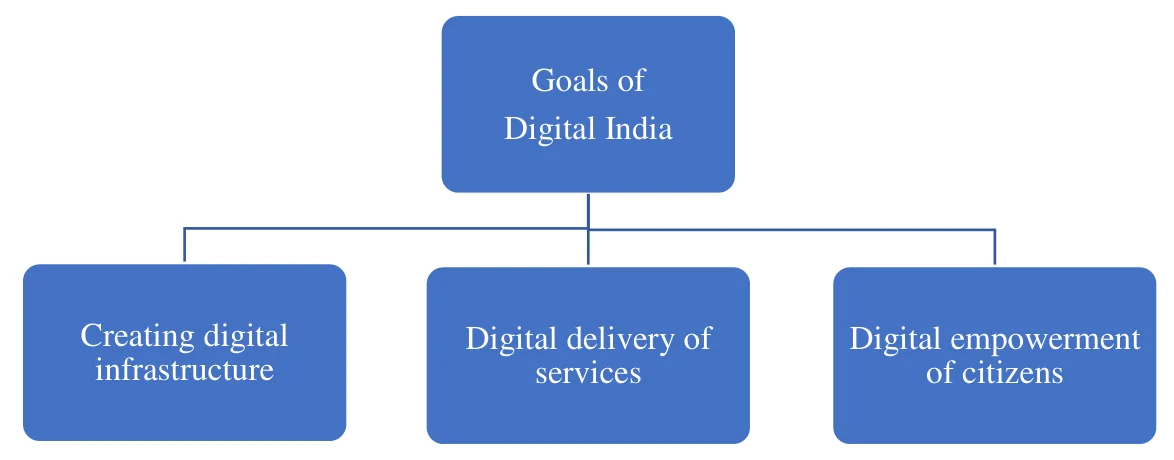
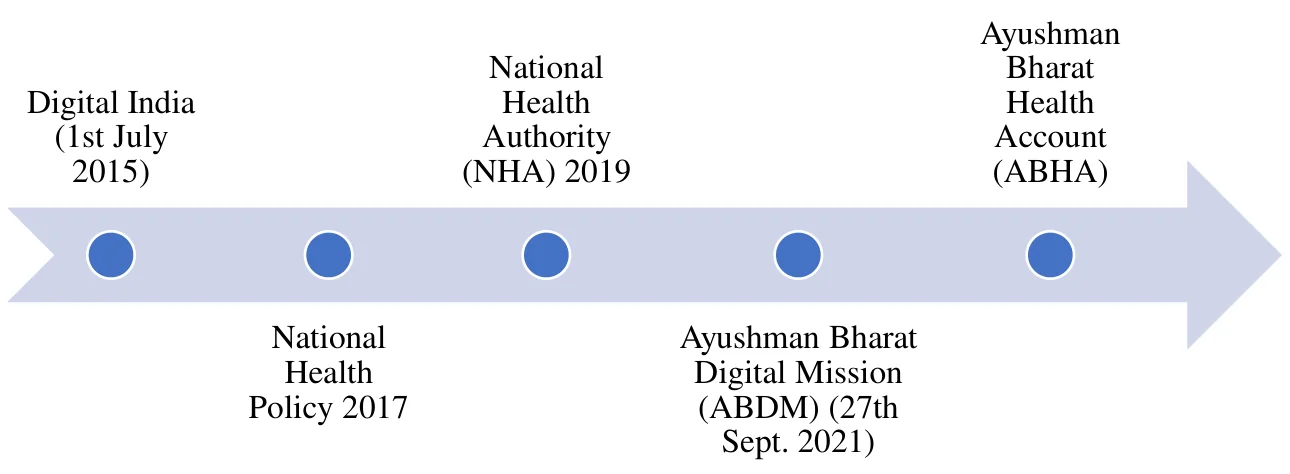
ABHA, or Ayushman Bharat Health Account, previously called ‘Health ID’ is a seamless method of accessing and sharing your health records digitally. It enables smooth interaction between patients, healthcare facilities and healthcare professionals, allowing for the exchange of laboratory reports, prescriptions, and diagnosis digitally. ABHA is one of the components of the ‘Ayushman Bharat Digital Mission’ (ABDM), which was launched on 27th September 2021 as part of ‘Digital India’ to create a unified digital health ecosystem [2]. ‘Digital India’ is a flagship program of the Government of India launched on 1st July 2015 with an aim to transform India into a digitally empowered society and knowledge economy [6]. It has three key vision areas: digital infrastructure as a utility to every citizen, digital governance of citizens, and governance and services on demand [6], which are depicted in Figure 1. The evolution of ABHA is depicted in Figure 2.
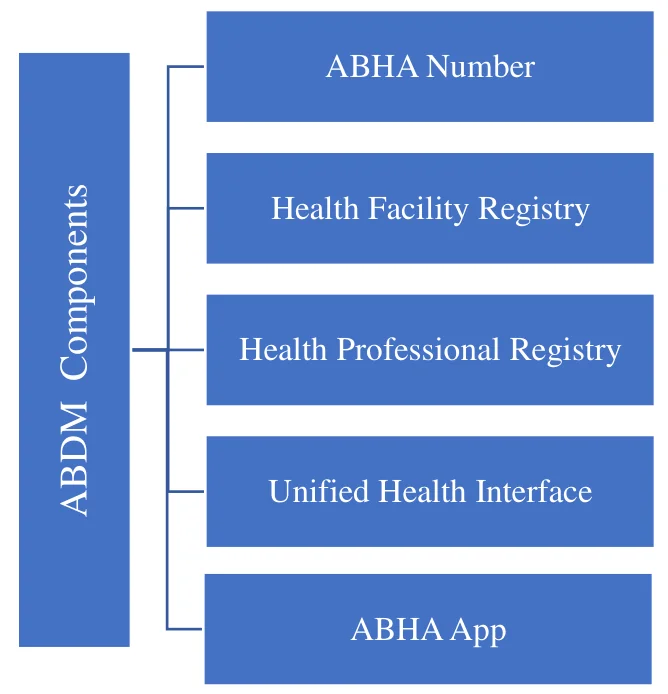
Ayushman Bharat Digital Mission - The flagship initiative of the Government of India aimed to create a digital health ecosystem. It is created to provide seamless information and a digital pathway between different stakeholders in the health ecosystem. It has five key components. ABHA number, Health Facility Registry, Health Professional Registry, Unified Health Interface, and ABHA App [2] depicted in Figure 3.
Implementing Agency - ‘National Health Authority’ or NHA is the apex body formulated under the Ministry of Health and Family Welfare (MOHFW) and is the implementing agency for both ‘Ayushman Bharat Pradhan Mantri Jan Arogya Yojna’ (AB PMJAY) and ‘Ayushman Bharat Digital Mission’ (ABDM), which covers Ayushman Bharat Health Account (ABHA) [8].
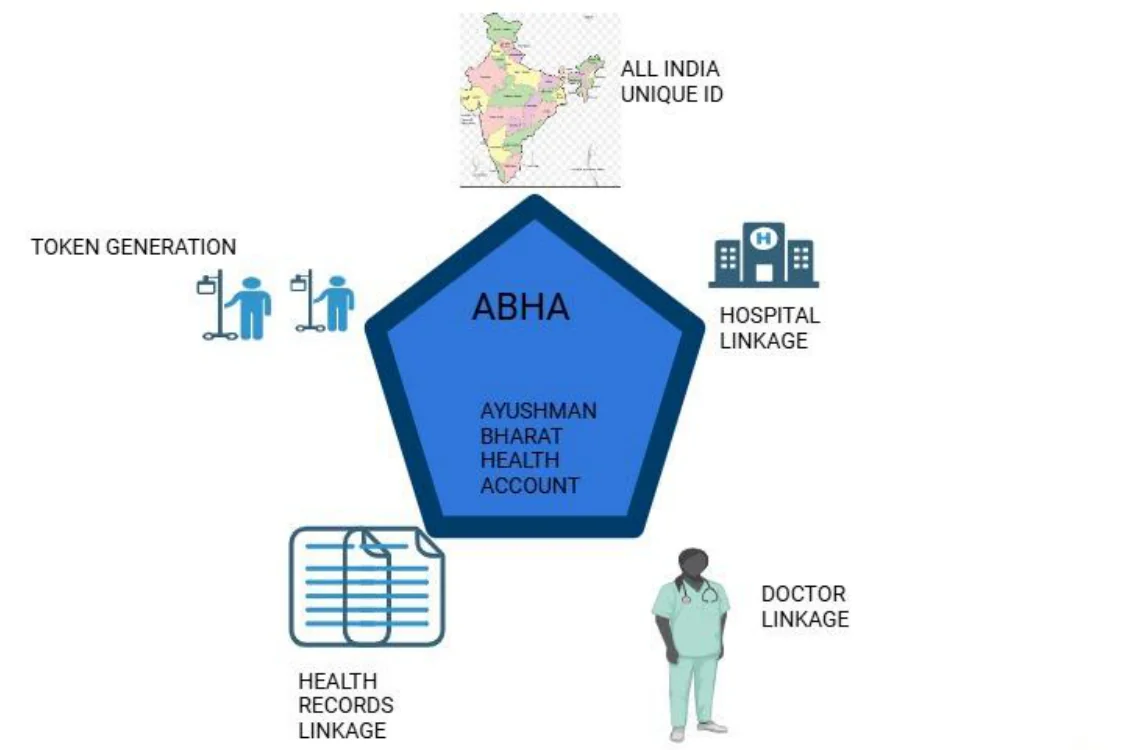
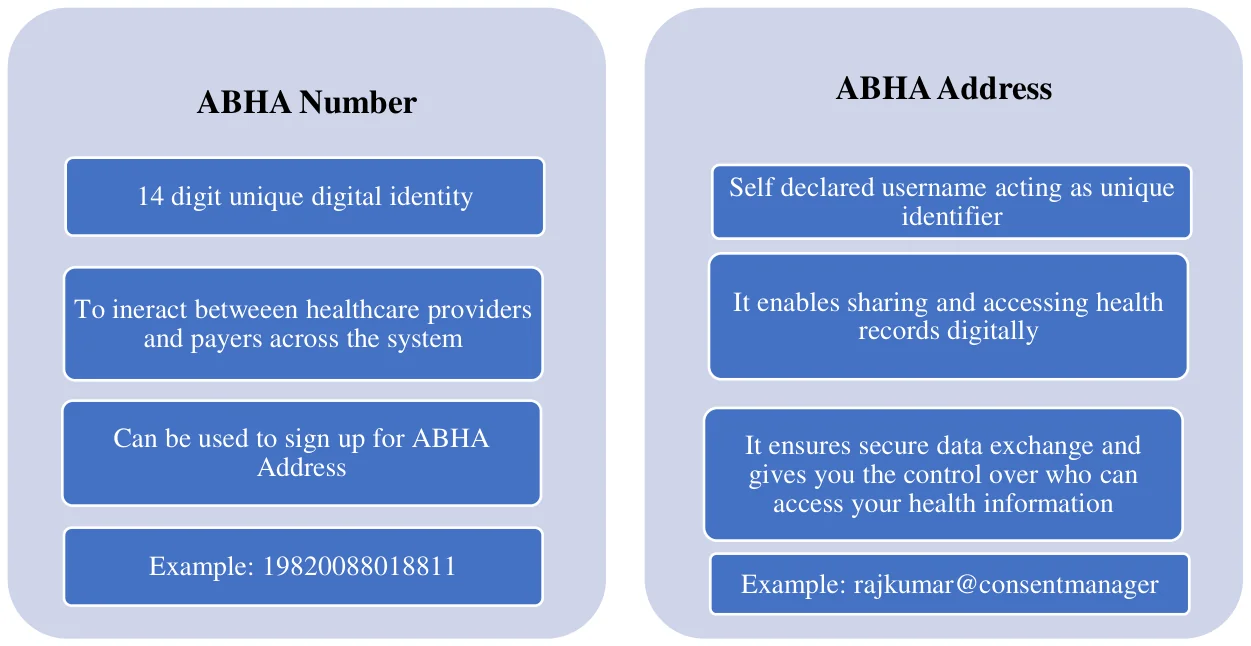
Ayushman Bharat Health Account /ABHA/Health ID - ABHA is a 14-digit unique digital health identity for people of India across the healthcare system, unifying and linking all healthcare benefits and integrating public health programs to insurance schemes [1]. ABHA ‘Scan and Share’ aims to provide hassle-free access, avoiding long queues for registration at the hospitals and other healthcare facilities [1]. It also aims to provide linkage and pan-India portability for health records of patients. There is also a provision of linking the ABHA Number with the ABHA Address that ensures that health records created for you are only shared with you, ensuring the data security [1]. The difference between an ABHA Number and an ABHA Address are depicted in Figure 5 below. The registration is voluntary, free of cost and people can opt out at will any time requesting permanent deletion and temporary deactivation of the ABHA number [1]. The benefits of the ABHA are that it will provide for a unique all-India digital identity for the individuals, linkage of hospitals and health professionals, both public and private and health records accessibility and portability throughout India and token generation at hospitals through ‘Scan and Share,’ which will prevent delays and long queues at the hospital (Figure 4).
Adoption of ABHA in India
Data analysis of the ABDM public dashboard on 20th November 2024 at 9:30pm.
68 crore ABHA IDs have been created, which is 48.5% of the 140 crore population of India [1]. 45 crore health records have been linked with the ABHA which is 32% of the 140-crore total population of India [1]. A total of 3.48 lakh health facilities are registered with ABDM, with Uttar Pradesh being at the top with 61,000 facilities [1]. The state of Uttar Pradesh has also created the largest number of ABHA IDs at 12.6 crore, followed by Maharashtra with 5.5 crore and Madhya Pradesh with 4.6 crore [1]. The top partners in ABHA creation are PMJAY, with 26.3 crore ABHA which is 38% of the total 68 crore. It is followed by COWIN with 13 crores ABHA IDs which is 19% of the total 68 crores [1].
Objectives
To assess enrolment, knowledge, and usage gaps about ABHA in people in proximal areas of tertiary care teaching hospital PGIMER, Chandigarh.
Materials and Methodology
The area of conduction of study Nehru OPD, in the vicinity of the MRI Centre and in the market area where there are shops and eateries.
Duration of study
From 9th November to 9th December 2024 as a short preliminary study.
Design
Cross-sectional study with direct face-to-face interviews using interviewer-administered questionnaire.
Sampling technique
Purposive and convenience sampling was done to ensure heterogeneity of response.
Sample Size
The data was collected as a part of a preliminary study. Twenty subjects were interviewed directly in person by the interviewer through an interviewer-administered questionnaire. ABHA ID was checked with the downloading of ABHA App in patients’ smartphones and filling in the OTP that would be generated for verification in the Aadhar linked mobile number. The verbal consent of people was taken. Only attendants of patients who were waiting were interviewed to prevent any delay and discomfort to the patients. People associated with the informal registration were also interviewed to understand their views and knowledge of ABHA. Although the sample is small, it was diverse enough to generate heterogeneity of response.
Data collection
The study was carried out for a month by directly interviewing people in Nehru OPD, in proximal areas of PGIMER. The heterogeneity of responses was ensured by interviewing people from different regions. Along with people seeking healthcare, people who were not seeking healthcare were also interviewed to gain different perspectives and responses in data.
Results
A purposive sample of 20 people was taken. Table 1 shows the socio-demographic characteristics of the study respondents. The absolute size of the sample is 20. The geographic distribution of the respondents reveals that 6 (30%) of the respondents belonged to Chandigarh, 6 (30 %) belonged to Himachal Pradesh, 6 (30%) belonged to Punjab, 1 respondent (5 %) belonged to Bihar and 1 (5%) belonged to Uttar Pradesh. With regard to the gender, a general male preponderance was evident, with males being 14 (70%) and females being 6 (30%). The educational profile of the respondents reflects that 15 (75%) were literates as against 5 (25%) illiterates. Furthermore, the data highlighted that 17 (85%) respondents have smartphones, whereas 3 (15%) did not have smartphones. With regard to the linkage of mobile number with Aadhaar number it was found that 16 (80 %) of the respondents had their mobile number linked to Aadhaar in contrast to 4 (20%) who did not have it linked.
| Region | Absolute Number | Percentage % |
|---|---|---|
| Chandigarh | 6 | 30 |
| Himachal Pradesh | 6 | 30 |
| Punjab | 6 | 30 |
| Bihar | 1 | 5 |
| Uttar Pradesh | 1 | 5 |
| Total | 20 | 100 |
| Gender | Absolute Number | Percentage % |
| Male | 14 | 70 |
| Female | 6 | 30 |
| Total | 20 | 100 |
| Literacy Status | Absolute Number | Percentage % |
| Literate | 15 | 75 |
| Illiterate | 5 | 25 |
| Total | 20 | 100 |
| Smartphone | Absolute Number | Percentage % |
| Have | 17 | 85 |
| Don’t have | 3 | 15 |
| Total | 20 | 100 |
| Phone Number linked with Adhaar Number | Absolute Number | Percentage % |
| Yes | 16 | 80 |
| No | 4 | 20 |
| Total | 20 | 100 |
Table 2 represents the ABHA status among respondents. The data shows 12 (60%) of respondents have heard about ABHA, and 8 (40%) of respondents have not heard about ABHA. Moreover, 13 (65%) respondents have ABHA IDs, and 7 (35%) do not have ABHA IDs. Further, the table reflects that out of 13 respondents who have ABHA ID, 9 (69%) were aware of being registered, and 3 (31%) were not aware of being registered. The ABHA status was determined by the author by downloading the ABHA app and checking the status by logging in with the respective Aadhaar-linked mobile number for these cases. With regard to the awareness and possession of ABHA ID, it was found that the number of respondents who have awareness about ABHA ID was 12, and out of them, 9 (75%) had awareness about ABHA ID and had ABHA ID, and 3 (25%) of them were aware of ABHA ID but did not have ABHA ID. Further, there is a perceived confusion among the respondents about the different types of government health cards, like the Ayushman Card, PMJAY Card, HIMCARE Card, and ABHA ID which is seen in 14 (70%) of respondents. It also suggests that 6 (30%) of the respondents have some idea about ABHA ID being different from other cards. With respect to the usage, the table highlights that the usage of ABHA is 0% among the respondents in PGIMER, Chandigarh, during the duration of the study.
| Awareness rate about ABHA | Absolute Number (N=20) | Percentage % |
|---|---|---|
| Have heard about ABHA ID | 12 | 60 |
| Have not heard about ABHA | 8 | 40 |
| Total | 20 | 100 |
| Adoption rate of ABHA | Absolute Number (N=20) | Percentage % |
| Have ABHA ID | 13 | 65 |
| Do not have ABHA ID | 7 | 35 |
| Total | 20 | 100 |
| Awareness about registration in ABHA | Absolute Number (N =13) | Percentage % |
| Have ABHA ID and were aware of being registered | 9 | 69 |
| Have ABHA ID but were not aware of being registered | 4 | 31 |
| Total | 13 | 100 |
| Awareness and possession of ABHA | Absolute number (N=12) | Percentage % |
| Have heard about ABHA and have ABHA ID | 9 | 75 |
| Have heard about ABHA and do not have ABHA ID | 3 | 25 |
| Total | 12 | 100 |
| Perceived confusion rate | Absolute Number (N=20) | Percentage % |
| Are confused about different cards like Ayushman Card, PMJAY Card, HIMCARE Card with ABHA ID | 14 | 70 |
| Have some idea about ABHA ID being different from others | 6 | 30 |
| Usage rate | Absolute Number (N=13) | Percentage % |
| Have ABHA ID and have used ABHA ID | 0 | 0 |
| Have ABHA ID but have not used it | 13 | 100 % |
| Total | 13 | 100 % |
Table 3 represents the different ways in which respondents were enrolled in ABHA. In 6 (46.2%) out of 13 who are enrolled, ASHA (Accredited Social Health Activist) has done the enrolment at the doorstep. In 5 (38.4%) the enrolment has been through COWIN. In 1 (7.7%) case enrolment was done at the Primary Health Centre, and in 1 case, (7.7%) enrolment was done by some unknown third party, according to the respondent.
| ABHA enrolment done by | Absolute Number (N=13) | Percentage % |
|---|---|---|
| ASHA | 6 | 46.2 |
| COWIN | 5 | 38.4 |
| PHC | 1 | 7.7 |
| Third Party | 1 | 7.7 |
| Total | 13 | 100 |
Table 4 depicts the desired mode of information reception about ABHA by the respondents. Social media is desired by 17 (85%) out of 20 respondents, making it the most desirable. It includes YouTube, WhatsApp, Instagram, and Facebook with short-duration videos as the desired mode at the urban level. Two (10%) of the respondents also advised the dissemination of information at the hospital reception the setting up of a ‘May I Help You’ kiosk to ease out the process for the patients and their attendants. One (5%) of the respondents also advised the disbursal of information at the grassroots level in rural settings with the help of outreach worker.
| Desirable mode of receiving information | Absolute Number (N=20) | Percentage % |
|---|---|---|
| Social media | 17 | 85 |
| At doorstep by outreach workers | 1 | 5 |
| Hospital | 2 | 10 |
Discussion
The National Health Policy 2017 has (13.12) as an objective of creating a ‘Health Information System’ with the creation of ‘Electronic Health Records.’ ABHA, or Ayushman Bharat Health Account, erstwhile ‘Health ID,’ is the proposed ‘Electronic Health Record’ that would act as the foundation for digital health to achieve universal health coverage [9]. To implement the objective, ‘Ayushman Bharat Digital Mission’ (ABDM) was created in 2021[2], and ‘National Health Authority’ was assigned as the implementing agency [8]. ABHA is one of the components of the Ayushman Bharat Digital Mission to provide every individual with a unique identity number that aims to access healthcare services digitally and create, access, and port the health records of individuals digitally across India. Since the concept of digital health is new in India, there are few studies available. According to our study, the awareness gap is 40% in a tertiary care educational hospital, PGIMER of Chandigarh. The awareness gap was 75% according to a study conducted by Fazili Anjum et. al. in Kashmir in 2022-23 in an underprivileged population [5]. The awareness rate in our study, is comparatively high due to the setting of the study which is a tertiary care hospital where people are referred from the periphery who are mostly seeking health care, so they usually possess most of the documents as well as the cards that are necessary for their treatment. The percent of people having ABHA ID in our study is 65%, although 31% of them had ABHA ID but were not aware of registering for it. Apart from doorstep registration by ASHA in outreach areas and at the Primary Health Centre at the facility level at the registration counter, it is also being done by partners like ‘COWIN,’ ‘PMJAY,’ and the ‘Non Communicable Disease Program’ of the Government of India and by various partners at the state level like ‘EKAVACH’ of Uttar Pradesh. The possible reason for the aberration may arise in the cases where ABHA is generated by partners and may fail to convey to the patient their registration status, or the patient may have not given due attention, and this requires further research due to the lack of any such study. The acceptability of ABHA has increased, as it was only 11.7% in a multi-centre study conducted by Neeta Kumar et al. [4] in 2022-23. In our study the rate of ABHA adoption is 65%, which highlights the fast uptake of the program at the ground level due to the involvement of multiple partners, both public and private. Thus, the increase in enrolment is evidently justified.
Along with the awareness gap the confusion is high at 70%. As per self-reported responses, people confuse ABHA ID with Ayushman Card, PMJAY Card, HIMCARE Card, and think that it has some monetary benefit attached to it. The usage percentage is 0% in PGIMER, Chandigarh, among the respondents during the duration of the study. It is evident that for the utilisation of ABHA, the integration of digital infrastructure at the facility level is mandatory, in the absence of which the utilisation is not possible. In this direction, ‘National Health Authority’ has started the ‘Digital Health Incentive Scheme’ to upgrade digital infrastructure of health facilities. The uptake of the scheme varies according to the facility, with AIIMS, New Delhi, topping the list.
In one case from Punjab, Rupees 100 were charged per person for the creation of an ABHA card, although the creation of ABHA is free according to the scheme [1]. When analysed, the reason for charging money could be that they were provided with a physical card. There is no provision of providing a physical card in the scheme. Only the ABHA ID, which is a digital ID, in numeric form, is being given to the patient written on the reception receipt. That could possibly explain the aberration and confusion among people about ABHA being a card or a number or an ID.
It was also pointed out by the respondents that the ABHA registration is not being done in the OPD of PGIMER Chandigarh. The patients are being referred to private computer shops that make ABHA IDs. The informal registration personnel who make ABHA IDs, Ayushman Cards and PMJAY Cards have also highlighted that they face difficulty in issuing ABHA IDs in the absence of the names of beneficiaries in the Ayushman List. The lack of an update of the ration card also hinders registration. The lack of linkage of mobile numbers with Aadhaar also poses a challenge. The generation of an ABHA ID takes around 24 hrs for verification, thus delaying the process.
Conclusion
The ABHA enrolment is picking up pace with 68 crore ABHA IDs made and 45 crore health records being linked in India [1]. In Chandigarh, the data is 8.6 lakh ABHA IDs generated with 12 lakh health records being linked [1]. But the usage percentage is 0% in PGIMER, Chandigarh, which is a tertiary care research facility according to our study. The possible reasons are an awareness gap (40%) at the end of patients as well as providers. The other possible reason is the required update of software of PGIMER. Chandigarh, and its integration with other facilities. The confusion is high due to the duplicity of cards and the lack of correct information in the public domain. The choice of mode of information disbursal about ABHA and its benefits is social media (85%) according to our study highlighting the willingness of people for digital solutions.
Limitations
The size of the sample in our study is 20, which limits the generalisation of results due to the small sample size. The short duration of the study prevented in-depth analysis of the issue, which requires a larger study to be carried out in the same domain. The lack of availability of literature and research papers due to the recent inception of ABHA and the simultaneous evolution of the scheme hampers in making any concrete conclusions. The sampling was purposive to maximise variability of answers in the data. It is an institute-level study conducted at PGIMER, Chandigarh, so results cannot be extrapolated to other institutes due to variation in uptake of the ‘Digital Health Incentive Scheme’ (DHIS) for digital system integration and upgradation among different institutes. The preliminary nature of the study makes it non-conclusive but provides it as a starting point for future studies in the similar domain.
Recommendations
Information Education and Communication (IEC) activities are required to disseminate the correct information in the public domain to decrease the knowledge gap both among the people and healthcare professionals. The desired mode of information dissemination from the study is social media at the urban level, outreach workers at the village level, and the setting up of kiosks at the registration counter in hospitals. HMIS upgradation is a prerequisite for the integration of digital services across the platforms and will help in delays and long queues with the adoption of ABHA Scan and Share at the institute level.
Conflict of interest
No conflict of interest is expected in the study.
Source of funding
Nil
References
- ABHA abha.abdm.gov.in 2024
- Abdm.gov.in public dashboard on 20th November 2024 at 9.30 pm
- Pib.gov.in 2023 ABHA Scan and Share
- Neeta Kumar, Madhulika Mehrotra, Ravleen Kaur Bakshi, Vinoth Gnana Chellaiyan D., Pragya Kumar, Anjum Fazili, Mintu Dewri Bharali, Jutika Ojah, Kh. Jiten Kumar Singh. Factors Affecting Acceptability of Ayushman Bharat Health Account (ABHA) Digital Health ID: A Multicentre Study. Research & Reviews: A Journal of Health Professions.2023; 13(2): 46–54p [Google Scholar]
- Fazili, Anjum & Ahmad, Javid & Ahmad, Javeed & Shah, Rohul & Kumar, Neeta & Hamid, Shamila & Lone, Ajaz & Farhat, Deeba. (2023). Ayushman Bharat Health Account (Abha) Among The Selected Underprivileged Rural And Urban Population Of Kashmir, India: A Cross-Sectional Study. International Journal of Academic Medicine and Pharmacy. 5. 923-928. 10.47009/jamp.2023.5.5.181.
- DigitalIndia.gov.in
- BioRender.com
- National Health Authority https://nha.gov.in
- National Health Policy 2017 https://mohfw.gov.in

Published
Article metrics
- Views
- 1,073
- Downloads
- 572
Based on this site's usage statistics.
Issue
Section
How to Cite
More in this topic: Health information & digital health
View Point · 2024
Digitalization of ASHA Work: Challenges and Way Forward
Original Article · 2024
Stakeholders' Perception of Digital Payment in a Public Hospital in India