View Point Vol. 8 No. 2 (2024): International Journal of Health Systems and Implementation Research
From Tubewell to Tap: The Persistent Challenge of Safe Drinking Water in Rural India
Safe Drinking Water in Rural India
Downloads
Topics
Keywords:
- Drinking water, Health policy, Rural India, Village
Abstract
Ensuring universal access to safe water remains a challenge across rural India. In this viewpoint, we reflect on our observations regarding drinking water quality in a village in Haryana in northern India. We discuss how the issues we face are part of larger systemic issues in rural administration and healthcare. Despite a robust policy framework and several programmes over the decades, almost one-fourth of rural households still lack functional tap water connections, and there are wide regional inequalities. We attempt to dissect the social, administrative and environmental factors which contribute to these gaps. Improving water supply and quality in Indian villages can go a long way in achieving Sustainable Development Goal 6, and enhancing the health of millions of people. This needs coordinated efforts from various stakeholders, including community members, local administrations, state and central governments and healthcare professionals. In particular, we advocate for broader involvement of the health sector in water-related health across India, going beyond the traditional roles of quality monitoring, medical interventions and surveillance.
Full text
This web version was prepared from the published PDF, which is the version of record. Please cite and quote from the PDF.
Introduction
Access to safe drinking water is a fundamental human right and a cornerstone of public health. Sustainable Development Goal 6.1 targets access to safe drinking water for all people across the world by 2030 [1]. In rural areas of India, however, the reality often falls short of this ideal. Despite various governmental and non-governmental efforts to address water quality issues, many rural communities continue to face significant challenges related to water contamination [2]. This is particularly evident in regions such as Haryana, where historical data and recent surveys reveal persistent problems with water safety and public health [3].
Our team is involved in providing primary healthcare to rural areas in Haryana, a state in northern India, under our Department’s broader Community Health Service Programme [4]. As part of this work, our team conducts comprehensive assessments of drinking water quality in a village in Haryana from time to time. In this village, groundwater is the primary source of drinking water. Electric pumps draw water from tubewells and supply them to the households through a network of pipes. A chlorine dosing unit located at the tubewell chlorinates the water before it enters the domestic supply network. The gram panchayat has the responsibility of maintaining this water supply system. When we tested water quality a decade ago, the results were alarming: the water had faecal contamination, and had inadequate free chlorine. Primary school children, crucially dependent on safe water for their health and well-being, were consuming this water from taps installed in their school. Our team shared these findings with the gram panchayat (the elected governing body of the village), which took corrective steps. The panchayat closed one tubewell which supplied contaminated water, and operationalised a new one. However, ten years after this intervention, recent water sampling revealed that the water remains contaminated with coliform bacteria and has inadequate chlorine, indicating that the situation has not improved. Many villagers are compelled to install reverse osmosis (RO) purifiers in their homes, which are not only expensive but also waste water and electricity. Others, who cannot afford these purifiers and do not have time for boiling water, have no option but to consume the contaminated water.
National surveys and studies corroborate these findings, highlighting a broader issue across rural India. According to the National Family Health Survey (NFHS-5; 2019–21), less than one-fourth of rural households in India receive piped water directly to their home. Around 5% rely on unimproved drinking water sources such as surface water and unprotected wells. Further, for 1.6% of households, a round trip to collect water takes more than 30 minutes. In most such households, women are tasked with carrying water over such long distances [5]. Even when piped water is available, the water quality is often compromised by pollutants such as faecal coliforms, nitrates, and arsenic, which are linked to various waterborne diseases. The World Health Organization (WHO) estimates that in 2019, over 500,000 diarrhoeal deaths in low- and middle-income countries, i.e. 35% of all diarrhoeal deaths in these countries, were due to contaminated drinking water [6].
These statistics underscore a critical public health crisis. Availability of safe water does not only affect individual health; it also has profound impacts on community well-being, economic productivity, and educational outcomes [7]. Children, who are particularly vulnerable to the effects of unsafe water, suffer the most from preventable water-borne diseases, leading to high rates of school absenteeism and long-term health complications [8].
The persistent contamination of water sources, despite interventions, raises questions about the effectiveness of current strategies and the adequacy of infrastructure in rural areas. This article aims to explore the ongoing challenges of ensuring safe drinking water in rural India, examine the implications for public health, and discuss potential strategies for improving water safety and health outcomes in similar contexts across the country.
Evolution of rural infrastructure for safe drinking water: key policies and programmes in India
India has a strong policy framework for provision of safe drinking water to all its residents. Though the Constitution of India does not explicitly mention access to drinking water as a right, the judiciary has consistently interpreted it as part of the fundamental right to life, under Article 21 [9]. As early as the First Five Year Plan (1951–56), the Government of India recognised the importance of safe drinking water for rural health [10]. The National Water Policy (1987) asserted that all urban and rural areas should have adequate drinking water supply, even going so far as to say that, ‘Drinking water needs of human beings and animals should be the first charge on any available water.’ [11]
The Government of India's efforts to improve rural water infrastructure have evolved significantly over the decades, marked by several key programmes and missions. Among the earliest of these programmes was the Accelerated Rural Water Supply Programme (ARWSP), launched in 1972. This programme allowed for Centrally sponsored infrastructure development for water supply in villages. In 1986, the Government revamped this programme and established a mission structure for decentralised planning at the state level. This National Drinking Water Mission, launched in 1986, was renamed the Rajiv Gandhi National Drinking Water Mission (RGNDWM) in 1991. The Mission aimed to provide potable water amounting to at least 40 litres per capita per day (lcpd) for the rural population, with additional allowances for desert areas [12]. It emphasised improving infrastructure, increasing community participation, and focusing on sustainable water management. Under this Mission, the Government of India also launched the Swajaldhara initiative in 2002, to facilitate gram panchayats’ ownership of the programme [13]. Despite these efforts, the Mission faced challenges in reaching remote areas and ensuring the sustainability of water sources. These were due to gaps in the state-level annual plans, financial irregularities, and inadequate facilities for water quality testing [12,14].
The National Rural Drinking Water Programme (NRDWP; 2009) succeeded the RGNDWM. It raised the bar for water availability in rural areas: it went beyond per capita average supply in habitations, and aimed to ensure drinking water availability at the household level. It had a special focus on populations with inadequate coverage and Scheduled Caste / Scheduled Tribe habitations [15]. Yet, a subsequent audit showed that the programme did not perform as hoped, due to the same lacunae that affected the RGNDWM. By 2017, only 17% of rural households had piped water connections, against the target of 35% [16].
In 2019, the Government of India renamed the NRDWP as Jal Jeevan Mission (JJM), with the motto, ‘Har ghar nal se jal’ (tap water for every home). The JJM aims to provide piped water supply to every rural household by 2024. It emphasises decentralised planning and implementation to improve infrastructure, expand coverage, and ensure the sustainability of water supply systems [17]. At the time of this writing in September 2024, piped water supply under the Mission had reached an impressive 78% of all rural households. It is worth keeping in mind that some households with a piped water connection eventually lose access to water, because of lack of maintenance of the source or supply system. This phenomenon, called “slip-back”, has been seen in previous programmes [16]. Time will tell if this will be an issue with JJM. Further, as we have seen in our rural practice, even a functional piped water connection can supply contaminated water. Thus, piped water supply should not be seen as an end in itself. It is a first step in the process of maintaining a safe water supply; a process which requires continuous and active efforts from all stakeholders.
Statewide Comparison of Safe Drinking Water Availability
The availability of safe drinking water varies significantly across Indian states [Table 1]. It is influenced by factors such as infrastructure development, geographic conditions, and local governance.
| Proportion of rural households with piped water supply (%) | Number of water samples tested in laboratories | Number of samples found contaminated on laboratory examination | Proportion of samples found contaminated (%) | |
|---|---|---|---|---|
| States | ||||
| Andhra Pradesh | 73.4 | 2,58,501 | 1,158 | 0.4 |
| Arunachal Pradesh | 100.0 | 9,895 | 0 | 0.0 |
| Assam | 81.0 | 1,19,003 | 1,937 | 1.6 |
| Bihar | 96.1 | 1,06,110 | 13,893 | 13.1 |
| Chhattisgarh | 78.7 | 46,933 | 369 | 0.8 |
| Goa | 100.0 | 5,953 | 9 | 0.2 |
| Gujarat | 100.0 | 28,598 | 2,114 | 7.4 |
| Haryana | 100.0 | 21,493 | 1,110 | 5.2 |
| Himachal Pradesh | 100.0 | 1,04,204 | 15 | 0.0 |
| Jharkhand | 54.3 | 99,984 | 6 | 0.0 |
| Karnataka | 78.8 | 1,27,203 | 8,884 | 7.0 |
| Kerala | 53.6 | 2,39,507 | 26,959 | 11.3 |
| Madhya Pradesh | 64.9 | 2,28,921 | 383 | 0.2 |
| Maharashtra | 86.6 | 2,38,225 | 15,812 | 6.6 |
| Manipur | 79.6 | 11,392 | 0 | 0.0 |
| Meghalaya | 80.6 | 20,405 | 90 | 0.4 |
| Mizoram | 100.0 | 10,686 | 624 | 5.8 |
| Nagaland | 92.2 | 2,239 | 4 | 0.2 |
| Odisha | 74.6 | 1,22,335 | 1,851 | 1.5 |
| Punjab | 100.0 | 31,553 | 83 | 0.3 |
| Rajasthan | 53.0 | 94,839 | 7,982 | 8.4 |
| Sikkim | 89.2 | 1,892 | 438 | 23.2 |
| Tamil Nadu | 86.1 | 4,06,968 | 24 | 0.0 |
| Telangana | 100.0 | 1,16,964 | 3 | 0.0 |
| Tripura | 83.2 | 35,257 | 387 | 1.1 |
| Uttar Pradesh | 85.0 | 4,73,492 | 1,296 | 0.3 |
| Uttarakhand | 96.2 | 52,303 | 62 | 0.1 |
| West Bengal | 52.4 | 2,36,701 | 77,789 | 32.9 |
| Union Territories | ||||
| Andaman and Nicobar Islands | 100.0 | 322 | 79 | 24.5 |
| Dadra and Nagar Haveli and Daman and Diu | 100.0 | 0 | 0 | — |
| Jammu and Kashmir | 79.9 | 1,08,335 | 50 | 0.0 |
| Ladakh | 94.9 | 5,736 | 93 | 1.6 |
| Lakshadweep | 90.8 | 3,212 | 53 | 1.7 |
| Puducherry | 100.0 | 214 | 39 | 18.2 |
Data obtained from the piped water supply (https://ejalshakti.gov.in/jjmreport/JJMIndia.aspx) and water quality (https://ejalshakti.gov.in/WQMIS/) dashboards of the Jal Jeevan Mission on September 10, 2024.
By September 2024, four states and three Union Territories had been certified as ‘Har Ghar Jal,’ meaning that they had achieved 100% coverage of rural households with piped water [18]. Haryana is one of these states.
During the year 2024, laboratory testing showed that most water samples collected were satisfactory. However, in some status and union territories such as Sikkim, West Bengal, and Andaman and Nicobar Islands, over 20% of the water samples were found to be contaminated [Table 1]. About 5% of the samples collected from villages in Haryana were contaminated [19]. These findings reiterate that maintaining quality of piped water is still a challenge in many parts of India.
Why is drinking water availability greater in some states of India?
The significant disparities in the availability of safe drinking water across Indian states can be attributed to a complex interplay of factors. Understanding these reasons requires examining various elements including rural infrastructure, education, rural development, administrative and governance capabilities, and political forces [Table 2].
| Factor | Examples of states with favourable conditions for access to safe water | Examples of states with unfavourable conditions for access to safe water |
|---|---|---|
| Rural infrastructure and development | Punjab, Himachal Pradesh, Sikkim, Gujarat | Kerala, Jharkhand |
| Social and economic development | Goa, Himachal Pradesh, Mizoram | Jharkhand, Odisha, Chhattisgarh |
| Governance | Sikkim, Himachal Pradesh | West Bengal, Uttar Pradesh |
| Political stability | Tamil Nadu | Assam, Jharkhand |
| Environmental factors | Tamil Nadu | Rajasthan |
1. Rural infrastructure and development
Infrastructure is a major determinant of water supply quality and availability. States which have historically had water purification and distribution systems in place find it easier to expand piped water supply [20]. This is why some states like Punjab, Himachal Pradesh, Sikkim and Gujarat have high coverage of piped water supply. Conversely, states such as Kerala and Jharkhand need to establish additional infrastructure for drinking water delivery.
3. Administrative and Governance Abilities
Administrative efficiency and governance are crucial for implementing water safety measures effectively. States with effective administrative frameworks and strong governance, such as Himachal Pradesh and Sikkim, are more successful in maintaining high levels of safe water supply. In contrast, states with weaker governance structures may face inefficiencies in water management and delivery, contributing to lower levels of safe water availability. States like West Bengal and Uttar Pradesh need to overcome such administrative challenges that impact water safety [22].
4. Political stability
Political influence can affect the allocation of resources and prioritisation of water safety initiatives. States with stable political environments and effective local leadership, such as Tamil Nadu, are better able to implement and sustain water safety measures. States facing political instability or frequent changes in leadership may experience delays in implementing water safety programmes. This can lead to disparities in safe water access, as seen in some northeastern states.
5. Geographical and environmental Factors
Even where water is piped to rural homes, the supply is primarily sourced from underground aquifers. Thus, it is no surprise that states which are richly endowed with groundwater, such as Tamil Nadu, can more easily provide safe drinking water in villages. States with challenging conditions, such as Rajasthan, where ground water is over 40 metres below ground level in many places, need additional efforts to provide safe water to rural residents [23].
Thus, the disparities in rural safe water supply across Indian states are multifaceted. Addressing these disparities requires a holistic approach that includes improving rural infrastructure, poverty alleviation and education, empowering backward communities, strengthening governance, and considering local environmental conditions. Local bodies and district administrations can also contribute immensely in these measures. We discuss next the role of decentralisation in safe water delivery.
Role of gram panchayats and district administrations
The theme of decentralisation comes up in all rural water supply programmes in India. Over the past decades, the Government of India has increasingly taken the role of enabler and funder for rural water delivery, leaving the planning, implementation and maintenance aspects to gram panchayats, districts and states. Gram panchayats shoulder several important responsibilities for delivery of safe water.
First, panchayats play a pivotal role in educating the local community about the importance of safe drinking water and sanitation. They organise awareness campaigns and workshops to promote good hygiene practices and the use of safe water [24]. They also encourage community participation in maintaining water sources and sanitation facilities, fostering a culture of cleanliness and safety.
Second, panchayats are involved in the planning and execution of water supply infrastructure projects [25]. They ensure that water sources such as tube wells, hand pumps, and pipelines are installed and maintained properly. Panchayats oversee the day-to-day operations of water supply systems, including regular maintenance and repairs. They ensure that water sources are functional and that any issues are addressed promptly.
Third, panchayats manage local budgets for water supply and sanitation projects. They allocate funds for infrastructure development, repairs, and upgrades. In addition, they mobilise local resources and labor for the construction and maintenance of water facilities, leveraging community support and participation.
Finally, panchayats also monitor the quality and quantity of water supplied to the community. They conduct regular inspections to ensure that water sources are not contaminated and that safety standards are upheld. Feedback from the panchayat acts as a bridge between the community and higher administrative levels, reporting issues to district authorities [26].
District administrations also play crucial roles in ensuring safe water access. They provide oversight and coordination for water supply and sanitation projects. They are also responsible for disbursing funds and grants for water supply projects, and ensuring transparency [27]. Monitoring of water supply and quality is also done at the district level. In cases of water contamination or shortages, district administrations coordinate emergency responses, including temporary water supply solutions and health interventions.
Many have welcomed the decentralisation of rural water delivery in India, stating that local communities are most knowledgeable about the contexts in which they live. Therefore, they are best placed to make decisions about their water supply [28]. While this argument seems valid theoretically, practical experience has shown that gram panchayats often lack the expertise needed for infrastructure maintenance and quality assurance in water supply. In fact, an econometric analysis of district- and state-level Indian data from 2013 to 2019 found that devolution of responsibilities to gram panchayats was negatively associated with piped water supply coverage [20]. We contend that village-level planning and implementation for water delivery are likely to succeed only if gram panchayats are enabled for these activities. For this, the Central and state governments need to develop panchayats’ technical and managerial capacities, and minimise procedural inefficiencies (e.g. corruption) [29].
Role of the health sector
The role of water in human health is so crucial that in many states of India, water and sanitation departments are called ‘Public Health Engineering Departments’. However, these departments are staffed mainly by engineers, who have limited understanding of public health principles [30]. On the other hand, core health-related functions pertaining to water are vested in the government health system [Figure 1]. In fact, the Indian Public Health Standards stipulate certain water supply-related responsibilities that rural primary health centres must carry out [31]:
1. Quality testing
Health departments conduct regular testing of water sources to ensure compliance with safety standards. They analyse samples for contaminants and take corrective actions if necessary. Thus, they help enforce standards for water quality.
2. Preventive and therapeutic interventions
Primary health centres provide medical treatment and support to individuals affected by waterborne diseases. They also implement vaccination programmes and other preventive measures to protect communities from waterborne diseases such as rotavirus infection and typhoid.
3. Disease surveillance and control
Health departments monitor waterborne disease outbreaks and investigates cases of illness related to water contamination. They track trends and implement control measures as needed. They also provide education on the health impacts of unsafe water and promote preventive measures to reduce the incidence of waterborne diseases.
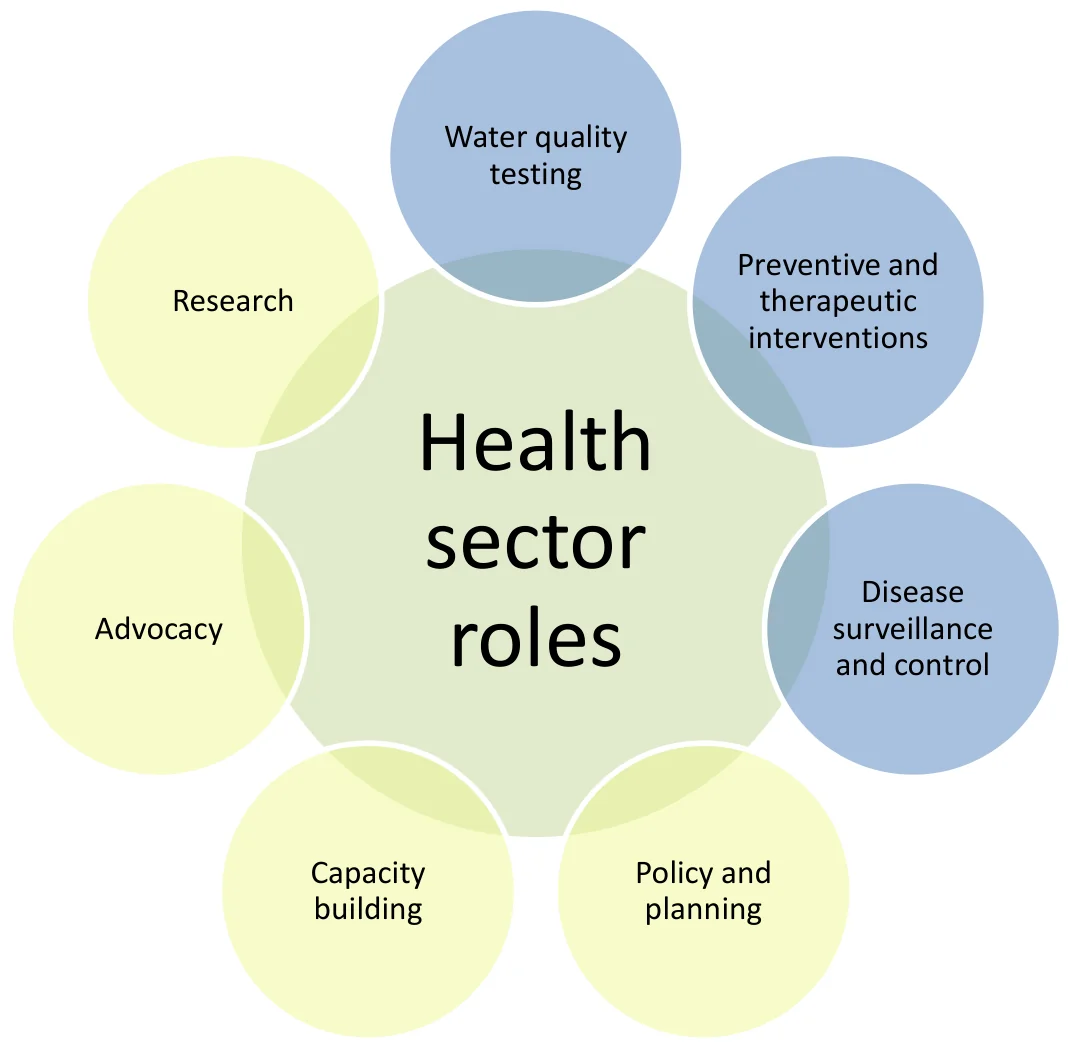
How can public health departments contribute?
The health sector can be an important partner and advocate for enabling access to safe water in villages. Considering the social justice aspects of access to safe water that we discussed earlier, the role of the government healthcare system becomes even more important. There is scope for greater involvement of public health professionals in ensuring rural water supply. We envision this involvement happening in several ways [Figure 1]. Health departments can participate in formulating policies and strategies for improving water quality. They can contribute scientific knowledge to development of guidelines and best practices for rural water supply management. They can also build local capacity, by training other functionaries in water quality management. Leveraging their connections with the community, health departments can conduct national and regional advocacy campaigns, to involve the community in decisions about water safety. They can also use various media and outreach methods to educate the public and policymakers. Lastly, health professionals can contribute by conducting research on water-related health issues. They can identify trends and inform policy decisions. They can also monitor the effectiveness of water safety programmes and interventions.
Conclusion
Despite progress in recent decades, much remains to be achieved for safe water supply in India, especially in Haryana. The effective provision and monitoring of safe drinking water in rural areas depend on a collaborative approach involving local panchayats, district administration, and public health departments. Each entity plays a distinct but complementary role in ensuring that water supply systems are well-managed, safe, and sustainable. By working together, these organisations can address the challenges of water safety and improve public health outcomes in rural communities.
Ethical considerations
This article comments on the existing public health situation in different parts of India. No human research participants were involved in this work.
Conflict of interest
The authors declare that they have no conflicting interests.
Author contributions
Arun Kumar Aggarwal: Conceptualisation; writing–original draft; writing–review and editing; supervision. Adhish Kumar Sethi: Conceptualisation; writing–review and editing; visualisation. Navneet Gupta: Writing–review and editing. Tanvi Kiran: Writing–review and editing; supervision.
All authors read and approved the final version of the manuscript for submission.
Source of funding
The authors did not receive any funding for writing this paper.
References
- UN General Assembly. Transforming our world: the 2030 Agenda for Sustainable Development [Internet]. New York: UN General Assembly; 2015 [cited 2024 Aug 2]. 35 p. Available from: https://undocs.org/en/A/RES/70/1
- Cameron DB, Ray I, Parida M, Dow WH. Product preferences and willingness to pay for potable water delivery: experimental evidence from rural Bihar, India. PLoS ONE. 2023 Apr 6;18(4):e0283892. [doi:10.1371/journal.pone.0283892]
- Majra JP, Verma RK, Kumar S. Assessment of bacteriological quality of drinking water in a rural tertiary healthcare institute of Haryana: a record-based descriptive study. JCDR. 2022 Aug 1;16(8):LC01–5. [doi:10.7860/jcdr/2022/58033.16683]
- Postgraduate Institute of Medical Education and Research, Chandigarh. Annual report 2022-23 [Internet]. Chandigarh, India: Postgraduate Institute of Medical Education and Research; 2023 [cited 2024 Oct 25] p. 1027. Report No.: 56. Available from: https://pgimer.edu.in/PGIMER_PORTAL/AbstractFilePath?FileType=E&FileName=Final%2056th%20Annual%20Report%20%20PGIMER%202022-23%20Eng%20Version.pdf&PathKey=EDITORREPOSITORY_PATH
- International Institute for Population Sciences (IIPS), ICF. National Family Health Survey (NFHS-5), 2019–21: India. Vol. 1. Mumbai: IIPS; 2022. 675 p. [Google Scholar]
- World Health Organization. Burden of disease attributable to unsafe drinking-water, sanitation and hygiene: 2019 update. Geneva: World Health Organization; 2023. 84 p. [Google Scholar]
- WaterAid. Mission-critical: invest in water, sanitation and hygiene for a healthy and green economic recovery [Internet]. New York: WaterAid; 2021 [cited 2024 Sep 9]. 59 p. Available from: https://washmatters.wateraid.org/publications/mission-critical-invest-water-sanitation-hygiene-healthy-green-recovery
- Schuster-Wallace CJ, Grover VI, Adeel Z, Confalonieri U, Elliott S. Safe water as the key to global health. Hamilton, Ontario: United Nations University International Network on Water, Environment and Health (UNU-INWEH); 2008. 28 p. [Google Scholar]
- National Human Rights Commission. Right to water [Internet]. New Delhi: National Human Rights Commission, India; c2021 [cited 2024 Sep 9]. 21 p. Available from: https://nhrc.nic.in/sites/default/files/Right%20to%20water.pdf
- Planning Commission. The First Five Year Plan: a draft outline [Internet]. New Delhi: Government of India; 1951 [cited 2024 Sep 9]. 295 p. Available from: https://www.hansrajcollege.ac.in/hCPanel/uploads/elearning/elearning_document/The_First_Five_Year_Plan.pdf
- Ministry of Water Resources. National Water Policy [Internet]. New Delhi: Government of India; 1987 [cited 2024 Sep 9]. Available from: https://www.ielrc.org/content/e8701.pdf
- Comptroller and Auditor General of India. Performance audit of Accelerated Rural Water Supply Programme - ARWSP (Ministry of Rural Development, Department of Drinking Water Supply) [Internet]. New Delhi: Comptroller and Auditor General of India; 2008 [cited 2024 Sep 9] p. 95. (Reports of 2008). Report No.: 12. Available from: https://cag.gov.in/en/old-audit-reports/view/13573
- Ministry of Rural Development, Department of Drinking Water Supply. Guidelines on Swajaldhara [Internet]. Government of India; 2002 [cited 2024 Sep 9]. Available from: https://www.ielrc.org/content/e0212.pdf
- Programme Evaluation Organisation, Planning Commission. Evaluation study on Rajiv Gandhi National Drinking Water Mission [Internet]. New Delhi: Government of India; 2010 [cited 2024 Sep 9]. 76 p. Available from: https://dmeo.gov.in/sites/default/files/2019-10/Evaluation%20Study%20on%20Rajiv%20Gandhi%20National%20Drinking%20Water%20Mission%20%28RGNDWM%29.pdf
- Department of Drinking Water Supply, Ministry of Rural Development. National Rural Drinking Water Programme: framework for implementation [Internet]. New Delhi: Government of India; 2010 [cited 2024 Sep 9]. 90 p. Available from: https://phed.cg.gov.in/sites/default/files/ruraldrinkingwater-2ndapril-0-0-0.pdf
- Comptroller and Auditor General of India. Report of the Comptroller and Auditor General of India on performance audit of National Rural Drinking Water Programme [Internet]. New Delhi: Comptroller and Auditor General of India; 2018 [cited 2024 Sep 9] p. 156. (Reports of 2018). Report No.: 15. Available from: https://cag.gov.in/en/audit-report/details/46268
- Department of Drinking Water and Sanitation. Jal Jeevan Mission (JJM) [Internet]. Ministry of Jal Shakti, Government of India; 2019 [cited 2024 Sep 9]. Available from: https://jaljeevanmission.gov.in/sites/default/files/guideline/JJM_note.pdf
- Department of Drinking Water and Sanitation, Ministry of Jal Shakti. JJM Dashboard [Internet]. 2024 [cited 2024 Sep 9]. Available from: https://ejalshakti.gov.in/jjmreport/JJMIndia.aspx
- Department of Drinking Water and Sanitation, Ministry of Jal Shakti. Jal Jeevan Mission - Water Quality Management Information System [Internet]. 2024 [cited 2024 Sep 9]. Available from: https://ejalshakti.gov.in/WQMIS/
- Paul S, Sarkhel P. Delivery of safe drinking water in rural India: an appraisal of public water supply initiatives. In: Dasgupta B, Sarkhel P, Ghosh A, Ghosh B, editors. In quest of humane development: human development, community networking and public service delivery in India. Singapore: Springer; 2022. p. 85–104. (India Studies in Business and Economics). [doi:10.1007/978-981-16-9579-7_6]
- Ghosh P, Hossain M, Sarkar S. Inequality among social groups in accessing improved drinking water and sanitation in India: a district-level spatial analysis. The Professional Geographer. 2023 May 4;75(3):361–82. [Google Scholar]
- Department of Administrative Reforms & Public Grievances. Good governance index: assessment of state of governance, GGI 2020-21 [Internet]. New Delhi: Government of India; 2021 [cited 2024 Oct 25]. 191 p. Available from: https://darpg.gov.in/sites/default/files/GGI_2021.pdf
- Central Ground Water Board. Aquifer systems of India [Internet]. New Delhi: Ministry of Water Resources, Government of India; 2012 [cited 2024 Sep 11]. 92 p. Available from: https://cgwb.gov.in/cgwbpnm/public/uploads/documents/1687419512680023437file.pdf
- Puranik R. Study of Nirmal Gram Puruskar (NGP) awarded Panchayats in Madhya Pradesh with reference to open defecation free status and water availability. In New Delhi: World Water Council; 2015. [Google Scholar]
- Wescoat JL, Shah RP, Singh R, Murty JVR. Habitations, villages, and gram panchayats: local drinking water planning in rural India with a Pune district case study. Journal of Water, Sanitation and Hygiene for Development. 2019 Sep 1;9(3):522–30. [doi:10.2166/washdev.2019.196]
- Department of Drinking Water and Sanitation. Drinking water quality monitoring & surveillance framework [Internet]. New Delhi: Ministry of Jal Shakti, Government of India; 2021 [cited 2024 Oct 6]. 127 p. Available from: https://jaljeevanmission.gov.in/sites/default/files/guideline/WQMS-Framework.pdf
- Singh R, Brahmankar R, Murty JVR, Verma P, Wescoat JL. Analyzing rural drinking water services for district planning in Maharashtra, India. Water Policy. 2020 Feb 1;22(1):37–51. [Google Scholar]
- Dinesh Kumar M, Bassi N, Kumar S. Drinking water security in rural India: dynamics, influencing factors, and improvement strategy. Singapore: Springer; 2022. 192 p. (Water resources development and management). [doi:10.1007/978-981-16-9198-0]
- Asthana AN. Decentralisation and supply efficiency: the case of rural water supply in Central India. Journal of Development Studies. 2003 Apr;39(4):148–59. [doi:10.1080/713601203]
- Public Health Engineering Department, Haryana. Organisation structure of Public Health Engineering Department, Haryana [Internet]. Public Health Engineering Department, Haryana. c2022 [cited 2024 Oct 6]. Available from: https://phedharyana.gov.in/Organisation/Organisation_Structure_of_Department
- Indian Public Health Standards 2022 [Internet]. Vol. III: Health and Wellness Centre-Primary Health Centre. New Delhi: Ministry of Health and Family Welfare, Government of India; 2022 [cited 2022 Dec 1]. 100 p. Available from: https://nhsrcindia.org/sites/default/files/PHC%20IPHS_2022_Guideline_pdf.pdf

Published
Article metrics
- Views
- 727
- Downloads
- 307
Based on this site's usage statistics.