Original Article Vol. 3 No. 1 (2019): International J of Health Systems and Implementation Research
Rising Public Interest of Hookah and E-cigarettes after Tobacco Cessation Law in India: A Google Trend Analysis
Hookah and E-cigarettes after Tobacco Cessation Law
Downloads
Topics
Keywords:
- Google trends
- COTPA
- E-cigarette
- Hookah
- Tobacco
Abstract
Introduction: Internet search query data from Google Trends (GT) have been used to assess public interest after inacting a policy. Cigarettes and Other Tobacco Products Act (COTPA),2003 may change the interest towards choice of tobacco products. In India, limited data is available on the interest of tobacco products in lieu to COTPA ,2003.Objective: To assess the impact of implementation of COTPA on public interests of tobacco products in India using Google trends from 2004 to 2018. Methodology: Using GT, monthly aggregated Google search volume in India was collected in terms of relative search volume (RSV) ranging from 0 to 100. For analysis, data was analysed in two phases 2004 to 2011 and 2011 to 2018. The RSV data was collected on tobacco products (cigarette, beedi, hookah, electronic cigarette and gutka). The trends were analysed using visual inspection. and forecast tool. Results: In India, the trend from 2004 to 2011 showed public interest was dominated by cigarettes. After the pictorial warning implementation in 2011 the trend was changed. In 2011 to 2018, showed an increasing trend in Hookah and E cigarettes. Hookah was dominated in Goa, Maharashtra, Telangana. Electronic cigarette was majorly searched in Andaman and Nicobar island, Meghalaya and Puducherry. Conclusion: There has been a changing trend of public interest for tobacco products, with rise in hookah and E-cigarette after COTPA. The rising trends may help the researchers, lawmakers and health policy officials to go into further research to improve policy in this area.
Full text
This web version was prepared from the published PDF, which is the version of record. Please cite and quote from the PDF.
Introduction
Tobacco consumption is an epidemic and a public health concern worldwide. Globally, more than 7 million people are killed every year because of tobacco. Around 80% of the 1.1 billion smokers worldwide live in low and middle income countries, where the burden of tobacco related illness and death is enormous.[1] As per the Global Tobacco Survey Adults (GATS) 2016-17 estimates for India, 28.6% adults were tobacco users, with 10.6% smokers and 21.4% smokeless tobacco users. Khaini and beedi were most commonly used tobacco products. The ‘Cigarette and Other tobacco Prevention Act’ (COTPA), was launched in 2003. After the implementation of the law, a decrease in prevalence of tobacco usage by 6% was observed.[2] Any tobacco use by men observed an increase from 46.5% in NFHS-2 to 57% in NFHS-3. However, it reportedly decreased to 44.5% in NFHS-4. Any tobacco use by women reported consistent reduction in all the three NFHS surveys: 13.8% in NFHS-2, 10.8% in NFHS-3, and 6.8% in NFHS-4. The percentage reduction in tobacco use from NFHS-3 to NFHS-4, was higher in rural areas than in urban areas, both among men (urban: 50% to 39%; rural: 61% to 48%) and women (urban: 7% to 4%; rural: 13% to 8%). Except for the four states of Meghalaya, Andhra Pradesh, Manipur and Telangana; all other Indian states reported a reduction of any form of tobacco use from NFHS-3 to NFHS-4.[3] Since the COTPA, there have been many amendments in the law pertaining to tobacco(Table 1).[4]
| Year | Tobacco cessation laws in India |
|---|---|
| 1989 | The Railways Act. It prohibits smoking if objected to by another passenger and imposes a maximum penalty of 100 Rupees. |
| 1991 | Issued pursuant to Section 5B(2) of the Cinematograph Act of 1952, required the Central Board of Film Certification to ensure that “scenes tending to encourage or glamorize consumption of tobacco or smoking” do not appear in movies. |
| 1995 | The Cable Television Networks (Regulation) Act, 1995 (Act No. 7 of 1995) (CTNA) required that all advertisements comply with a prescribed advertisement code in the 2009 CTNA Rules and prohibited direct advertising of cigarettes or tobacco products. |
| 2003 | Cigarettes and Other Tobacco Products (Prohibition of Advertisement and Regulation of Trade and Commerce, Production, Supply and Distribution) Act, 2003 (Act No. 34 of 2003) (COTPA) is the principal law governing tobacco control in India. COTPA is comprehensive, covering topics including, but not limited to: definitions of key terms; restrictions on smoking in public places; advertising, promotion and sponsorship; sales to minors; packaging and labelling; and enforcement and penalties. The Act does not apply to tobacco products which are to be exported. The law available here is in English only. The first provisions of COTPA entered into force on May 1, 2004 |
| 2008 | The Prohibition of Smoking in Public Places Rules, 2008. |
| 2009 | Substitute language regarding health warnings on retail packaging, requiring warnings to be printed on external packaging such as cartons. |
| The Cable Television Networks (Amendment) Rules, 2009, indirect advertisement and brand stretching, permitting such surrogate advertising under certain circumstances. | |
| 2010 | Substitute language on the issue of rotation, requiring that health warnings be rotated every 24 months instead of one year. The rule also re-establishes the May 2009 health warnings, ensuring that pictures of a lung x-ray and diseased lungs continue to be displayed on smoked tobacco product packages and a picture of a scorpion continues to be displayed on smokeless tobacco product packages. |
| 2011 | Food Safety and Standards (Prohibition and Restrictions on Sales) Regulations, 2011 prohibit, among other things, tobacco and nicotine from being used in any food products. Courts in several states have relied on this provision to impose bans on the manufacture, distribution, and sale of "gutka" or "pan masala". |
| Amends regulations related to the prohibition on the sale of tobacco products to and by minors. | |
| Rules for television and film including a prohibition on tobacco product placement and a requirement for health warnings when tobacco products or their use are displayed. | |
| New graphic health warnings for packages of smoked and smokeless forms of tobacco. Increase the number of warnings for smoked tobacco products from two to four, and the number of warnings for smokeless tobacco products from one to four. The new warnings became effective December 1, 2011, but were subsequently replaced by the health warnings. | |
| 2012 | Amend provisions governing the display of tobacco products or their consumption in film and television |
| 2013 | New health warnings for tobacco product packaging, effective April 1, 2013 |
| 2016 | New health warnings covering 85% of the front and back of tobacco product packaging |
| New health warnings to cover 85% of the front and back of tobacco product packaging. These Rules were to have gone into effect on April 1, 2015, but the MOHFW has issued a subsequent notification establishing April 1, 2016 as the implementation date of the new warnings | |
| 2017 | Second of the two health warnings is to be used on product packaging beginning April 1, 2017. |
| Prohibiting service in any smoking area and requiring signage with health warning | |
| 2018 | The next round of pictorial health warnings, which will be required to appear on tobacco product packaging beginning on September 1, 2018. The new health warnings will also include a Quitline phone number. |
Google is the most commonly used search engine. Google trends was started in 2004, it provides trends of the Google searches. In India, internet usage has increased tremendously and continues to grow. As the role of information technology in health care is on an increase, Google trends can be utilized for the purpose of searching the public interest in tobacco products. Data regarding public interest in tobacco products is limited even after implementation of the COTPA. Hence, this study aims to assess the trends of public interest in tobacco products after the implementation of COTPA in India, using Google trends.
Methodology
Google Trends (http://google.com/trends), a societal prospective record of search activity, calculates the relative search volume (RSV) for specific search terms. It is an open access format of data available on internet. It measures the fraction of searches that include a specific search term in a specific, user-chosen location (in this case, India) at a specific time (in this case, from January 2004 to December 2018; total of 168 months). For the purpose of analysis, the data was divided into two parts i) 2004 to 2011 ii) 2011 to 2018. The data was collected in terms of RSV i.e. relative to the total number of searches conducted at that time, normalized to a 0–100 scale (100 being highest proportion of all searches; 50 being 50% of the highest proportion). Monthly aggregated search trends originating in India were analysed. The search trends for various tobacco products like “cigarette”, “beedi”, “E cigarette”, “gutka” and “hookah” were collected. With the help of ‘related search’ the key words in Google trends were refined. Searches on these terms were screened for “India” and other synonymous terms for “water pipe” (e.g. “hookah” in Hindi language) were used. Care was taken to refine key words using the punctuations, plus and minus sign in the Google trend. Furthermore, the synonyms for the tobacco products were also corroborated with the key-words used in the Global Adults Tobacco Survey.[2]
The key words for search were “Cigarette”, “Bidi + Beedi”, “E Cigarette + Electronic Cigarette”, “Gutaka + Quid + Khaini + pan masala + betel” and “Hookah- bar + waterpipe + hukah sheesha + shisha”.
To observe the impact of tobacco-related events on public interest in tobacco products over time, on web search, projections of RSV were interpreted as the higher impact point. Thus, high spikes were detected by visual inspection, and RSVs ranging from 0 to 100 were evaluated as continuous values. Using those values with spikes, we evaluated possible relationships between the RSV and tobacco control measures in India. In addition to the non-statistical method of visual inspection f, to forecast the trends for next 5 years (60 months) the data was analysed in Excel with help of a forecasting tool.
Results
Trend analysis shows that there has been an increasing search trend towards hookah and e- cigarettes as compared to search for cigarettes after COTPA implementation.
In 2011, a major change was brought in the law for graphic health warnings on the tobacco product. For the purpose of analysis the time trend was therefore split in two phases from 2004 to 2011 and 2011 to 2018.
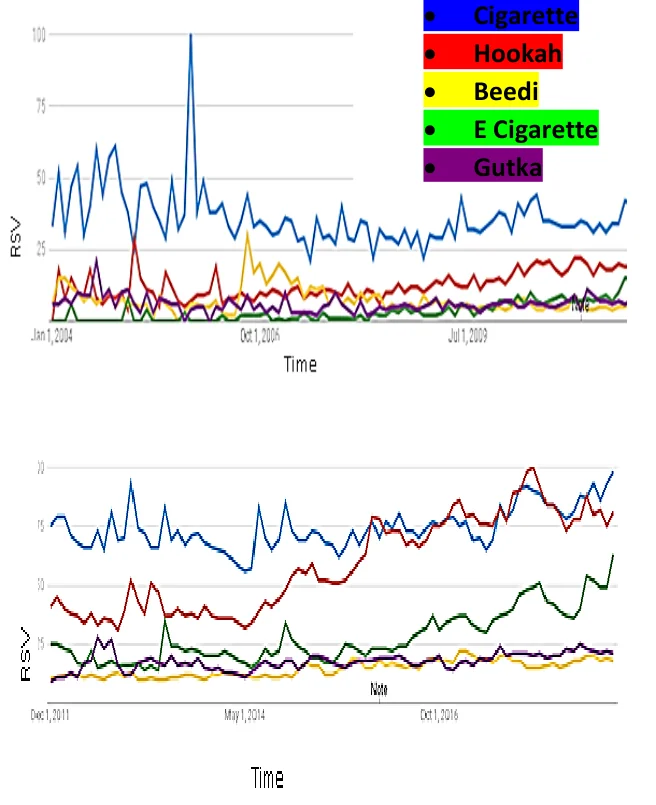
After implementation of COTPA (2003), the time trend from 2004 to 2011 showed a steep rise of public interest in cigarettes with a peak in November 2005 but stabilized in the year 2006, and remained the same till the 2011(Figure Ia). The trend for rest of the tobacco products remained insignificant but in Febuary 2005 a peak can be seen for hookah, and in October 2006 a peak was observed for beedi.
In 2016, the law observed that 85% the packaging of the tobacco products should show ill effects of the tobacco consumption. After 2011, especially in 2016, the internet query saw a steep rise in the hookah and electronic cigarette. (Figure Ib)
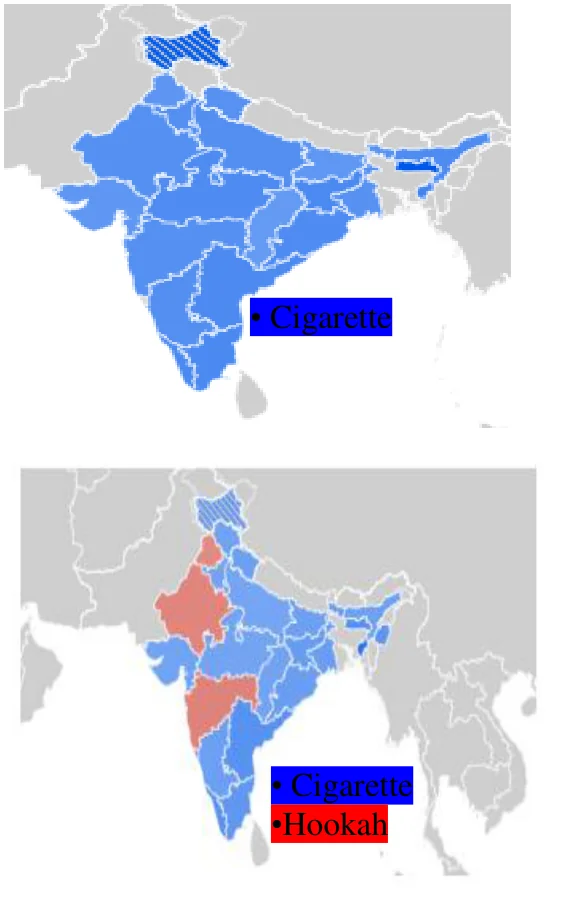
On sub-region analysis, from 2004 to 2011 the top internet queries for cigarettes were found in Tripura (100), Puducherry (70), Uttarakhand (63), and Chhattisgarh (60). Hookah was searched in Uttarakhand (32), Odisha (29), Maharashtra (26), Chandigarh (26), Assam (26). Electronic cigarettes were searched in Jammu & Kashmir (47), Puducherry (30), Andhra Pradesh (15), Kerala (15), and Tamil Nadu (14). Beedi was searched in Bihar (32), Chhattisgarh (13), Karnataka (10), Gujarat (9), and Assam (8). Gutka was searched in Bihar (32), Madhya Pradesh (14), Punjab (14), Uttar Pradesh (14), and Gujarat (12). (Figure IIa).
A major change was seen in the internet query on sub-region analysis from 2011 to 2018. The top internet queries for cigarettes were found in Puducherry (73), Tripura (73), Kerala (51), Andhra Pradesh (49), and Meghalaya (47). Hookah was searched in Goa (39), Maharashtra (37), Telangana (36) Rajasthan (35), and Uttarakhand (33). Electronic cigarette was searched in Andaman and Nicobar Island (100), Meghalaya (27), Puducherry (27), Tripura (27), and Goa (22). Beedi was searched in Bihar (17), Himachal Pradesh (11), West Bengal (11), Madhya Pradesh (11), and Kerala (8). Gutka was searched in Punjab (22), Chandigarh (20), Assam (14), Uttar Pradesh (14), and Bihar (13). (Figure IIb)
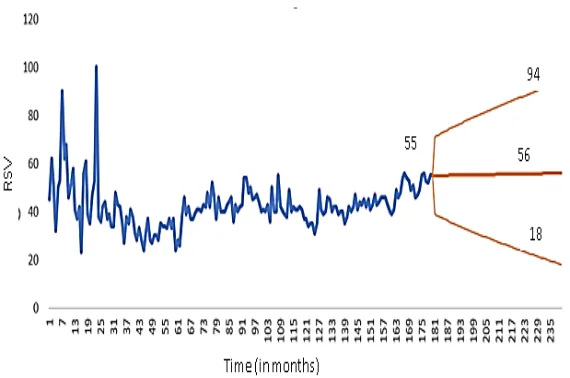
Forecast analysis shows a nearly stationary trend for cigarette with 55 RSV at December 2018 and 56 (95% CI 94-18) in next 5 years. (Figure IIIa)
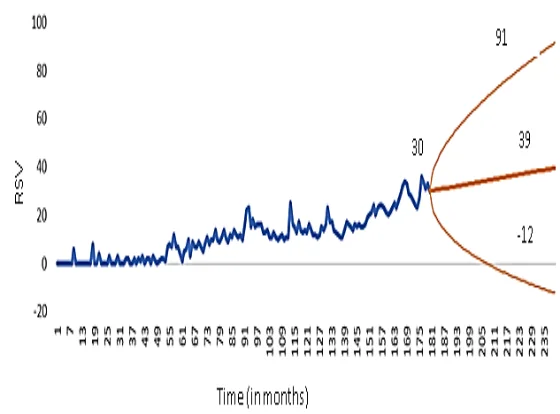
Forecast analysis shows an increasing trend for cigarette with 30 RSV at December 2018 and 39 (95% CI 95-12) in next 5 years. (Figure IIIb)
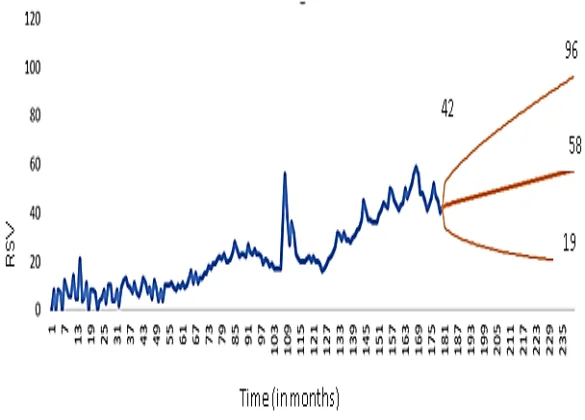
Forecast analysis shows an increasing trend for cigarette with 42 RSV at December 2018 and 58 (95% CI 96- 19) in next 5 years. (Figure IIIc)
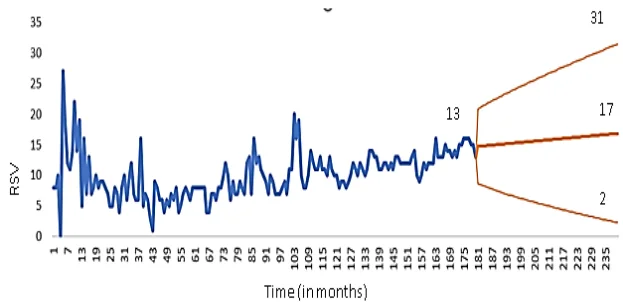
Forecast analysis shows an increasing trend for cigarette with 13 RSV at December 2018 and 17 (95% CI 31-2) in next 5 years. (Figure IIId)
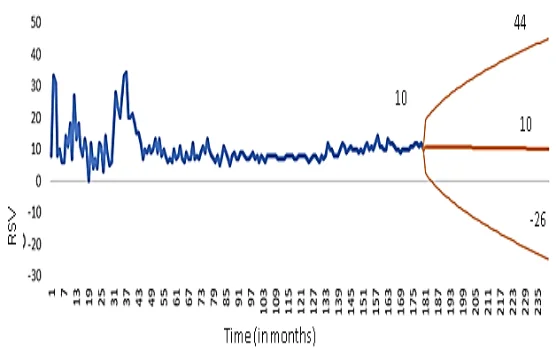
Forecast analysis shows a stationary trend for cigarette in the next five years with a 10 RSV (95% CI 44 - -26). (Figure IIIe)
Discussion
Summary of Findings
The study highlights that the search trend for cigarette remained stable till December 2018. However, there has been a significant rise of the public interest in hookah and E cigarettes. Hookah search dominated in Goa, Maharashtra, and Telangana. Electronic cigarette was majorly searched in Andaman and Nicobar Island, Meghalaya and Puducherry. The forecast showed an increasing trend in hookah and E-cigarettes in the coming 5 years.
Interpretations
The study shows an increasing trend of popularity of hookah which is in line with global scenario, wherein hookah has become a public health problem. Developing surveillance, interventions and regulatory/policy frameworks specific to the waterpipe has become a public health priority.[5]
In India, a study of Haryana where hookah smoking on a daily basis was reported among 37.7% participants and 44.7% amongst them smoked hookah in hookah cafés, shows similar conclusions to the present study.[6] Studies also show a connection between smoking cigarette and hookah among health professionals.[7,8] The possible increase in the Hookah popularity could be due to the notion that as the smoke passes through water it becomes less irritant and toxic but the World Health Organization (WHO) committee on Tobacco Product Regulation has refuted these claims stating that the amount of smoke inhaled in a single hookah session often surpasses that from a single cigarette, and that hookah smoking contains the same harmful substances.[9]
Earlier studies with participants from Egypt, Israel and Syria, reported ignorance of health hazards among users, as hookah smoking was considered less harmful than cigarette smoking.[10,11,12]According to reports by Ward et al. and Smith-Simone et al., many hookah smokers do not see themselves as addicts, and there is a common perception among hookah users that they can quit whenever they want and in this study 63.3% reported that they are hooked to hookah.[13] Another study documented that most of people learned about hookah from friends (63.2%), usually smoked hookah in hookah lounges (85.5%) and there was a belief that hookah was safer and more socially acceptable than cigarettes.[14]
In India, as per the COTPA, any form of tobacco smoking in public places including restaurants, hotels recreational centres, etc., is banned. Currently, there is a ban on hookah parlours in in several cities of India. However, tobacco vendors sell easy to assemble hookah water pipes to be assembled at home for convenient use, encouraging hookah smoking.[14]
E cigarettes have been shown to be popular in the western countries. In India however, only big metropolitan cities share such interest. This may be due to ‘cool image’, perceived less harmful effect, better affordability of the people in metro cities.[15]
The use of Google trends shows the public interest of the country as a whole, something which has not been done before. The use of this technology for the purpose is an innovation in itself. However, data gathered is restricted and trends can be gathered only from people having access to internet, those who have utilized Google search engine. As in India, the access to internet and Google, in lower socioeconomic status is limited; the popularity of beedi seems to have been underestimated. This can be considered as a limitation of the study.
Conclusions
The trends show an increasing popularity of the hookah and E cigarette as compared to other tobacco related products. This trend generates a hypothesis that public interest may lead an increase in usage as well. However, further research is required to validate the hypothesis. Nevertheless, the strengthening of educational programs against all forms of tobacco including hookah and E cigarettes, with emphasis to catch them young by focussing on in schools and colleges, may show long-term benefits. Immediate prioritization to sensitize young adults through evidence based policy, strict and vigilant enforcement of the COTPA will further facilitate a healthier, tobacco-free lifestyle in young adults.
Conflict of Interest
None
Acknowledgement
None
References
- WHO. Tobacco [Internet]. Who.int. 2019 [cited 5 May 2019]. Available from: http://www.who.int/en/news-room/fact-sheets/detail/tobacco
- Tata Institute of Social Sciences (TISS), Mumbai and Ministry of Health and Family Welfare, Government of India. Global Adult Tobacco Survey GATS 2 India 2016-17. 2019 Available from : http://www.tiss.edu/view/11/research-projects/global-adult-tobacco-survey-round-2-for-india-2016/
- Mini GK, Thankappan KR. Trends in tobacco use among Indian adults 1998 - 99 to 2015 - 16: results from nationally representative data of the national family health surveys. Tob. Induc. Dis. 2018;16(Suppl 1):A21 Available from :http://www.ijncd.org/article.asp?issn=2468-8827;year=2017;volume=2;issue=2;spage=30;epage=35;aulast=Pandey
- India Details | Tobacco Control Laws [Internet]. Tobaccocontrollaws.org. 2019 [cited 5 May 2019]. Available from: https://www.tobaccocontrollaws.org/legislation/country/india/laws
- Maziak W. The global epidemic of waterpipe smoking. Addictive Behaviors. 2011;36(1-2):1-5. [doi:10.1016/j.addbeh.2010.08.030]
- Bali E, Chinmaya BR, Chand S, Tandon S, Prasad S, Sahu D, et al. An emerging trend: Hookah smoking among youth smokers in Gurgaon, Haryana. J Indian Assoc Public Health Dent 2015;13:244-9 [doi:10.4103/2319-5932.165240]
- Maziak W, Eissenberg T, Rastam S, Hammal F, Asfar T, Bachir ME et al. Beliefs and attitudes related to narghile (waterpipe) smoking among university students in Syria. Ann Epidemiol 2004;14:646-54 [doi:10.1016/j.annepidem.2003.11.003]
- Khan N, Siddiqui MU, Padhiar AA, Hashmi SA, Fatima S, Muzaffar S. Prevalence, knowledge, attitude and practice of shisha smoking among medical and dental students of Karachi, Pakistan. J Dow Univ Health Sci 2008;2:3-10. [Google Scholar]
- World Health Organization. Waterpipe tobacco smoking: Health effects, Research needs and Recommended action by regulators. Geneva, Switzerland: WHO Study Group on Tobacco Product Regulation (TobReg); 2005 [Google Scholar]
- Varsano S, Ganz I, Eldor N, Garenkin M. Water-pipe tobacco smoking among school children in Israel: Frequencies, habits, and attitudes. Harefuah 2003;142:736-41, 807. [Google Scholar]
- Israel E, Loffredo C, El-Setouhy M, Mohamed MK. Egyptian Smoking Prevention Research Institue (ESPRI). J Egypt Soc Parasitol 2003;33:1009-17. [Google Scholar]
- Ward KD, Eissenberg T, Rastam S, Asfar T, Mzayek F, Fouad MF, et al. The tobacco epidemic in Syria. Tob Control 2006;15 Suppl 1:i24-9. [doi:10.1136/tc.2005.014860]
- Ward KD, Eissenberg T, Gray JN, Srinivas V, Wilson N, Maziak W. Characteristics of U.S. Waterpipe users: A preliminary report. Nicotine Tob Res 2007;9:1339-46. [doi:10.1080/14622200701705019]
- Vishal K, Anand N, Sushma K, Nupur N, Anand N. Hookah use among high school children in an Indian city. Journal of Indian Society of Pedodontics and Preventive Dentistry. 2013;31(3):180. [doi:10.4103/0970-4388.117980]
- McMillen R, Gottlieb M, Shaefer R, Winickoff J, Klein J. Trends in Electronic Cigarette Use Among U.S. Adults: Use is Increasing in Both Smokers and Nonsmokers. Nicotine & Tobacco Research. 2014;17(10):1195-1202. [doi:10.1093/ntr/ntu213]
Published
Article metrics
- Views
- 1,769
- Downloads
- 1,400
Based on this site's usage statistics.
Issue
Section
How to Cite
More in this topic: NCDs & mental health
View Point · 2025
From Screens to Sips: Social Media's Impact on Adolescent Alcohol Use