Case Studies Vol. 1 No. 1 (2017): Int J Health Systems and Implementation Research
Home delivery, a journey on dark side of the road from womb to tomb: A case study in Tangi- Odisha (India)
Home delivery a journey on dark side of the road
Downloads
Topics
Keywords:
- Home Delivery
- Spina Bifida
- Health Care Utilzation
- Infant Mortality
- Health Seeking Behaviour
Abstract
Worldwide, every year nearly 300,000 women die due to reasons related to pregnancy and child birth, with India being the largest contributor. Significant steps have been taken to strengthen the health care delivery system. Despite of these, pregnant woman in India continue to die due to factors ranging from poverty to ineffective or inaccessible health services. Through this case report we try to uncover some of the factors, responsible for home delivery, and non-utilisation of essential maternal & child health services, in spite of a family experiencing continued poor health outcomes. Nisha (named changed) mother of six living children underwent four home deliveries and two of her youngest children expired during the infancy period owing to congenital birth defects. Conditional cash transfers, free ambulance service for to and fro transfers around delivery, availability of incentivised ASHAs, are some of the steps to ensure institutionalised deliveries but its availability and utilisation varied from place to place. We hope that this case study will help the concerned stakeholders to view these problems more holistically and initiate corrective measures to curb corruption, ensure availability of right information to patients and the health system, at the right time, while seeking care and thus ensure larger health gains in the near future.
Full text
This web version was prepared from the published PDF, which is the version of record. Please cite and quote from the PDF.
Introduction
Worldwide, every year nearly 300,000 women die due to reasons related to pregnancy and child birth, with India being the largest contributor [1]. The global target to restrict maternal death is set at 140 for every 100,000 child births [2]. India appears to have made significant progress in reduction of maternal mortality ratio (MMR) since the implementation of RCH programme i.e. from 398 in 1997-1998 to 167 in 2011-2013 (sample registration system, SRS-2013). But, this average hides a wide range of disparity within its constituent states ranging from as good as 9 in Kerala to as poor as 300 in Assam [3].
Risk of death during prenatal, natal and postnatal period is high, but parturition carries highest importance as interventions during this phase can avert two thirds of maternal deaths [2]. This is possible if maternal deliveries take place in health facilities under the supervision of skilled manpower. Government of India launched National Rural Health Mission (NRHM) almost a decade ago to improve maternal and child mortality [4]. Significant steps were taken to strengthen the health care delivery system like creation of cadre of Accredited Social Health Activist (ASHA) to bridge the gap between provision and utilization of health care services, a conditional cash transfer scheme to provide financial assistance to women undergoing institutional deliveries, provision of dedicated ambulance services to pregnant women etc.
Despite of these measures, pregnant woman in India continue to die due to factors ranging from poverty to ineffective or inaccessible health services [5]. Even though 90% of pregnant woman receive some form of antenatal check-up, still one in four women undergo home delivery [3,6].
Home delivery is an indicator of poor service utilisation. Poor service utilisation means high chances of poor maternal and child health indicators, particularly increased risk of mortality among mother and child due to unforeseen complications and lack of facilities to tackle the same. Odisha, is one of the worst performing state in India with respect to all maternal & child health indicators. MMR of Odisha is higher than the national average at 222 per 100,000 live births and nearly 30% births take place at homes [7]. Through this case report we try to uncover some of these factors, responsible for home delivery and non-utilisation of essential maternal & child health services, in spite of the family having experienced continued poor health outcomes.
Case study
Home delivery: The first information report (FIR) by ASHA
Odisha, one of the states in eastern India, has 30 districts and 310 blocks. Each block is further divided into sectors. There is a district hospital, community health centre (CHC) at block level, primary health centre (PHC) at sector level. This study was carried out in Bhusandapur village of Bhusandapur sector within the Tangi block of Khorda district.
We are a central institute and health is a state subject. So, we have been allowed to access and utilize the field practice area of Tangi block for regular teaching and training of our undergraduate MBBS and nursing students. The health care service delivery is primarily the responsibility of the State government. During a routine visit to this village to reorient medical students in community health and development, we were informed by the village ASHA about a family that resorted to home deliveries consistently in spite of repeated counselling against it.
First Encounter
We investigated the case to find out the reasons for such a practice. We carried out in-depth interviews of adult family members available in the house, the local health worker (ASHA), neighbours, to gain deeper understanding in the case. This was a joint family with thirteen members i.e. five adult members and eight children. The index case, women named Nisha (name changed- means dark night) who had recently delivered at home, her husband was a fisherman by occupation. Mother in law was the head of the family. They belonged to low socio-economic status and due to job compulsion; her husband remained away from the home throughout the year. Nisha had seven pregnancies and had six living children (4 males and 2 females) at the time of the first interview. Her fifth child (male) had spina-bifida. Examination revealed developmental delays (gross motor and language) and grade III malnutrition (IAP classification) (Photograph 1B). The youngest child (male) still a neonate during our visit, also had similar congenital malformation at birth (Photograph 1A). On examination, Nisha appeared to be malnourished with severe anaemia. We counselled her as well as the family members about their condition and motivated them to seek care at our government tertiary health facility (public sector) which was 55 km away from the village with assurance of providing all necessary support and free services. We took this opportunity to sensitize them about the family planning (FP) and specifically motivated the health worker to take special care regarding this.

Second Encounter
Since we had not heard from the family for nearly a month, we paid second visit to their home, a month later to inquire about the health status of both Nisha and her children. But, by then her youngest child had died at the age of one and half month. The family tried to hide this information from us. Details were told by her neighbours. ASHA wasn’t even aware of the infant death until this time. Subsequently, few months later, the fifth child who had similar birth defect was also reported to have died. A total of 2 contacts weren’t sufficient to motivate the family to seek health care. The question was why? The story is summarized below based on the information obtained from different sources during these encounters.
Nisha’s story
She was 37 years old, with primary education, married at the age of 19 years. Her first delivery took place at home at the age of 20. The child didn’t survive for long, exact reasons were not known. Next two deliveries were institutional. At this stage she did try to use some OCPs as birth control measures but soon discontinued its usage due to some side effects and there was no alternate method used. Subsequently she delivered four more children, all at home and this was after the launch of National Rural Health Mission in 2005. Her mother-in-law was a traditional birth attendant who favoured institutional deliveries by virtue of her training and experience with other couples. Nisha was aware of financial incentives, free transport facilities to promote institutional deliveries, but felt that it wasn’t sufficient. She believed that free services were a myth, as corruption was rampant to access health services based on her previous experience while seeking treatment to her sick child (oldest) in a state run medical college. So, her poverty prevented her from accessing so called free services. Alternately, she had access to her father, a traditional healer for any minor illnesses. All these had motivated her to experiment with home deliveries. As there was no fatal outcome, it reinforced her belief that institutional care was not really needed. Above all she dreaded painful procedures and lack of privacy at such facilities. So last four pregnancies ended up with home deliveries. Consequently, she didn’t access antenatal check-ups, avoided tetanus toxoids and didn’t respond to ASHAs persuasion to attend health facilities for continued care. As there was no intake of IFA tablets, perhaps she became folate deficient with time. Her last two children had spina bifida birth defects. She along with her husband visited a hospital for seeking care for her older child with the birth defect but again experienced delays, rude behaviour, high out of pocket expenditure, and corruption for availing speedy services. All these further strengthened their belief and prevented the family from utilising any government health services, and so also resisted interaction with ASHA at their home. They expected ASHA to provide free drugs/ services, which she was often unable to provide due to issues with the supply chain management of essential drugs for minor illnesses. Inadequacies in local health system had further demotivated the family. Though Nisha’s mother-in-law was the head of the family, and a trained birth attendant, still she couldn’t influence their health seeking behaviour. Nisha’s husband took all the major health related decisions based on his beliefs and past experiences.
ASHA’s version
The ASHA, was a young female of 27 years and had been working in the said village for last 5 years. She found Nisha’s family a difficult one to deal with as they always found a way to avoid her. Nisha’s husband abused alcohol and often invited fights with the neighbours. This had also isolated the family within their own community. So, a clear lack of social support was evident. He never gave importance to her counselling. Corruption was not an issue for not accessing health care, but lack of knowledge regarding health benefits of hospital delivery, their resistance to seek support from her were perhaps the main reasons.
In fact, the counter argument put forth by Nisha was that only if she had the evidence of harm during the process of home delivery would she be convinced in favour of institutional delivery. The ASHA also reported that the couple were not willing to accept family planning advice as the coupled feared operation and the husband was unwilling for any temporary measures.
Our response
During our second visit the older baby with birth defect was still alive. We realised that dwindling faith, poor economic conditions, lack of public transport were some of the barriers in availing services for the deceased child. Though the neuro- and paediatric surgeons were willing to operate, the chances of survival weren’t good due to delayed presentation in case of older child and the decision to undergo operation had to be made by the family members. Had they reported earlier the youngest child would have survived.
So, we decided to co-ordinate with the Rashtriya Bal Swasthya Karyakram (RBSK) team at CHC Tangi. RBSK is a recently initiated national program that envisages Child Health Screening for 30 conditions including birth defects and Early Intervention Services, a systemic approach of early identification and link to care, support and treatment. There were only two RBSK teams with four members required to implement this programme in 167 villages and all the schools covering a population of 1.6 lakhs in Tangi. Unfortunately, as per the micro plan, the first scheduled visit for screening based on the availability of resources to this particular village was slated in February 2017. We personally communicated to the concerned doctor, who responded positively, to facilitate referral transport to the surviving child. The response was perhaps delayed, and the child succumbed before help would reach.
Discussion
This is a sad story of two children born with birth defects at home, unable to access health care, who finally succumbed to their disease leaving mother emotionally fragile, sick and family entangled in the spirals of poverty and ill-health.
This case study has helped us identify a number of social factors and those within the health system that prevented the family from utilizing health services and ultimately resulted in poor maternal & child health outcomes which has been summarized in figure 1.
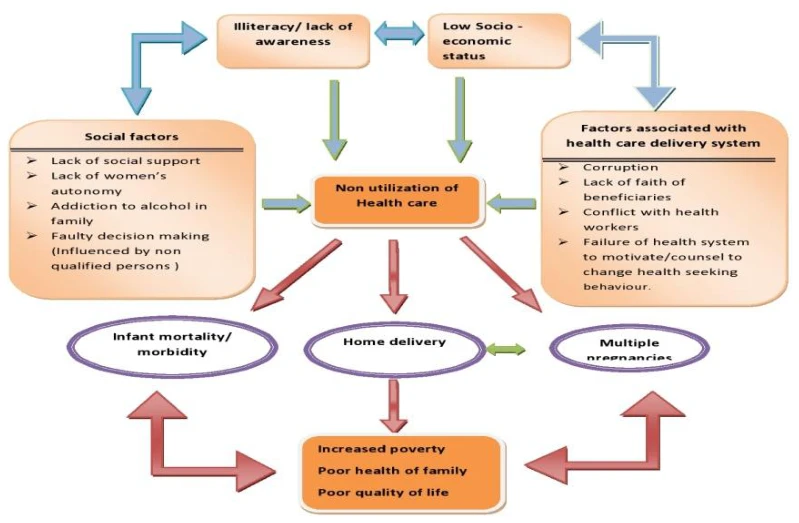
Conditional cash transfers, free ambulance service for to and fro transfers around delivery, availability of incentivized ASHAs, are some of the steps undertaken to ensure institutionalized deliveries and provision of quality maternal and child health care services between conception and first five years of new-born’s life. This does help prevent poor outcomes. But its availability and utilization varies from place to place.
Research has shown that women continue to deliver with the same provider and in familiar settings if they had positive experiences. So those comfortable with home deliveries continue to do so [8,9]. However, if they experience abusive language, sense of intolerance within the health care providers, they are likely to avoid such settings subsequently [10,11]. Corrupt practices in public sector promote inequities, as poor cannot afford so called free services [12].
Some of the other reasons for non-utilization of incentivised access to institutional delivery include fear of procedures and health care providers, rising out-of-pocket expenses in poorly managed public facilities, and extreme poverty among health care seekers [13].
Public health care system in India is crippled by shortage of trained health personnel, inadequate infrastructure, insufficient supplies, corruption, and rude behavior of health care professionals while private sector is urbanized, expensive and not easily accessible to poor people. Thus, ability to pay also determines utilization of maternal health services [14,15].
Knowledge about risk involved in child birth, felt needs etc. are important determinants of choice of place of delivery. Mother’s education, educational messages and counselling by health workers play a significant role [16,17].
Women’s autonomy, ability to take informed decisions, control over material resources to pay for any expenses would determine her mobility and choice of place of delivery. It is often noticed that in our society male members or mother-in-law take these decisions [18]. Somewhere, the health system failed to renew faith in the family in accessing maternal health care services. Even though it could not avoid home deliveries, at least antenatal care, IFA supplementation could have been provided at home. Lack of family planning, lead to large family. Thus, precipitating poverty and ill-health especially in mother and her children. Alcohol abuse indirectly plunged the family into social and economic isolation and this too was not properly addressed. System further failed to intervene early and provide essential services to both the children born with birth defects, thus leading to avoidable waste of human life.
This case study could very well serve as an important eye opener to understand the woes of our present health care delivery system. We hope that this stimulates the concerned authorities to initiate corrective measures especially in areas of corruption and availability of right information to patients and the health system, at the right time, while seeking care and thus ensure larger health gains in the near future.
References
- World Health Organisation, UNICEF, UNFPA, The World Bank. Trends in maternal mortality: 1990 to 2013. WHO, UNICEF, UNFPA and The World Bank estimates. 2014. [Internet] Geneva: World Health Organisation.2015 [cited 2016 May 15]. Available from: http://apps.who.int/iris/bitstream/10665/112682/2/9789241507226_eng.pdf
- Chou D, Daelmans B, Jolivet RR, Kinney M, Say L; Every Newborn Action Plan(ENAP) and Ending Preventable Maternal Mortality (EPMM) working groups. Ending preventable maternal and newborn mortality and stillbirths. BMJ. 2015 Sep 14;351: h4255. doi: 10.1136/bmj.h4255. PubMed PMID: 26371222
- Office of the Registrar General, India, Ministry of Home Affairs, Govt. of India. SRS statistical report 2013.[Internet]. New Delhi. [Cited 2015 Sep 26]. Available from: http://www.censusindia.gov.in/vital_statistics/SRS_Reports_2013.html.
- Government of India. Ministry of Health & Family Welfare (2005). National rural health mission: Mission document. [Internet]. New Delhi, Government of India; 2005: 1-17. [cited 2016 March 15].Available from: http://jknrhm.com/Guideline/Frame_Work.pdf
- Rai RK, Tulchinsky TH. Addressing the sluggish progress in reducing maternal mortality in India. Asia Pac J Public Health. 2015; 27(2):NP1161-9. doi: 10.1177/1010539512436883. PMID:22308538
- National Health Mission. Ministry of Health & Family Welfare, Government of India. 2015. [Internet] [cited 2015 Sep 26]. Available from: http://nrhm.gov.in/nrhm-components/rmnch-a/maternal-health/background.html
- National Health Mission. Department of Health & Family Welfare. Government of Odisha. [Interment]. [Cited 2015 August 30].Available from: http://www.nrhmorissa.gov.in/frmhealthStatistics.aspx
- Duong DV, Binns CW, Lee AH: Utilization of delivery services at the primary health care level in rural Vietnam. Soc Sci Med 2004, 59(12):2585-95. doi:10.1016/j.socscimed.2004.04.007. PMID: 15474211.
- Griffiths P, Stephenson R: Understanding users' perspectives of barriers to maternal health care use in Maharashtra, India. J Biosoc Sci 2001, 33(3):339-59. PMID:11446398. [doi:10.1017/s002193200100339x]
- Mrisho M, Schellenberg JA, Mushi AK, Obrist B, Mshinda H, Tanner M, Schellenberg D. Factors affecting home delivery in rural Tanzania. Trop Med Int Health. 2007 Jul; 12(7):862-72. doi:10.1111/j.1365-3156.2007.01855.x. PMID: 17596254.
- Choudhury N, Ahmed SM. Maternal care practices among the ultra poor households in rural Bangladesh: a qualitative exploratory study. BMC Pregnancy Childbirth. 2011 Mar1;11:15.doi: 10.1186/1471-2393-11-15.PMID:21362164, PMCID: PMC3056829.
- Chattopadhyay S. Corruption in healthcare and medicine: Why should physicians and bioethicists care and what should they do? Indian Journal of Medical Ethics. 2013; 10(3):154-59. [doi:10.20529/ijme.2013.049]
- Centre for Operation research and training. Assessment of ASHA and Janani Suraksha Yojana in Orissa. [Internet]. UNFPA, New Delhi. [cited 2016 March 15]. Available from: http://www.cortindia.in/RP%5CRP-2007-0303.pdf
- Hussain, Z. Health of the national rural health mission. Economic & Political Weekly.2011; 46: 53-60. [Google Scholar]
- Mohanty S, Srivastava A. Out-of-pocket expenditure on institutional delivery in India. Health Policy and Planning.2013; 28:247-62. DOI:10.1093/heapol/czs057,PMID: 22709923
- Stekelenburg J, Kyanamina S, Mukelabai M, Wolffers I, van Roosmalen J: Waiting too long: low use of maternal health services in Kalabo, Zambia. Trop Med Int Health 2004, 9(3):390-8. doi: 10.1111/j.1365-3156.2004.01202.x, PMID:14996369.
- Gage A J: Barriers to the utilization of maternal health care in rural Mali. SocSci Med. 2007; 65(8):1666-82. doi: 10.1016/j.socscimed.2007.06.001, PMID:17643685
- Gabrysch S, Campbell OM. Still too far to walk: literature review of the determinants of delivery service use. BMC Pregnancy Child birth. 2009 Aug 11;9:34. doi: 10.1186/1471-2393-9-34., PMCID: PMC27446
Published
Article metrics
- Views
- 1,476
- Downloads
- 1,032
Based on this site's usage statistics.