Policy Debate Vol. 4 No. 2 (2020): International J Health Systems and Implementation Research
A Narrative Review of Testing Recommendations for COVID-19: The Changing Scenarios
Downloads
Topics
Keywords:
- COVID-19, n-COV, Asymptomatic cases, Testing strategies
Abstract
The novel coronavirus infection (COVID-19) has affected millions of people, globally. India ranks among the worst affected countries. As the pandemic progresses, the risk of asymptomatic transmission is largely debated. Such transmission may lead to additional loss in terms of healthcare settings, that are already facing shortage of healthcare workers (HCWs) due to quarantine protocols or COVID-19 infection. We reviewed the evolving guidelines for testing specified by the apex Indian (Ministry of Health and Family Welfare recommended - ICMR guidance), and major international (World Health Organization -WHO, and Centers for Disease Control and Prevention -CDC) agencies; with focus on asymptomatic HCWs. We observed that in early directives, the organizations had unanimously emphasized testing of symptomatic cases. With the progression of the pandemic however, the guidance has intensified and suggests testing of asymptomatic contacts as well. This holds true for CDC and ICMR. WHO and CDC being global organizations suggest countries to test as per local conditions and diagnostic capacity. In India, ICMR has expanded testing directive to include asymptomatic direct high-risk contacts. Premier medical institutes of the country also reported ICMR guidelines on their websites. Despite the international directive being adjustive to local conditions, ICMR has reinforced testing directive to include vulnerable asymptomatic persons. The Indian testing strategy thus addresses the concern of asymptomatic transmission among HCWs.
Full text
This web version was prepared from the published PDF, which is the version of record. Please cite and quote from the PDF.
Background
By the mid of August 2020, the novel coronavirus (2019-nCoV) infection, widely known as COVID-19, affected over 21 million persons, and caused 755,786 deaths, globally. With over 2.5 million cases and 49,036 deaths, India ranks third among the countries affected by the COVID-19 pandemic [1].
Preliminary evidence and public advisories regarding COVID-19 infection identified a range of symptoms like influenza and acute respiratory illness. Later, it was found that not all confirmed COVID-19 cases show symptoms. One of the earliest evidences on asymptomatic COVID-19 positive cases was reported from the Diamond Princess Cruise ship, wherein almost 48% of those testing positive were reportedly asymptomatic [2]. Thereafter, while early data suggested that around 80% of those infected by the virus are either asymptomatic or show mild symptoms [3], the risk of disease transmission through asymptomatic cases has however been largely debated.
The World Health Organization (WHO) defines asymptomatic transmission as, “transmission of the virus from a person, who does not develop symptoms” [4]. Until early April 2020, the WHO did not find any documented evidence on asymptomatic transmission. Although, the organization did not negate the possibility (of asymptomatic transmission) either [4]. In an early scientific brief regarding modes of transmission of COVID-19 virus also, the asymptomatic mode of transmission remained unhighlighted [5]. However, in a press briefing held on June 8, 2020, the technical lead from WHO acknowledged asymptomatic transmission, though specifying it as ‘very rare’ [6]. A later update to the scientific brief on modes of transmission reported that infected persons who do not have symptoms can infect others. The document also noted that some persons who transmit the virus at a time when they are asymptomatic may themselves develop symptoms at a later stage. It is thus difficult to ascertain the actual share of asymptomatic infection [7]. A systematic review that found the proportion of asymptomatic COVID-19 cases to be 16% also noted certain limitations due to deficits in included studies [8].
Evidence on asymptomatic transmission in the healthcare settings has also remained varied. In certain settings all exposed healthcare workers (HCWs) [9], and all asymptomatic HCWs [10] caring for COVID-19 patients were found negative on real-time reverse-transcriptase polymerase chain reaction (rRT-PCR). These findings raise a question to aggressive blanket quarantine protocols for exposed HCWs, which limit the active healthcare workforce dealing with the pandemic. It has thus been suggested to opt for alternatives to such quarantine practices, especially in areas at higher-risk of transmission dealing with staff inadequacy [11]. Certain studies on the other hand have reported otherwise [12,13]. In a recent screening-based study, 3% HCWs in an asymptomatic cohort tested positive for COVID-19. Although, among these only 0.5% were truly asymptomatic, while, the rest developed certain symptoms a week before or after the day of testing [12]. A study based in India also reported asymptomatic COVID-19 positive HCWs, 10 out of a total of 920 asymptomatic HCWs tested positive for COVID-19 [13].
HCWs are essential to COVID-control strategies, especially in terms of critical care. Their nature of work however places HCWs at an unavoidable risk of COVID-19 infection [14]. As most healthcare systems are facing staff shortage due to extended quarantine protocols or staff getting infected with the virus; additional precautions need to be in place to avoid further loss. Though the extent of asymptomatic transmission as well as its implications in healthcare settings remain unclear, healthcare settings cannot negate the possibility of such transmission without adequate screening or testing of exposed asymptomatic HCWs. Furthermore, there is a need to generate further evidence regarding asymptomatic mode of disease transmission in the context of COVID-19 [7]. It is thus plausible to study the extent to which current screening and testing strategies in healthcare settings address the issue of asymptomatic transmission.
We reviewed guidance on testing criteria for COVID-19 with special emphasis on recommendations for HCWs. The websites of WHO, Centers for Disease Control and Prevention (CDC); Indian Council of Medical Research (ICMR) and Ministry of Health and Family Welfare (MoHFW), Government of India (GoI); and two national medical institutes were searched for guidance and directives regarding testing criteria to be employed.
Recommendations on testing criteria for COVID-19
Indian Council of Medical Research (ICMR)
In India, the MoHFW, GoI has appointed ICMR as the apex body for issuing guidance pertaining to management of COVID-19. The organization has played an instrumental role in developing guidelines for testing for COVID-19. In a country like India, which has limited resources, it is essential to rationalize testing by clearly defining the testing criteria. Indiscriminate testing may overburden the health systems and may introduce panic. Also, there is a possibility that those who have high chances of testing positive are missed out, and the opportunity to break the chain of transmission is compromised.
The first version of the guidelines laying out criteria for whom to test were released in early March. At this time the country had reported only a handful of cases, most of which could be linked to those having history of international travel or the close contacts of such persons. In such a scenario with limited local transmission, the guidelines mandated that only symptomatic cases (travellers, contacts of positive cases) should be tested and asymptomatic individuals should not be tested [15]. The second version of the guidelines was largely similar to the first, however testing of symptomatic HCWs managing patients with respiratory distress/ severe acute respiratory illness (SARI) was additionally specified [16]. With the number of cases increasing rapidly, particularly in the hospital settings, the third version of the guidelines mandated that all symptomatic HCWs and all patients with SARI should also be tested [17]. Additionally, the risk of transmission among asymptomatic individuals was also recognized and for the first time testing of asymptomatic individuals was suggested. It was recommended that asymptomatic direct and high-risk contacts of positive cases should be tested once between 5th and 14th day of contact [17]. HCWs workers with prolonged (>15minutes) close (<1 meter) contact without adequate personal protective equipment (PPE) were specifically identified in this group. By early April, the country had identified hotspots and containment zones reporting higher than normal transmission among the general population. The revised guidelines released on 9th April recommended that all symptomatic individuals with influenza like illness (ILI) in hotspots/clusters and in large migration/ evacuation centers should be tested within 7 days of illness with rRT-PCR and after 7 days of illness with antibody testing [18]. By the time the first phase of lockdown ended, the country had witnessed reverse migration in large numbers. The fifth set of guidelines thus recommended additional testing of migrants/returnees having ILI symptoms. Furthermore, it was recommended that asymptomatic high-risk direct contacts should be tested once between 5th and 10th day of coming in contact with confirmed cases [19], Figure 1.
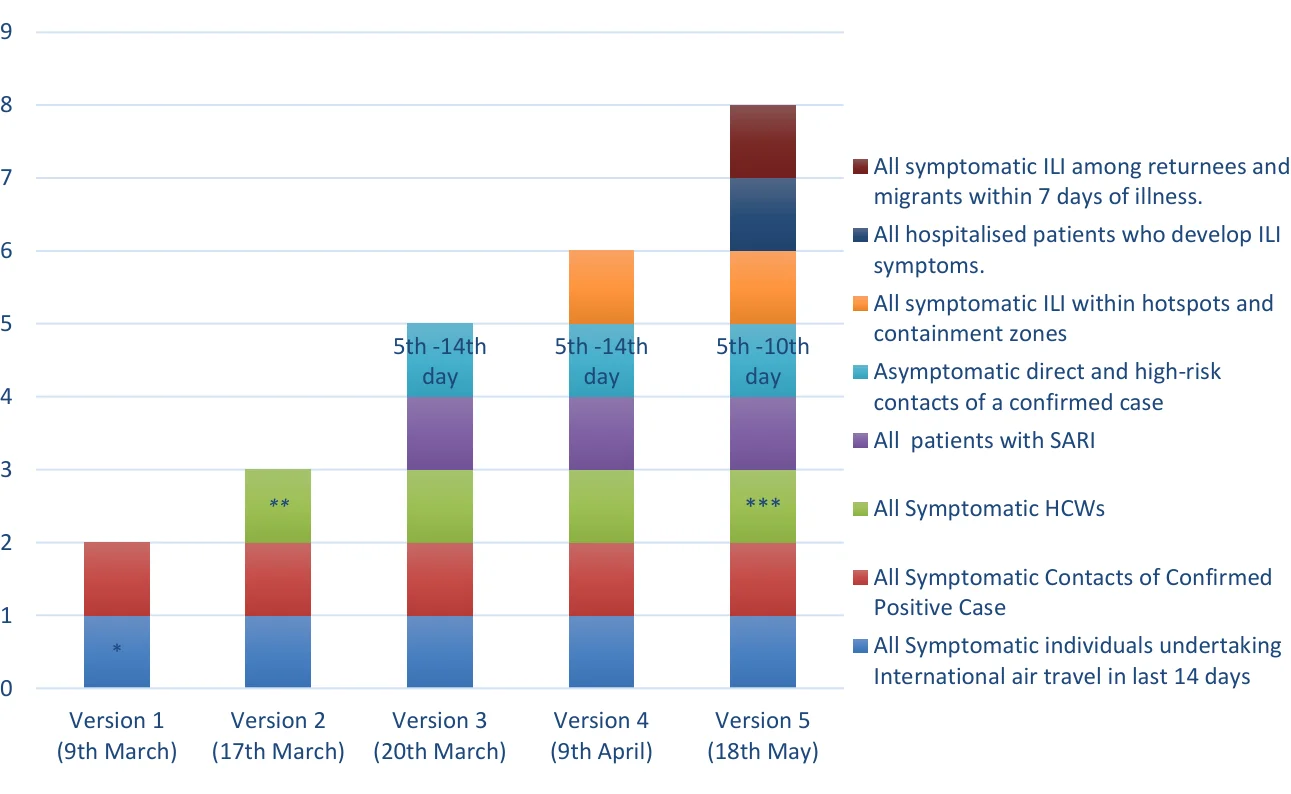
While guidance for rRT-PCR has not been updated since the release of fifth version in mid-May, the ICMR however recognized newer testing strategies such as rapid point of care (PoC) antigen detection test and IgG antibody test [20,21]. Though the former is recommended for diagnosing positive cases along with rRT-PCR, the latter is mandated only for surveillance and not for diagnosis. The rapid antibody PoC test is recommended for high-risk asymptomatic patients undergoing chemotherapy or transplant or elderly with comorbidities, etc. [20]. Also, asymptomatic high-risk patients undergoing interventions involving aerosol generation are recommended to be tested using rapid antibody PoC test [20]. Sero-surveillance using IgG and ELISA in vulnerable groups (such as HCWs, security personnel, police and paramilitary personnel, press, individuals in containment zones, banks, post offices, air travel staff, prisons) is recommended to identify the proportion of exposure among population and subsequent implementation of public health interventions. With the introduction of these newer technologies there is additional scope for testing asymptomatic individuals particularly HCWs aiding in mitigating workforce shortage by avoiding unnecessary quarantine and limiting transmission.
World Health Organization (WHO)
Due to the rapid influx of new evidence regarding the spread of COVID-19, the guidance issued by the WHO has been updated regularly. Since the early course of the pandemic, the organization recommended testing of suspected human cases [21,22]. A later guidance document includes refined definitions for probable case, and contacts. These definitions render important implications for testing of HCWs. Suspect cases are those who have a confirmed contact with a positive case, or a travel history to places of community transmission, in addition to an acute respiratory illness; or a severe acute respiratory illness of unknown etiology [23]. To define a ‘contact’, (apart from — 15 minute face to face interaction in a range of 1 meter, or a direct physical contact, with a probable or confirmed case;) the document specifies providing, “direct care for a patient with probable or confirmed COVID-19 disease without using proper PPE”. The time for such ‘contact’ is described between 2 days before onset of symptoms and 14 days post symptom appearance in the case with whom contact has occurred. In case of an asymptomatic confirmed case, the time-frame would be seen on the basis of day of the confirmatory test rather than appearance of symptoms [23]. While testing has been recommended for suspected cases [21,22], the organization recommends a 14-day quarantine for other individual who have come in contact with a confirmed or probable case [24,25].
In addition to the case classification, the WHO has also issued testing protocols based on disease transmission patterns. In March 2020, WHO classified transmission scenarios based on ascending order of transmission as — i) no cases, ii) sporadic cases, iii) cluster of cases, and iv) community transmission. While in areas with no cases or localized clusters the aim is to stop the transmission; in areas with community spread the aim lies in slowing the spread, and controlling local outbreaks. In areas with no cases, WHO recommends testing all suspect cases, and a subset of SARI/ILI cases, and certain patients having unexpected clinical presentation. In areas with sporadic cases or cluster of cases, testing of all suspect cases, SARI/ILI surveillance, and additional consideration of COVID-19 case and cluster investigation has been recommended. Areas with community transmission however, may be functioning under strained testing capacity, so here the WHO recommends to prioritize testing. The testing priority includes – vulnerable populations who may require advanced care; HCWs inclusive of non-clinical staff, irrespective of contact with a confirmed case; and initial symptomatic individuals in closed settings which includes hospitals. The preference for HCWs is to both ensure their safety as well as prevent hospital-based transmission [26, 27].
A surveillance protocol released by the organization in May-2020, aimed at finding the epidemiology, exposure characteristics and predisposing factors for COVID-19 among HCWs. The protocol mentions asymptomatic transmission as a possible mode apart from other forms of transmission and thus targets identification of confirmed COVID-positive HCWs irrespective of presence of symptoms [28]. Another guidance by the organization regarding infection prevention and control specified active syndromic surveillance of HCWs at entry points of healthcare settings [29].
In a recent scientific brief, WHO recognized asymptomatic transmission among modes of transmission of COVID-19. In this document, apart from infection control strategies such as masking and hand-hygiene, the organization recommends identification and testing of suspect cases at the earliest and isolation of all cases; while quarantine is recommended for close contacts and testing is specified for those contacts that develop symptoms [7].
Centre for Disease Control and Prevention (CDC)
As per CDC guidelines on contact tracing in community, viral testing is recommended for all those who have had close contact with persons having COVID-19 infection, this includes household contacts and HCWs [30]. In another document that gives an overview of testing strategies, the CDC identifies five categories of population for whom testing should be done- i) individuals having signs and symptoms consistent with COVID-19, ii) individuals being tested to determine resolution of infection, iii) individuals being tested for public health surveillance, iv) asymptomatic individuals with recent known exposure, and v) asymptomatic individuals without recent known exposure [30]. While testing recommendations for the first three groups are unidirectional, however for asymptomatic individuals these recommendations vary depending on testing capacity. For asymptomatic individuals with known or suspected exposure to COVID-19 case — all close contacts should be tested. The list of close contacts may be expanded based upon setting-specific testing capacity. In certain special settings, testing for asymptomatic cases without any known or suspected exposure has also been recommended by the CDC. These settings particularly refer to vulnerable populations at high risk such as the health departments, hospitals, and nursing homes [31]. However, in scenarios where testing capacities are limited, HCWs who have a prolonged (>15 minutes) close (<6 feet) contact with a confirmed COVID-19 case, without adequate PPE, while performing an aerosol-generating procedure — are prioritized for testing. Other HCWs are considered at low risk of disease; so, symptom based screening is recommended for them [31]. Furthermore, CDC in its guidelines acknowledges the fact that testing can be logistically challenging and has its own limitations.
Limitations
We reviewed the evolving guidelines for testing as specified by the apex Indian (MoHFW recommended -ICMR guidance) agency. We did not review further to the extent of the testing criteria being adopted by individual states, assuming that the states are following testing protocol recommended by the ICMR — as directed by the MoHFW.
Though we also searched the websites of premier medical institutes such as All India Institute of Medical Sciences (AIIMS), Post Graduate Institute of Medical Education and Research (PGIMER), to review the testing criteria being followed, these have not been mentioned explicitly under Recommendations on testing criteria for COVID-19 section. The institute websites specify the ICMR guidelines, which have been detailed under the aforementioned section.
As the review is a rapid review and includes the evolving guidance regarding a novel pandemic; we restricted the search to the apex national, and major international guidance. Furthermore, a fraction of the reviewed guidelines were in draft format. These could not be included or cited despite being reviewed.
Conclusion
The COVID-19 pandemic has put an unprecedented strain on the healthcare systems worldwide. While extensive emphasis on identifying COVID-19 cases among the symptomatic group was laid in the earlier directives, asymptomatic transmission of the infection could not be ignored. As testing capabilities increased, both in terms of increase in number of testing laboratories and availability of rapid diagnostic tests; guidance has intensified with recommendations on testing of asymptomatic contacts as well. In India, ICMR has expanded testing directive to include asymptomatic direct high-risk contacts [18]. India has tried to rationalize testing strategies for optimal utilization of limited resources. Further, use of rapid antigen and antibody tests for vulnerable asymptomatic groups such as HCWs is suggested [20]. WHO guidance lays emphasis on testing of all suspect cases. Such cases are defined in terms of acute respiratory illness in addition to either being a contact, or having a specific travel history, or unknown disease etiology [23]. Therefore, asymptomatic transmission has a bearing in the definition of ‘contact’, rather than suspect. For contacts however, quarantine has been recommended, rather than testing [24,25]. For areas with community transmission, testing prioritization for HCWs irrespective of contact with confirmed case, vulnerable populations and initial symptomatic cases from high-risk settings has now been suggested in case of low testing capacity [26,27], though the frequency is not specified. Furthermore, WHO and CDC being global organizations suggest countries to test as per local conditions and diagnostic capacities. However, with spread of the pandemic, countries should aim to adapt to more liberal and widespread testing strategies wherein wider population groups are tested. This approach of expanded testing is critical to limit transmission and flatten the curve of COVID-19 spread.
References
- World Health Organization. Coronavirus disease (COVID-19) Situation Report– 208. 15 Aug 2020. Available from: https://www.who.int/docs/default-source/coronaviruse/situation-reports/20200815-covid-19-sitrep-208.pdf?sfvrsn=9dc4e959_2. Last accessed, 2020 Aug 15.
- National Institute of Infectious Diseases Field briefing: Diamond Princess COVID-19 cases. Feb 19, 2020. https://www.niid.go.jp/niid/en/2019-ncov-e/9407-covid-dp-fe-01.html. Last accessed, 2020 Aug 20.
- World Health Organization. Coronavirus disease 2019 (COVID-19) Situation Report – 46. 06 Mar 2020. Available from: https://www.who.int/docs/default-source/coronaviruse/situation-reports/20200306-sitrep-46-covid-19.pdf?sfvrsn=96b04adf_4. Last accessed, 2020 Aug 20.
- World Health Organization. Coronavirus disease 2019 (COVID-19) Situation Report – 73. 02 Apr 2020. Available from: https://www.who.int/docs/default-source/coronaviruse/situation-reports/20200402-sitrep-73-Covid-19.pdf. Last accessed, 2020 Aug 20.
- World Health Organization. Modes of transmission of virus causing COVID-19: implications for IPC precaution recommendations: scientific brief, 29 March 2020. World Health Organization. 2020. Available from: https://apps.who.int/iris/handle/10665/331616. License: CC BY-NC-SA 3.0 IGO. Last accessed, 2020 Aug 27
- Craven, J. WHO clarifies comments on asymptomatic transmission of SARS-CoV-2. Medscape 2020 Jun 3. Available from: https://www.medscape.com/viewarticle/932088. Last accessed, 2020 Aug 20.
- World Health Organization. Transmission of SARS-CoV-2: implications for infection prevention precautions: scientific brief, 09 July 2020. World Health Organization. 2020. Available from: https://apps.who.int/iris/handle/10665/333114. License: CC BY-NC-SA 3.0 IGO. Last accessed, 2020 Aug 28
- Byambasuren O, Cardona M, Bell K, Clark J, McLaws ML, Glasziou P. Estimating the extent of true asymptomatic COVID-19 and its potential for community transmission: systematic review and meta-analysis. Available at SSRN 3586675. 2020 Apr 23. Available from: https://www.medrxiv.org/content/medrxiv/early/2020/05/15/2020.05.10.20097543.full.pdf. Last accessed, 2020 Aug 20.
- Ng K, Poon BH, Kiat Puar TH, Shan Quah JL, Loh WJ, Wong YJ, et al. COVID-19 and the risk to health care workers: a case report. Ann Intern MEd. 2020 Mar 16. Available from: https://www.acpjournals.org/doi/full/10.7326/L20-0175. Last accessed, 2020 Aug 20.
- Al-Zoubi NA, Obeidat BR, Al-Ghazo MA, Hayajneh WA, Alomari AH, Mazahreh TS, et al. Prevalence of positive COVID-19 among asymptomatic health care workers who care patients infected with the novel coronavirus: A retrospective study. Ann Med Surg (Lond). 2020;57:14-16. doi:10.1016/j.amsu.2020.06.038
- Sharma D, Sharma A, Monga D, Hudia J, Aggarwal AK. Mitigating Healthcare Workforce Shortage during COVID-19: Indian Context. International Journal of Health Systems and Implementation Research. 2020 Jun 10;4(1):88-102. [Google Scholar]
- Rivett L, Sridhar S, Sparkes D, Routledge M, Jones NK, Forrest S, et al. Screening of healthcare workers for SARS-CoV-2 highlights the role of asymptomatic carriage in COVID-19 transmission. Elife. 2020 May 11;9:e58728. Available from: https://elifesciences.org/articles/58728. Last accessed, 2020 Aug 20.
- Jha S, Soni A, Siddiqui S, Batra N, Goel N, Dey S, et al. Prevalence of Flu-like Symptoms and COVID-19 in Healthcare Workers from India. J Assoc Physicians India. 2020 Jul 1;68(7):27-9. [Google Scholar]
- Mhango M, Dzobo M, Chitungo I, Dzinamarira T. COVID-19 risk factors among health workers: A rapid review. Safety and Health at Work. 2020 Jun 6. [doi:10.1016/j.shaw.2020.06.001]
- Indian Council of Medical Research. Testing strategy for COVID-19 testing in India (09.03.2020). 2020 Mar 09. Available from: https://www.mohfw.gov.in/pdf/ICMRstrategyforCOVID19testinginIndia.pdf. Last accessed, 2020 Aug 20.
- Indian Council of Medical Research. Strategy of COVID19 testing in India (17/03/2020). 2020 Mar 17 Available from: https://www.icmr.gov.in/pdf/covid/strategy/Strategy_COVID19_testing_India.pdf. Last accessed, 2020 Aug 20.
- Indian Council of Medical Research. Revised Strategy of COVID19 testing in India (Version 3, dated 20/03/2020). 2020 Mar 20. Available from: https://www.icmr.gov.in/pdf/covid/strategy/2020-03-20_covid19_test_v3.pdf. Last accessed 2020 Aug 20
- Indian Council of Medical Research. Strategy for COVID19 testing in India (Version 4, dated 09/04/2020.Available from: https://www.icmr.gov.in/pdf/covid/strategy/Strategey_for_COVID19_Test_v4_09042020.pdf. Last accessed 2020 Aug 20.
- Indian Council of Medical Research. Strategy for COVID-19 testing in India (Version 5, dated 18/05/2020) 2020 May 18.Available from: https://www.icmr.gov.in/pdf/covid/strategy/Testing_Strategy_v5_18052020.pdfLast accessed 2020 Aug 20
- Indian Council of Medical Research. Advisory. Newer additional strategies for COVID-19 Testing. 2020 Jun 23. Available from: https://www.icmr.gov.in/pdf/covid/strategy/New_additional_Advisory_23062020_3.pdf. Last accessed 2020 Aug 20.
- World Health Organization. Laboratory testing of 2019 novel coronavirus (2019-nCoV) in suspected human cases: interim guidance, 17 January 2020. World Health Organization. 2020. Available from: https://apps.who.int/iris/handle/10665/330676. License: CC BY-NC-SA 3.0 IGO. Last accessed 2020 Aug 21
- World Health Organization. Laboratory testing for coronavirus disease (COVID-19) in suspected human cases: interim guidance, 19 March 2020. World Health Organization. 2020. Available from: https://apps.who.int/iris/handle/10665/331501. License: CC BY-NC-SA 3.0 IGO. Last accessed 2020 Aug 21
- World Health Organization. Global surveillance for COVID-19 caused by human infection with COVID-19 virus: interim guidance, 20 March 2020. World Health Organization. 2020. Available from: https://apps.who.int/iris/handle/10665/331506. License: CC BY-NC-SA 3.0 IGO. Last accessed 2020 Aug 21
- World Health Organization. Considerations for quarantine of contacts of COVID-19 cases: interim guidance, 19 August 2020. World Health Organization. 2020. Available from: https://apps.who.int/iris/handle/10665/333901. License: CC BY-NC-SA 3.0 IGO. Last accessed, 2020 Aug 27
- World Health Organization. Considerations in the investigation of cases and clusters of COVID-19: interim guidance, 2 April 2020. World Health Organization. 2020. Available from: https://apps.who.int/iris/handle/10665/331668. License: CC BY-NC-SA 3.0 IGO. Last accessed 2020 Aug 21
- World Health Organization. Laboratory testing strategy recommendations for COVID-19: interim guidance, 21 March 2020. World Health Organization.2020. Available from: https://apps.who.int/iris/handle/10665/331509. License: CC BY-NC-SA 3.0 IGO. Last accessed 2020 Aug 21
- World Health Organization. Critical preparedness, readiness and response actions for COVID-19: interim guidance, 24 June 2020. World Health Organization. 2020. Available from: https://apps.who.int/iris/handle/10665/332665. License: CC BY-NC-SA 3.0 IGO. Last accessed 2020 Aug 21
- World Health Organization. Surveillance protocol for SARS-CoV-2 infection among health workers: 28 May 2020, version 1. World Health Organization. 2020. Available from: https://apps.who.int/iris/handle/10665/332203. License: CC BY-NC-SA 3.0 IGO. Last accessed 2020 Aug 21
- World Health Organization. Infection prevention and control during health care when coronavirus disease (COVID-19) is suspected or confirmed: interim guidance, 29 June 2020. World Health Organization. 2020. Available from: https://apps.who.int/iris/handle/10665/332879. License: CC BY-NC-SA 3.0 IGO. Last accessed 2020 Aug 21
- Centre for Disease Control and Prevention. Overview of testing for SARS-CoV-2. 2020 Jul 17. Available from: https://www.cdc.gov/coronavirus/2019-ncov/hcp/testing-overview.html#:~:text=Viral%20(nucleic%20acid%20or%20antigen,recommended%20to%20diagnose%20acute%20infection. Last accessed 2020 Aug 21
- Centre for Disease Control and Prevention. Interim U.S. Guidance for Risk assessment and work restrictions for Healthcare Personnel with potential exposure to COVID-19. 2020 Jun 18. Available from: cdc.gov/coronavirus/2019-ncov/hcp/guidance-risk-assesment-hcp.html. Last accessed 2020 Aug 21

Published
Article metrics
- Views
- 1,145
- Downloads
- 657
Based on this site's usage statistics.