Policy Debate Vol. 4 No. 1 (2020): International J Health Systems and Implementation Research
Mitigating Healthcare Workforce Shortage during COVID-19: Indian Context
Health Workforce Shortage for Covid 19
Downloads
Topics
Keywords:
- COVID-19, novel coronavirus, healthcare workers, high-risk exposure, quarantine
Abstract
Increasing COVID-19 cases have put an unprecedented strain on the global and national healthcare systems. Higher risk of COVID-19 among the serving healthcare staff worsens the situation. We conducted a review of international and national guidelines, to address the key concerns regarding healthcare workers serving during the COVID-19 outbreak in Indian context. A few guidelines have pioneered in minimization of exposure risk, by limiting the working hours of healthcare staff serving in COVID wards. Nevertheless, in most settings’ exposure is foreseen. These exposures range from low to high-risk, based on – procedure conducted, use of personal protective equipment (PPE) as recommended, duration and proximity of contact. While low-risk exposures suffice self-monitoring for COVID-19 symptoms and do not require work restriction; high-risk-exposed are generally restricted from work for 14 days. Testing is mandated in symptomatic cases. Indian guidelines additionally suggest testing of high-risk asymptomatic staff. Certain international guidelines suggest a more liberal approach towards re-entry of exposed and infected staff, should there be a severe crisis of staff serving in COVID areas. Adequate testing capacity and PPE are indispensable assets in dealing with staff shortages. Guidelines released at central government level are a standard in most national settings. Additionally, many states have laid their own set of protocols. With the government dividing the landscape into ‘zones’ as per the current discourse of epidemic, it may help health systems at more disaggregated levels to study the range of management options and opt accordingly.
Full text
This web version was prepared from the published PDF, which is the version of record. Please cite and quote from the PDF.
Introduction
Widely referred as ‘COVID-19’, the coronavirus disease first reported in the December 2019 is a contagious disease caused by a novel strain of coronavirus. This disease with no known cure is characterized by flu-like symptoms that worsen into an acute respiratory failure [1]. Over the past few months, COVID-19 has established as a public health emergency. By the mid of May 2020, over 4 million people were infected by the disease, and 2,97,119 deaths were reported, worldwide [2]. Reportedly, over a fifth of those infected progress to a severe stage, while more than 3% die [3]. With over 80,000 cases lately, India ranks among the top 15 countries affected by the pandemic [2, 4].
Increasing cases have put an unprecedented strain on the healthcare services of even the most flexible healthcare systems [3]. Higher incidence hints towards a greater healthcare burden. It has been reported that this high healthcare burden is positively correlated with COVID-19 mortality [5]. Furthermore, infected healthcare staff pose a risk to patients admitted for emergencies other than COVID-19.
Hand hygiene, physical distancing, ensuring proper personal protective equipment (PPE) for the healthcare staff, restriction of travel and mass gatherings, are all aimed at curbing the trajectory of the outbreak or “flattening the curve”. This is indeed a way to limit the strain on the healthcare services and avoid compromising its capacity to deal with the epidemic [3]. However, sturdy healthcare systems such as those of Hong Kong, Japan, and Singapore speculate that if the situation continues, it will have a bearing on the capacity of their health workforce to provide services; fearing shortage of PPE and infectious disease specialists in near future [6].
Healthcare services already plagued by shortage of PPE and specialists are further decapacitated by a higher risk of COVID-19 among the serving healthcare staff. A study by Ong et al, demonstrated substantial contamination of clinical environment from COVID-19 patients; the risk of contamination of PPE was negligible, however this was not nil [7]. Another study from China, found that staff serving in departments that conducted aerosol generating procedures were twice more likely to contract COVID-19 as compared to others. Longer duty hours increased the risk further [8]. A testing protocol in a United Kingdom (UK) based hospital revealed 20% staff to be infected with COVID-19. Moreover, the spread was not confined to those treating COVID-19 patients, suggesting a wider, nosocomial transmission [9]. In Italy, 20% of the healthcare workforce handling COVID-19 was found to be infected [10]. In the United States (US), around 19% of a subset of COVID-19 cases were reportedly healthcare workers [11]. With less than 1 doctor serving per 1000 population, India is already disadvantaged when compared to the likes of US (2.59 per 1000); UK and France (around 3 per 1000); Italy and Spain (around 4 per 1000), that are facing adversity despite a good doctor to patient ratio [12]. There is thus a need to optimize the country’s response, by managing the present healthcare workforce and protecting it against infection from COVID-19.
There are thus several pressing questions concerning healthcare workers (HCWs) serving during the COVID-19 outbreak in Indian context: What would be an optimal duty schedule for staff serving in COVID-areas?; How is risk of contracting COVID-19 defined for healthcare staff?; Can HCWs using recommended PPE continue working despite exposure?; Whether staff serving in COVID-areas should be given mandatory duty-offs or quarantined after completion of their shift?; Should staff serving in COVID-areas be tested? and How can staff shortage be minimized in the face of current pandemic?
To address these (aforementioned) key concerns, we conducted a narrative review of available guidelines. We searched databases such as Pubmed and Google Scholar; websites of premiere global and national level agencies, and academic institutes. For national guidelines, we looked up the websites of government affiliated national-level health agencies and the central governing body for healthcare. For state guidelines, the ‘Directorate Health Services’ websites of all 28 states of India and the national capital were searched for related content. The search was complimented with State Government and State-level National Health Mission websites for many states. Apart from these guidelines, we also searched three websites of three premiere national-level medical institutes (academic) and the websites for the national medical association. A combination of search words such as, ‘COVID-19’, ‘coronavirus’, ‘staff shortage’, ‘duty hours’, ‘healthcare workers’, ‘healthcare staff’, ‘quarantine’ and ‘guidelines’ were used to identify appropriate guidelines. All guidelines providing specific recommendation for addressing HCW management during COVID-19 and addressing one or more of the mentioned research questions were included in the review. Guidelines regarding management of general patients were not included. Non-English and non-Hindi guidelines were also excluded. International level guidelines were restricted to premiere organizations, providing either national or multinational guidance, sub-national guidelines were not included. The results were compiled as below:
Results
Work Schedule for HCWs Posted in Designated COVID-19 Areas
Effective allocation of HCWs is the need of the hour for managing the COVID-19 pandemic. In principle, it was observed that guidelines recommend categorizing the available human resource (HR) into two or more groups, to serve in COVID-19 wards on a rotational basis [13-15]. Additionally, it is also recommended to have a reserve pool of professionals who can be engaged in case of emergency [13-16]. The emergency may be a result of an in-house crisis wherein members of the HCWs actively involved in COVID-19 patient care services get infected thus demanding immediate replacement, or there may be a rapid surge in the number of COVID-19 positive cases amongst the general population. While several guidelines did not explicitly state the division of HCWs into groups, their work schedules and duty rosters however implied the same [16-18]. Another common recommendation noted among the guidelines was a 14-day off for HCWs serving in the COVID-19 wards [13, 14, 16, 17-19]. However, there was ambiguity regarding whether this 14-day period was for self-isolation, or HCWs could work in non-COVID areas. Also, there was a variation, with some guidelines suggesting 14-day break for specific group of HCWs, while others giving a uniform recommendation for all HCWs. Figure (1) represents the recommendations made by different agencies with respect to the work schedule (days on duty followed by post duty advice) of the involved staff.
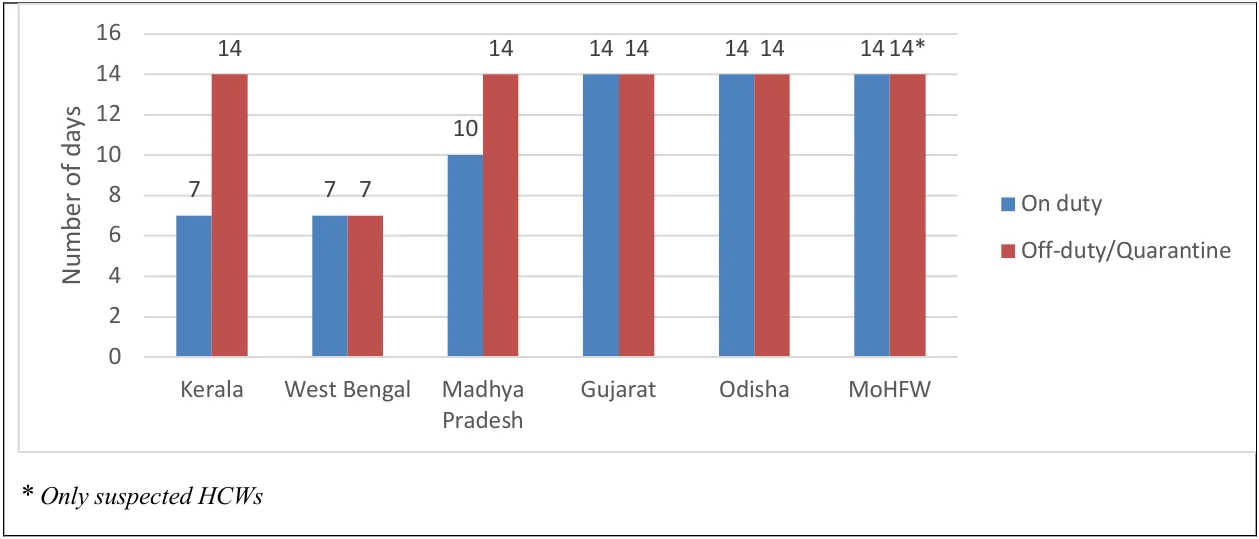
Although, prolonging duty hours of the available HCWs is one of the easier options employed to cope up with HR shortages, several guidelines rightly contradict this practice [15, 20]. For instance, the state of Kerala recommends that staff should be on duty for a maximum of 8 hours. Furthermore, these 8 hours should be split into two halves to limit the duration of wearing PPE [20].
Organizations must restrict the duty hours of the HCWs for a number of reasons. Firstly, a direct correlation between duration of work and risk of getting infected has been reported [8, 21]. Secondly, with increase in duty hours, the compliance of HCWs decreases and distrust in the administration increases. The staff often gets reluctant to work, this reluctance may be attributable to physical as well as mental fatigue.
Risk Categorization of Exposed HCWs
Physical distancing is indispensable to limit transmission of COVID-19. However, HCWs incur an inherent risk of exposure, due to unavoidable contact with patients. Based on presence or absence of independent risk factors of COVID-19, most guidelines follow a graded approach to categorize the degree of exposure envisaged in healthcare settings.
At the height of the exposure spectrum, are the ‘high-risk’ exposures. As per, Centres for Disease Control and Prevention (CDC) guidelines for managing COVID-19 in the US, such exposures are those where HCW had a, “prolonged close contact” with COVID-19 patients (48 hours prior to symptom onset), without both patient and HCWs wearing any mask, and presence of HCW in a room where aerosol generating procedures were carried out or poor control of respiratory secretions is expected. Here, ‘close contact’ refers to being within a range of 6 feet (2 meters) of a person with COVID-19 for a prolonged period [22]. For non-US settings, use of mask by patient is not considered for risk categorization. Any close contact (6 feet or less) with a COVID-19 case or provision of direct patient care ranging from simple physical examination to aerosol generating procedure without use of recommended PPE or hand hygiene regimen is considered a high-risk exposure [23]. Risk assessment as per World Health Organization (WHO), is based on a questionnaire format. If answer to any of these questions is not ‘Always, as recommended’, the HCW is considered at ‘High-Risk’. These questions include: use of PPE indicated for the procedure; extent of following PPE “donning” and “doffing” protocols; hand hygiene protocol after performing any clean or aseptic procedure; exposure to body fluid; and frequency of decontamination of “high-touched areas” [24]. Similarly, Ministry of Health & Family Welfare (MoHFW), India, certain states and medical institutes have laid their own guidelines for risk categorization and subsequent management [25-27]. In general, if an HCW is exposed to a positive patient without adequate PPE for 15 minutes or more, at a distance of less than 2 meters, he/she is categorized as high-risk. State guidelines of Madhya Pradesh, India, label all HCWs serving in COVID intensive care units (ICUs) or involved aerosol generating procedures as high-risk. Furthermore, staff involved in laundry and waste disposal are also managed in accordance to high-risk category protocols [27].
‘Low-risk’ exposures, as per CDC guidance for US are those where HCWs wear an N-95 facemask or higher-level respirator and patient is also wearing a mask [22]. Exposures which do not qualify as high-risk, simply fall into the low-risk category as per CDC non-US guidance, WHO, and MoHFW, India [23-25]. Another national institute has further categorized low-risk exposure into two: ‘Group A’, and ‘Group B’ as per the type of staff involved. A protected exposure at 2 meters or greater distance to the source, lasting less than 15 minutes; in a non-ICU setting; involving staff such as X-ray technician, porters who transport patients and physiotherapists; is classified as a low-risk-Group A exposure. Whereas similar exposure involving staff serving at pantry, registration, security, data entry area, sample transport and logistics transport are categorized into low-risk-Group B exposures [27].
Only a few guidelines define an intermediate category of ‘medium risk’ exposures. As per CDC guidance for US, this refers to conditions similar to high-risk exposure, except that the infected patient had been wearing mask. An otherwise low-risk exposure may also be considered under this category in case an aerosol-generating or similar risk inducing procedure is conducted. For example, HCWs who were wearing a gown, gloves, eye protection and a facemask instead of a respirator during an aerosol generating procedure would be considered to have a medium-risk exposure [22]. The All India Institute of Medical Sciences, considers screening, emergency, and some other clinical areas as ‘medium-risk’, wherein a potential exposure is expected [26].
Management of HCWs Suspected or Confirmed as COVID-19 Positive
Once risk is defined, exposed HCWs are principally managed as per presence or absence of symptoms. The spectrum of management ranges from simple monitoring of symptoms; to a stringent quarantine and restriction from work. Table (1) compiles the management strategies from the reviewed guidelines.
| Organization | Asymptomatic | Symptomatic | Post-test protocol | Other considerations |
|---|---|---|---|---|
| INTERNATIONAL GUIDELINES | ||||
| WHO [24] | Low-risk: SM+AM (F) for 14 days; WR= Nil High-risk: WR for 14 days + Test | |||
| CDC – Interim U.S. Guidance [22, 38, 40] | Low-risk: SM twice a day +AM (F) for 14 days; WR= Nil Medium to High-risk: AM (F,G) + WR for 14 days (Allowed to work during crisis situations, masking mandatory for 14 days) | Immediate SQ; WR based on test results; high-risk prioritized for testing | Negative: If 2 consecutive negative test results from samples collected ≥24 hours apart + full recovery, then, WR lifted + masking mandatory till symptoms persist + SM | If testing cannot be done for return to work: WR lifted if [≥3 days past full recovery + ≥10 days past symptom onset] or [≥10 days past confirmatory test]. Exposed/confirmed yet to fulfill return criteria, may also be allowed in severe staff shortage. Subject to certain conditions. (Details in section 2.3) |
| CDC – Guidance for non-US setting [23] | Low-risk: SM twice a day for 14 days; WR= In this period, can care only for COVID positive patients High-risk: AM (F,G) + WR for 14 days | Immediate SQ; WR based on test results | Same as U.S guidance | If testing cannot be done: WR if ≥3 days past full recovery + ≥7 days past symptom onset. |
| UK Government [41] | WR= Nil until symptomatic | Negative: WR lifted if feeling well. Positive: SQ for 1 week, WR until symptom-free (cough may persist though) for 2 days post SQ period | ||
| NATIONAL LEVEL GUIDELINES – INDIA | ||||
| MoHFW [19, 25] | Exposed HCW FQ, AM(F) up to 14 days. | Immediate WR, Isolation and management in COVID-19 designated hospital | Exposed HCW to be given Hydroxychloroquine prophylaxis for 7 weeks | |
| ICMR [33] | Direct contact and high-risk: Test between 5th and 14th day of contact | All symptomatic HCWs to be tested | ||
| NCDC [34] | Direct and high-risk contacts of confirmed cases: Test between 5th and 14th day of contact | All symptomatic (within 28 days of contact): Self-isolation. Frontline workers =WR | ||
| IMA [42] | Active screening of HCWs for fever and flu-like symptoms | |||
| STATE LEVEL GUIDELINES – INDIA | ||||
| Kerala [20] | Isolation and AM(F) for 14 days | Isolation and testing | ||
| Gujarat [14] | All HCWs: SM and FQ for 14 days, test at Day 7 High-risk HCW (who examined confirmed case without adequate PPE): Immediate test, FQ for 28 days | Immediate testing and management according to suspected COVID-19 case | Negative: WR=Can be deployed in dedicated COVID Hospitals/ isolation wards | |
| Andhra Pradesh [32] | SM twice a day for 14 days | Standard protocol for management of suspected COVID-19 case | ||
| Odisha [16] | SQ and SM for 14 days | Standard protocol for testing and management of suspected COVID-19 case | ||
| West Bengal [28] | Exposed (<1 metre range) lasting >15 min without PPE and mask): FQ for 14 days, Test between 7th - 14th day from the exposure | Standard protocol for testing and management of suspected COVID-19 case | ||
| Uttarakhand [29] | SM twice a day for 14 days | Standard protocol for management of suspect case of COVID-19 | ||
| Haryana [18] | HCW providing direct care to COVID-19 patients without proper PPE: FQ for 14 days, AM(F), Test at the end of quarantine period | Should be tested and managed according to standard protocols for suspected COVID-19 case | ||
| Madhya Pradesh [27] | High-Risk: FQ for 14 days, AM(F), Test at Day 13 Low-Risk (Group A): WR + SQ, SM, Test at Day 13 Low-Risk (Group B): SM, no WR | Isolated at COVID facilities. If test results are positive treat as confirmed COVID case, if negative treat as non-COVID case | Negative: WR= Nil if asymptomatic | Group B included support staff (kitchen staff, security personnel, data entry operators, registration counter staff etc.) |
| Himachal Pradesh [31] | Examined a confirmed case without adequate protection to be tested | To be tested | ||
| Tamil Nadu [30] | Examined a confirmed case without adequate protection: FQ, Test once between Day 5 and Day 14 | Testing and hospital isolation | ||
| INSTITUTIONAL GUIDELINES - INDIA | ||||
| AIIMS, New Delhi [26,35] | Close/direct contact with PPE: SM for 14 days; WR= Nil Close/direct contact without PPE: WR, SQ, AM (F) for 14 days; Asymptomatic with PPE breach: Test as per ICMR between 5th -14th day from the exposure | Test as per ICMR | Positive: SQ for 14 days, medical management | |
| PGIMER, Chandigarh [36, 37] | Without PPE: SM, WR, SQ for 14 days Test as per recommendation of consultant-in-charge | WR, SQ, SM for 2-3 days; Test if COVID-like symptoms persist (including fever exceeding 38.5°C) | Positive: Isolated in designated unit for management Negative: Further decision on case-by-case basis by consultant-in-charge | HCWs on COVID duty: Q for 14 days after completion of shift |
SM = Self-monitoring of fever and COVID symptoms; AM (F) = Active-monitoring at facility level; AM (G) = Active-monitoring by governing authority; WR = Work restriction; SQ = Self-Quarantine at Home, FQ = Quarantine at government designated quarantine centers
For asymptomatic HCWs with low-risk exposures, CDC’s guidance for US suggests such HCWs constituting essential workforce to continue to work while monitoring themselves twice a day for COVID-19 symptoms – rise in body temperature (>100° F) and cough, malaise, difficulty in breathing and body-ache. This “self-monitoring” of symptoms is under a delegated supervision of the infection control team of the healthcare setting, which reviews HCW’s symptoms on the days of work [22]. Similar management is recommended by the WHO [24], CDC guidance for non-US settings [23], and Indian guidelines [14, 16, 18-20, 25-33]. It is important to note that: though no potential exposure is expected for HCWs who use full PPE; such HCWs should however maintain a self-monitoring protocol to cover for any inadvertent exposure stemming from the inconsistency in PPE protocol followed [22].
Asymptomatic HCWs with medium to high-risk exposure are restricted from work for 14 days and are monitored for the development of COVID-19 symptoms. This “active-monitoring” is done both at the level of hospital as well as the local/state governing bodies. If symptoms develop then they should be evaluated and tested for COVID-19 [22].
Most guidelines recommend testing symptomatic HCWs only. However, several guidelines additionally recommend that asymptomatic high-risk HCWs should also be tested [25-31, 33-37]. As per the current discourse of the epidemic, the latter practice may help maneuver better control of the situation as it helps to identify the hidden pool of asymptomatic COVID-positive HCWs. If the tests results come out to be negative, the tested HCWs can rejoin duty, symptomatic HCWs can rejoin subject to resolution of symptoms. However, if tested positive, HCWs are restricted from work. Recently, the CDC guidance document was also updated in this direction. Return to work of COVID-suspected or COVID-positive HCWs is warranted only when two consecutive test results (samples taken 24 hours apart) are negative along with resolution of fever and respiratory symptoms, while for the asymptomatic only the aforementioned test results suffice. In situations where the test-based protocol cannot be followed, the work restriction of the HCW can be lifted on condition: a) for symptomatic (COVID-suspected or COVID-positive) HCWs, 3 days should have passed since resolution of fever without antipyretics along with betterment of respiratory symptoms, and 10 days should have passed after the initial onset of symptoms; b) for asymptomatic (confirmed positive) HCWs, 10 days should have passed after the first confirmatory test. The symptom based return to work criteria may bear significance in countries/settings with low testing capacity as it is applicable for both suspected and confirmed cases and does not require an initial confirmatory test [23, 38].
In India, MoHFW guidelines consider any HCW with flu-like symptoms as a suspect of COVID-19 patient [25, 33]. Such HCW should inform the authorities with immediate effect. He/she is restricted from work, isolated, and sent to designated health centres for further management. All close contacts of such HCW are also quarantined for 14 days [33]. If the HCW in question tests positive, then all close contacts are to be given a prophylaxis of Hydroxychloroquine for seven weeks. Additionally, measures of disinfection of the health facility are to be taken. The Ministry however does not recommend closing down the whole facility [25].
Currently, the transmission in India can be seen as clusters of cases [2]. Our management protocols thus reflect a more optimistic scenario. However, it may be plausible for the health systems, especially in certain high-risk areas, to get adept with strategies to control inadvertent exposures in healthcare settings, such as those delineated for situations of community spread. For example, as a precautionary measure for US based settings, the CDC advises all HCWs to monitor themselves daily for any symptoms of COVID-19 [22]. In places with broader disease spread, a daily screening protocol for checking fever and respiratory symptoms among HCWs is to be set up [38]. The CDC has also documented contingency protocols for mitigation of staff shortage which allow asymptomatic exposed HCWs (even those with high-risk exposures) to work if a crisis situation arises. A medical grade mask is to be used by such HCWs, always. If severe staff crisis ensues despite allowing asymptomatic exposed HCWs at work, then: even COVID-19 suspected or confirmed HCWs can continue to provide patient care (barring contact with immuno-compromised patients) in the order of: 1) telemedicine/consultation without direct patient contact, 2) positive HCWs can treat positive patients, 3) positive HCWs can treat suspected patients, and 4) finally in an unavoidable crisis, positive HCWs being allowed to treat patients who aren’t suspected/infected with COVID-19 [30, 38].
Study Limitations
Our review should be interpreted subject to a few limitations. Firstly, since the review focuses solely on healthcare workforce serving during the COVID-19 epidemic, we may have left out excerpts from guidelines which do not specify human resource management as a purpose. Secondly, to avoid inaccuracy in translation of vernaculars (Mandarin, Mizo, Tamil, Telugu, etc), the review has been confined to guidelines which were available in English or Hindi language. Thirdly, the extant PPE guidelines regarding: recommended PPE as per procedure conducted, “donning” and “doffing” protocols, etc. are beyond the scope of our review. Though, we expect that most state health departments and medical institutes of importance have in-depth guidelines to handle the COVID-19 epidemic and follow their own set of duty rosters. However, we were unable to retrieve many of these from public domain, thus restricting the review to available guidelines. Lastly, to the best of our knowledge the review includes the latest versions of guidelines, however, inadvertent fallacies may result from rapid influx of new evidence in the COVID-19 discourse.
Conclusion
While the world struggles to “flatten the curve” and release the emergent strain on healthcare systems, HCWs brace up for long hours of duty with or without adequate PPE. Duration of contact being a key risk factor for COVID-19 infection, a reduction in duty hours is plausible. A good example here is the state of Kerala, which has shown promising results in controlling COVID-19. As we struggle to keep away from community transmission, it may be a good call to develop screening or self-monitoring protocols for HCWs in high-risk pockets. Nevertheless, in most settings’ exposure is inevitable. Based on risk from type of procedure conducted, extent of use of PPE, duration and proximity of contact, these exposures have been classified from low to high-risk. While low-risk exposures can be dealt with simple self-monitoring for COVID-19 symptoms and such HCW can continue to work; those having high-risk exposures are restricted from duty for a 14-day period. Certain international guidelines suggest that if resource constraint ensues, the latter may be allowed to work subject to an active monitoring protocol and ensuring PPE, especially higher-grade masks at all times. Though HCWs who used full PPE don’t fall under any potential risk category and can continue to work, self-monitoring can still be observed as a best practice. Furthermore, as breach in PPE is critical to risk categorization, it is imperative to document compliance to recommended PPE protocols once work-shift of HCW ends. Standard checklists such as those provided by the WHO, CDC maybe helpful here. Testing is mandatory for symptomatic HCWs, if found positive they are immediately taken off duty and can only resume after full recovery from disease and symptoms. Many guidelines (including those followed in India) additionally suggest testing of high-risk asymptomatic staff. Facilitation of entry of exposed HCWs back into the active workforce necessitates adequacy of PPE and testing capacity to prevent inadvertent nosocomial exposures. In case of poor testing capacity, the path suggested by CDC (symptom or time base approach) may be considered. Currently, as per MoHFW, India all HCWs reporting flu-like symptoms are suspected of COVID-19 infection and quarantined for 14 days.
In a large and diverse country like ours, a one fit for all solution may not work. Many states have thus laid their own set of protocols. With the government dividing the landscape into alert zones (red, orange and green) as per the current discourse of epidemic, it may help health systems at more disaggregated levels to study the range of management options and opt for stricter quarantine protocols in low-risk areas with adequate HCWs; to a more rational protocol of allowing exposed HCWs back in the workforce of high-risk areas with staff shortage, on the condition of adequate PPE and other necessary precautions.
References
- World Health Organization. Coronavirus. World Health Organization; 2020. Available from: https://www.who.int/health-topics/coronavirus#tab=tab_1. Last accessed May 15, 2020.
- World Health Organization. Coronavirus disease 2019 (COVID-19) Situation Report – 111. Available from: https://www.who.int/docs/default-source/coronaviruse/situation-reports/20200515-covid-19-sitrep-116.pdf?sfvrsn=8dd60956_2. Last accessed, May 16, 2020.
- World Health Organization. COVID-19 Strategy Update. 14 April 2020. World Health Organization; 2020. Available from: https://www.who.int/docs/default-source/coronaviruse/covid-strategy-update-14april2020.pdf?sfvrsn=29da3ba0_19&download=true. Last accessed, May 14, 2020.
- COVID-19 dashboard by the Center for Systems Science and Engineering (CSSE) at Johns Hopkins University (JHU). Available from: https://coronavirus.jhu.edu/map.html. Last accessed, May 16, 2020.
- Ji Y, Ma Z, Peppelenbosch MP, Pan Q. Potential association between COVID-19 mortality and health-care resource availability. Lancet Glob Health. 2020 Apr;8(4):e480. [doi:10.1016/s2214-109x(20)30068-1]
- Legido-Quigley H, Asgari N, Teo YY, Leung GM, Oshitani H, Fukuda K, et al. Are high-performing health systems resilient against the COVID-19 epidemic? Lancet. 2020;395(10227):848-50. [doi:10.1016/s0140-6736(20)30551-1]
- Ong SW, Tan YK, Chia PY, Lee TH, Ng OT, Wong MS, et al. Air, surface environmental, and personal protective equipment contamination by severe acute respiratory syndrome coronavirus 2 (SARS-CoV-2) from a symptomatic patient. Jama. 2020;323(16):1610-2. [doi:10.1001/jama.2020.3227]
- Ran L, Chen X, Wang Y, Wu W, Zhang L, Tan X. Risk factors of healthcare workers with corona virus disease 2019: A retrospective cohort study in a designated hospital of Wuhan in China. Clin Infect Dis. 2020. [Google Scholar]
- Hunter E, Price DA, Murphy E, van der Loeff IS, Baker KF, Lendrem D, et al. First experience of COVID-19 screening of health-care workers in England. Lancet. 2020 [doi:10.1016/s0140-6736(20)30970-3]
- Lancet T. COVID-19: protecting health-care workers. Lancet. 2020;395(10228):922. [doi:10.1016/s0140-6736(20)30644-9]
- Burrer SL, de Perio MA, Hughes MM, Kuhar DT, Luckhaupt SE, McDaniel CJ, et al. Characteristics of health care personnel with COVID-19—United States, February 12–April 9, 2020. MMWR Morb Mortal Wkly Rep, 2020;69(15):477-81. [Google Scholar]
- World Health Organization. Density of physicians (total number per 1000 population, latest available year). Global Health Observatory (GHO) data; 2019. Available from: https://www.who.int/gho/health_workforce/physicians_density/en/. Last accessed May 15, 2020.
- COVID-19 (nCorona) Virus Outbreak Control and Prevention State Cell, Health & Family Welfare Department, Government of Kerala. Reference Guide for Converting Hospitals into dedicated COVID Hospitals. Government of Kerala; Mar 2020. Available from: https://dhs.kerala.gov.in/wp-content/uploads/2020/04/2.04.20-How-to-convert-Hospitals-into-COVID-Hospitals.pdf. Last accessed May 14, 2020.
- Health and Family Welfare Department, Government of Gujarat. Implementing the Guidelines for Human Resource Management in Dedicated COVID-19 Facilities. Government of Gujarat; Apr 2020. Available from: https://gujhealth.gujarat.gov.in/Portal/News/1161_1_02-28-4-20-HRM-in-Dedicated-Covid-19.pdf. Last accessed May 14, 2020.
- Health and Family Welfare Department, Government of West Bengal. Shift system for Frontline Medical Personnel in Government Hospitals Treating SARI/COVID-19. Available from: https://www.wbhealth.gov.in/uploaded_files/corona/Order-_16-04-2020.pdf . Last accessed May 14, 2020.
- Government of Odisha. COVID-19 Master Circular on COVID Hospitals. Government of Odisha; May 2020. Available from: http://mphealthresponse.nhmmp.gov.in/covid/wp-content/uploads/2020/04/Measures-for-Quarantine.pdf. Last accessed May 14, 2020.
- Directorate of Health Services, Government of Madhya Pradesh. Guideline on Appropriate Management of Suspect/Confirmed Cases. Government of Madhya Pradesh; Mar 2020. Available from: http://mphealthresponse.nhmmp.gov.in/covid/wp-content/uploads/2020/05/CCC-TechnicalGuidelines.pdf. Last accessed May 14, 2020.
- Department of Health and Family Welfare, Government of Haryana. Guidelines and protocols for Prevention and Control of Novel Corona Virus (COVID-19). Government of Haryana; 2020. Available from: https://cdn.s3waas.gov.in/s305049e90fa4f5039a8cadc6acbb4b2cc/uploads/2020/04/2020040511.pdf. Last accessed May 14, 2020.
- Ministry of Health and Family Welfare, Government of India. Guidelines to be followed on detection of suspect/confirmed COVID-19 case in a non-COVID Health Facility. GOI; 2020. Available from: https://www.mohfw.gov.in/pdf/GuidelinestobefollowedondetectionofsuspectorconfirmedCOVID19case.pdf Last accessed May 14, 2020.
- COVID-19 (nCorona) Virus Outbreak Control and Prevention State Cell, Health & Family Welfare Department, Government of Kerala. Guidelines for Human Resource Management in COVID Hospitals. Government of Kerala; Mar 2020. Available from: http://dhs.kerala.gov.in/wp-content/uploads/2020/04/Advisory-Staff-management-at-Hospitals-.pdf. Last accessed May 14, 2020.
- Wong SY, Kwong RS, Wu TC, Chan JW, Chu MY, Lee SY, Wong HY, Lung DC. Risk of nosocomial transmission of coronavirus disease 2019: an experience in a general ward setting in Hong Kong. J Hosp Infect. 2020. [doi:10.1016/j.jhin.2020.03.036]
- Centers for Disease Control and Prevention. Interim US guidance for risk assessment and public health management of healthcare personnel with potential exposure in a healthcare setting to patients with coronavirus disease (COVID-19). CDC; 2020. Available from: https://www.cdc.gov/coronavirus/2019-ncov/hcp/guidance-risk-assesment-hcp.html#a Last accessed May 15, 2020.
- Center for disease control and Prevention. Interim Operational Considerations for Public Health Management of Healthcare Workers Exposed to or with Suspected or Confirmed COVID-19: non-US Healthcare Settings. CDC; 2020 Available from: https://www.cdc.gov/coronavirus/2019-ncov/HCW/non-us-settings/public-health-management-hcw-exposed.html. Last accessed May 14, 2020.
- World Health Organization. Risk assessment and management of exposure of health care workers in the context of COVID-19: interim guidance, 19 March 2020. World Health Organization; 2020. Available from: https://apps.who.int/iris/bitstream/handle/10665/331496/WHO-2019-nCov-HCW_risk_assessment-2020.2-eng.pdf. Last accessed May 14, 2020
- Ministry of Health and Family Welfare, Government of India. Advisory for managing Health care workers working in COVID and Non-COVID areas of the hospital. GoI; May 2020. Available from: https://www.mohfw.gov.in/pdf/AdvisoryformanagingHealthcareworkersworkinginCOVIDandNonCOVIDareasofthehospital.pdf. Last accessed May, 15, 2020.
- All India Institute of Medical Sciences. Guidance Document for Quarantine and Isolation Related Issues for HCW’s at AIIMS New Delhi. AIIMS; Apr 2020. Available from: https://covid.aiims.edu/wp-content/uploads/2020/04/AIIMS-Guidance-Isolation-and-Quarantine-of-HCWs.pdf. Last accessed May 15, 2020.
- Directorate of Health Services, Government of Madhya Pradesh. Guidelines for the Quarantine Facilities. Government of Madhya Pradesh; Apr 2020. Available from: http://mphealthresponse.nhmmp.gov.in/covid/wp-content/uploads/2020/04/Measures-for-Quarantine.pdf. Last accessed May, 14, 2020
- Health and Family Welfare Department, Government of West Bengal. Health Care personnel are at risk of contacting COVID-19 infection while treating the in-patients with less suspect and not tested for COVID-19. Memo No 1336. 2020. Available from: https://www.wbhealth.gov.in/uploaded_files/corona/Examination_of_Patient.pdf. Last accessed May 14, 2020.
- Department of Medical Health and Family Welfare, Government of Uttarakhand. Protocol for Hospitals with Suspected/Confirmed cases of COVID-19. Government of Uttarakhand; Mar, 2020. Available from: http://health.uk.gov.in/files/Corona/9._Protocol_for_Hospitals_with_Suspected_Confirmed_cases_of_COVID-19.pdf. Last accessed May 15, 2020.
- COVID-19 — Health and Family Welfare Department, Government of Tamil Nadu. Guidelines for COVID-19 affected persons, family members, Contacts and Containment Measures — Orders — Issued. Government of Tamil Nadu; Apr 2020. Available from: https://cms.tn.gov.in/sites/default/files/go/hfw_e_166_2020.PDF. Last accessed May 15, 2020.
- National Health Mission, Government of Himachal Pradesh. Regarding Measures Undertaken to Ensure Safety of Health Workers Drafted for COVID 19 Services. Government of Himachal Pradesh; Apr 2020. Available from: http://nrhmhp.gov.in/sites/default/files/files/safety%20of%20health%20workers.pdf. Last accessed May 15, 2020.
- State Control and Prevention Cell of Novel Corona Virus (COVID19) Commissionerate of Health & Family Welfare Health & Family Welfare Department Government of Andhra Pradesh; 2020. Available from: http://hmfw.ap.gov.in/COVID-19%20IEC/1.Govt%20of%20AP%20Protocols/Protocols%20COVID%2019.pdf. Last accessed May 15, 2020.
- Indian Council of Medical Research, Department of Health Research, MoHFW, GoI. Protocol for using 'Rapid antibody test' in Hot area - epidemiological studies and surveillance. Government of India; Apr 2020. Available from: https://www.icmr.gov.in/pdf/covid/strategy/Rapid_Antibody_test_Protocol.pdf. Last accessed May 15, 2020.
- NCDC, Government of India. SOP - Contact Tracing for COVID-19 Cases. Government of India. Available from: https://ncdc.gov.in/showfile.php?lid=538. Last accessed May 15, 2020.
- All Indian Institute of Medical Sciences. AIIMS COVID Portal, Individuals at High Risk Testing strategy. Available from: https://covid.aiims.edu/information-for-professionals/. Last accessed May 15, 2020.
- Post Graduate Institute of Medical Education and Research. PGIMER, COVID Healthcare Workers. PGIMER; 2020. Available from: http://pgimer.edu.in/PGIMER_PORTAL/PGIMERPORTAL/covid19/PDF/staffinst.pdf. Last accessed May 15, 2020.
- Advanced Pediatrics Centre, Post Graduate Institute of Medical Education and Research. COVID-19 Containment Standard Operating Procedures, Version 4.0. PGIMER; Apr 2020. Available from: http://pgimer.edu.in/PGIMER_PORTAL/PGIMERPORTAL/covid19/PDF/sop.pdf. Last accessed May 15, 2020
- Centers for Disease Control and Prevention. Criteria for Return to Work for Healthcare Personnel with Suspected or Confirmed COVID-19 (Interim Guidance). CDC;2020. Available from: https://www.cdc.gov/coronavirus/2019-ncov/hcp/return-to-work.html. Last accessed May 15, 2020.
- Centers for Disease Control and Prevention Healthcare Facilities: Preparing for Community Transmission. Available from: https://www.cdc.gov/coronavirus/2019-ncov/hcp/guidance-hcf.html. Last accessed May 15, 2020.
- Centers for Disease Control and Prevention. Strategies to Mitigate Healthcare Personnel Staffing Shortages. Available from: https://www.cdc.gov/coronavirus/2019-ncov/hcp/mitigating-staff-shortages.html. Last accessed May 15, 2020.
- Public Health England. Guidance COVID-19: Management of Exposed Healthcare Workers and Patients in Healthcare Settings. Public Health England; 2020. Available from: https://www.gov.uk/government/publications/covid-19-management-of-exposed-healthcare-workers-and-patients-in-hospital-settings/covid-19-management-of-exposed-healthcare-workers-and-patients-in-hospital-settings Last accessed May 15, 2020.
- Indian Medical Association Hospital Board of India, Indian Medical Association. COVID-19 – Role of Hospitals & Healthcare Professionals. Indian Medical Association; 2020. Available from: https://www.ima-india.org/ima/pdfdata/COVID-19-Guidelines-for-Hospitals-n-Doctors.pdf. Last accessed May 15, 2020.
Published
Article metrics
- Views
- 2,253
- Downloads
- 1,132
Based on this site's usage statistics.