Protocol Vol. 7 No. 2 (2023): International J Health Systems and Implementation Research
Understanding Implementation issues in Maternal Death Surveillance and Response: A Protocol for Process Reviewing the High Burden States of India
Implementation Issues in MDSR in India
Downloads
Topics
Keywords:
- Audit
- India
- Maternal Mortlaity
- MDSR
- Review
Abstract
Maternal mortality remains a significant public health challenge in India, particularly in high burden states where MMR is exceptionally high. The MDSR Guidelines were introduced to address the need for accurate identification, reporting and analysis of maternal deaths, with the aim of developing targeted intervention and improving maternal health outcomes. However, there is limited evidence on the effective implementation of MDSR in the country. This research will help to bridge this knowledge gap and provide insights into the strengths and weakness of the current MDSR system, as well as recommendations for improvement. This research will employ a mixed method approach, combining quantitative analysis of secondary MDSR data along with qualitative data analysis collected through in-depth interviews and surveys among health care providers and stakeholders involved in the MDSR process.
Full text
This web version was prepared from the published PDF, which is the version of record. Please cite and quote from the PDF.
Introduction
India has made substantial progress in reducing maternal mortality rates over the years, yet challenges persist. According to recent estimates, India's MMR stands at around 97/lakh live birth, which is still higher than the Sustainable Developmental Goal (SDG) target of less than 70 by 2030[1]. The burden of maternal deaths is concentrated in certain states with limited access to quality healthcare, including Uttar Pradesh, Bihar, Madhya Pradesh, Rajasthan, and Assam[2]
Each instance of a mother's death has wide-ranging implications for both her family and society, encompassing economic losses as well as other discernible and imperceptible impacts" . Therefore, it is crucial to accurately assess mortality data, encompassing both the number of deaths and their causes. To address this concern, numerous strategies have been introduced at the global and national levels, including the implementation of the Maternal Death Surveillance and Response (MDSR). The process serves as a valuable instrument for gathering comprehensive information on the various issues that need to be addressed at different levelsranging from healthcare facilities to communities, regions, districts, and the entire countryto reduce preventable maternal mortality . By identifying systemic issues, socio-cultural barriers, and deficiencies in healthcare that contribute to maternal mortality, it becomes possible to bridge service delivery gaps and implement corrective measures. This study examines the current status of implementation ofMDSR guidelines issued by Ministry of Health and Family Welfare, Government of India. Assessing the implementation of MDSR will offer an opportunity to identify gaps, challenges, and successes within the system, ultimately leading to evidence-based recommendations for improvement" .
MDR was initially addressed during RCH Phase I (1997-2004), with a few states like Tamil Nadu and Kerala initiating them. During RCH Phase II (2005-2012), focus was brought on community engagement and quality care. The India Public Health Standards (IPHS) brought under the aegis of National Health Mission also had formats for undertaking MDR. Pilot research was conducted by WHO in 2003-2004, followed by the establishment of MAPEDIR by UNICEF India in 2004-2005. In 2010, the Government of India initiated the MDR process intending to identify healthcare system gaps and improve the quality of obstetric care to reduce maternal morbidity and mortality by bringing out operational guidelines on MDR . The World Health Organization (WHO) introduced Maternal Death Surveillance and Response (MDSR) in 2012. In 2017 MoHFW revised its MDR guidelines to MDSR . This was in response to a growing recognition that there is an urgent need to properly institutionalize the process and switch over to continuous MDSR that informs the larger health system" .
A comprehensive search of electronic databases including PubMed, and Google Scholar was conducted to identify relevant research studies on MDSR implementation globally and in India. Studies most relevant (CBMDSR, FBMDSR) and focusing on process and implementation were analysed.
According to the World Health Organization (WHO), it is feasible to prevent maternal deaths even in countries with limited resources, provided that appropriate information is available. Each maternal death carries valuable insights and can offer practical strategies for tackling the issue. This document 'Beyond the numbers' suggest five approaches for examining maternal mortalities: Facility-Based Maternal Death Review (FBMDSR), Community-Based Maternal Death Review (CBMDSR) known as Verbal Autopsy, Confidential Inquiries into Maternal Deaths, Surveys of Severe Morbidity (Near Misses), and Clinical Audits . WHO's Technical Guidance document on the subject provides detailed instructions for implementing an effective MDSR system. It emphasizes data collection, analysis, and reporting to identify causes of maternal deaths and implement evidence-based intervention s .The research article by Kansas etal named “Moving from Maternal Death Response to Surveillance and Response: a paradigm shift” focuses on developing and implementing systems to monitor maternal mortality and to ensure that appropriate action is taken in response to identified trends or cases of maternal deaths. Improvement in both maternal death reviews and through surveillance and response, can lead to achievement of goal of reducing maternal mortality and improving maternal health outcomes . In a systematic review and meta-analysis done to assess the reliability of maternal audit instruments to assign the cause of death in the maternal deaths review process, it was observed that the MDSR process can be used as a feasible instrument in assessing the causes of maternal death as per the ICD10 classification [11].
The WHO and UNFPA launched a survey in 2014 to assess MDR implementation in member nations. Among the South Asian countries evaluated (India, Indonesia, Nepal, Myanmar, and Sri Lanka), only six states in India met the requirements. The report suggested adopting Tamil Nadu's facility-based reviews and community-based verbal autopsies for scaling up the Review process nationwide. A confidential review of maternal deaths can result in noteworthy systemic enhancements and effectively prevent such deaths, while simultaneously upholding the morale of healthcare professionals. Kerala has successfully adopted and implemented this investigative model, which has proven to be effective . Learnings from this model was taken up by the Government of India guidelines of 2017.
In 2021, a mixed-method case study was conducted in three districts of Gujarat to examine the maternal death review procedure. The governance, operational, and implementation domains were employed to categorize issues in the MDSR process. The most often mentioned constraint in healthcare institutions was the lack of trained staff in the process implementation. The majority of MDSR forms were incomplete, and reason for death were listed inaccurately in them. Lack of awareness and knowledge, expertise and information regarding the MDR process, lack of understanding of the importance of recording and reporting maternal deaths as well as their fear of facing retaliation were observed during interviews as a hindrance to effective MDSR implementation–
However, the literature search yielded a paucity of studies focusing on the assessment of the implementation status of MDSR in India. Despite the significance of MDSR in reducing maternal mortality rates and improving maternal health outcomes, it appears that comprehensive investigations into its implementational progress were not taken up. Therefore, this knowledge gap hinders the evaluation of MDSR's effectiveness, identification of barriers, and development of targeted interventions.
Objectives
This study aims to analyze 'The current status of MDSR implementation in high-burden states of India'. The Research will look into 'The successes and challenges in the implementation of the MDSR process at the State level'. Further, this study seeks to find out 'Howthe MDSR system be strengthened to improve maternal health outcomes and reduce maternal mortality'. The objectives of this study are-
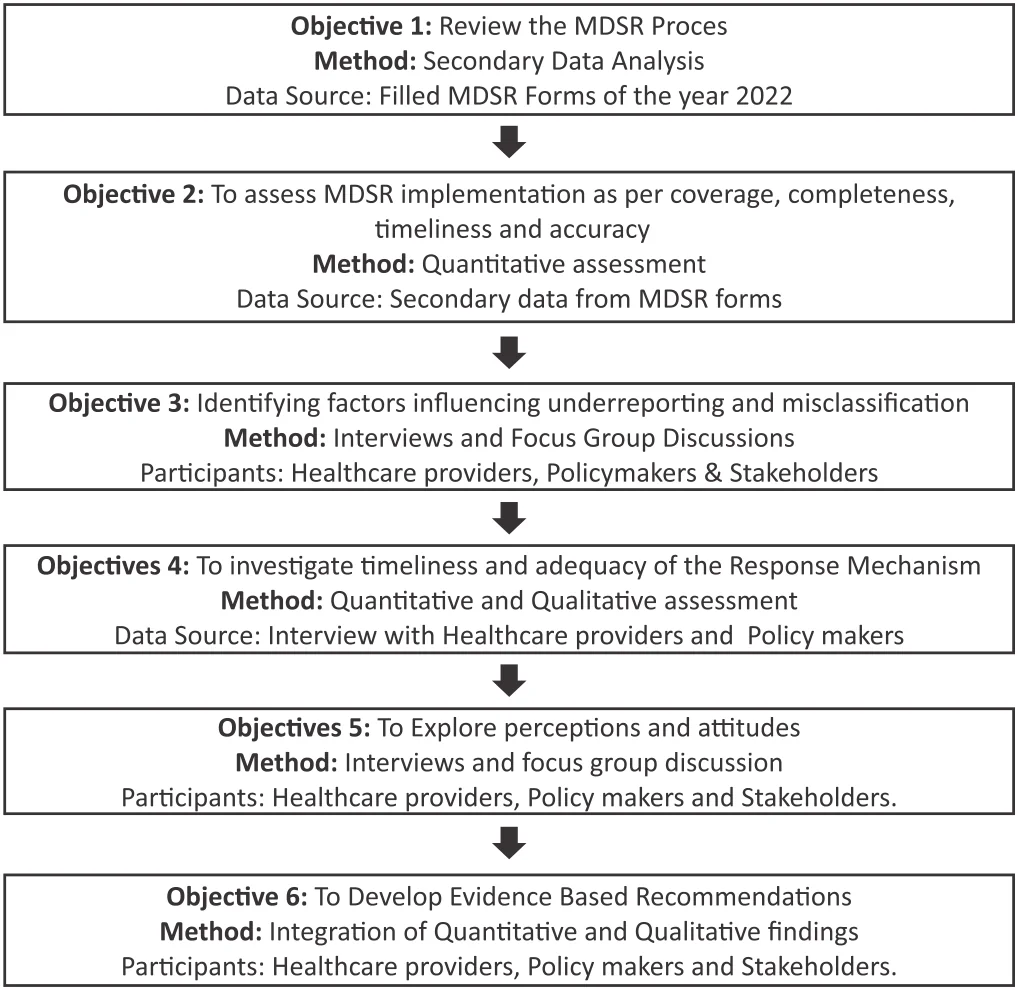
- To review the Maternal Death Review Process in high burden States in the year 2022.
- To assess the state of implementation of the Maternal Death Surveillance and Response (MDSR) process in terms of coverage, completeness, timeliness, and accuracy across high-burden states
- To Identify the factors influencing under reporting and misclassification against 'ICD-10 classification on the causes of maternal deaths'.
- To investigate the timeliness and adequacy of the response mechanism for reporting and review of maternal deaths.
- To explore the perceptions, experiences, & attitudes of healthcare providers and stakeholders toward the MDSR system.
- Develop evidence-based recommendations to enhance the MDSR system and improve maternal health outcomes.
Methodology
It will be a mixed methods study. The quantitative methods will use checklists, questionnaire adapted from guideline and a score-card. The qualitative methods will use indepth interviews / FGD of providers, and other stakeholders.
Study Site Selection
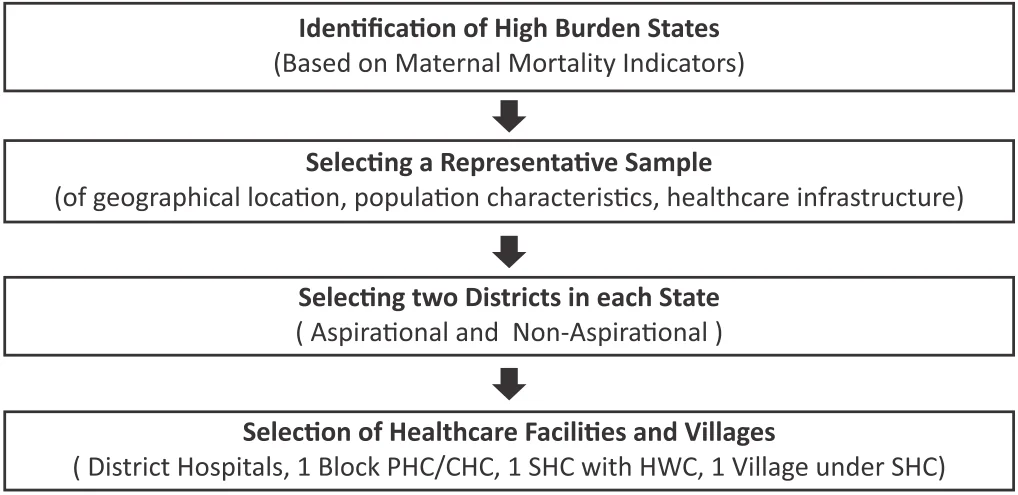
- High burden states in India based on maternal mortality indicators will be identified.
- A representative sample (3 States, one of which in Nort-East) of high-burden states to ensure diversity in geographical locations, population characteristics, and healthcare infrastructure will ne selected.
- Two districts each from 3 States – one Aspirational and one non-aspirational district will be selected.
- In each district – district hospital, one block PHC/CHC, one PHC under block, One SHC /HWC and one village under SHC will be selected.
Data Collection: Study Tools
- Quantitative Data Collection:
- Secondary data from filled in MDSR forms(of the year 2022).
- Standardized checklist to assess the implementation of key components of MDSR Guidelines.
- Surveys/Questionnaires (Adapted from Guidelines) to collect demographic information and to assess knowledge, attitudes, and practices.
- Self- developed Scorecard.
- Qualitative Data Collection
- In-depth interviews with healthcare providers, policymakers, and stakeholders involved in MDSR implementation.
- Focus group discussion to capture diverse perspectives on MDSR including challenges and strategies for improvement.
Study Participants
- Healthcare Providers (Obstetricians, Gynaecologists, Medical Officers, Nurses, Skilled Birth Attendants, ANMs, and ASHAs) involved in the process of MDSR.
- Policymakers and Stakeholders
- Officers from State involved in MDSR process (DC, CMHO, BMO, FNO), nodal officer from MoHFW
Inclusion criteria:
- Health care providers, health officials who are involved in the MDSR process from the public sector.
Exclusion criteria:
- Health officials from private hospitals
- Maternal deaths due to accidental or incidental causes
Consent: Participation is voluntary and consent will be sought for participation in the study.
Data Analysis: Quantitative Data:
- MDSR data will be analyzed using descriptive statistics, focusing on the completeness, timeliness, and accuracy of reporting, identification of causes of maternal deaths, and subsequent action taken.
- Statistical analysis of survey/ questionnaire data will be conducted to identify knowledge gaps and perceptions of healthcare providers.
Qualitative Data
- Transcription and analysis of the in-depth interview and focus group discussion data using the Thematic Analysis approach will be done.
- Emerging themes related to challenges in the implementation, gaps in knowledge and skills will be identified, and recommendations for improvement will be given.
Ethical Considerations:
Ethical clearance from the respective Institutional Review Board will be taken
Limitations:
The study's generalizability may be limited to the selected high-burden states.
Conflict of interest:
None
Acknowledgments
Valuable inputs and constant motivation from Dr. K Madangopal, Advisor (Public Health Administration), NHSRC, MoHFW, Government of India.
References
- India on verge of achieving SDG target of Maternal Mortality Ratio (MMR) of 70/ lakh live births by 2030 [Internet]. [cited 2023 May 23]. Available from: https://pib.gov.in/pib.gov.in/Press release share.aspx? PRID=1805731
- Meh C, Sharma A, Ram U, Fadel S, Correa N, Snelgrove J, et al. Trends in maternal mortality in India over two decades in nationally representative surveys. BJOG Int J Obstet Gynaecol. 2022;129(4):550-61. [Google Scholar]
- Population NRC (US) C on, Reed HE, Koblinsky MA, Mosley WH. Evidence on The Consequences of Maternal Mortality. In: The Consequences of Maternal Morbidity and Maternal Mortality: Report of a Workshop [Internet]. National Academies Press (US); 2000 [cited 2023 Jul 25]. Available from: https://www.ncbi.nlm.nih.gov/books/NBK225436/
- Miller S, Belizán JM. The true cost of maternal death: individual tragedy impacts family, community, and nations. Reprod Health. 2015 Jun 17;12(1):56. [doi:10.1186/s12978-015-0046-3]
- Guideline_for_MDSR.pdf [Internet]. [cited 2022 Sep 30]. Available from: https://www.nhm.gov.in/ images/pdf/ programmes/maternal-health/ guidelines / Guideline_ for_MDSR.pdf
- Smith H, Ameh C, Roos N, Mathai M, Broek N van den. Implementing maternal death surveillance and response: a review of lessons from country case studies. BMC Pregnancy Childbirth. 2017 Dec;17(1):233. [doi:10.1186/s12884-017-1405-6]
- World Health Organization. Regional Office for South-East Asia. Study on the implementation of maternal death review in five countries in the South-East Asia Region of the World Health Organization [Internet]. WHO Regional Office for South-East Asia; 2014 [cited 2022 Aug 15]. Available from: https://apps.who.int/iris/handle/ 10665/205952
- Beyond the numbers [Internet]. [cited 2022 Sep 17]. Available from: https://www.who.int/ publications-detail-redirect/9241591838
- World Health Organization. Maternal death surveillance and response: technical guidance information for action to prevent maternal death [Internet]. Geneva: World Health Organization; 2013 [cited 2023 Mar 29]. Available from: https://apps.who.int/iris/handle/10665/8 7340
- Kansal A, Garg S, Sharma M. Moving from maternal death review to surveillance and response: A paradigm shift. Indian J Public Health. 2018;62(4):299-301. [doi:10.4103/ijph.ijph_37_18]
- Time to respond: a report on the global implementation of maternal death surveillance and response (MDSR) [Internet]. [cited 2022 Sep 25]. Available from: https://www.who.int/ publications-detail-redirect/9789241511230
- Kumar MS, Metilda RSA. Confidential review of maternal deaths in a South Indian state: current status and the way forward. Sex Reprod Health Matters [Internet]. 2021 Dec 20 [cited 2022 Jun 21]; Available from: https://www.tandfonline. com/doi/ abs/10.1080/ 26410397. 2021. 2009657
- Vora KS, Mavalankar DV, Ramani KV, Upadhyaya M, Sharma B, Iyengar S, et al. Maternal Health Situation in India: A Case Study. J Health Popul Nutr. 2009 Apr;27(2):184-201. [doi:10.3329/jhpn.v27i2.3363]
- Vora KS, Saiyed SL, Yasobant S, Shah SV, Mavalankar DV. Journey to Death: Are Health Systems Failing Mothers? Indian J Community Med Off Publ Indian Assoc Prev Soc Med. 2018;43(3):233-8. [doi:10.4103/ijcm.ijcm_57_18]

Published
Article metrics
- Views
- 910
- Downloads
- 483
Based on this site's usage statistics.