Original Article Vol. 3 No. 1 (2019): International J of Health Systems and Implementation Research
Electronic Vaccine Intelligence Network (eVIN): Are Cold Chain Handlers Supporting this m Health? An Application of Kurt Lewin Theory of Change Management.
Downloads
Topics
Keywords:
- eVIN, Cold chain,Cold chain handler, Immunization
Abstract
Background: The success of the immunization programme depends on timely reporting of stock- outs and thereby ensuring its availability. Electronic Vaccine Intelligence Network (eVIN) was introduced for real-time stock visibility and stock register maintenance. Objectives: The study aimed to conduct a situational analysis of eVIN and to explore various challenges faced by cold chain handler. Methodology: An observation study was carried on cold chain handler of all the 29 PHCs, where eVIN was introduced. Findings: Cold chain handlers were deputed at all the blocks. All the cold chain handlers were literate and had received eVIN training. The open vials were labelled during issuing and after a return. At most of the blocks, the stocks were updated in eVIN on utilisation, on receipt, stock count and discarded stocks. The stocks were updated mostly daily (69%), followed by twice daily and twice weekly. Most of the respondents either contact district cold chain manager or the technical support or discussed with seniors/ colleagues when they faced any problem. One- fifth of participants had difficulty in either handling a smartphone or in the network connection. Participants suggested that there should provision of the 3G network, additional training and auto- selection for updating VVM status. These challenges were used to study the sustainability of eVIN based on Kurt Lewin theory of change management. Conclusions: Electronic vaccine intelligence network has made the management of vaccine stocks much simpler for cold chain handler
Full text
This web version was prepared from the published PDF, which is the version of record. Please cite and quote from the PDF.
Introduction
While India has made tremendous progress in eradicating polio and eliminating neonatal tetanus, the country is home to ten million under-immunised children, about a fifth of the total among Global Alliance for Vaccines and Immunization (GAVI) supported countries. According to National Family Health Survey (NFHS) - 4 (2015-16), about 62% of children of age 12-23 months in India are fully immunized, and in Bihar, this percentage is 61.7%.[1]
The success of the immunization programme depends mainly on timely reporting of stock-outs and thereby ensuring vaccine availability. The role of the supply chain is to provide sufficient vaccine storage, handling, and stock management; rigorous temperature control in the cold chain; and maintenance of adequate logistics management information systems. Thus, the ultimate goal of the immunization program is to ensure uninterrupted vaccine availability at service delivery levels, so that no child misses the opportunity of being vaccinated.
The current vaccine logistic system in the country varies from district to district. One of the major reasons for the ad-hoc management at various levels of the supply chain is the limited visibility of stocks at each node, ‘a coal mine effect’. ‘Deep Dive Study’ conducted by the Immunization Technical Support Unit (ITSU) brought forward the end-to-end issues with vaccines (with diluents and syringes), supply chain and root causes for the stock-outs such as lack of real-time stock visibility across all levels and improper record of returned vaccines and stock register maintenance.[2]
To answer these fundamental issues, United Nations Development Programme (UNDP), in partnership with Ministry of Health and Family Welfare and GAVI designed and implemented electronic Vaccine Intelligence Network (eVIN), that enables real-time information on cold chain temperature and vaccine stocks and flows at all points of the cold chain, from the dispatch of vaccines from the state offices, to the Primary Health Centers (PHCs) where auxiliary mid-wives administer the vaccines.
However, any change which is introduced in the health system has some facilitating factors and some refraining factors. The identification and evaluation of these factors and planning and implementing operations makes sure that the change is worthwhile and relevant.[3] Managing change is a complex, dynamic and challenging process.[4] It is never a choice between technological or people-oriented solutions but a combination of all.
Health care administrators face challenges in introducing any new technology or initiatives such as electronic health records, mobile health and quality improvement initiatives. The philosophies of John Kotter and William Bridges, scholars in ‘Change Management Project’, provide an insight to the administrators regarding the successful implementation of the programme. Kotter[5] proposed that organizational change can be managed using a dynamic, nonlinear 8-step approach - increase urgency, build guiding teams, get the vision right, communicate for buy-in, enable action, create short-term wins, don’t let up, and make it stick.
Kotter organizes each of these steps into three distinct phases. The first phase is called “creating a climate for change” and includes first three steps of the eight step regime. The second phase, “engaging and enabling the whole organization,” consists of the next three steps. The final phase, ‘implementing and sustaining the change’ encompasses the final two of the eight steps. William Bridges[6] believes that it is not change that determines the success or failure of a project; but it is the transitions. For Bridges, changes are situational, whereas transitions are more psychological.
Kurt Lewin[7] also developed his 3-Step model of change management. The first step of ‘unfreezing’ was to destabilize before old behaviour can be discarded or unlearnt and new behavior can be successfully adopted. The second step of ‘moving’ is to implement the change and the third step is ‘refreezing’, which seeks to stabilize the group at a new quasi-stationary equilibrium to ensure that the new behaviours are relatively safe from regression.[8–10]
Promoting change is both demanding and fatiguing. Thus, bringing about any change and its proper execution requires the commitment on the part of the manager.[11]
Thus, it was deemed necessary to study the behaviour and the acceptance level of staff towards eVIN. In the current study, we have attempted to superimpose the Kurt Lewin three-step theory of change, with the ongoing change process of stock management from paper-based to web-based/mobile based.
On an average, one CCP (Cold Chain Point) caters to 176 session sites and the majority of the session sites (more than 70 per cent) in Bihar are within the range of 30 km from respective CCP. The National Cold Chain Management Information System (NCCMIS), which provides the baseline data of cold chain space, storage capacity, distribution of equipment, etc. was defunct in Bihar and all the aforementioned information was unavailable.[12] So, there was an urgent need felt by State Task Force to increase the available cold chain space across the stores in the state. This study was performed with the objectives to conduct a situational analysis on the functioning of eVIN and to explore various challenges faced by cold chain handlers after eVIN introduction.
Methodology
A cross-sectional observational study was conducted at all the existing 39-cold chain points of Patna district over a period of 3 months from February to April, 2017. The cold chain handlers were enquired about the functioning of eVIN. A semi-structured questionnaire was used to collect data, which was pre-designed and pre-tested. Before data collection, ethical clearance from ethical committee of AIIMS- Patna was taken. Investigators had imparted training for administration of the questionnaire before the data collection. The eVIN equipment, stock registers and the mobile applications were physically verified at each cold chain points. The cold chain handlers were asked about their experiences and challenges after introduction of eVIN. Both close-ended and open-ended questions were asked. Cold chain handlers were also probed about their approach in case of any difficulty faced. The investigators also sought their suggestions for improving eVIN.
Supportive supervision: This opportunity was utilized to educate the cold chain handlers that the focus of eVIN was towards transition and not changing in totality. They had to update the availability of stock of vaccines and logistics by eVIN application for better management while retaining the previous way of updating the registers. Cold chain handlers were very cooperative, keen to learn and improvise. Our visit and guidance boosted the skills they had acquired during training sessions. They were asked to update the data during our visits in order to ensure that they learn the technique.
The statistical analysis was done using SPSS version 22(IBM). The analysis of data was done only for 29 CCPs; data was insufficient for the remaining 10 CCPs. The data were analyzed in a descriptive manner and the result was expressed as a proportion.
The introduction of eVIN can be viewed as a change. In our study, we tried to relate force-field analysis of Kurt Lewin Theory with the experience of cold chain handlers. The driving and restraining forces, thus identified in the study, can be used to make the change sustainable.
Results
Details of Cold chain handlers:
Cold chain handlers were deputed at all the blocks surveyed. However, these posts of cold chain handlers were filled by utilising the existing human resource. Auxiliary nurse midwifes were mostly deputed as cold chain handlers. Others included clerk, Family Planning Worker (FPW), lab technician, sanitary inspector, swasthya sevak, male FPW and basic health workers. All the cold chain handlers were literate; most were either graduate (14, 48.3%) or intermediate pass (14, 48.3%). Except one, all the cold chain handlers (96.5 %) were trained in the past 3 years and all cold chain handlers had received eVIN training. [Table 1]
| n | (%) | |
|---|---|---|
| Presence of cold chain handler | 29 | 100.0 |
| No. of cold chain handlers who have received training in the last 3 years | 28 | 96.5 |
| No. of cold chain handlers who have received eVIN training | 29 | 100.0 |
Situational Analysis of the performance of eVIN:
The open vials were labelled during issuing and after return in approximately 90% of blocks. The cold chain handlers were enquired for updating stocks in eVIN. The stocks were updated in eVIN on utilization in more than 90% of blocks; in about 80% of blocks on receipt and stock count. The discarded stocks were updated in 21 (72.4%) blocks. However, the stock update on the export of inventory was done only in 1 of the CCPs. The entry under open vial was done in all 29 blocks; while it was done in 28 (96.5%) PHCs during routine immunizations; and in 26 (89.7%) PHCs during campaigns.
The stocks were updated in eVIN mostly daily (69%), followed by twice daily in only 3 (10.3%) PHCs. At three CCPs, it was updated twice weekly on Wednesday and Friday. The stock was updated on eVIN 3-4 times weekly at one CCP and after each session at another CCP. There was one centre, where the stocks were not updated for the last 11 months.
The cold chain handlers were asked an open ended question about their approach in case they faced any problem. In most of the cases (10, 34.5%), they responded that they contact the district cold chain manager. One-fifth (6, 20.7%) contact the technical support provided on eVIN, while another one-tenth (3, 10.3%) discussed their problems with seniors/ colleagues. At two centres, the stocks were updated the next day in case of network breakdown. One-fourth of the participants gave no response.
The cold chain handlers were then enquired how quickly they received a response. One-fifth of them were responded immediately and another one-fifth within two days. Three cold chain handlers were responded within 1 day. Half of the participants however didn’t answer this question.
| N | % | |
|---|---|---|
| Labelling of open vials during issuing and after return | 26 | 89.7 |
| Updating eVIN | ||
| Updating eVIN utilization | 27 | 93.1 |
| Updating eVIN receipt | 24 | 82.8 |
| Updating eVIN stock count | 23 | 79.3 |
| Updating eVIN discards | 21 | 72.4 |
| Updating eVIN export of inventory | 1 | 3.5 |
| Entry under RI vaccines | 28 | 96.5 |
| Entry under open vial | 29 | 100.0 |
| Entry under campaign | 26 | 89.7 |
| Frequency of Updating of stock in eVIN | ||
| Once daily | 20 | 69.0 |
| Twice daily | 3 | 10.3 |
| Twice weekly on Wednesday and Friday | 3 | 10.3 |
| Three to four-times weekly | 1 | 3.4 |
| After each session | 1 | 3.4 |
| Not updated for 11 months | 1 | 3.4 |
| The approach towards the problem-solving | ||
| Technical support using toll-free no | 6 | 20.7 |
| Contact District Cold chain manager | 10 | 34.5 |
| Contact District eVIN manager | 1 | 3.4 |
| Discuss the problem with seniors/ colleagues | 3 | 10.3 |
| In the case of a network breakdown, Updating is done next day | 2 | 6.9 |
| No response | 7 | 24.1 |
| Readiness to respond | ||
| Immediately | 6 | 20.7 |
| Within 1 day | 3 | 10.3 |
| Within 2 days | 6 | 20.7 |
| No response | 14 | 48.3 |
Challenges faced by Cold chain handlers in handling eVIN
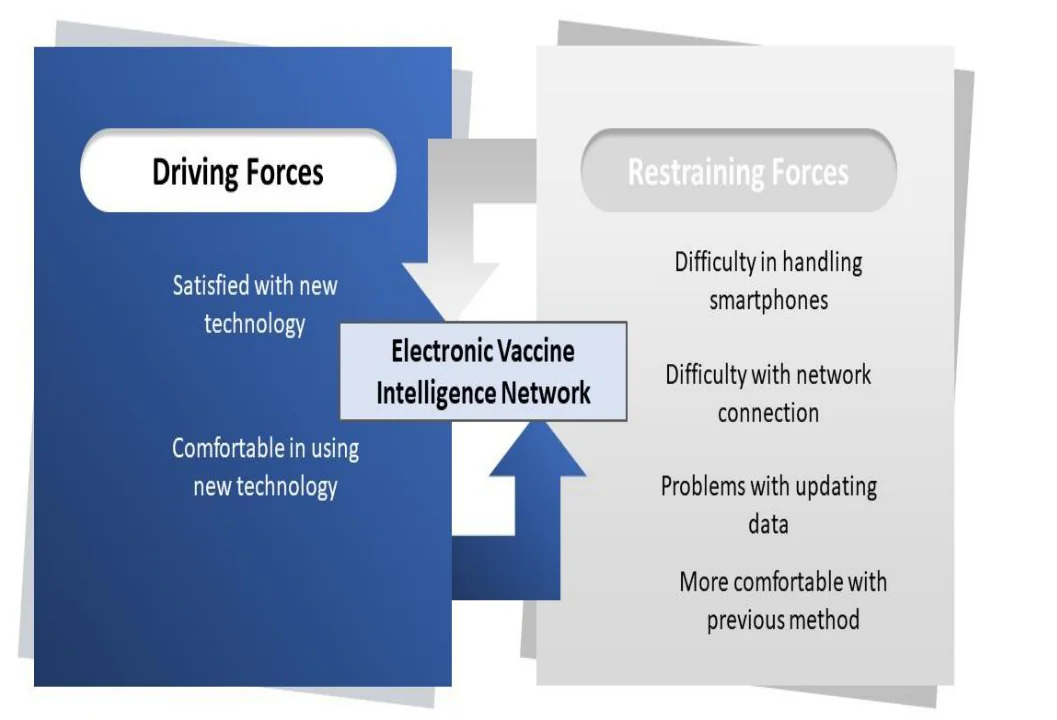
Most of the cold chain handlers were satisfied (25, 86.2%) and comfortable (24, 82.8%) with the new technology of eVIN. On being enquired about the challenges faced by them on working on eVIN, one- fifth of them had difficulty in handling smartphone (6, 20.7%) and another one-fifth had trouble with network connection (6, 20.7%). Three of them (10.3%), reported that they had difficulty in updating data and another two (6.9%) found the previous method of updating the stock better than eVIN.
The cold chain handlers were then enquired about their suggestions on tackling their problems. Most basic tips given were; the provision of the 3G network in eVIN (6.9%), additional training (6.9%) and auto-selection for updating VVM status (6.9%). Few participants also suggested that there should be the provision of correction of filled data (3.5%) and entry of logistic details in eVIN (3.5%).
| n | (%) | |
|---|---|---|
| No. of cold chain handlers who were satisfied with new technology | 25 | 86.2 |
| No. of cold chain handlers who were comfortable with new technology | 24 | 82.8 |
| Challenges as stated by cold chain handlers | ||
| Difficulty in handling smartphone | 6 | 20.7 |
| Difficulty with the network connection | 6 | 20.7 |
| Problems in updating data | 3 | 10.3 |
| Felt that the previous method was better for updating of stock | 2 | 6.9 |
| Recommendations suggested by the cold-chain handlers | ||
| Provision of 3G network | 2 | 6.9 |
| Requirement of the additional training session | 2 | 6.9 |
| Provision of entry of logistics details in eVIN | 1 | 3.5 |
| Auto-selection for updating VVM status | 2 | 6.9 |
| Provision of correction of filled data | 1 | 3.5 |
These challenges represent the complex set of the behaviour of the staff as postulated by Kurt Lewin in his Force Field Theory.[7] According to this theory, the change; which in this case is the introduction of eVIN, can be made permanent only when a balance between the driving and restraining factors is maintained. Once the new equilibrium is formed, it can be ensured that the staff will accept the change in the system. [Figure 1]
Discussion
The mobile health initiative launched for improving vaccine management system is an innovation that focuses on strengthening the logistics system by capturing real-time data and conducting bottle-neck analysis for appropriate and timely action. A similar intervention of using the cloud-based mobile phones; named ‘logistics’ was also introduced in the Republic of South Sudan.[13] The response to the new tool was positive at the staff level, as it could tide over the severe data barriers to transmission of stock levels. Likewise, to improve data accuracy, timeliness and increased immunization rates, a successful introduction of the mobile phones equipped with special software was also made in Mozambique.[14]
In the current study, the identified driving forces were the satisfaction with the new technology and the ease of operation. Whereas, the restraining forces identified were difficulty in handling a smartphone, difficulty with network connection, the problem with updating data and having greater comfortable with the previous method (Figure 1). Although many restraining forces were identified, after the implementation of the initiative the overall situation of vaccine management in health facilities, district vaccine stores, and regional vaccine stores improved.
Addressing the identified inhibitory forces will lead to a permanent change in the system. Supportive supervision by medical college faculties and their on-the-spot advice can result in sustained improvement in the accepted global vaccine management indicators.
Conclusion
Electronic vaccine intelligence network has made the management of vaccine stocks much simpler. The eVIN is a mobile and web app that enables real-time visibility of vaccine stocks across all cold chain points encouraging effective vaccine logistics management. It will help improve vaccine coverage in India, a country with the world’s largest birth cohorts. The eVIN is plugging gaps to improve vaccination systems in India and addressing the restraining force as perceived by the cold chain handlers will help to embed this change in the system.
Ethical Approvals
This study had ethical clearance by the Institute Ethical Committee of AIIMS, Patna.
Conflict of Interest
None declared.
Acknowledgements
None.
References
- NFHS-4. Bihar: MOHFW, GOI, http://rchiips.org/NFHS/pdf/NFHS4/BR_FactSheet.pdf (2016 2015, accessed 23 May 2019).
- How eVIN (electronic Vaccine Intelligence Network) Can save a life !! Issuu, https://issuu.com/itsuorg/docs/electronic_vaccines_intelligence_ne_b5756f15a0a0bb (accessed 23 May 2019).
- McConnell CR. Umiker’s management skills for the new health care supervisor. Jones & Bartlett Learning, 2016. [Google Scholar]
- Mabey C, Mayon-White B, Mayon-White WM. Managing change. Sage, 1993. [Google Scholar]
- Campbell RJ. Change management in health care. The health care manager 2008; 27: 23–39. [doi:10.1097/01.hcm.0000285028.79762.a1]
- What is William Bridges’ Transition Model? William Bridges Associates, https://wmbridges.com/what-is-transition/ (accessed 23 May 2019).
- Burnes B. Kurt Lewin and the Planned Approach to Change: A Re-appraisal. Journal of Management Studies 2004; 41: 977–1002. [doi:10.1111/j.1467-6486.2004.00463.x]
- Freed DH. Please don’t shoot me: I’m only the change agent. The Health care supervisor 1998; 17: 56–61. [Google Scholar]
- Appelbaum SH. Managing Organizational Behaviour: A Canadian Perspective. Dryden, 1995. [Google Scholar]
- Armenakis AA, Harris SG, Mossholder KW. Creating readiness for organizational change. Human relations 1993; 46: 681–703. [doi:10.1177/001872679304600601]
- Weiss WH. Change: how to bring it about and meet its challenge. Supervision 1998; 59: 9–11. [Google Scholar]
- Bassi A, John O, Praveen D, et al. Current Status and Future Directions of mHealth Interventions for Health System Strengthening in India: Systematic Review. JMIR Mhealth Uhealth; 6. Epub ahead of print 26 October 2018. DOI: 10.2196/11440.
- Gargar M. South Sudan deploys new mobile phone-based stock management tool. OPTIMIZE, 2012, https://www.who.int/immunization/programmes_systems/supply_chain/optimize/Optimize-newsletter-october-2012.pdf (2012, accessed 21 May 2019).
- Mobile Phones to Transform Vaccine Management in Mozambique - Devex Impact | Devex, https://www.devex.com/impact/partnerships/mobile-phones-to-transform-vaccine-management-in-mozambique-382 (accessed 23 May 2019).
Published
Article metrics
- Views
- 2,027
- Downloads
- 1,666
Based on this site's usage statistics.