Original Article Vol. 4 No. 1 (2020): International J Health Systems and Implementation Research
Post Flood Health Relief Response: An experience from AIIMS Patna
Downloads
Topics
Keywords:
- Health relief response, Flood, Disaster
Abstract
Background: Patna, the state capital of Bihar in India experienced a devastating flood due to unprecedented rains in September 2019. There was indiscriminate damage to housing, communication and transport networks, and health facilities affecting the lives of thousands of people. Objectives: To assess the morbidity profile of patients attending the health response camps conducted in different regions of Patna by AIIMS Patna team during the post-flood period. Methodology: On the direction of Government officials, eleven flood relief health response team of AIIMS Patna was formed on the evening of 4th October 2019. All the required logistic were arranged within next 12 hours and the teams started working from 5th of October 2019. Data were collected regarding age, gender, presenting health problems and history of any chronic diseases using Google form. The total number of patients attending the camps was 3511. Real-time data analysis was done using cloud based google sheets. Results: In the camp it was found that the common health problems reported by the cases were of itching (19.2%) followed by cough (14.7%) and fever (11.7%). About 13% (448) cases were having history of chronic non-communicable diseases. Maximum cases reported in our camp was on 8th October 2019, which was 30.5% (1072). Conclusions: Rapid action by government and the health system averted epidemic outbreaks. However, strengthening of existing health care systems and sanitation measures is required to handle such disasters.
Full text
This web version was prepared from the published PDF, which is the version of record. Please cite and quote from the PDF.
Introduction
Floods are the most common disasters globally, and were responsible for 53,000 deaths worldwide in the last ten years. A flood causes major loss of both life and property. The resultant disturbance of transportation, communication and unavailability of clean water affects the human health [1]. The onset of a flood results in higher infectious disease burden. Flooding is associated with an increased risk of infection; population displacement, inadequate shelter conditions, degree of overcrowding, consumption of contaminated water, improper sanitation, underlying health status of population, malnutrition, local disease ecology, and difficulty in access of health care services [2]. Bihar is located in the eastern region of India, it is an entirely land-locked state under the sub-tropical region of the temperate zone. It is bounded by Nepal in the north, and by the state of Jharkhand, India in the south. Rainy season occurs mainly from June to September; with a rain-fall ranging from 1250 mm to 1400 mm. There are two distinct regions which divide Bihar into two parts viz. north of Ganges river and south of Ganges river. Patna lies south of the Ganges river [3]. Being situated on the bank of river Ganges, Patna lies in an area liable to floods as per the flood hazard map (http://bmtpc.org/) of Bihar. Various infectious disease outbreaks have been reported following floods in developing countries, and these outbreaks vary in magnitude and rates of mortality [4].
This year in 2019, during the entire emergency period, the National Disaster Response Force (NDRF) team rescued two persons and evacuated 9490 persons. They provided medical assistance to 5806 needy people in Bihar. A total of 17 relief camps were run across the state on directives of the State Government; displaced people were accommodated in these relief camps [5]. With this background our study aimed to assess the morbidity profile of patients attending the health response camps conducted in different regions of Patna by AIIMS during the post flood period.
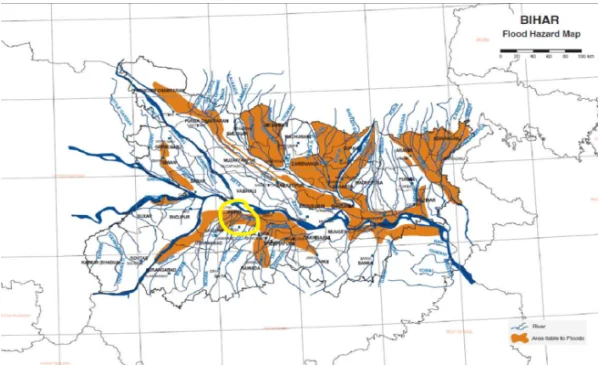
Methodology
Study design – Cross sectional study
Study setting – Nine different flood affected areas of Patna district, Bihar
Study duration – 2 weeks
Study participants – All the patients who came to the flood health relief response camp to seek medical advice were included.
Sampling technique – Total enumeration
Data collection - The questionnaire for data collection from the health response camps was developed using an online platform using Google forms. A ‘Whatsapp’ group of flood response team was formed. The online form link was shared on this group. Data from each camp was obtained through Google form and stored in Google spreadsheet. A dynamic dashboard (which changed with every data entry) was created for real-time data monitoring and to keep a check on patient flow at each mobile health unit.
Study tools – Data collection was done regarding age, gender, presenting health problems and history of any chronic diseases.
Statistical analysis – Finally the analysis of data was done using the SPSS (version 21) software. The results were expressed as frequency and percentage of the variables.
We used to generate a daily report once all units got closed for the day.
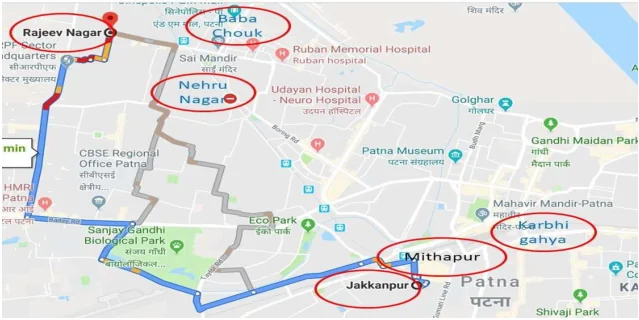
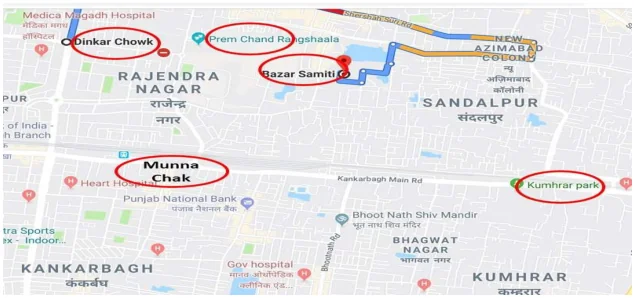
During the five-day camp, 496 person-days were contributed by AIIMS, Patna staff for flood-hit areas. On the 5th and 6th of October, 2019, patients from ‘Bazar Samiti’ areas were served from the nearest camp of Vaishali Chowk. Due to some network error data from the area of Rajiv Chowk could not be captured on first day. About 50 cases were treated this day. On later days some teams were merged for better resource allocation in severely affected areas.
Execution Plan of the flood health relief response camp
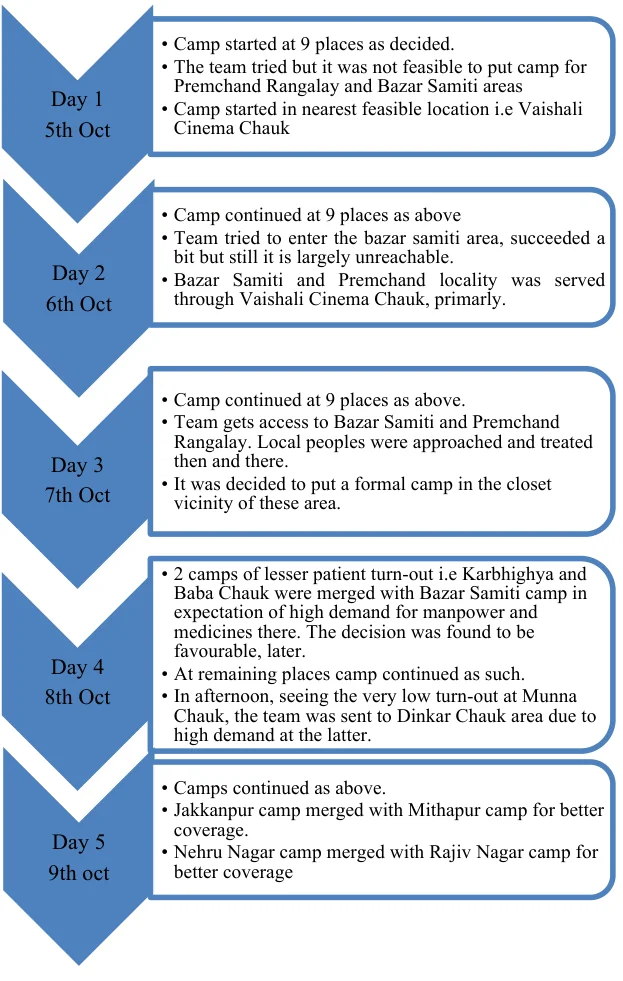
Findings
The relief teams attended a total of 3511 cases, during the five days of health camp. Table 1 shows the date-wise details of number of patients. About 13% (448) cases were having history of chronic non-communicable diseases (diabetes, hypertension, asthma, Chronic Obstructive Pulmonary Disease & hypothyroidism) as shown in table 2. From table 3, it is evident that maximum cases were of itching (19.2%), followed by cough (14.7%), and fever (11.7%). About 6% cases presented with diarrhoea and loose stools, while 5% cases had weakness as their primary complaint.
| Team Location | Dates | Grand Total | ||||
|---|---|---|---|---|---|---|
| Oct-5 | Oct-6 | Oct-7 | Oct-8 | Oct-9 | ||
| Baba Chauk | 48 | 30 | 60 | 138 | ||
| Bazar Samiti Chauk | 26 | 102 | 60 | 406 | 116 | 710 |
| Dinkar Chauk | 38 | 84 | 77 | 108 | 103 | 410 |
| Jakkanpur | 19 | 23 | 39 | 61 | 142 | |
| Karbighaiya | 34 | 38 | 80 | 152 | ||
| Kumhrar Park | 68 | 74 | 94 | 62 | 298 | |
| Mithapur | 39 | 42 | 37 | 70 | 67 | 255 |
| Munna Chauk | 40 | 23 | 37 | 16 | 116 | |
| Nehru Nagar Chauk | 28 | 83 | 87 | 79 | 122 | 399 |
| Rajiv Nagar Chauk | 52 | 98 | 121 | 271 | ||
| Vaishali Cinema Chauk | 36 | 135 | 119 | 149 | 181 | 620 |
| Grand Total | 376 | 686 | 788 | 1072 | 589 | 3511 |
| Case | Frequency | Percentage (%) |
|---|---|---|
| Diabetes | 132 | 3.7 |
| Hypertension | 218 | 6.2 |
| Asthma/COPD | 42 | 1.2 |
| Hypothyroidism | 56 | 1.6 |
| Total | 448 | 12.7% |
| Primary Complaint | Gender | ||
|---|---|---|---|
| Female (%) | Male (%) | Grand Total (%) | |
| Abscess | 3 (0.08%) | 11 (0.31%) | 14 (0.39%) |
| Backache | 33 (0.93%) | 55 (1.56%) | 88 (2.5%) |
| Breathlessness | 18 (0.51%) | 32 (0.91%) | 50 (1.4%) |
| Chest Pain | 14 (0.39%) | 39 (1.11%) | 53 (1.5%) |
| Cough | 145 (4.12%) | 374 (10.6%) | 519 (14.8%) |
| Diarrhoea | 54 (1.53%) | 162 (4.61%) | 216 (6.2%) |
| Dizziness | 25 (0.71%) | 50 (1.42%) | 75 (2.1%) |
| Dysentery | 10 (0.28%) | 18 (0.51%) | 28 (0.8%) |
| Fever | 119 (3.38%) | 294 (8.37%) | 413 (11.7%) |
| Headache | 49 (1.39%) | 89 (2.53%) | 138 (4%) |
| Injury | 14 (0.39%) | 74 (2.1%) | 88 (2.5%) |
| Itching | 142 (4.04%) | 533 (15.18%) | 675 (19.2%) |
| Pain abdomen | 67 (1.9%) | 105 (2.99%) | 172 (4.9%) |
| Pain-Generalized | 60 (1.7%) | 105 (2.99%) | 165 (4.7%) |
| Pain-Localized | 89 (2.53%) | 192 (5.46%) | 281 (8%) |
| Rash-Generalized | 13 (0.37%) | 13 (0.37%) | 26 (0.7%) |
| Rash-Localized | 13 (0.37%) | 30 (0.85%) | 43 (1.2%) |
| Swelling | 12 (0.34%) | 38 (1.08%) | 50 (1.4%) |
| Taenia Infection | 11 (0.31%) | 27 (0.76%) | 38 (1.1%) |
| Ulcer/Wound | 22 (0.62%) | 82 (2.33%) | 104 (3%) |
| Upper Respiratory Tract Infection | 23 (0.65%) | 26 (0.74%) | 49 (1.4%) |
| Urinary Tract Infection | 2 (0.05%) | 6 (0.17%) | 8 (0.2%) |
| Vomiting | 19 (0.54%) | 26 (0.74%) | 45 (1.3%) |
| Weakness | 74 (2.1%) | 99 (2.81%) | 173 (5%) |
| Grand Total | 1031 (29.4%) | 2480 (70.6%) | 3511 (100%) |
Discussion
Floods are caused by natural factors or by a combination of natural and human factors. Risk from a flood is the probability of loss, this can be expressed as: Risk = Hazard × Vulnerability [6, 7]. The hazards of flood depend on the magnitude of flood depth, velocity, and duration. Vulnerability may be defined as the conditions determined by physical, social, economic, and environmental factors, which increase the susceptibility of a community to the impact of hazards. If flood water enters the habitation of people and infrastructure, then the vulnerability of people and infrastructure is liable for harm and damage. In urban areas impact of floods are significant in terms of economic losses, both direct and indirect. This is due to high density of population, large impervious areas, clogged of drainage systems, high economic value of property and infrastructure, etc. Better flood emergency response mechanisms help reduce potential secondary losses. While in rural areas, the damages due to floods are mostly direct – in terms of loss of agricultural production. In our study it was found that the commonest complaint of cases were itching, followed by cough. In a similar study done after Chennai floods the most common cases were of acute respiratory infections, followed by gastroenteritis [8]. The results of a study done in Pakistan by Ahmad et al. showed that the distribution of infectious disease cases presented to relief camps were gastrointestinal cases (acute diarrhoea) – 30%, skin and soft tissue infection (33%), eye infection (Conjunctivitis) – 07%, ear, nose and throat infection (05%), respiratory tract infection (21%), and suspected malaria (4%) [9]. In another study done in Taiwan by Lin et al. there was a higher percentage of female cases (66.7%) than males (33.3%). Whereas, in our study more percentage was of male cases (70.6%) [10]. In a study done in Nepal by Kafle et al. it was found that waterborne infectious diseases and mental disorders were prominent diseases during the post-flood period [11]. However, in our study no mental disease case was reported. Our study was done only in some of the flood relief health response camps in certain areas of Patna district. The health response camps were arranged immediately after the flood and no follow-up health response camps were held in the same area.
We conclude from the study that there were large number of cases of itching and fever, but there was no need for hospitalization for any of these cases. Some cases also had a history of chronic non-communicable diseases. Also, there was no epidemic of dengue or cholera or other waterborne diarrhoeal diseases. It is important to provide health relief response camps during floods, however basic sanitation and hygiene should also be maintained.
Ethical Approvals
Declaration of Helsinki have been followed throughout the study.
Conflict of Interest
None declared
Acknowledgements
We are thankful to State Government officials, medical superintendent of AIIMS, Patna, faculty members for their guidance and support. We also thank residents, interns, MBBS students, nursing officers and ambulance, vehicle drivers for putting all their efforts to make the flood health response camps successful. There was no financial support in this study.
References
- Menon et al. Study of morbidities in a flood relief camp: observations from kerala 2018. European Journal of Pharmaceutical and Medical Research 2018;5(11):443-445 [Google Scholar]
- Watson JT, Gayer M, Connolly MA. Epidemics after Natural Disasters. Emerg Infect Dis 2007;13(1):1-5. [doi:10.3201/eid1301.060779]
- Government of India, Ministry of Micro, Small and Medium Enterprises, BIHAR STATE PROFIE, 2015-16 http://dcmsme.gov.in/dips/state_wise_profile_16-17/Bihar%20%20State%20Profile.pdf [Last accessed on 31/01/2020]
- Ministry of Home Affairs Disaster Management Division (National Emergency Response Centre) Situation report on Flood/Heavy Rain fall as on 30th September, 2019 at 1800 Hrs. https://www.ndmindia.nic.in/images/gallery/Situation%20report%20as%20on%2030.09.2019%20at%201800%20Hrs.pdf [Last accessed on 31/01/2020]
- Mondal NC, Biswas R, Manna A. Risk factors of diarrhoea among flood victims: A controlled epidemiological study. Indian J Public Health 2001;45:122-127. [Google Scholar]
- Srikantha Herath, Geographical information systems in disaster reduction, Institute of Industrial Science, The University of Tokyo, Japan; 2001. [Google Scholar]
- Tingsanchali T, Keokhumcheng Y. Flood damage functions for surrounding area of Second Bangkok International Airport, Proceedings, International Symposium on Urban Safety of Mega Cities in Asia, Phuket, Thailand, November, 2006; p. 291-300. [Google Scholar]
- Angeline N, Anbazhagan S, Surekha A, Joseph S, Kiran PR. Health impact of Chennai floods 2015: Observations in a medical relief camp. Int J Health Syst Disaster Manage [serial online] 2017 [cited 2018 Oct 6]; 5: 46-8. 7. Available from: http://www.ijhsdm.org/text.asp?2017/5/2/46/213887 [Last accessed on 01 feb 2020]
- Z, Khan AA, Nisar N. Frequency of infectious diseases among flood affected people at district Rajanpur, Pakistan. PJMS, 2011; 27: 866-9. Available from: http://www.pjms.com.pk/index.php/pjms/article/view/975. [Last accessed on 01 feb 2020].
- Lin C, Chen T, Dai C, et al Serological investigationto identify risk factors for post-flood infectious diseases: a longitudinal survey among people displaced by Typhoon Morakot in TAIWAN BMJ Open, 2015; 5: e007008. doi: 10.1136/bmjopen-2014-007008.
- Kafle KR, Dahal RK, Khanal SN. Postdisaster epidemiological assessment of Koshi flood 2008, in Nepal. Int J Health Syst Disaster Manage 2016;4:15-24 [doi:10.4103/2347-9019.175674]
Published
Article metrics
- Views
- 1,417
- Downloads
- 795
Based on this site's usage statistics.