View Point Vol. 9 No. 2 (2025): International Journal of Health Systems and Implementation Research
Adult Immunization in India: Need, Current Status, Challenges, and Way Forward
Adult Immunization in India
Downloads
Topics
Keywords:
- Adult immunization; Challenges; COVID-19; Need; Program; Rationale; VPDs
Abstract
While childhood immunization has been a cornerstone of public health in India, adult immunization remains under-prioritized and given lesser attention. With increasing life expectancy, urbanization, and prevalence of non-communicable diseases, the need for protecting adults from vaccine-preventable diseases (VPDs) is becoming more critical than ever. This paper discusses the rationale for adult immunization in India, assesses its current status, identifies key challenges, and suggests strategies to strengthen adult vaccine uptake in the country. Evidence suggests that adult vaccination significantly reduces morbidity, mortality, and healthcare expenditures, while also improving productivity and quality of life. Despite these benefits, India lacks a universal adult immunization programme, and current recommendations from national advisory bodies remain poorly implemented due to limited awareness, high out-of-pocket costs, weak surveillance systems, and inadequate integration with primary healthcare services. Building upon the experiences from the COVID-19 vaccination campaign, the article highlights policy, system, and implementation-level actions required to institutionalize adult immunization as an integral component of India’s preventive health framework. With strategic investment and sustained political commitment, adult immunization can become a key pillar of preventive healthcare, contributing to healthier ageing and improved population health outcomes.
Full text
This web version was prepared from the published PDF, which is the version of record. Please cite and quote from the PDF.
Introduction
India has made significant strides in childhood immunization, particularly through its Universal Immunization Programme (UIP), targeting vaccine-preventable diseases (VPDs) among children. However, adult immunization remains a relatively neglected area in public health policy and practice. As the population ages and the burden of non-communicable diseases (NCDs), comorbidities, and occupational hazards rises, adult vaccination becomes a crucial tool to reduce morbidity, mortality, and healthcare costs [1, 2]. Recent experiences from the COVID-19 pandemic have further highlighted the need for robust adult immunization systems [3].
The article explores the rationale for adult immunization in India, reviews its current status, highlights the challenges, and provides a roadmap for its future integration into national health priorities.
The Need for Adult Immunization
Changing Demographics and Epidemiology
India's demographic profile is undergoing a rapid transformation, with the proportion of adults (aged 18 and above) increasing significantly. As per the 2021 census projections, over 60% of the population is in the working-age group (15–59 years). Older adults and those with chronic conditions which impairs immune responses such as diabetes, cardiovascular disease, chronic kidney disease, and chronic respiratory illnesses face heightened risks of severe infections like influenza, pneumococcal pneumonia, hepatitis, and herpes zoster [4-6]. Vaccination in adulthood reduces morbidity, mortality, and healthcare expenditure while improving productivity and quality of life. Furthermore, vaccination of high-risk groups such as healthcare workers, pregnant women, and immunocompromised individuals contributes to both direct and indirect protection.
Burden of Vaccine-Preventable Diseases Among Adults
Many VPDs traditionally associated with childhood are increasingly affecting adults. Hepatitis B and C, Human Papillomavirus (HPV) related cancers, tuberculosis, influenza, and pneumococcal infections contribute substantially to adult morbidity and mortality. According to the World Health Organization (WHO), lower respiratory tract infections including influenza and pneumococcal pneumonia are leading causes of death among adults globally [7].
In India, studies have shown that:
Occupational and High-Risk Groups
Healthcare workers, laboratory personnel, sanitation workers, and others in high-risk occupations are more prone to infections such as HBV, tetanus, and influenza [1]. Adult immunization is also vital for people with immunocompromising conditions (e.g., HIV, cancer), travellers, and pregnant women, where immunization can protect both the mother and child (e.g., Tdap, influenza) [11].
Current Status of Adult Immunization in India
Absence of a Universal Programme
India does not currently have a universal adult immunization programme. Some adult vaccines are recommended by professional bodies such as the Indian Association of Preventive and Social Medicine (IAPSM), Indian Academy of Pediatrics (IAP), and National Technical Advisory Group on Immunization (NTAGI), but there is no structured, government-supported delivery mechanism [12].
Policy Framework and Recommendations
The National Technical Advisory Group on Immunization (NTAGI) and Indian Academy of Pediatrics (IAP), in conjunction with the Association of Physicians of India (API) and Indian Medical Association (IMA), have published guidelines for adult immunization. These include recommendations for vaccines such as [12].
- Hepatitis B: For all adults, especially healthcare workers and those with chronic liver disease.
- Influenza: Annual vaccination for adults ≥65 years, pregnant women, and high-risk individuals.
- Pneumococcal Vaccine (PCV, PPSV23): For elderly and persons with chronic conditions.
- HPV Vaccine: For females aged 9–45 years.
- Tetanus-diphtheria (Td) or Tdap: Booster every 10 years, especially for pregnant women.
- Typhoid, Rabies, Japanese Encephalitis: For travellers and region-specific needs.
COVID-19 Vaccination: A Turning Point
The most significant adult immunization drive in Indian history was the COVID-19 vaccination campaign [13]. Launched in January 2021, it targeted adults first and achieved over 2 billion doses administered, showcasing the feasibility of a nationwide adult vaccination programme. This experience has established cold-chain capacity, digital tracking (CoWIN), and public acceptance, which can be leveraged for broader adult vaccination efforts [14].
Limited Uptake and Awareness
Despite available recommendations, vaccine uptake among adults remains low. According to a 2022 study by the Public Health Foundation of India [15], awareness about adult vaccines was below 30% among the general population. Many private hospitals offer adult vaccines, but these are largely out-of-pocket expenses and underutilized.
Challenges in Implementing Adult Immunization
1. Policy and Programmatic Gaps
Unlike the robust infrastructure for childhood immunization under UIP, there is no dedicated policy or programme for adult immunization. Lack of integration with primary healthcare services leads to missed opportunities for vaccination during routine adult visits.
2. Limited Awareness Among Public and Providers
Vaccination is often perceived as a childhood-only intervention. Healthcare providers receive limited training on adult immunization, resulting in low recommendation rates [16].
3. Cost and Access Barriers
Most adult vaccines are not subsidized under public health schemes and are often available only in tertiary care or private facilities, limiting access for rural or economically disadvantaged populations.
4. Surveillance and Data Limitations
There is inadequate disease surveillance and vaccine coverage data among adults, making it difficult to assess disease burden and prioritize immunization strategies. This hinders evidence-based policymaking.
5. Logistics and Cold Chain
While childhood immunization benefits from dedicated cold chain and logistics under UIP, adult vaccines are often excluded from these systems. Ensuring vaccine availability at the point of care remains a challenge.
6. Vaccine Hesitancy
Despite India's success in COVID-19 vaccination, hesitancy around safety, side effects, and misinformation remains a challenge for adult immunization, especially for newer vaccines like HPV or shingles [17].
The Way Forward
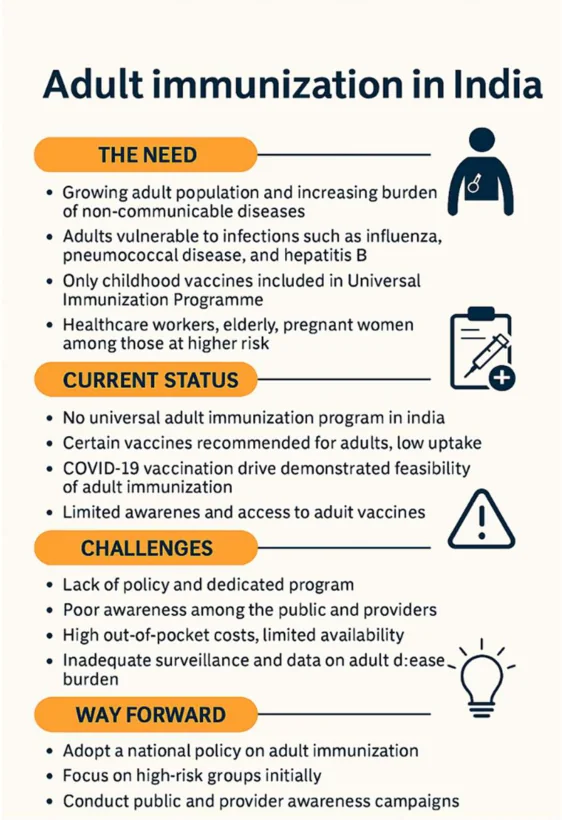
To build a sustainable adult immunization programme in India, a multifaceted strategy is required (Figure 1)
1. Policy Integration and National Programme
There is an urgent need to develop a National Adult Immunization Policy that outlines priority groups, vaccines, funding mechanisms, and integration with existing health systems. Adult immunization should be embedded within Ayushman Bharat’s Health and Wellness Centres and linked to routine NCD care [18].
2. Prioritizing High-Risk Groups
Initial focus can be on vaccinating healthcare workers, elderly, people with comorbidities, pregnant women, and institutionalized individuals, where cost-effectiveness and health impact are highest.
3. Public Awareness and Health Provider Training
Intensified Information, Education, and Communication (IEC) campaigns must be launched to inform the public and debunk myths about adult vaccines. Simultaneously, capacity building of healthcare providers through inclusion in medical curricula and continuing medical education (CME) is crucial.
4. Leveraging COVID-19 Infrastructure
The success of CoWIN, cold-chain improvements, and public-private partnerships during the COVID-19 vaccination drive offer a ready foundation for broader adult immunization efforts. Expanding this infrastructure for multiple vaccines would enhance efficiency [19].
5. Financing and Incentives
Inclusion of key adult vaccines in publicly funded schemes like Ayushman Bharat can improve affordability. Innovative financing models such as employer-sponsored vaccination, insurance coverage, or PPP models can be explored.
6. Research and Surveillance
Regular serosurveys, vaccine coverage monitoring, and disease burden assessments are vital for tracking impact and refining strategies. The establishment of a National Vaccine Registry for adults would be a progressive step [20].
Conclusion
India stands at the cusp of a demographic and epidemiological transition where adult immunization can no longer remain a blind spot in public health policy. The experience gained during the COVID-19 pandemic provides a historic opportunity to institutionalize adult vaccination and protect millions from preventable diseases. With political will, public awareness, and programmatic integration, adult immunization can emerge as a key pillar of India’s preventive health system.
A paradigm shift is needed from treating vaccination as a one-time childhood intervention to viewing it as a lifelong investment in health.
Source of Funding
Nil
Conflict of Interests
None declared
References
- Koul PA, Swaminathan S, Rajgopal T, Ramsubramanian V, Joseph B, Shanbhag S, Mishra A, Raut SK. Adult immunization in occupational settings: A consensus of Indian experts. Indian Journal of Occupational and Environmental Medicine. 2020 Jan 1;24(1):3-15. [doi:10.4103/ijoem.ijoem_50_20]
- Gottfredson LS. The transition to noncommunicable disease: How to reduce its unsustainable global burden by increasing cognitive access to health self-management. Journal of Intelligence. 2021 Dec 9;9(4):61. [doi:10.3390/jintelligence9040061]
- Vilajeliu A, Vega V, Gibson R, Nogareda F, Wang X, Brooks DJ, Wiysonge CS, Cakmak ON, Mere O, Marti M, Lambach P. Global Status of Adult Immunization Post COVID-19 Pandemic. Vaccines. 2025 Apr 11;13(4):401. [doi:10.3390/vaccines13040401]
- No AG. " Immunization Agenda 2030" A Global Strategy To Leave No One Behind. [Google Scholar]
- Centers for Disease Control and Prevention (CDC. Recommended adult immunization schedule--United States, 2011. MMWR. Morbidity and mortality weekly report. 2011 Feb 4;60(4):1-4. [Google Scholar]
- Government of India, Ministry of Health and Family Welfare. National Guidelines on Adult Immunization. MoHFW; 2023. [Google Scholar]
- World Health Organization. Global Health Estimates 2023: Leading Causes of Death. Geneva: WHO; 2024. [Google Scholar]
- Narayan VV, Iuliano AD, Roguski K, Bhardwaj R, Chadha M, Saha S, Haldar P, Kumar R, Sreenivas V, Kant S, Bresee J. Burden of influenza-associated respiratory and circulatory mortality in India, 2010-2013. Journal of Global Health. 2020 Apr 15;10(1):010402. [Google Scholar]
- WHO-SEARO. Hepatitis B in the South-East Asia Region. 2020. [Google Scholar]
- GLOBOCAN 2020. Cancer Fact Sheets: Cervical Cancer. International Agency for Research on Cancer. [doi:10.32388/pfg7jq]
- Mehta B, Chawla S, Kumar Dharma V, Jindal H, Bhatt B. Adult immunization: the need to address. Human vaccines & immunotherapeutics. 2014 Feb 1;10(2):306-9. [Google Scholar]
- Ministry of Health and Family Welfare (MoHFW). National Technical Advisory Group on Immunization (NTAGI) Adult Vaccination Guidelines, 2021. [Google Scholar]
- UNICEF South Asia. COVID-19 Vaccine launch in India. Available from: https://www.unicef.org/rosa/stories/covid-19-vaccine-launch-india [Last accessed on June 20, 2025]
- Ministry of Health and Family Welfare. COVID-19 Vaccination Operational Guidelines. Government of India, 2021. [Google Scholar]
- Public Health Foundation of India (PHFI). Adult Vaccine Awareness Survey Report. 2022. [Google Scholar]
- Indian Association of Preventive and Social Medicine (IAPSM). Recommendations on Adult Immunization in India. 2023. [Google Scholar]
- World Health Organization. Behavioural and Social Drivers of Vaccination: Tools and Data for Country Implementation. WHO; 2022. [Google Scholar]
- National Health Authority. Ayushman Bharat Comprehensive Primary Healthcare Guidelines. Government of India; 2022. [Google Scholar]
- Ministry of Health and Family Welfare. Leveraging CoWIN for Universal Vaccination. MoHFW; 2023. [Google Scholar]
- Indian Council of Medical Research. National Adult Vaccine Registry Concept Paper. ICMR; 2024. [Google Scholar]
Published
Article metrics
- Views
- 373
- Downloads
- 117
Based on this site's usage statistics.
Issue
Section
How to Cite
License
Copyright (c) 2025 MD. Abu Bashar, Nazia Begam

This work is licensed under a Creative Commons Attribution 4.0 International License.