Original Article Vol. 9 No. 2 (2025): International Journal of Health Systems and Implementation Research
Family Adoption Programme (FAP) Implementation in Phase I MBBS Curriculum: Experience from a Government Medical College in Kerala
Family Adoption Programme (FAP) Implementation
Downloads
Topics
Keywords:
- Curriculum, FAP, Implementation.
Abstract
Background: The National Medical Commission in their recent notification included Family Adoption Programme (FAP) in the undergraduate medical curriculum under the department of Community Medicine. As per the notification, the FAP programme will provide a very good learning opportunity to the Indian Medical graduate about the Community oriented heath care needs, health seeking behavior and also the gaps in knowledge regarding the diseases. The bottlenecks in implementation and the strategies adopted for the same differ between colleges. Methodology: followed in our college involved Preparation of the FAP module, Identification of the Field area, Creation of Field Team, Field Mapping, Orientation of Students, Involving the Institutional authorities and the LSG members ensuring proper Implementation of the Programme. Results: Manpower shortage, Transportation to the field, Camp Fund, Climate-Hot and Humid, Resistance from the Community were the main hurdles encountered. Conclusion: The implementation of the FAP programme needs coordinated team work, time management, intersectoral coordination, training of the team and orientation of the students.
Full text
This web version was prepared from the published PDF, which is the version of record. Please cite and quote from the PDF.
Introduction
The Flexner report (1910) sparked groundbreaking reforms on the Education of Health Professionals. A thorough re-examination was advocated by the Commission adopting a global outlook, involving multiprofessional perspective and a systems approach, amidst the intersection of education and health systems. Educational reforms of the past century transitioned through three generations from the science-based curriculum to problem based and third generation of system-based approach adapting core professional competencies drawing on global knowledge. To assure universal coverage of optimum comprehensive health care services, institutional reforms are needed guided by the outcomes of Transformational learning and Interdependence on Education. Informative learning involves skills acquired to become experts; formative learning involves socialising skills around values to ensure professionalism and transformative learning involve soft skills to acquire leadership qualities. Interdependence was recommended by the Commission as the basic reform to improve system performance, alongside adapting competencies in the local milieu ensuring collaborative relationships. Therefore, a renaissance to a higher standard inculcating patient centred, team-based approach is thrust upon. The Commission on Education of health professionals for the 21st century, launched in January 2010 proposed Transformative learning for the deliverance of Effective patient care starting with Institutional reforms. Competency based education encourages personalised learning over the traditional curriculum which is a one size that fits all. Focus on Professional competencies ensure more opportunities, creativity in health systems involving imagination, teamwork including non-medical health workers too.
On the lines of the Global Commission,the National Medical Commission established in 2020, mandated the Undergraduate Medical Education Board (UGMEB) to modify the current traditional curriculum into a dynamic competency based medical education(CBM) curriculum in 2019[2].As per the NMC Mandate, the Family Adoption Programme(FAP)programme hails to be a learning opportunity to the Indian Medical graduate about the Community oriented heath care needs, health seeking behaviour to develop a perspective regarding the environmental conditions, dietary patterns, social factors and interaction with family members to improve their communication, counselling skills.
FAP was conceptualised under SEWAGRAM model success stories involving longstanding village outreach activities at Kasturba Hospital in Sevagram, India, spanning 40 form the first professional phase executed under the Department of Community Medicine,3-5 families must be adopted by each medical student in their first year and should be followed up till end of the MBBS course. Community engagement gives medical student a first-hand experience of the living conditions of the people they encounter as patients in the hospital [2,3].
In this context Family Adoption Programme (FAP) implementation was conducted by the Department of Community Medicine,GMC Thrissur for the 2024 MBBS batch. The bottlenecks in implementation at each step has been a herculean task and the strategies adopted for the same differ between colleges.
Implementation of FAP–Strategies adopted
The planning and implementation of Family Adoption Programme (FAP) by a government college in Kerala state, the hurdles and strategies adopted to overcome it, the SWOC analysis is as follows:
Methodology
The Steps followed at GMC Thrissur in Kerala for MBBS students for the year of admission 2024:
i) Preparation of the FAP module
Family adoption Programme module was prepared considering the NMC guidelines and the mandated competencies to be acquired by the. The module was finalized after consultation and discussion by all the faculties of the department.
ii) Identification of the Field area
As per the guidelines of NMC,a rural area, Avanoor Grama Panchayath located outside the field practice area of both the rural and urban health training centres of the institution was selected by the department of Community Medicine considering the population and accessibility from college. Incorporating the essential concept of interdependence in Health Education, Wards 6,7,8 were selected after discussions with the Local self-government, Institutional authorities and in consultation with the medical officer of Avanoor Family Health Centre.
iii) Creation of Field Team
Incorporating the essential concept of Teamwork, seven field teams were formed including all faculties in the Department of Community Medicine both Medical and Non-Medical members. Teaching faculty, Health Educator, Social Scientist, Statistician, Entomologist, Health Inspectors, Lab Technicians constituted the team. In each field team, there were at least 3 members including one medical person. Each field team comprised of a leader, 25 medical students which remains the same throughout all the FAP visits. Roles and responsibilities were mentioned to all members by the leader which included supervision and monitoring of the students and in getting the feedbacks, in evaluation of students, maintenance of their FAP log books.
iv) Field Mapping
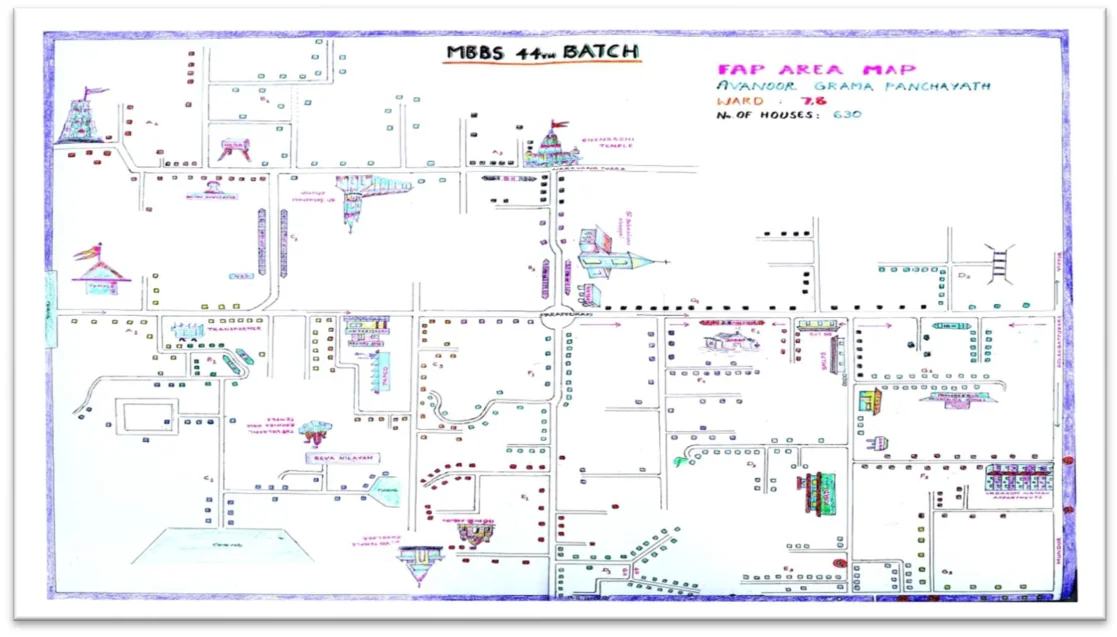
formed the backbone of the Family Adoption Programme. The wards identified were visited by the field team prior to the actual visits by the students and listing of houses was done with the help of field workers from the concerned Family health center (Health inspector, Junior Public Health nurse and ASHA workers). Listing of houses was done along with landmarks and each house was given a house number. Hand drawn Maps and landmarks were plotted for the houses by the team members (Figure 1) for each group. 700 Houses were listed, out of which, 525 houses were allotted (considering 3 houses per student) for the 175 students excluding the locked houses, houses with non-permanent and migrants as inhabitants.
v) Orientation of Students
A brief orientation session about explaining the needs and competencies to be learned through Family Adoption Programme as recommended by National Medical Commission of India was conducted by the Professor who is the faculty in charge of the batch .In this session ,all the 175 students were sensitized about the need of the programme and the necessity to reach out to the rural community and providing health care to the family and therefore adopt three families from the community. Participatory learning involving experience sharing by the Head of Department and other faculties and interaction with students ensued.
Orientation was given to students about the FAP module, the FAP Questionnaire in the class and doubts clarified regarding the questionnaire. The students were also oriented towards the importance of Communication skills and how to interact with the members of the households to build rapport effectively. In order to demonstrate the interaction between the members of the households and the students, a role play was organized by the active participation of the students. The students acted as Health care workers, family members and enacted the process of interviewing the families. The queries, difficulties and barriers to fill the FAP proforma was answered by the faculties. All the students were receptive and proactive in the sessions.
vi) Coordinating with the Institutional authorities and the LSG members
Alongside the above-mentioned activities, the field area was visited by the Department team after selecting the concerned wards from Avanoor Panchayath. The team met the local self-government representatives and Panchayath president. The members were briefed about the program and they ensured whole hearted cooperation towards the implementation of the programme. Principal, The Institutional Head, was briefed about the program and the funds needed to arrange the inauguration session, which was duly fulfilled subsequently.
vii. Implementation of the Programme
With the consensus of all the stake holders – Principal, members from the local self-government, department team, students; an inaugural FAP session was planned and conducted in a nearby school adjacent to the adopted wards. In the inaugural session, the LSG members interacted with the students. This helped to ensure familiarity with the LSG body in future endeavors.
The actual field visits rolled out soon after the inaugural session. The students with their assigned team leaders visited the respective families, explained the purpose of the visit to the family members, sought verbal consent to collect information regarding various demographic, environmental and health parameters. A good rapport in a professional manner under the guidance of their FAP faculty / mentor was the basis of the healthy interaction involving -All the families and the students. After the completion of each visit, all students were asked to complete the Family adoption programme record. Their doubts were clarified and asked to submit the completed family adoption record within the forthcoming week to the concerned faculty team leader. All the students were asked to record their reflections in the FAP record and logbooks were reviewed by the faculty, evaluated and marks were put on successful submission with completion.
Steps in the Implementation of Methodology
- Field Area Identification-LSG Involvement
- FAP Team creation
- Field Area Mapping
- Students’ Orientation- FAP Questionnaire, Role play
- Discussion with LSG, Institutional Authorities
- FAP Inauguration with Active Student participation
- Field visits planned(8x3=24hrs)
Findings
For the 175 students, 3 houses were allotted to each student and a total of 575 houses’ details were collected.100% of the students completed their three visits to the families and 97% submitted their FAP records with feedback which was evaluated by faculties and given marks (Tables 1 and 2).
| HURDLES | STRATEGIES adopted |
|---|---|
| 1.Manpower shortage | Creation of FAP Team-all members in the department were included- Faculty, JRs, SRs, Health educator, Social scientist, Health inspectors to overcome the shortage. |
| 2.Transportation to the field – 4 buses were needed per day. | Administrative sanction and Hand holding venture with Government Nursing College, Thrissur to use the vehicle from nursing college |
| 3.Camp Fund | Administrative sanction and allocation of funds from Principal. |
| 4.Climate-Hot and Humid | Orientation to students and Staff on previous day regarding protection from sun-wearing hats/using umbrellas and carry water bottle and snacks |
| 5. Resistance from the Community | Good Communication with members of local self-government, ward member, Panchayath President. Also, with the help of the existing Health team in the FAP area- Medical officer in charge in PHC Avanoor, ASHA workers and anganwadi workers of the area. |
| Strength | Weakness |
|---|---|
| 1. Good team built especially the field team with all category of staff including medical and paramedical. 2. Good Health System in Kerala-Support from FHC Medical officer concerned, Health inspector, ASHA worker, Anganwadi worker. 3. Support from Local self-government and other government sectors. (School) | 1. Transportation facility to the field in the form of vehicle. The college bus is only available vehicle which is large and not able to enter into small roads. 2. Inadequate funding for the programme. |
| Opportunity | Challenges |
| 1. A good opportunity to know the health care needs of the population and also the health seeking behaviour of the community. 2. Good opportunity for community-based implementation research. 3. Way forward to achieve the Universal Health Coverage Everyone everywhere. | 1. Resistance and unavailability of family members during visit. 2. More services are not being provided to community apart from that availing feely from Government medical college hospital. 3.No good models available on how to integrate these families with the tertiary health care system. |
Discussion
The Family Adoption Programme offers medical students a valuable experiential learning opportunity that involves both the students and the communities they serve4. Familiarising with more than a family helps the budding Indian medical student to gain perspective on cultural sensitivity and thereby a cultural competence. This soft skill crossing cultural differences is instrumental for better patient management and to facilitate better functioning of the health system [5].
Under the National Medical Commission’s direction to implement the Family Adoption Programme, there is provision of options and feasibility to medical colleges to tailor the program according to their strengths and resources. Implementation of FAP in our college has been on similar grounds with experience gained at each step for both students and the Team involved. Thus, Contextual Experiential Learning is an ideal method for future Indian Medical Graduates and teamwork reinforces the concept of “Intellectual Collective Thinking” strategy. Utilizing FAP as a useful tool, enhancement of medical students’ communication skills, gaining acquaintance, overcoming social anxiety and ensuring better rapport through subsequent visits helps to develop the essential attitudes needed for goal of Indian Medical Graduate [6]. Utilizing FAP as a screening tool for risk assessment for various non-communicable diseases can be effective in motivating at-risk individuals to adopt healthy lifestyles. Thereby students gain practical knowledge in a community setting emphasizing the importance of nonjudgmental behaviour and local terminology in their communication [7].
According to the qualitative study done by Panchasheel et al to identify the Strengths, weaknesses, opportunities and challenges of Family Adoption Programme the important challenges they identified were competencies not aligned with phase wise curriculum, difficulties in adopting five families per student, implementation feasibility of the programme ,resistance and refusal from the families[8].Logistics of planning, mode of conveyance eto filed area, Evaluation of students with follow up presentations for periodic monitoring can help to make FAP more effective [9].Another study by Preetil et al ,overall experience was good was the feedback given by students[10].Unavailability of families at the time of visit was challenging, yet FAP was found to be beneficial [11].Students expressed their opinion that FAP would bring about a generation of future doctors having insight on the problems faced by the rural communities]12].Family Adoption Programme upholds the story of Teamwork, leadership approach in making students comprehend the social dynamics existing at grass root levels[13].Implementation of the FAP program requires resource such as manpower ,money, time alongside challenges faced such as locked houses, on cooperative family members, language barrier thereby increasing the non-response rate. Community sensitization and involvement of the stakeholders is crucial in ensuring the success of FAP [14]. Our study identified lack of manpower, fund, vehicle, logistics as challenges in contrast to the study by Dongre et al [5] where clash of academic schedules were the main challenge. Contrasting with the work by Randhir Kumar ,since a dedicated transport system was present, communication barrier posed the main challenge which was not the main challenge ,our study did not identify communication barrier as a major challenge[15].FAP is perceived to be useful since it has a positive impact on the affective domain of the medical student, team work similar to our experience was shared by the study by Panchasheela[16].Study by Anuja Baruah had similar challenges as our experience with logistics, transport facilities posing as the main hurdles]17].FAP provides ample opportunity for implementation research in the community setting[18].
Conclusion
- FAP-critical platform to facilitate Authentic learning of the under-graduate students in order to sensitize them with the real-life challenges. It provides immense Opportunity for field experience and for fulfilling the NMC VISION-of STUDENT AMBASSADORSHIP. The implementation of the FAP programme needs coordinated team work, time management, intersectoral coordination, training of the team and orientation of the students.
Acknowledgements
Our special thanks to all the families who cooperated with us in our adoption programme. We thank all the field team including all the faculties, junior residents, senior residents and other supporting staff for their immense support in the implementation of the programme. We also express our gratitude and thanks to all the members of the local self-government of Avanoor Panchayath,Thrissur.Our special thanks to the health care workers from the health Service department who helped us to do this venture-The Medical officer of FHC Avanoor, Health inspectors and also the ASHA workers and Anganwadi workers of the concerned wards. A big thanks to our Principal, Government Medical College, Thrissur for giving the administrative sanction towards the funds needed and also for gracing the Inaugural function with his presence. We thank all the students of the current 2024 MBBS batch of Government Medical College, Thrissur for their active participation in the programme.
Funding
Nil
Conflict Of Interest
None Declared
Ethical Issues
No Ethical Issues present since no persons were involved as patients in the study and its experience sharing regarding the implementation.
References
- Frenk J, Chen L, Bhutta ZA, et al. Health professionals for a new century: transforming education to strengthen health systems in an interdependent world. Lancet 2010; published online Nov 29. DOI:10.1016/S0140-6736(10)61854-5.
- Vanikar A, Kumar V. Unique program of Indian undergraduate medical education – Family adoption through village outreach. Indian J Community Med 2024;49:459-60. [doi:10.4103/ijcm.ijcm_273_24]
- Shikha S, Kumar A, Begum J, Ali SI, Tripathy S. Family adoption program for undergraduate medical students at a new medical school of Jharkhand: An experience and SWOC analysis. Indian J Community Med 2024;49:218-22. Received: 28-11-22, Accepted: 02-1 [doi:10.4103/ijcm.ijcm_954_22]
- Yalamanchili VK, Uthakalla VK, Naidana SP, Kalapala A, Venkata PK, Yendapu R. Family adoption programme for medical undergraduates in India – The way ahead: Aqualitative exploration of stakeholders’ perceptions. Indian J Community Med 2023;48:1426. [Google Scholar]
- Chakraborty A, Sarkar N, Lahiri U, Bhowmick S, Sen S, Majumdar R, et al. Family adoption program in medical education and role of community medicine in its implementation in India: An overview. J Integr Med Public Health 2023;2:49-53. [doi:10.4103/jimph.jimph_18_23]
- Chepuru R, Sushma KS, Vadlamani S, Manasa RV, Vennam BS. Family adoption program (FAP) as a learning tool—perceptions of students and faculty of community medicine. J Family Med Prim Care 2025;14:51-5. [doi:10.4103/jfmpc.jfmpc_510_24]
- Arulmozhi M, Raveendran A, Ganapathy K, Kandasamy P. Implementing and evaluating risk assessment as a new learning tool in family adoption program: A qualitative study. Indian J Community Med 2025;50:815-21. [doi:10.4103/ijcm.ijcm_47_24]
- Reshmi, Panchasheela S; Lunagariya, Ruchita; Patel, Hiren1; Patel, Nikhil2; Chauhan, Dixit2; Patel, Ravi2. Qualitative Study to Identify Strengths, Weakness, Opportunities, and Challenges of Family Adoption Programs among Students. Indian Journal of Community Medicine 49(4):p 610-616, Jul–Aug 2024. DOI: 10.4103/ijcm.ijcm_58_23.
- Anurag, Gupta A, Dwivedi S, Mahore R, Rohit BK, Singh S. Reflections of Indian medical graduates participating in the family adoption program: a qualitative evaluation, at bundelkhand region, India. J Family Med Prim Care 2025;14:3758-64. [doi:10.4103/jfmpc.jfmpc_405_25]
- Preeti, Kanubhai TH, Dhapola VS. Family adoption programme implementation feedback from undergraduate medical students in Almora: A cross-sectional study. J Family Med Prim Care. 2024 Dec;13(12):5609-5614. doi:10.4103/jfmpc.jfmpc_689_24. Epub 2024 Dec 9. PMID: 39790772; PMCID: PMC11709028.
- Thayyil J, Lakshmanan MT, Salam A, Palakkunnath S. Perception of under graduate medical students on the family adoption program. Int J Community Med Public Health 2025;12:2241-6. [doi:10.18203/2394-6040.ijcmph20251382]
- Vairavasolai P,Mariavinifa X,Karthikeyn S,Felicia J P. Impact of Family Adoption Program: A Cross-Sectional Study from Rural Tamilnadu,IJAMP 2023;5(5);1088-1090. [Google Scholar]
- Arumugam B, Sanjana L, Singh DG, Kuppuraj P, Sayee TSM. A narrative review on the experience of “Family Adoption Programme” in a tertiary care institute. J Community Health Manag2022;9(2):54-59. [doi:10.18231/j.jchm.2022.012]
- Eshwari K, Mallya SD, Kumar A, Rao CR, Sekar A, Das S. Implementation of community‑centric medical education through Family Adoption Program: Descriptive results from coastal Karnataka.Indian J Community Med 2025;50:479-85. [doi:10.4103/ijcm.ijcm_694_23]
- Randhir Kumar,Arunkumar Rameshwarprasad Varun, Nipendra Anand,Alok Pritam.Evaluate the impact of Implementation of Family Adoption Programme among Phase 3 part 1 Undegrraduate Medical Students in LBKMCH Sharsha.International Journal of Life Sciences, Biotechnology and Pharma Research Vol. 14, No. 4, April 2025. [Google Scholar]
- Reshmi P S, Patel G K, Patel H K, et al. (September 17, 2025) An Investigation of the Effectiveness of the Family Adoption Program Among Undergraduate Medical Students. Cureus 17(9): e92582. DOI 10.7759/cureus.92582
- Baruah A, Choudhari S G (July 01, 2024) Perceptions of Stakeholders and the Way Forward to Implementing the Family Adoption Programme in Medical Education: A Study from Assam, India. Cureus 16(7): e63586. DOI 10.7759/cureus.63586.
- Landge J, Kasbe S, Singh R, Satardekar A. Experience of Family Adoption Programme Implementation in Phase I MBBS Curriculum in a Medical College of Western India. GAIMS J Med Sci 2023;3(2):74-79. https://doi.org/10.5281/zenodo.8157717.
Published
Article metrics
- Views
- 366
- Downloads
- 155
Based on this site's usage statistics.
Issue
Section
How to Cite
License
Copyright (c) 2025 Mini S.S, Rini Raveendran

This work is licensed under a Creative Commons Attribution 4.0 International License.
More in this topic: Health workforce
Short Review · 2024
The Growing Burden: Workload on Community Health Officers