Review Article Vol. 10 No. 1 (2026): International Journal of Health Systems and Implementation Research
Supplementary Nutrition in India through the Anganwadi Lens: A Narrative Review of Policy Evolution, Community-Centric Adaptation, and a Differentiated Roadmap
Supplementary Nutrition and Community-Centric Policy in India
Downloads
Topics
Keywords:
- Anganwadi, Child malnutrition, Community nutrition, Dietary diversity, Food policy, ICDS, POSHAN 2.0, Supplementary Nutrition Programme.
Abstract
Background: India's Supplementary Nutrition Programme, delivered through 1.3 million Anganwadi centres under the Integrated Child Development Services scheme since 1975, reaches over 100 million beneficiaries nationally. Despite this scale, NFHS-5 data show 35.5% stunting and 19.3% wasting among children under five, with marked inter-state disparities and persistent inadequacy in dietary diversity across high-burden states. This narrative review traces the policy evolution of supplementary nutrition through the Anganwadi system from 1975 to 2025, synthesising evidence from NFHS rounds, government policy documents, Supreme Court interim orders, IFPRI-POSHAN analyses, and state-level programmatic data from eight states selected to represent BIMARU, Empowered Action Group, and high-performing contexts. Methodology: A systematic literature search was conducted between January and March 2026. PubMed, Scopus, and Google Scholar were searched using terms including 'ICDS supplementary feeding India', 'Anganwadi nutrition policy', 'POSHAN Abhiyaan', 'dietary diversity Anganwadi', 'child undernutrition India state', and 'Supplementary Nutrition Programme'. Results: The trajectory from ICDS through Supreme Court-mandated universalisation, the National Nutrition Policy, POSHAN Abhiyaan, and Poshan 2.0 reflects a clear directional shift from standardised caloric supplementation toward community-responsive nutrition governance. ICDS utilisation rose from 58% in NFHS-4 to 71% in NFHS-5. States investing in local food integration, self-help group procurement, and culturally embedded community events, particularly Odisha and Tamil Nadu, consistently outperform high-burden peers on dietary diversity indicators. Conclusion: India's supplementary nutrition policy has made a genuine but incomplete community-centric turn. Institutionalising local food integration, differentiating supplementary food by developmental age group, and investing in Anganwadi Worker capacity are the most urgent priorities for achieving national nutrition security targets by 2047.
Full text
This web version was prepared from the published PDF, which is the version of record. Please cite and quote from the PDF.
Introduction
India presents one of the sharpest contradictions in global public health: it operates the world’s largest institutionalised child nutrition programme yet carries one of the highest absolute burdens of child undernutrition. The Integrated Child Development Services scheme (ICDS), launched in 1975, now spans 1.3 million Anganwadi centres and serves over 100 million beneficiaries [1]. NFHS-5 data recorded 35.5% stunting and 19.3% wasting among children under five in 2019-21, with approximately 36 million stunted children nationally [2].
The Anganwadi centre was designed to deliver six integrated services: supplementary nutrition, immunisation, pre-school education, health check-ups, referral, and nutrition and health education. Its Supplementary Nutrition Programme (SNP) was conceived as a bridge between the Recommended Dietary Allowance and the average household dietary intake. Under ICDS norms, the SNP is mandated to provide 500 calories and 12-15 grams of protein per day to children aged 6 months to 3 years and those aged 3 to 6 years, covering approximately 50% and 33% of their respective daily RDA for energy, and 600 calories with 18-20 grams of protein to pregnant and lactating women, covering 50% of their RDA. For severely malnourished children, the norm rises to 800 calories and 20-25 grams of protein, covering approximately 67% of RDA [1,3,4].
India’s food cultural complexity makes this challenge structurally distinctive. A seven-month-old in coastal Karnataka is introduced to rice gruel and coconut milk. In rural Rajasthan, bajra porridge dominates early feeding. A tribal infant in Jharkhand may receive minor millets and forest greens unavailable in the commercial supply chain [5]. A nutrition programme that treats this diversity as an inconvenience rather than a resource risks being adequate on paper but rejected at the plate.
Over five decades, India’s Supplementary nutrition policy has moved imperfectly and unevenly toward an architecture that treats cultural and contextual diversity as central to nutritional effectiveness. This review paper documents that trajectory, examines Demand → Supply → Quality → Impact dynamics across India’s state spectrum, maps the multi-agency ecosystem, and proposes a differentiated roadmap for deepening the community-centric turn in Indian nutrition governance.
Methods
We conducted a narrative review, a method suited to tracing historical policy trajectories and synthesising heterogeneous evidence types. A systematic literature search was conducted between January and March 2026. PubMed, Scopus, and Google Scholar were searched using terms including ‘ICDS supplementary feeding India’, ‘Anganwadi nutrition policy’, ‘POSHAN Abhiyaan’, ‘dietary diversity Anganwadi’, ‘child undernutrition India state’, and ‘Supplementary Nutrition Programme’. Government policy documents, Five-Year Plan nutrition chapters, Supreme Court interim orders, NFHS-1 through NFHS-5 reports,[4] IFPRI-POSHAN analyses, and World Bank and UNICEF programme evaluations were included. Studies published between 1975 and 2025 in English were eligible. NFHS-4 [6] and NFHS-5 [2] served as the primary quantitative reference for national and state nutritional outcome data.
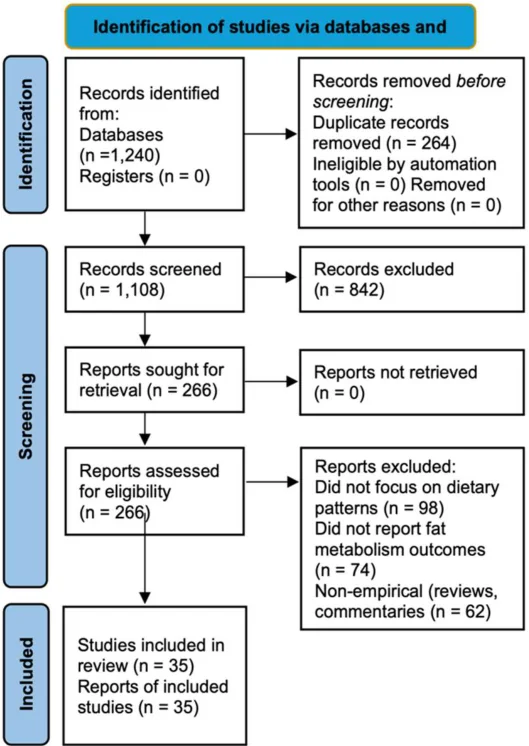
State-level evidence was drawn from eight states: Odisha, Tamil Nadu, Bihar, Uttar Pradesh, Madhya Pradesh, Rajasthan, Jharkhand, and Chhattisgarh, selected to represent diverse programmatic and epidemiological contexts. Bihar, Uttar Pradesh, Madhya Pradesh, and Rajasthan represent the BIMARU states with a historically high undernutrition burden. Odisha, Jharkhand, and Chhattisgarh are designated Empowered Action Group (EAG) states, a classification used by the Ministry of Health and Family Welfare to identify high-focus states with persistently poor reproductive and child health indicators, significant tribal populations, and complex implementation environments. Tamil Nadu was included as a high-performing comparator state with a mature ICDS system and consistently strong nutrition outcomes. Evidence was organised thematically across five domains: policy evolution, supply, demand, quality, and impact. The literature selection followed PRISMA 2020 principles adapted for narrative reviews, as presented in Figure 1 below.
Policy Evolution: Five Decades of Community-Centric Learning
a) The Standardised Phase (1975-2000)
The 1975 ICDS launch in 33 pilot blocks introduced a multipronged community platform through the AWW. The SNP was standardised from inception: nationally uniform blended food packets or hot cooked meals providing 300-500 calories and 8-12 grams of protein per child per day [1,4]. By 2000, ICDS covered 70 million beneficiaries across 5,600 projects [7]. Yet palatability failures and cultural unfamiliarity with processed blended foods were documented consistently in field evaluations of this period, and the impact on stunting remained modest [8].
b) The Judicial Inflection: PUCL v. Union of India (2001-2004)
In April 2001, the People’s Union for Civil Liberties filed WP(Civil) No. 196 of 2001, contesting starvation deaths alongside overflowing FCI godowns. The Supreme Court recognised the right to food under Article 21 read with Article 47 [9]. The 17 September 2001 interim order mandated SNP delivery for at least 300 days annually [10]. The 7 October 2004 order doubled per-child allocation and directed ICDS universalisation to all habitations exceeding 300 population [11]. These orders reframed the SNP from a discretionary welfare measure to a constitutional entitlement, a shift with lasting implications for state accountability and community ownership.
c) Multisectoral Consolidation (1993-2017)
The National Nutrition Policy of 1993 established India’s first multi-sectoral framework, linking agriculture, food processing, health, and women’s empowerment [12]. The 11th Plan piloted SHG-based local food procurement. The 12th Plan deepened ICDS-NHM convergence, repositioning AWWs as nutrition counsellors rather than merely food distributors [4]. Evidence from Odisha and Chhattisgarh during this period demonstrated that the cultural acceptability of SNP food mattered as much as nutritional adequacy [13,14].
d) POSHAN Abhiyaan (2018-2021) and Poshan 2.0 (2021-Present)
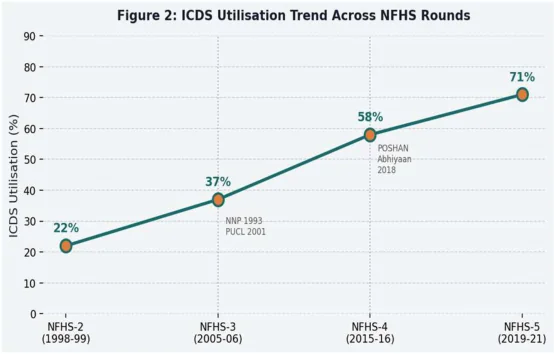
POSHAN Abhiyaan launched in March 2018 with a three-pronged approach: nutrition-specific interventions, nutrition-sensitive cross-sector convergence, and Jan Andolan [15]. Community-based events - Annaprasan Diwas, recipe demonstrations, Godhbharai anchored nutrition messaging in cultural practice [16,17]. Poshan 2.0 (2021) consolidated schemes into a lifecycle architecture and introduced Poshan Vatikas, millet promotion, and the Poshan Tracker across 11.04 lakh AWCs in 24 languages [18,19]. ICDS utilisation rose from 58% in NFHS-4 to 71% in NFHS-5, with improved supplementary feeding initiation rates across most high-burden states [20].
| Phase & Period | Key Policy / Event | Change in SNP Design | Community-Centric Indicator | Outcome Marker |
|---|---|---|---|---|
| Phase 1: 1975-2000 Standardised Delivery | ICDS launch (1975); progressive block expansion to 5,600 projects | Uniform blended THR and hot cooked meals; national caloric standards | Minimal - uniform national menu; no local food adaptation | Coverage expanded to 70 million beneficiaries; stunting remained ~52% |
| Phase 2: 2001-2006 Judicial Mandate | PUCL v. Union of India (2001); interim orders 2001 & 2004 | SNP delivery mandated 300 days/year; per-child budget doubled Re.1→Rs.2 | Constitutional entitlement framing; ICDS universalised to all habitations >300 population | ICDS utilisation rose from 22% (NFHS-2) to 37% (NFHS-3) |
| Phase 3: 1993-2017 Multisectoral Consolidation | National Nutrition Policy 1993; Mission ICDS (11th Plan); ICDS-NHM convergence (12th Plan) | SHG-based local procurement piloted; AWW repositioned as nutrition counsellor | State flexibility in food sourcing introduced; Odisha decentralised procurement model | Stunting declined from 48% (NFHS-3) to 38.4% (NFHS-4); ICDS utilisation reached 58% |
| Phase 4: 2018-2021 Mission Mode | POSHAN Abhiyaan 2018; Jan Andolan; Poshan Maah; Poshan Tracker | Community-based events (Annaprasan Diwas, Godhbharai) embedded in programme; ILA for AWWs | Cultural practices integrated into programme design; behaviour change as co-equal pillar | ICDS utilisation rose to 71% (NFHS-5); stunting declined to 35.5% |
| Phase 5: 2021-Present Convergence & Institutionalisation | Mission Saksham Anganwadi & Poshan 2.0; millet promotion; Poshan Vatika | Millet integration in SNP; nutri-gardens at AWCs; lifecycle convergence across schemes | Local food production at AWC level; traditional food knowledge formally recognised | 9.14 crore beneficiaries on Poshan Tracker; 97.16% Aadhaar seeding |
Abbreviations: AWC: Anganwadi Centre; AWW: Anganwadi Worker; ICDS: Integrated Child Development Services; ILA: Incremental Learning Approach (smartphone-based training module for AWWs under POSHAN Abhiyaan); NHM: National Health Mission; NFHS: National Family Health Survey; PUCL: People’s Union for Civil Liberties; SHG: Self Help Group; SNP: Supplementary Nutrition Programme; THR: Take Home Ration. Sources: [1,4,9–12,15–19]
State-Level Variation: Between Centralism and Community Adaptation
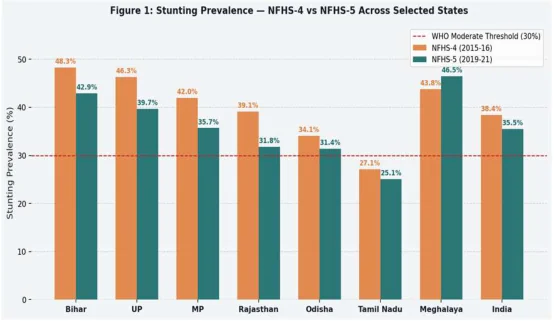
Table 2 reveals a consistent pattern: states that have invested in AWW compensation (Tamil Nadu), local food integration (Odisha), or both tend to outperform peers with similar baseline deprivation on dietary diversity indicators. The Meghalaya outlier a state with relative food security but rising stunting, underscores that supply-side food availability does not automatically translate into appropriate infant feeding practice, particularly in the critical 6–24-month window [21,22].
In BIMARU states, the knowledge-practice gap is the central demand-side challenge. Field surveys document high awareness of supplementary feeding timing alongside substantially lower practice rates reflecting not ignorance but structural barriers: income constraints, gender inequality in food distribution decisions, and time poverty of women with multiple caregiving roles [23-25].
| State | THR Procurement Model | Local Food Integration | AWW Compensation (approx.) | Stunting % NFHS-4 | Stunting % NFHS-5 | Key Programme Feature |
|---|---|---|---|---|---|---|
| Tamil Nadu | Centralised state-run production | Limited in formal SNP; high household food diversity | Above national norm | 27.1% | 25.1% | Universal PDS; high AWW investment; strong infrastructure |
| Odisha | Decentralised SHG-led procurement | High - locally sourced THR ingredients; eggs and vegetables from AWC | National norm | 34.1% | 31.4% | First dedicated nutrition budget; outcome-linked allocation; IYCF district plan |
| Bihar | Centralised state supply | Low - standard blended food packets predominant | Below national norm | 48.3% | 42.9% | Highest stunting burden; weak ICDS-NHM convergence at block level |
| Uttar Pradesh | Mixed state-SHG model | Emerging - POSHAN Abhiyaan CBE push | National norm | 46.3% | 39.7% | Improved MDD with POSHAN investment; large scale challenges persist |
| Madhya Pradesh | Centralised state supply | Low - some millet integration post-2021 | National norm | 42.0% | 35.7% | Tribal belt challenges; improving post-Poshan 2.0 millet push |
| Rajasthan | Centralised state supply | Low - bajra locally available but not in SNP menu | National norm | 39.1% | 31.8% | Improved stunting; MMF improvements; cultural food gap in SNP remains |
| Chhattisgarh | Mixed - SHG emerging | Moderate - forest foods and millets being integrated | National norm | 37.6% | 32.2% | Largest improvement in MMF nationally; strong tribal nutrition focus |
| Meghalaya | Centralised | Low - traditional foods not in SNP | National norm | 43.8% | 46.5% | Stunting increased - largest national rise; caregiver practice gap identified |
Supply, Demand, Quality, and Impact: A four-lens analysis
a) Supply
The original ICDS relied on centrally procured standardised blended food. Three persistent problems accompanied this model: palatability failures, logistics constraints in remote geographies, and procurement leakages [1,2,4]. SHG-led decentralised procurement, now adopted in several states, simultaneously achieves cultural food fit, women’s economic empowerment, and supply chain resilience [26]. Millet integration under Poshan 2.0 links nutritional value, cultural heritage, and agricultural sustainability in a single supply policy [18].
b) Demand
Despite ICDS utilisation reaching 71%, minimum dietary diversity, meal frequency, and acceptable diet remain inadequate across most high-burden states [2,20,27]. The community-based events under POSHAN Abhiyaan have increased awareness [28]. Yet awareness without structural support is insufficient; income constraints, gender inequality in food decisions, and women’s time poverty are barriers that information campaigns alone cannot resolve [24,25,29].
c) Quality
Quality has three dimensions in this context: nutritional adequacy, food safety, and developmental age-appropriateness. FSSAI regulations and MoWCD’s 2021 Streamlining Guidelines address the first two [18]. Age-appropriateness remains critically neglected: the 7-month-old transitioning to first foods and the 5-year-old preschooler have fundamentally different needs, yet standard THR formulations are rarely differentiated across the full 6-month to 6-year span [30,31].
d) Impact
National trend data show consistent stunting reduction from approximately 52% (NFHS-1) to 35.5% (NFHS-5) [2,6]. Pradhan and Shete (2022) identified household food security, maternal education, and AWW service quality as the most significant determinants among ICDS-enrolled children [32]. Panda et al. (2024) found a small but statistically significant association between ICDS utilisation and reduced underweight, with Poshan Abhiyaan quality improvements as a mediating factor [20]. Conversely, stunting increases in 13 states/UTs in NFHS-5 confirm that coverage expansion without cultural fit and structural support cannot drive outcomes in the most vulnerable contexts [21].
| Lens | Current Status | Critical Gaps | Roadmap Recommendations |
|---|---|---|---|
| Supply | SHG-led decentralised procurement adopted in Odisha, Jharkhand, Chhattisgarh, MP. Millet integration under Poshan 2.0. Poshan Vatikas at AWCs. | Centralised supply dominates most BIMARU states. Blended THR lacks cultural fit in tribal geographies. Procurement leakages estimated at ~28% in some states. | Mandate State Food Diversity Index. National Millet Target: 30% SNP caloric content from local millets in dryland states by 2027. SHG-led procurement in all states within 3 years. |
| Demand | ICDS utilisation at 71% nationally (NFHS-5). Community-based events (Annaprasan Diwas, Godhbharai) institutionalised. Jan Andolan reached >90 crore sensitisation activities. | MDD, MMF, MAD remain inadequate in most high-burden states. Knowledge-practice gap persists. Gender barriers and time poverty limit behaviour change. Grandmothers and fathers not systematically targeted. | Monthly CBEs with local food recipe demonstrations. District-specific visual food cards for AWWs. Gender-responsive programming: engage fathers, grandmothers. MGNREGS-linked nutrition for women’s economic autonomy. |
| Quality | FSSAI regulatory framework for THR. MoWCD January 2021 Streamlining Guidelines. Food fortification (rice) progressively adopted. Poshan Tracker enabling real-time monitoring. | Age-inappropriate THR formulations - no differentiation across the 6-month to 6-year age range. CAG-documented AWC infrastructure gaps (toilets, clean water). Patchy quarterly testing compliance across states. | Three-tier age-differentiated SNP formulations (6-12m, 12-24m, 24-72m). Mandatory quarterly FSSAI quality testing with public state reporting. Community verification: mother committees in monthly SNP quality assessment. |
| Impact | National stunting declined from 38.4% to 35.5% (NFHS-4 to NFHS-5). ICDS-underweight association confirmed with DID analysis. Tamil Nadu, J&K, Chhattisgarh show significant improvements. 13 states show stunting increases. | Stunting increase in 13 states/UTs. Meghalaya rose to 46.5%. Wasting has not shown consistent improvement. Impact evidence limited by absence of longitudinal cohort data in India. | Evolve Poshan Tracker into outcome measurement platform. Weight NITI Aayog state rankings on dietary diversity, not only utilisation. Establish National Nutrition Longitudinal Cohort Study. |
The Multi-Agency Ecosystem
The most persistent coordination failure is the ICDS-NHM interface at the block and village level. Qualitative studies in Odisha document that joint supervisory visits between AWWs and ASHA/ANM rarely occur in practice despite policy mandates [33]. Vertical accountability structures within each ministry create institutional incentives against the horizontal coordination that community-level nutrition convergence requires, a governance problem that communication initiatives alone cannot solve.
| Agency/Institution | Primary Role in Supplementary Nutrition | Level of Operation | Convergence Partner | Critical Gap/Opportunity |
|---|---|---|---|---|
| Ministry of Women and Child Development (MoWCD) | Nodal ministry for ICDS, SNP standards, POSHAN Abhiyaan, and Poshan 2.0 policy direction | National → State → District | MoHFW, NITI Aayog, Ministry of Agriculture | Policy-to-implementation translation; limited direct oversight of food quality at AWC level |
| Ministry of Health and Family Welfare / NHM | ASHA and ANM as convergence partners for VHNDs, IYCF counselling, SAM referral | District → Block → Village | MoWCD / ICDS | ICDS-NHM coordination gap at block level; separate accountability structures impede joint supervision |
| State Departments of WCD | State-level ICDS implementation; food procurement policy; AWW management | State → District → Block | State NHM, PRI institutions | Wide variation in AWW compensation, SHG procurement adoption, and local food menu flexibility |
| FSSAI | Regulation of nutritional and safety standards for fortified foods and THR products; lab accreditation | National (regulatory) | MoWCD, state food testing labs | Quarterly testing compliance patchy across states; public reporting incomplete |
| NITI Aayog | Coordination of multi-ministry nutrition governance; district-level data publication; state rankings | National → State | All nutrition-relevant ministries | State rankings currently weighted on coverage, not dietary diversity or quality outcomes |
| Self-Help Groups (SHGs / NRLM) | Local THR production, ingredient sourcing, community distribution; women’s economic empowerment | Village → Block | MoWCD / State WCD Depts | Adoption limited to progressive states; national scale-up policy not yet mandated |
| UNICEF India | Technical support for state IYCF programme design, AWW capacity building, BCC material development | National → State (selective) | MoWCD, State WCD, NHM | State coverage selective; not embedded in all high-burden geographies |
| World Bank | Financial and technical support for POSHAN Abhiyaan implementation in 11 focus states (2018-2022) | National → 11 States | MoWCD, NITI Aayog | Engagement phase completed 2022; sustainability of supported innovations uncertain |
| IFPRI-POSHAN | Principal research partner; evidence generation on CF indicators, state best practices, policy review | National (research) | MoWCD, NITI Aayog | Research-to-policy translation gap; findings not systematically embedded in programme revisions |
| Panchayati Raj Institutions (PRI) | Community governance; local accountability for AWC functioning; Poshan Vatika oversight | Village → Block | MoWCD, State WCD | Highly variable engagement across states; strong in Odisha model, weak in BIMARU states |
Policy Roadmap: Completing The Community-Centric Turn
The five-domain roadmap below draws directly from the gap analysis in Tables 3 and 4 and the state evidence in Table 2. Recommendations are differentiated by implementation tier.
a) Supply: Mandate Local Food Integration
MoWCD should mandate a State Food Diversity Index district-level mapping of locally available, culturally accepted, nutritionally relevant foods by season and require states to incorporate this into SNP menu design. A National Millet Target should mandate at least 30% of SNP caloric content from locally appropriate millets in dryland states by 2027. All states should transition to SHG-led decentralised THR procurement within three years, and Poshan Vatikas should be operational at every functional AWC with produce entering the hot cooked meal menu.
b) Demand: Address Structural Barriers
AWWs should be equipped with district-specific food cards, visual guides to locally available supplementary foods by age group and season. Monthly community-based events with local food recipe demonstrations should be mandatory, documented in the Poshan Tracker. Behaviour change programming must address gender dynamics: convergence with SHG meetings for IYCF counselling, norm-change activities engaging fathers and grandmothers, and MGNREGS-linked nutrition activities addressing women’s economic autonomy are evidence-based interventions requiring systematic scale-up [24,25].
c) Quality: National Floors, State Flexibility, Community Accountability
A tiered quality framework should govern SNP delivery: nationally mandated nutritional composition minimums (non-negotiable), with state-level flexibility in food type and menu. FSSAI should operationalise mandatory quarterly THR quality testing with public state reporting. Most urgently, age-differentiated SNP formulations across three developmental sub-groups (6-12 months, 12-24 months, 24-72 months) must be mandated by MoWCD through revised product specifications [31].
d) Impact: Manage for Outcomes
The Poshan Tracker must evolve from service monitoring to outcome measurement generating district-level dietary diversity, anthropometric, and feeding practice dashboards for District Collectors, as Odisha has pioneered. NITI Aayog’s state rankings should be weighted more heavily on dietary diversity outcomes than utilisation coverage [34]. India should invest in a National Nutrition Longitudinal Cohort Study tracking children from conception to age six to provide long-term evidence on ICDS impact pathways.
e) Workforce: The Anganwadi Worker as Nutrition Champion
No roadmap element matters more than the AWW. A national Capacity and Compensation Framework should mandate Rs. 15,000 minimum monthly honorarium, annual nutrition counselling certification, and smartphone-plus-data support. AWW selection should prioritise women with local food and agricultural knowledge [32]. An AWW Knowledge Recognition Programme that documents traditional food expertise would preserve a community nutrition intelligence resource that current policy does not acknowledge.
Discussion
The evidence reviewed here supports the central argument: India’s supplementary nutrition policy has made a genuine community-centric turn. The shift from standardised central procurement to SHG-led local production, from information campaigns to culturally embedded community events, from uniform supplementation to millet promotion and Poshan Vatikas, these reflect a system learning, from experience, that nutritional adequacy on paper does not translate to dietary adequacy on the plate without cultural and structural fit [12,13,17,18]. States that have invested substantively in this direction show consistently better outcomes. Odisha’s local food integration and outcome-linked budgeting, Tamil Nadu’s AWW compensation and infrastructure, these policy choices explain inter-state differentials more than national allocation differences [13,27]. The persistent ICDS-NHM coordination gap, most clearly documented in Odisha’s qualitative evidence, remains the most important governance failure in the ecosystem. It requires structural reform, joint accountability frameworks, shared data systems, and more communication guidance [33].
Three policy tensions require explicit attention. First: national quality standardisation versus local food diversity, these are not inherently in conflict but require a tiered governance framework rather than a single national menu. Second: coverage metrics versus outcome metrics, the Poshan Tracker provides the technical infrastructure for this shift; political commitment must follow. Third: AWW as programme implementer versus AWW as community nutrition champion, the latter demands empowerment and compensation that current policy does not provide [24,34]. An important dimension this review does not fully capture is the intergenerational pathway. Evidence from India’s Mid-Day Meal scheme demonstrates that school feeding targeting girls produces measurable improvements in their children’s linear growth, working through maternal education, fertility decisions, and health service utilisation [35]. The Anganwadi programme’s long-term legacy, the nutrition and empowerment of today’s adolescent girls who will become tomorrow’s mothers, may ultimately be as significant as its immediate impact on currently enrolled children.
Conclusion
Five decades after its 1975 launch, the Anganwadi system is the world’s largest community nutrition platform - 1.3 million centres, over 100 million beneficiaries, real-time monitoring in 24 languages. The policy trajectory from ICDS through the PUCL judicial mandate, POSHAN Abhiyaan, and Poshan 2.0 documents a system learning persistently from failure and moving toward community-centric nutrition governance [1,15,18]. Stunting at 35.5% and wasting at 19.3% in NFHS-5 confirm this evolution is unfinished [2]. The roadmap offered here - local food integration, age-differentiated formulations, structural demand interventions, outcome-focused management, and AWW workforce transformation is not a new direction but a deepening of the one India’s nutrition system has, through decades of contested learning, already chosen.
India’s food diversity is not a complication for its nutrition programme. It is the resource on which community-centric nutrition must be built. The Anganwadi system that places a Meghalaya grandmother’s traditional weaning food alongside a Rajasthani bajra porridge and a Tamil Nadu rice-lentil kanji in its supplementary feeding toolkit and that trusts its frontline workers to counsel on these foods with skill and community respect is the system that will end the paradox of undernutrition in a food-abundant nation.
Funding
No external funding was received for this review.
Conflict of Interest
The author declares no conflicts of interest.
Acknowledgements
The author acknowledges the published evidence base of IFPRI-POSHAN, the International Institute for Population Sciences, UNICEF India, and the World Bank India team, whose analyses formed the empirical backbone of this review.
References
- Government of India, Ministry of Education and Social Welfare. Report of the Task Force on Integrated Child Development [Government Report]. New Delhi: Ministry of Education and Social Welfare; 1975.
- International Institute for Population Sciences (IIPS) and ICF. National Family Health Survey (NFHS-5), 2019–21: India Report [DHS Final Report] [Internet]. Mumbai, India: International Institute for Population Sciences (IIPS); 2021 [cited 2026 Mar 1]. DHS Final Report no.: FR375. Available from: https://dhsprogram.com/pubs/pdf/FR375/FR375.pdf
- Government of India. Integrated Child Development Services Scheme: Programme Implementation Plan [Programme Document / Government Report]. New Delhi: Ministry of Women and Child Development; 2009.
- Vir S, Sreenath KC, Bose V, Chauhan K, Mathur S, Menon S. National Policies and Strategic Plans to Tackle Undernutrition in India: A Review [POSHAN Report] [Internet]. New Delhi: International Food Policy Research Institute (IFPRI); 2014 [cited 2026 Mar 4]. POSHAN Report no.: 2. Available from: https://poshan.ifpri.info/files/2013/01/PR-002-National-Policy-Review-060214.pdf
- Deaton A, Dreze J. Food and Nutrition in India: Facts and Interpretations. Economic and Political Weekly [Internet]. 2009 Feb 14;44(7):42–65. Available from: https://www.epw.in/journal/2009/07/special-articles/food-and-nutrition-india-facts-and-interpretations.html
- International Institute for Population Sciences (IIPS), IFC. National Family Health Survey (NFHS-4), 2015-16: India [National Survey Report] [Internet]. Mumbai: International Institute for Population Sciences (IIPS); 2017 [cited 2026 Apr 3]. Available from: https://dhsprogram.com/pubs/pdf/FR339/FR339.pdf
- Koyuncuoglu H, Güngör M. Effect of nialamide and reserpine on brain free amino acids of rat dependent on and withdrawn from morphine. Arzneimittelforschung. 1975 Nov;25(11):1762–6. PubMed PMID: 1243083.
- Shekar M, Gragnolati M, Das Gupta M, Lee YK, Bredenkamp C. India’s Undernourished Children : A Call for Reform and Action [Internet]. World Bank, Washington, DC; 2005 [cited 2026 Jun 4]. Available from: https://hdl.handle.net/10986/13644 doi:10.1596/13644
- People’s Union for Civil Liberties v. Union of India and Ors. 2001.
- People’s Union for Civil Liberties v. Union of India and Ors. 2001.
- People’s Union for Civil Liberties v. Union of India and Ors. 2004.
- Government of India. National Nutrition Policy [Internet]. New Delhi: Department of Women & Child Development, Ministry of Human Resource Development; 1993 [cited 2026 Jan 3]. Available from: https://icds.gov.in/sites/default/files/policies-document/National_Nutrition_Policy.pdf
- Bhattacharjee S, Sarma S, Sahoo S, Garg A, Bikash Saha S, Chamois S. Pathways to improve complementary feeding in Odisha, an Eastern State in India [Internet]. Emergency Nutrition Network (ENN); 2025 [cited 2026 Jun 4]. Available from: https://www.ennonline.net/fex/75/en/pathways-improve-complementary-feeding-odisha-eastern-state-india doi:10.71744/ZJ11-A832
- Government of Odisha. Supplementary Nutrition Programme and Emergency Feeding Programme Guidelines [Internet]. Bhubaneswar; 2017 [cited 2026 Oct 3]. Available from: https://wcd.odisha.gov.in/sites/default/files/2021-06/doc20170527_121846.pdf
- Government of India. Operational Guidelines for Convergent Action Plan: POSHAN Abhiyaan [Programme Guidelines] [Internet]. New Delhi: Ministry of Women and Child Development; 2018 Nov [cited 2026 Jan 3]. Available from: https://nirdpr.org.in/crru/docs/health/Operational-Guidelines-for-Convergent-Action-Plan-Poshan%20Abhiyaan.pdf
- NITI Aayog. Transforming Nutrition in India: POSHAN Abhiyaan - A Progress Report [Internet]. New Delhi: Government of India; 2019 Feb [cited 2026 Apr 2]. Available from: https://www.niti.gov.in/sites/default/files/2020-02/POSHAN_Abhiyaan_first_progress_report_6_Feb_2019.pdf
- World Bank. Transforming India’s Nationwide Nutrition Program: Poshan Abhiyaan [Internet]. World Bank; 2024 [cited 2026 Apr 3]. Available from: https://www.worldbank.org/en/country/india/brief/transforming-india-s-nationwide-nutrition-program
- Government of India. Mission Saksham Anganwadi and Poshan 2.0: Scheme Guidelines [Internet]. New Delhi: Ministry of Women and Child Development; 2021 [cited 2026 Feb 24]. Available from: https://www.spniwcd.wcd.gov.in/uploads/pdf/Mission%20Saksham%20Anganwadi%20and%20Poshan%202.0%20scheme%20guidelines.pdf
- Press Information Bureau. Ministry of Women and Child Development Issues Guidelines of Saksham Anganwadi and Poshan 2.0 [Internet]. Ministry of Women and Child Development, Government of India; 2022 [cited 2026 Apr 3]. Available from: https://www.pib.gov.in/PressReleaseshare.aspx?PRID=1847548
- Singh SK, Chauhan A, Alderman H, Avula R, Dwivedi LK, Kapoor R, et al. Utilization of Integrated Child Development Services (ICDS) and its linkages with undernutrition in India. Matern Child Nutr. 2024 Jul;20(3):e13644. doi:10.1111/mcn.13644 PubMed PMID: 38586943; PubMed Central PMCID: PMC11168363.
- Press Information Bureau. State/UT-wise Prevalence of Stunting, Wasting and Underweight among Children under 5 Years as per NFHS-5 [Internet]. Ministry of Women and Child Development, Government of India; 2022 [cited 2026 Apr 3]. Available from: https://www.pib.gov.in/PressReleasePage.aspx?PRID=1806601
- Vir SC, Suri S. The 5th National Family Health Survey of India: A Sub-National Analysis of Child Nutrition [Internet]. New Delhi: Observer Research Foundation; 2021 May [cited 2026 Apr 3]. Report Occasional Paper No. 315. Available from: https://www.orfonline.org/research/the-5th-national-family-health-survey-of-india-a-sub-national-analysis-of-child-nutrition
- Corsi DJ, Mejía-Guevara I, Subramanian SV. Risk factors for chronic undernutrition among children in India: Estimating relative importance, population attributable risk and fractions. Social Science & Medicine. 2016 May;157:165–85. doi:10.1016/j.socscimed.2015.11.014
- Ruel MT, Alderman H. Nutrition-sensitive interventions and programmes: how can they help to accelerate progress in improving maternal and child nutrition? The Lancet. 2013 Aug;382(9891):536–51. doi:10.1016/S0140-6736(13)60843-0
- Cunningham K, Headey D, Singh A, Karmacharya C, Rana PP. Maternal and Child Nutrition in Nepal: Examining drivers of progress from the mid-1990s to 2010s. Global Food Security. 2017 Jun;13:30–7. doi:10.1016/j.gfs.2017.02.001
- R. S. R, Dinachandra K, Bhanot A, Unisa S, Menon GT, Agrawal N, et al. Context for layering women’s nutrition interventions on a large scale poverty alleviation program: Evidence from three eastern Indian states. Gopichandran V, editor. PLoS ONE. 2019 Jan 22;14(1):e0210836. doi:10.1371/journal.pone.0210836
- Aggarwal M, Agrawal S. Complementary Feeding in India: Evidence from NFHS-5 and 4. SSRN Journal. 2024. doi:10.2139/ssrn.4781042
- UNICEF. WHO. Global Strategy for Infant and Young Child Feeding. Geneva: World Health Organization; 2003. 37 p.
- Bhutta ZA, Das JK, Rizvi A, Gaffey MF, Walker N, Horton S, et al. Evidence-based interventions for improvement of maternal and child nutrition: what can be done and at what cost? The Lancet. 2013 Aug;382(9890):452–77. doi:10.1016/S0140-6736(13)60996-4
- Black RE, Victora CG, Walker SP, Bhutta ZA, Christian P, De Onis M, et al. Maternal and child undernutrition and overweight in low-income and middle-income countries. The Lancet. 2013 Aug;382(9890):427–51. doi:10.1016/S0140-6736(13)60937-X
- Victora CG, De Onis M, Hallal PC, Blössner M, Shrimpton R. Worldwide Timing of Growth Faltering: Revisiting Implications for Interventions. Pediatrics. 2010 Mar 1;125(3):e473–80. doi:10.1542/peds.2009-1519
- Pradhan MR, Shete MR. Determinants of nutritional status among under-five children receiving Integrated Child Development Services (ICDS) in India. Nutr Health. 2023 Sep;29(3):575–90. doi:10.1177/02601060221085809
- Kim SS, Avula R, Ved R, Kohli N, Singh K, Van Den Bold M, et al. Understanding the role of intersectoral convergence in the delivery of essential maternal and child nutrition interventions in Odisha, India: a qualitative study. BMC Public Health. 2017 Dec;17(1):161. doi:10.1186/s12889-017-4088-z
- Menon P, Avula R, Sarswat E, Mani S, Jangid M. Tracking India’s progress on addressing malnutrition: What will it take? [Internet]. 0 ed. Washington, DC: International Food Policy Research Institute; 2020 [cited 2026 Jun 5]. Available from: https://hdl.handle.net/10568/142019 doi:10.2499/p15738coll2.133750
- Headey DD, Hoddinott J. Understanding the Rapid Reduction of Undernutrition in Nepal, 2001–2011. Baud O, editor. PLoS ONE. 2015 Dec 23;10(12):e0145738. doi:10.1371/journal.pone.0145738

Published
Article metrics
- Views
- 119
- Downloads
- 46
Based on this site's usage statistics.
Issue
Section
How to Cite
License
Copyright (c) 2026 Nimisha Bhatu, Shantanu Shrivastava

This work is licensed under a Creative Commons Attribution 4.0 International License.