Case Studies Vol. 10 No. 1 (2026): International Journal of Health Systems and Implementation Research
Closing Gaps in Antenatal Care Service Delivery: A PDCA Based Intervention from Rural Haryana
Closing Gaps in Antenatal Care Service Delivery:
Downloads
Topics
Keywords:
- Antenatal care, Health system strengthening, Maternal health, Rural, Service quality.
Abstract
The RMNCAH programme outlines standards for quality antenatal care, but effective implementation remains key. This assessment evaluated antenatal services in Keri and Badona Kalan, Haryana, using a structured checklist based on RMNCAH guidelines through community visits, interviews, and record reviews. Routine services were well covered (BP, haemoglobin, weight, gestational age, Td, IFA, calcium, RBS/OGTT, registrations), but gaps existed in clinical history, examinations, advanced scans, TSH, urine tests, and documentation. PMSMA performance was satisfactory; counselling was adequate except for family planning. A training session with ASHAs and ANMs addressed gaps. A phased approach with supervision, strengthened referrals, and PDCA-based monitoring is recommended.
Full text
This web version was prepared from the published PDF, which is the version of record. Please cite and quote from the PDF.
Introduction
Strengthening antenatal care (ANC) is essential for improving maternal and neonatal outcomes and progressing towards universal health coverage. World Health Organisation (WHO) ANC and Reproductive, Maternal, Neonatal, Child and Adolescent Health (RMNCAH) guidelines focus on early pregnancy registration, adequate ANC contacts, timely screening of high-risk pregnancies, nutrition and immunization services, counselling, and family involvement. Effective implementation depends on well-trained frontline health workers, availability of essential investigations, functional referral linkages, and routine monitoring to guide local action [1,2].
National Family Health Survey (NFHS) data from round 3 to round 5 representing the pre-RMNCAH and post-RMNCAH periods show a substantial increase in the proportion of women receiving antenatal care in India from 77 percent to 94 percent indicating the positive impact and overall success of the programme[3,4]. Despite the implementation of RMNCAH programme in Kheri and Badona Kalan, routine services observations indicated gaps in the delivery of essential ANC components.
This case report describes the application of a systematic Plan–Do–Check–Act (PDCA) approach to identify service delivery gaps and implement context-appropriate improvements to strengthen routine antenatal care services in these villages.
Methods
The Rural Health and Training Centre (RHTC) of PGIMER, Chandigarh, located in Kheri, Haryana, caters to the healthcare needs of two villages - Kheri and Badona Kalan. Although RHTC Kheri does not directly integrated into National Health Mission, Haryana, it plays a vital role in delivering primary healthcare services; through its outreach and facility-based services, RHTC serves as a platform for strengthening national health programs, providing training to healthcare workers, and facilitating community-based interventions. The health and related services under various national programmes are delivered via Sub-center Samlerhi that is under the Hangola Primary Health Center (PHC) in Raipur Rani Block. Three Anganwadis situated in the two villages, provide the various services under Integrated Child Development Services (ICDS) scheme. According to Annual Health Survey FY 2024-25, villages of Kheri and Badona Kalan cover 3050 population and 541 households. In the year the birth rate was 10.4/ 1000 population and death rate 9.1/ 1000 population. Total 32 antenatal mothers were registered in the year 2024-2025, with zero maternal deaths.
The Plan Do Check Act (PDCA) approach[5] (Figure 1)
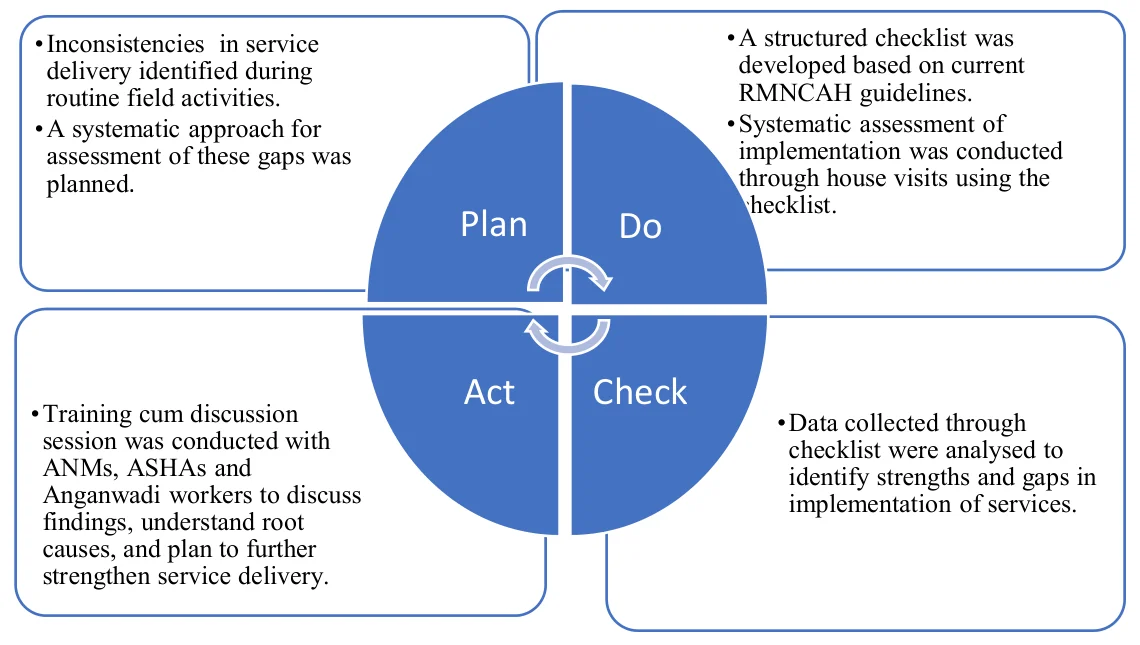
Identification of Problem
During regular ANC home visits and outpatient department (OPD) assessments at RHTC Kheri, it was noted that there was variable adherence to standard ANC guidelines.
Antenatal service delivery Assessment tool [6–8] (Supplementary material 1)
A tool was designed using current antenatal care guidelines and protocols under RMNCAH to assess the quality of antenatal care service delivery. The tool has three sections- Section A contains patient identification details and details of the pregnancy; Section B contains the checklist that includes 5 domains in each trimester with 33 items along with means of verification of the same; Section C contains information regarding the Pradhan Mantri Surakshit Matritva Abhiyan (PMSMA) visit.
Implementation of the tool during ANC Visits
The checklist was implemented during ANC house visits in the villages of Kheri and Badona Kala (n=11 pregnant women) by Community medicine residents and health care workers at RHTC Kheri. The checklist served as a tool to identify gaps and areas of non-compliance in real-time and ensured adherence to ANC guidelines as recommended by the Ministry of Health.
Results
(Please find attached details of results in Supplementary material 2)
Compliance was assessed by calculating the percentages of incomplete, partially complete, and complete observations out of the total observations. Observations were weighted as incomplete = 0, partially complete = 1, and complete = 2. The total compliance percentage was calculated using the formula: ((Incomplete%×0) +(Partially complete%×1) +(Complete%×2))/2. A total compliance percentage of more than 70% was interpreted as satisfactory performance, while ≤70% was considered non-satisfactory performance.
In the first trimester (n=11), domains of urine pregnancy test, assessment of last menstrual period and estimated date of delivery, blood pressure, haemoglobin, blood grouping and glucose testing had satisfactory performance; while documentation of obstetric score, thyroid testing, detailed history, height measurement, and clinical examinations including per vaginal, breast, and abdominal examinations had non-satisfactory performance. During the second trimester (n=10), domains of period of gestation, weight, blood pressure, haemoglobin estimation, tetanus toxoid, Iron Folic Acid (IFA) and calcium supplementation, and glucose testing had satisfactory performance; however domains of history taking, abdominal, per vaginal and breast examinations, urine albumin/sugar and completion of level two ultrasound had non-satisfactory performance. In the third trimester (n=4), satisfactory performance was observed for gestational age assessment, weight, blood pressure, haemoglobin, tetanus toxoid, IFA and calcium supplementation, whereas urine albumin and sugar testing, level three ultrasound, and clinical examinations were non-satisfactory performance.
Counselling services had satisfactory performance for IFA and calcium supplementation, birth preparedness, danger signs, diet and breastfeeding domains, with the exception of family planning counselling, which showed non-satisfactory performance. Satisfactory performance was observed in utilisation of ICDS, PMMVY, JSY. However non-satisfactory performance was observed in utilisation of PMSMA services.
Key patterns:
- Strengths: Routine tests (BP, Hemoglobin, weight, gestational age, Td, IFA, calcium, RBS/OGTT) and scheme registrations well covered.
- Gaps: Clinical history, physical examinations (abdomen, breast, per vagina), advanced ultrasounds (Level 2 & 3), thyroid testing, urine albumin/sugar, and documentation.
- Counselling: Adequate overall, but family planning counselling weak.
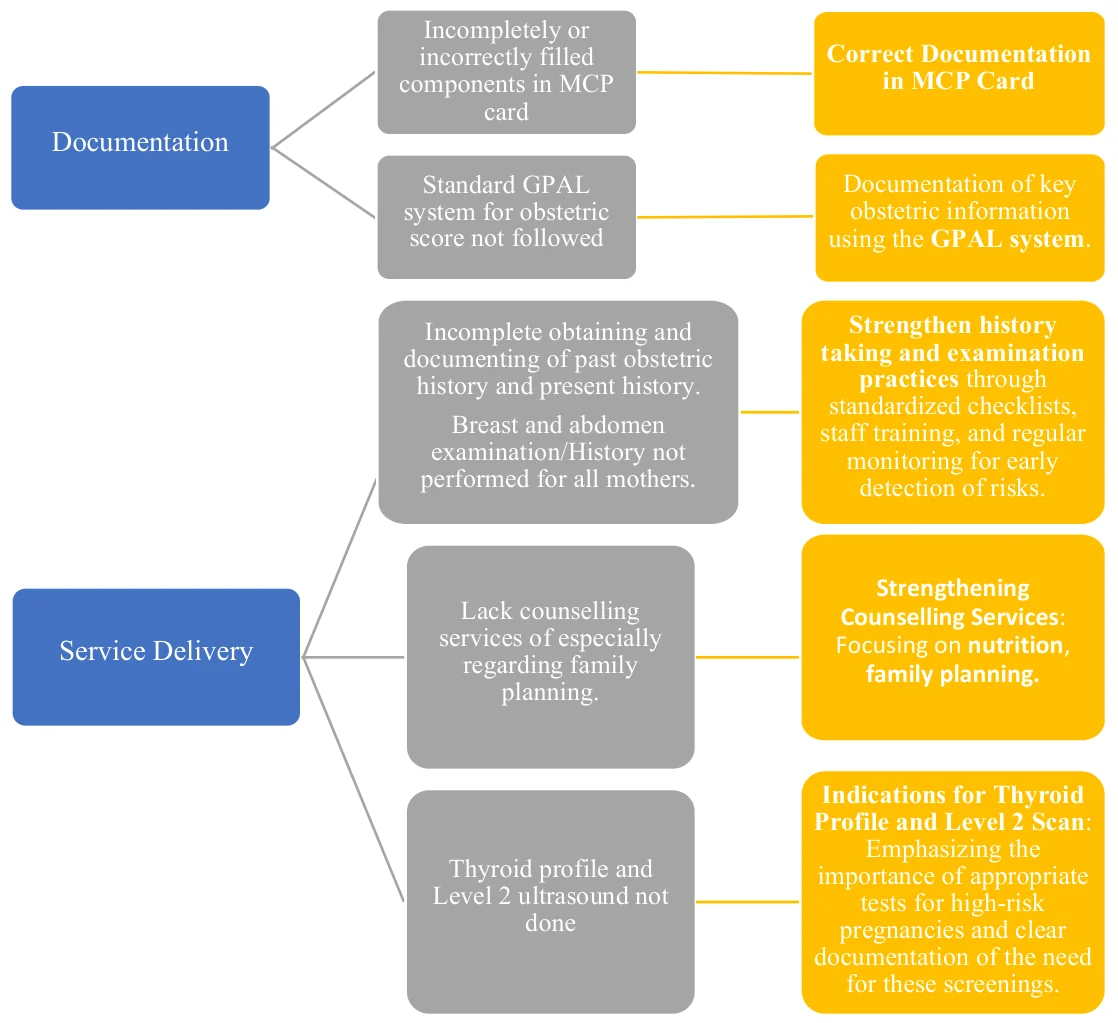
Lessons learnt [9] (Table 1)
Additional information can be made available by the authors upon request.
| Category | Gaps | Implications |
|---|---|---|
| Documentation |
|
|
| Knowledge |
|
|
| Service delivery |
|
|
|
|
*GPAL: Gravida Para Abortion Live. It is an obstetric score system commonly used [9]
Source: Authors’ Formulation
Actions Taken
A training and discussion session was held for ASHAs and ANMs in Kheri and Badona Kalan to address service delivery gaps identified during assessments. The session focused on identifying root causes and developing actionable strategies, while also refreshing knowledge on antenatal care and reinforcing the importance of guideline compliance to improve care quality and outcomes.
The session was conducted using sections of the Mother and Child Protection card, leveraging its familiarity among health workers. All content was based on standard RMNCAH guidelines. The module was based on antenatal care content from ASHA and ANM training under the National Health Mission. [6–8,10,11]
Discussion
To sustain improvements in antenatal care delivery, a phased approach is recommended. Immediate efforts should focus on establishing regular supportive supervision at Anganwadi centres to enhance service quality. In the intermediate term, strengthening referral pathways for high-risk pregnancies by facilitating access to Level 2 ultrasound scans and thyroid testing will be critical for improving early detection and management of complications. The first round of the PDCA cycle, guided by a systematic framework, has helped direct solution-oriented and actionable measures. Long-term efforts will emphasize continual monitoring and feedback to assess the effectiveness of implemented actions through regular reviews. This iterative process will enable timely corrections and ongoing improvements to antenatal care delivery.
Evidence from national and international studies suggests that improvements in antenatal care are driven more by strengthening the quality of service delivery rather than coverage alone. An implementation report from Uttar Pradesh[12] highlights the role of strong community platforms, convergence among ASHA, ANM, and AWW, structured tools, and supportive supervision in improving early registration, identification of high risk pregnancies, and overall ANC quality. These findings are echoed by a BJOG review and an expert consultation published in BMC Pregnancy and Childbirth[13,14], which emphasize that gaps in ANC in resource limited settings arise largely from health system weaknesses, limited frontline worker capacity, poor documentation, and inadequate monitoring rather than lack of access.
Evidence from an ANC strengthening intervention in Ethiopia[15] further demonstrates that targeted training, supportive supervision, improved documentation, and availability of investigations can significantly enhance the content and quality of antenatal care, including better risk detection and client satisfaction. Together, these studies reinforce the relevance of systematic quality improvement approaches and provide strong support for the PDCA based, health system strengthening strategy adopted in the present study to improve comprehensive antenatal care at the primary care level.
Ethical considerations
The activity was conducted as part of routine work at RHTC Kheri, PGIMER; hence, institutional ethical committee approval was not obtained. Informed consent was taken from mothers prior to data collection, anonymity was maintained, and participation was voluntary with the option to withdraw at any time without affecting routine care.
Conflict of interest
The authors declare that there are no conflicts of interest.
Acknowledgements
We acknowledge the support of the staff of RHTC Kheri, PGIMER, including ASHAs and ANMs, for their cooperation during the field activities. We are grateful to the participating mothers for their time and valuable inputs. We also thank our faculty and supervisors for their guidance throughout the study.
References
- Government of India. Ministry of Health and Family Welfare. A strategic approach to reproductive, maternal, newborn, child and adolescent health (RMNCH+A) in India. New Delhi: Ministry of Health and Family Welfare; 2013.
- World Health Organization. Reproductive health strategy to accelerate progress towards the attainment of international development goals and targets. Geneva: World Health Organization; 2004.
- International Institute for Population Sciences (IIPS) and Macro International. National Family Health Survey (NFHS-3), 2005–06: India. Mumbai: IIPS; 2007.
- International Institute for Population Sciences (IIPS) and ICF. National Family Health Survey (NFHS-5), 2019-21: India. Mumbai: IIPS; 2021.
- Pan N, Luo YY, Duan QX. The influence of PDCA cycle management mode on the enthusiasm, efficiency, and teamwork ability of nurses. Biomed Res Int. 2022;2022:9352735. doi:10.1155/2022/9352735.
- Ministry of Health and Family Welfare, Government of India. RMNCAH+N manual on counseling. New Delhi: Ministry of Health and Family Welfare; 2021.
- Ministry of Health and Family Welfare, Government of India. SBA guidelines for skilled attendance at birth. New Delhi: Ministry of Health and Family Welfare; 2010.
- Ministry of Health and Family Welfare, Government of India. Guidance note for extended PMSMA for tracking high risk pregnancies (HRPs). New Delhi: National Health Mission; 2022.
- American College of Obstetricians and Gynecologists. Revitalize obstetrics data definitions. Washington, DC: ACOG.
- Ministry of Health and Family Welfare, Government of India. Skills that save lives: ASHA module 6. New Delhi: National Health Mission; 2021.
- Ministry of Health and Family Welfare, Government of India; Ministry of Women and Child Development, Government of India. Mother-child protection card. New Delhi: Government of India; 2018.
- India Health Action Trust (IHAT). Strengthening antenatal care through community interventions in Uttar Pradesh. Bengaluru: IHAT; 2022.
- Van Den Broek N. Content and quality - Integrated, holistic, one-stop antenatal care is needed for all. BJOG. 2016;123(4):558. doi:10.1111/1471-0528.13937.
- Gamberini C, Angeli F, Ambrosino E. Exploring solutions to improve antenatal care in resource-limited settings: an expert consultation. BMC Pregnancy Childbirth. 2022;22(1). doi:10.1186/s12884-022-04778-w.
- Villadsen SF, Negussie D, Gebremariam A, Tilahun A, Friis H, Rasch V. Antenatal care strengthening for improved quality of care in Jimma, Ethiopia: an effectiveness study. BMC Public Health. 2015;15(1). doi:10.1186/s12889-015-170.

Published
Article metrics
- Views
- 155
- Downloads
- 53
Based on this site's usage statistics.
Issue
Section
How to Cite
License
Copyright (c) 2026 Smriti Jain, Stuti Pramod, Aritrik Das, Arun K Aggarwal

This work is licensed under a Creative Commons Attribution 4.0 International License.