Editorial Vol. 6 No. 2 (2022): International J Health Systems and Implementation Research
Geospatial Technology, Public Health and its Vulnerability Assessment
Public Health and GIS
Downloads
Topics
Keywords:
- GIS
- Vulnerability Assessment
- Software
Abstract
Providing health facility on time is very important for Public health management. Due to its ability to store large amount of data and its sophisticated tools, Geographical Information Systems (GIS) has become a cost-effective technology in storing, analyzing the disease information and its association with various environmental factors. Due to its ability to store both spatial and non-spatial data it enhances the disease surveillance, vulnerability mapping and through Web-based GIS, it helps the decision maker to preventing, controlling and responding to a specific disease outbreak.
Full text
This web version was prepared from the published PDF, which is the version of record. Please cite and quote from the PDF.
Introduction
Changing climate, environmental pollution are leading to spread of various disease. Understanding the complexity of disease and its relationship with environmental pollution and metrological factors and its spatio-temporal relationships are essential for effective public health management program. The outbreak of diseases has major determining factor of climate like temperature, humidity and rainfall which causes death of over one million people from vector borne diseases around the world like dengue fever, yellow fever, malaria, West Nile Virus, Japanese encephalitis, and filariasis. The discipline of medical geography integrated with geographic information system provides a better understanding of causes and consequences of disease epidemics because it integrates both people and the environment [1].
During last few decades, with the development of Earth observation system and geographical information systems (GIS), monitoring meteorological, environmental and anthropogenic factors that influence the spread of vector-borne diseases (VBDs) has become easy [2–3].
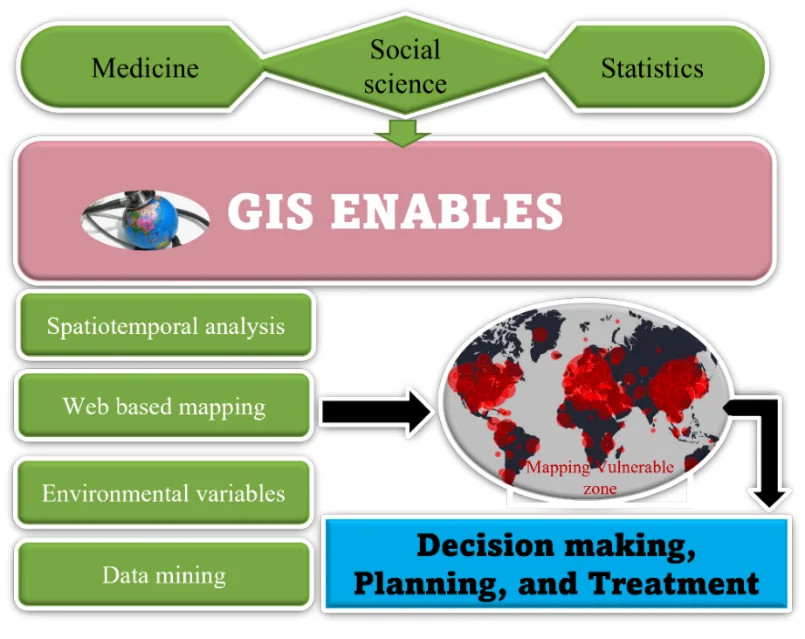
GIS are computer-based tools used to store, visualize, analyze, and interpret geographic data. GIS combine computer assisted hardware, various software and its tool (spatial analysis, geo-statistics), ground truth data, sophisticated algorithms and which can be used and modelled. In General, Every GIS is structured around five basic components; (i) Geo-referenced data, (ii) the hardware- for processing and storing big data. (iii) the software assembling the user-interface algorithms by inclusion of various ground truth data and other georeferenced data (iv) the algorithms and data management procedures; and (v) the people, both producers and consumers of spatial data (https://www.cise.ufl.edu/~mssz/GIS/GIS-Basics.html). Diagrammatic representation of benefits of GIS is given below in fig.1
Geographic information System (GIS) has been used worldwide in Public health Studies which includes- 1. Identifying areas where a particular disease is prevalent; 2. Quantifying Vulnerable Population and its spatial dynamics 3. Factors responsible for diseases i.e source cum receptor identification (water, soil and air pollution, vector borne diseases ets); 4. Quantification of morbidity and mortality rates; 5. Identify health care centres and surveillance and management plan.
R and D status of the work
Use of GIS were started in early 1990s, where it has been used as an important tool for strategic planning and management in hospitals of US. Analytical studies of patient origins and resident destinations, health facility site locating, and market demographic analysis were the most useful applications.
GIS has been used to process health data, analyze geographical and its spatial distribution, hotspot or vulnerable areas, factor responsible for vulnerability, probable area for disease and its mapping, surveillance, and epidemic disease management [4], [5]. Location-based analyses, such as disease risk mapping, identifying disease-sensitive areas, and illness clustering, can aid in disease management and prevention [6]. By identifying the disease’s vulnerable locations and updating the risk maps, it is possible to have a sufficient grasp of the situation.
Public health workers, researcher and Health management planners are using GIS to understand spatial relation of disease spread and its presentation capabilities. They use various thematic maps of resources such as health facility, various structures such as locations of landfills, reservoirs, rivers, topography of regions, and climate factors to understand this dynamics. Recent outbreak of Ebola epidemic was successfully controlled by using GIS and satellite images [7]. GIS has also been used to map the transmission of various mosquito vector borne diseases such as Malaria, Dengue, and, most recently, Zika [8–9].
The most recent outbreak of Corona Virus was monitored with GIS, GPS and other satellite-mediated technology which were crucial to detect the hotspots to understand the dynamic and evolution of infection [10–11].
The spatial statistical analyst of GIS can also be used to quantify vector habitat suitability; for example, niche modelling[12–13], generalised linear mixed models and linear regression model [14–15], non-linear equations [16] are among other techniques that have been used to model vector suitability across various spatial scales. Very recently, MAXENT algorithm has been used for species distribution modelling, even with limited data [14,17].
3. Various GIS software
Various software has been used to process large and robust data to integrate various thematic map and quantification of spatial dynamics. Various software such as ArcView, ArcGIS, ILWIS, ERDAS IMAGINE, AutoCad, and Integraph etc are used, which are frequently used in health sector.
Benefits of GIS
The disease outbreak can be understood under some categories of GIS supported tool with different themes.
Spatiotemporal Analysis
GIS and spatial statistics can be used to identify transmission dynamics over time and space. The spatial spread of epidemics is one of their most crucial characteristics, “a feature that primarily depends on the epidemic mechanism, human mobility, and management strategy.” The recent study by Guan et al. 2020 [18] on the COVID pandemic received the most citations and provided information on the typical patient’s profile, including mean age, gender, symptoms, and their spatiotemporal characteristics, which allowed for the discovery of the disease’s rapid spread.
Specific health geography issues
Developing countries faces the challenge of establishing disease control measures where the whole neighborhoods in extreme poverty. According to the feasibility criteria used by De Kadt et al. 2020 [19] to map the city in South Africa, maintaining social distance is one option that is not practical for everyone in all communities and the other was wider quarantine. But to achieve the basic hygiene social distancing, safe sharing of water and sanitation services, limited access to communication tools, crowded living conditions, dependence on public health services, and dependence on public transport are essential.
Environment, geography and socioeconomic correlations
Geo-environmental and demographic characteristics of each country has different effect on disease spread. Average temperature, relative humidity, wind speed, rainy and foggy weather, latitude, and population density are significant climatic elements that influence the spread of disease [20]. Due to integration of various thematic map it helps in analysis of impact of environment and geography on spread of disease.
Data mining
Data mining from different sources like information of human mobility, flight registration is fundamental during the time of epidemiological modelling [21]. Further the big data mining is used to predict the event to facilitate the accurate and timely policies by the authorities to act on provided data. Such research could aid in our understanding of a pandemic’s behavior in terms of tracking outbreaks, treating illnesses, and developing and disseminating vaccines in the future [22].
Web-based mapping
With the development of Web GIS, functionality of GIS has become online and it has become very interactive, customizable, social, and multimedia-intensive. Web GIS is a more efficient platform for timely integration and dissemination of health surveillance data which makes this effective in public health management. It empowers the end users at all levels to simultaneously view the updates of all the data. Use of health GIS is very cost effective.
Web mapping has been effective for spatial representation of the evolution of pandemics for both professionals and nonprofessional users of internet. With the recent pandemic of COVID 19, the detailed information is provided at local and provincial level which includes population mobility, sidewalks for suitability of social distancing and population surveys [23].
Current limitation with the use of computation and GIS
It has been pointed out that while GIS is a powerful tool for location allocation, characterization of population, spatial models, it does not provide the groundbreaking insights of disease dynamics over time and space [24]. GIS and its spatial analytical techniques are limited to static snaps of disease occurrence; furthermore these techniques have been developed for non-medical usage therefore not well suited to health researcher [25].
Summary
In conclusion, researchers are now able to visualize trends and monitor infectious disease and its relationships over time and space. It connects people with local resources and governing factors. It helps to identify vulnerable people and community and understand the cluster of disease and causes. Thus it improves our response. This also helps in strengthening the collaboration between different agencies and relief measures.
It can also track the impact of government policies like those intended to reduce health inequalities. Thus if healthcare professional begin to adopt and integrate GIS in their work connectivity between hospitals and the communities they serve become easier.
References
- Fradelos, E. C., Papathanasiou, I. V., Mitsi, D., Tsaras, K., Kleisiaris, C. F., & Kourkouta, L. (2014). Health based geographic information systems (GIS) and their applications. Acta Informatica Medica, 22(6), 402. Retrieved from (https://doi.org/10.5455%2Faim.2014.22.402-405).
- Palaniyandi, M. (2012). The role of remote sensing and GIS for spatial prediction of vector-borne diseases transmission: a systematic review. Journal of vector borne diseases, 49(4), 197. Retrieved from (http://mrcindia.org/journal/issues/494197).
- Malone, J. B., Bergquist, R., Martins, M., & Luvall, J. C. (2019). Use of geospatial surveillance and response systems for vector-borne diseases in the elimination phase. Tropical Medicine and Infectious Disease, 4(1), 15. Retrieved from (https://doi.org/10.3390/tropicalmed4010015)
- Johnson, C. P., & Johnson, J. (2001). GIS: a tool for monitoring and management of epidemics. Proceedings of Map India, 1-6. Retrieved from (https://www.geospatialworld.net/article/gis-a-tool-for-monitoring-and-management-of-epidemics/)
- Palaniyandi, M., Anand, P., Maniyosai, R., Mariappan, T., & Das, P. (2016). The integrated remote sensing and GIS for mapping of potential vector breeding habitats, and the Internet GIS surveillance for epidemic transmission control, and management. environment, 7(12), 14-16. Retrieved from (https://www.entomoljournal.com/archives/2016/vol4issue2/PartE/4-3-5.1.pdf)
- Gwitira, I., Murwira, A., Zengeya, F. M., & Shekede, M. D. (2018). Application of GIS to predict malaria hotspots based on Anopheles arabiensis habitat suitability in Southern Africa. International journal of applied earth observation and geoinformation, 64, 12-21. Retrieved from (https://doi.org/10.1016/j.jag.2017.08.009).
- Koch T. Ebola, quarantine, and the scale of ethics. Disaster medicine and public health preparedness. 2016;10(4):654-61. doi:10.1017/dmp.2015.115 (accessed on 23 Dec 2022)
- Delmelle EM, Zhu H, Tang W, Casas I. A web-based geospatial toolkit for the monitoring of dengue fever. Applied Geography. 2014;52:144-52. doi:10.1016/j.apgeog.2014.05.007 (accessed on 23 Dec 2022)
- Rodriguez-Morales AJ, Bandeira AC, Franco-Paredes C. The expanding spectrum of modes of transmission of Zika virus: a global concern. Annals of clinical microbiology and antimicrobials. 2016;15(1):1-2. doi:10.1186/s12941-016-0128-2 (accessed on 23 Dec 2022)
- Ahasan R, Alam MS, Chakraborty T, Hossain MM. Applications of GIS and geospatial analyses in COVID-19 research: A systematic review. F1000Research. 2020;9. doi:10.12688%2Ff1000research.27544.2 (accessed on 23 Dec 2022)
- Franch-Pardo I, Napoletano BM, Rosete-Verges F, Billa L. Spatial analysis and GIS in the study of COVID-19. A review. Science of the total environment. 2020;739:140033. doi:10.1016/j.scitotenv.2020.140033 (accessed on 23 Dec 2022)
- Peterson AT. Ecologic niche modeling and spatial patterns of disease transmission. Emerging infectious diseases. 2006;12(12):1822. doi:10.3201/eid1212.060373 (accessed on 23 Dec 2022)
- Moffett A, Shackelford N, Sarkar S. Malaria in Africa: vector species' niche models and relative risk maps. PloS one. 2007;2(9):e824. doi:10.1371/journal.pone.0000824 (accessed on 23 Dec 2022)
- Kulkarni MA, Desrochers RE, Kerr JT. High resolution niche models of malaria vectors in northern Tanzania: a new capacity to predict malaria risk?. PLoS One. 2010;5(2):e9396. doi:10.1371/journal.pone.0009396 (accessed on 23 Dec 2022)
- Bousema T, Stevenson J, Baidjoe A, Stresman G, Griffin JT, Kleinschmidt I, Remarque EJ, Vulule J, Bayoh N, Laserson K, Desai M. The impact of hotspot-targeted interventions on malaria transmission: study protocol for a cluster-randomized controlled trial. Trials. 2013;14(1):1-2. doi:10.1186/1745-6215-14-36 (accessed on 23 Dec 2022)
- Lindsay SW, Parson L, Thomas CJ. Mapping the range and relative abundance of the two principal African malaria vectors, Anopheles gambiae sensu stricto and An. arabiensis, using climate data. Proceedings of the Royal Society of London. Series B: Biological Sciences. 1998;265(1399):847-54. doi:10.1098/rspb.1998.0369 (accessed on 23 Dec 2022)
- Hernandez PA, Franke I, Herzog SK, Pacheco V, Paniagua L, Quintana HL, Soto A, Swenson JJ, Tovar C, Valqui TH, Vargas J. Predicting species distributions in poorly-studied landscapes. Biodiversity and conservation. 2008;17(6):1353-66. (https://link.springer.com/article/10.1007/s10531-007-9) (accessed on 23 Dec 2022)
- Guan WJ, Ni ZY, Hu Y, Liang WH, Ou CQ, He JX, Liu L, Shan H, Lei CL, Hui DS, Du B. Clinical characteristics of coronavirus disease 2019 in China. New England journal of medicine. 2020;382(18):1708-20. doi:10.1056/NEJMoa2002032 (accessed on 23 Dec 2022)
- De Kadt J, Gotz G, Hamann C, Maree G, Parker A. Mapping vulnerability to COVID-19 in Gauteng. GCRO Map of the Month, Gauteng City-Region Observatory 2020. (accessed on 23 Dec 2022) [doi:10.36634/yjfl8903]
- Lind JD, Fickel J, Cotner BA, Katzburg JR, Cowper-Ripley D, Fleming M, Ong MK, Bergman AA, Bradley SE, Tubbesing SA. Implementing Geographic Information Systems (GIS) into VHA home based primary care. Geriatric Nursing. 2020;41(3):282-9. doi:10.1016/j.gerinurse.2019.10.010 (accessed on 23 Dec 2022)
- Buckee CO, Balsari S, Chan J, Crosas M, Dominici F, Gasser U, Grad YH, Grenfell B, Halloran ME, Kraemer MU, Lipsitch M. Aggregated mobility data could help fight COVID-19. Science. 2020 Apr 10;368(6487):145-6. doi:10.1126/science.abb8021 (accessed on 23 Dec 2022)
- Pham QV, Nguyen DC, Huynh-The T, Hwang WJ, Pathirana PN. Artificial intelligence (AI) and big data for coronavirus (COVID-19) pandemic: a survey on the state-of-the-arts. IEEE access. 2020;8:130820. doi:10.1109%2FACCESS.2020.3009328 (accessed on 23 Dec 2022)
- Kamel Boulos MN, Geraghty EM. Geographical tracking and mapping of coronavirus disease COVID-19/severe acute respiratory syndrome coronavirus 2 (SARS-CoV-2) epidemic and associated events around the world: how 21st century GIS technologies are supporting the global fight against outbreaks and epidemics. International journal of health geographics 2020;19:1-12. doi:10.1186/s12942-020-00202-8 (accessed on 23 Dec 2022)
- Musa GJ, Chiang PH, Sylk T, Bavley R, Keating W, Lakew B, Tsou HC, Hoven CW. Use of GIS mapping as a public health Tool–-From cholera to cancer. Health services insights 2013;6:HSI-S10471. Doi:10.4137/HSI.S10471. (accessed on 23 Dec 2022)
- Chung K, Yang DH, Bell R. Health and GIS: toward spatial statistical analyses. Journal of medical systems 2004;28:349-360. doi:10.1023/B:JOMS.0000032850.04124.33 (accessed on 23 Dec 2022)
Published
Article metrics
- Views
- 676
- Downloads
- 536
Based on this site's usage statistics.
Issue
Section
How to Cite
More in this topic: Health information & digital health
View Point · 2024
Digitalization of ASHA Work: Challenges and Way Forward