Original Article Vol. 2 No. 2 (2018): International J Health Systems and Implementation Research
Digital Diary Tool Under Health Account Assessment For Community Participation And Action: An Implementation Experience From Rural, Urban And Tribal Field Sites In India
Downloads
Topics
Keywords:
- Health account diary
- community participation
- Gaps in health care delivery
Abstract
Background: Community participation and education during health data generation is missing and leading to compromised authenticity, utility of data at grass root level in India, hence module of Health Account Scheme-HAS been formulated at ICMR. Objective: Field trial of acceptability and utilisation of HAS. Methodology: Implementation research in cohort of 500 households at difficult areas (tribal, rural) with health diary and monthly updating in place for one year. Pre and post term surveys conducted for acceptability and comparison of pre and post morbidity pattern. Findings: 7484 individuals enrolled (98% acceptance) from 1500 household in rural urban (Uttar Pradesh), tribal (Arunachal Pradesh) block of 500 households at each of 3 sites. Pre and post term survey with health diary in use for one year and individuals/ health volunteers/ HAS staff updating it on monthly basis showed decrease in communicable diseases by 4%, addiction by 8%, 12% newly detected cases of previously undiagnosed cases of non-communicable disease. Gaps in health care delivery unknown to local system were detected and sorted using local resources. Conclusion: Unmet need exist in the community and participation is the key to address gaps of authenticity, education and service delivery. Recommendations: HAS module and increased skilled health care workers have potential for strengthening of health program delivery and utilisation.
Full text
This web version was prepared from the published PDF, which is the version of record. Please cite and quote from the PDF.
Introduction
As per WHO Declaration of Alma Ata, 1978,[1] “The people have the right and duty to participate individually and collectively in the planning and implementation of their health care”. Until need is assessed from user’s perspectives, the delivery of health services to the community can’t improve. [2–4] In other words preventive as well as curative and rehabilitative health care cannot be improved until mechanism of user’s feedback is inbuilt.[5–6] If service providers get authentic timely feedback and action is modified based on that feedback, then implementation of various programs on health care may be done more effectively.[7]
India possesses 2.4% of world’s area and caters to 17% of world’s population with diversity at every few hundred kilometers; hence for any health program, there are mostly local and area-specific challenges at the ground level for implementation. Current Indian Health Management Information System (HMIS) [10–11] works without the involvement of the community. There is no mechanism to verify the authenticity of the HMIS data and its use at grass root level.[8] Many efforts in this direction like Maternal Child Tracking Systems -MCTS found nearly 18% of the clients reported receiving short message service (SMS) and only 6% could understand the SMS.[9] Therefore, culturally appropriate tools are required which may be different in different locations. Lack of appropriate training, overburdened data entry operator (DEO) and auxiliary nurse midwife (ANM), poor Internet connectivity, slow server speed, frequent power failures are major limitations reported in MCTS and schemes like that.[10] HMIS can be considered useful if the specific patient to whom the specific health information is attributed can be traced back and specific service/ solution may be provided to “that” patient.[13–14] In view of situations of uncertainty [8] in data completeness, community participation and abysmal use of local information at local level to improve on situation, there is a need for a mechanism to strengthen health data and hence, service delivery, therefore, Health Account Scheme-(HAS) has been conceived at Indian Council of Medical Research (ICMR) and put to field testing.[15] As, “HAS” has not been systematically evaluated since, it’s roll out, this is first report on the observations made during its evaluation.
In HAS intervention, study site population been given individual health diary to write health status and health needs. Health diaries marked with the unique number on each page of the diary had space to write by self or by health volunteer. Self carbon page of each updated page is torn and collected for monthly update and prepare monthly health scenario report to share (without personal identity) with all stakeholders of that locality to improve on service delivery and health literacy. Such intervention may affect morbidity profile, so that is also explored. Objective of this paper is to document gaps observed in health care delivery in community by health care workers (during filling and updating of health diary) and measures undertaken for bridging them.
Methodology
This qualitative reporting is on the observations made during conduction of HAS module. These observations of gaps identified at field became possible by personal connections builtup during monthly health status updating in HAS. Linkages/ rapport developed between community and health care providers during health diary updating led to emergence of information on gaps existed in the study community which were not previously published.
Sample size: Study site selection was based on response and willingness conveyed by the state authority. Considering average 5 persons in one house, 2500 persons from a block of 500 houses per site, total 7500 persons were the anticipated sample size. The duration of observation was 2013-14 for Hardoi site and 2015-16 for tribal – Doimukh site of Arunachal Pradesh.
Sequence of Intervention undertaken: (Flow Chart 1):
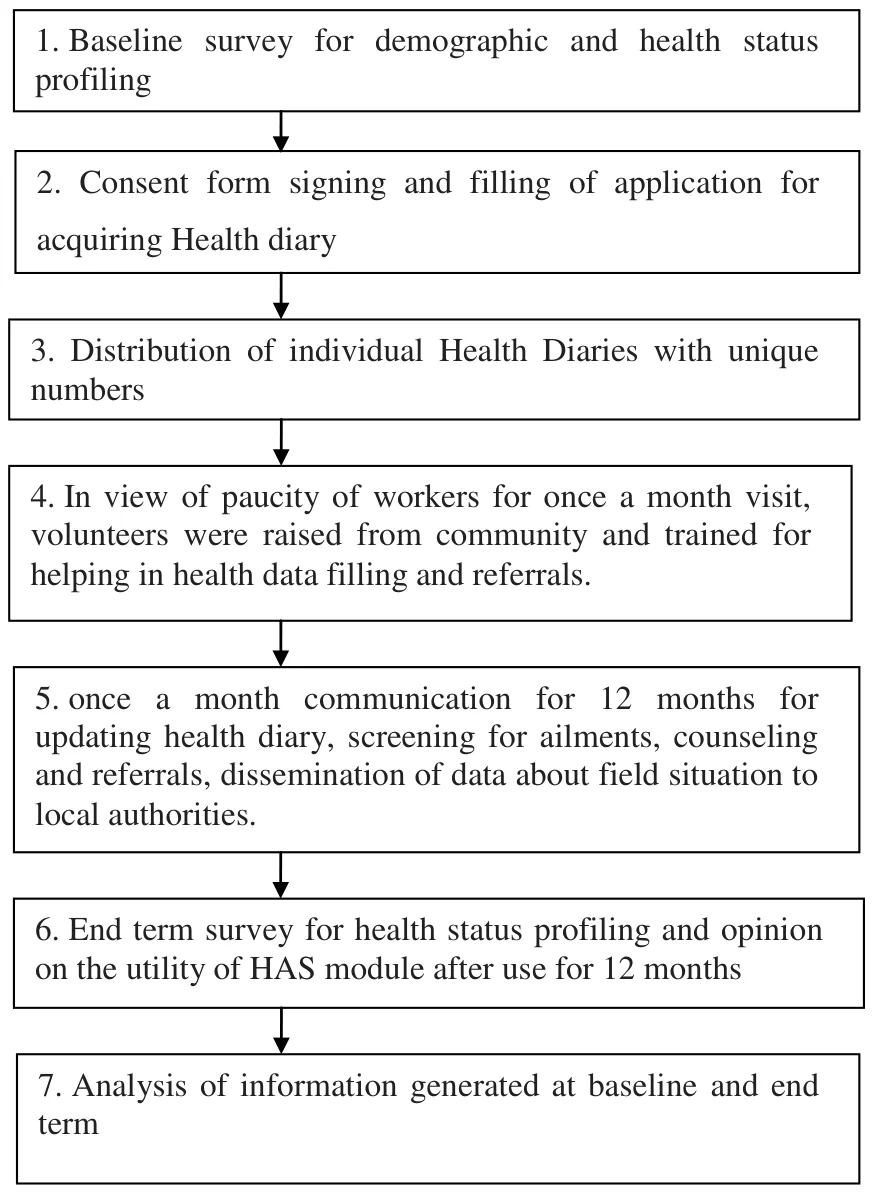
Codal formalities for research funds transfer were completed like Ethical clearance from local institution body, grant of undertaking of responsibility of equipment and staff, mandate form of statuary audit body, bank account details for e-transactions of funds, Staff was appointed at sites. Baseline survey for situation analysis was conducted to gather opinion on HAS intervention. Informed consent forms were filled and if consent granted, application form for individual health diary were filled simultaneously during baseline situation analysis. After distribution of health diaries to those who filled application form, self carbon page of health diary (containing information on health status, treatment and needs) were collected on once a month basis for 12 months.
Most observations have come by conversations done by team HAS comprising of medical officer, data entry operator, social worker who made community connections with local leaders, local Non-Governmental Organizations (NGOs), private practitioners, pharmacists, local health administration, Panchayat members, ANM, ASHA, Anganwadi, Health volunteers and individuals.
When it was observed that scheduled monthly visits of ANM and ASHA or any field worker is not taking place in any of the study areas, the reasons were explored. Lack of time and resources, travel expenses, filling of data sheets was time consuming to supply regular HMIS, were mentioned among some of those reasons.
Since, there was a need to connect on once a month basis under HAS intervention, so a volunteer catering 50 houses was deployed. Teacher, students, housewives, senior citizens who were available and willing to volunteer, were given orientation using ASHA manual for preventive health, helping Health diary filling & carbon page collection. Due to the regular monthly visits, good rapport was established among the community, HAS Team and volunteers that led to the identification of many lacunae/ gaps at ground level in the health care delivery and implementation of the health programs. Online data entry on HAS website could not be analysed due to deficiency in software and internet availability at sites. The baseline, end term and Health Diary data were entered in to the excel sheet and analysed after transporting to SPSS version 20 for comparison of pre-post morbidity profile as per WHO ICD 10 classification. Quantitative changes in morbidity profile during observation period and actions on gaps are reported in qualitative mode. Flow chart for data input shows the sequence in data collection.
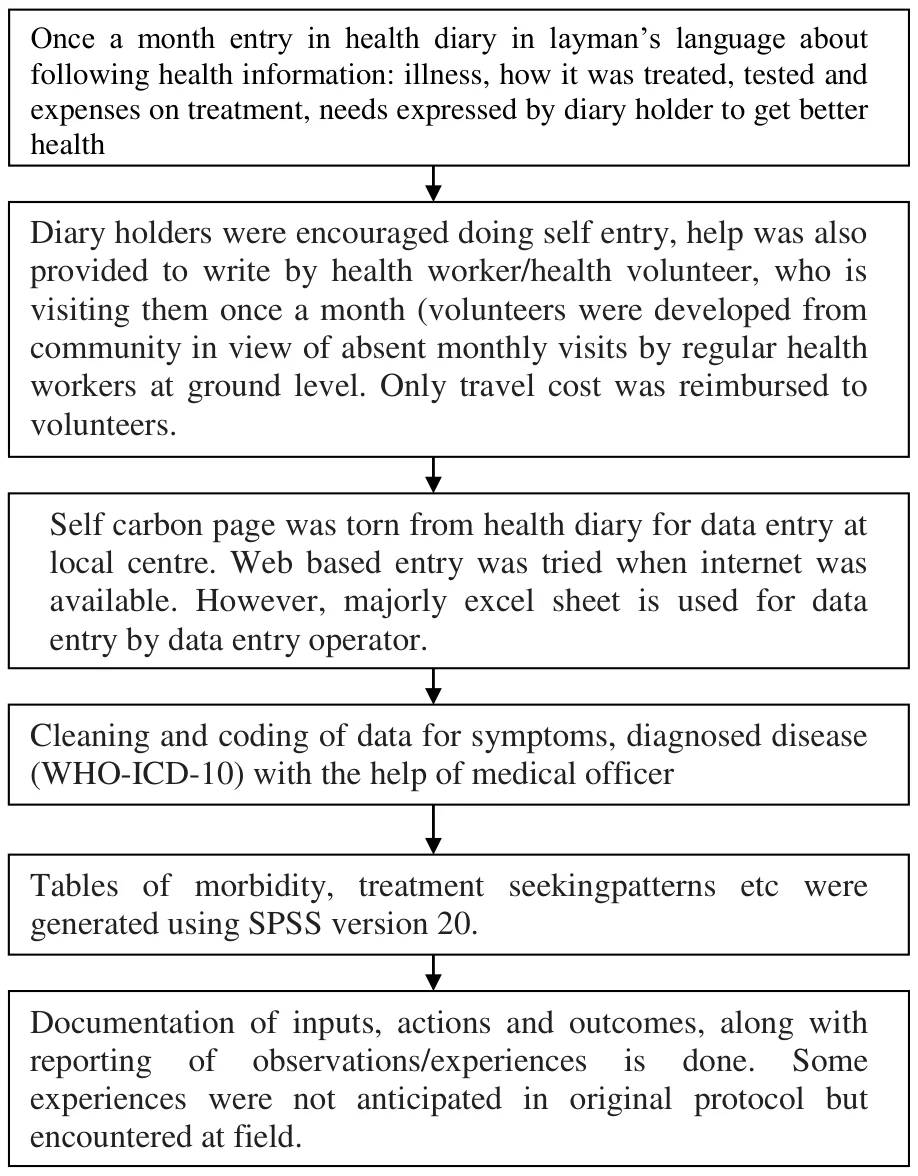
Results
The composition and demographical features of health diary holders are given in Table 1. 7484 (98%) accepted Health Diary out of 7637 contacted in study area. Majority of population (81.6% rural, 78.9% urban, 64% tribal sites) was found preferring private doctors. In tribal site (the highest among the three sites) one third populations preferred Government system.
| Demographic profile and treatment seeking | Rural N(%) 2781 (37.2) | Urban N(%) 2498(33.3) | Tribal N(%) 2205(29.5) |
|---|---|---|---|
| Gender | |||
| Male | 1443 (51.9) | 1292(51.7) | 924(41.9 |
| Female | 1338 (48.1) | 1206(48.3) | 1281(58.1) |
| Age (years) | |||
| 0 to 6 | 406 (14.6) | 277(11.1) | 308(14) |
| 6 to 18 | 823 (29.6) | 650( 26.0) | 662(30) |
| 18 to 60 | 1368 (49.2) | 1419(56.8) | 1191(54) |
| >60 | 184 (6.6) | 152 (6.1) | 44(2) |
| Education status | |||
| Illiterate | 770 (27.7) | 250(10.0) | 293(13.3) |
| Primary / middle/ high school | 1562 (56.2) | 1316(52.7) | 1396(63.3) |
| Intermediate/graduate/ PG | 424 (15.2) | 747 (29.9) | 507( 23) |
| Profession/honours | 25 (0.9) | 185(7.4) | 9(.4) |
| Occupation | |||
| Housewife | 784 (28.2) | 662(26.5) | 240(10.9) |
| Student-school/college | 1076 (38.7) | 972(38.9 | 956(43.4 |
| Skilled work | 25 (0.9) | 40(1.6) | 104(4.7) |
| Unskilled work | 623(22.4) | 172( 6.9) | 27 (1.2) |
| Business | 67(2.4) | 162(6.5) | 181(8.2) |
| Unemployed | 95(3.4) | 80(3.2) | 428(19.4) |
| Private Service | 45(1.6) | 132(5.3) | 44( 2) |
| Government job | 47 (1.7) | 190(7.6) | 223(10.1) |
| Pension | 19 (0.7) | 88(3.5) | 2( 0.1) |
| Treatment seeking preferences/choice of treatment facility for seeking health care | |||
| Private Doctor/ local healer/ quacks | 2269 (81.6) | 1971(78.9) | 1411(64) |
| Private Vaidya | 67 (2.4) | 90(3.6) | 24(1.1) |
| Government Doctor | 312 (11.2) | 295(11.8) | 728( 33) |
| Pharmacist | 78 (2.8) | 62(2.5) | 24(1.1) |
| Domestic treatment | 44 (1.6) | 27(1.1) | 0 |
| Alternative/Other | 11(0.4) | 10(0.4) | 18(0.8) |
| Homeopathy | 0 | 43(1.7) | 0 |
Changes observed in top five major categories of illness at baseline and at end-term after 12 months of Health diary use are given in Table 2.There was 1 to 3% rise in prevalence of morbidities at the end term survey. Significant changes observed in infectious illness in rural site, diabetes in rural and urban, digestive system disorders among tribal site population. The changing dynamics is of point prevalence during months of March-May. Overall improvement in reporting of non communicable illness may be the reason behind its rising prevalence. Previously unknown cases of Hypertension (6%), Diabetes (8%) were detected during study.
| Rural n (%) | Urban n (%) | Tribal n (%) | ||||
|---|---|---|---|---|---|---|
| Total participating population, n | Baseline 2781 | End-term 2506 | Baseline 2498 | End-term 2189 | Baseline 2205 | End-term 1789 |
| Overall morbidity prevalence [15] | 484 (17.4) | 464(18.5) | 335 (13.4) | 306(14) | 370 (16.8) | 345 * (19.3) |
| Infectious and parasitic disease$ | 120(24.8) | 38(8.2)# | 40 (11.9) | 31(10.1) | 123(33.2) | 85(24.6)# |
| Respiratory system diseases | 49 (10.1) | 29 (6.2)* | 27 (8.1) | 22(7.2) | 82 (22.2) | 48 # (13.9) |
| Diabetes and metabolic disorders | 11 (2.3) | 45 (9.7)# | 62 (18.5) | 120 # (39.2) | 16 (4.3) | 8 (2.3) |
| Cardiovascular illness | 29 (6) | 34 (7.3) | 40 (11.9) | 42 (13.7) | 55 (14.9) | 41 (11.9) |
| Disease of digestive system | 24 (5) | 26 (5.6) | 15 (4.5) | 16 (5.2) | 62 (16.8) | 4 # (1.2) |
*p<0.05, #p=<0.01 $including pyrexia of known origin, vaginal discharge, skin infection, urinary tract infections) ! Included coronary artery disease, blocks, septa defects, irregular heartbeats, and tachycardia!! Included dyspepsia, gastritis, diarrhoea, gall bladder stone, indigestion, nausea, pain in abdomen, constipation
About the Health Diary Use
People were hesitant doing self entries in their health diaries mainly due to 3 reasons: Perception that no one will care for it (80%), secondly due to apprehension on how to write (45%), thirdly apprehension and doubts no benefits in health service delivery (35%). Monthly updating required labour intensive persuasion initially for 3 months, it reduced thereafter. Monthly submissions of health diary pages were continued by 70% Diary users at the end of 12 months. Drop out of 2245 Diary holders by the end of 12 months was mostly due to migration for job (Arunachal -Tribal site-33%) and loss of Diary (UP rural-urban site-27%). The compliance was good among those who were asked for diary by treating doctors at health centre to see last month’s health pattern (Arunachal Pradesh). On spot counselling and referrals, remedial actions and preventive education imparted during monthly updating had brought confidence among users.
Unsolved gaps: some senior citizens could not be provided companions to ferry them to nearby health facility for cataract operation. Diagnosed infectious disease cases and TB patients could not be supplied with required antibiotics since local health facilities have no guidelines to give the medicines that way.
Discussion
Participative community handles chronic, acute, emerging and rarely occurring diseases in the better way.[17] That is evident from the shifting paradigm of disease profile in study sites. Health care is about care of human by human. It was visible in our study also when health volunteers and HAS team monthly contacted for health diary updation. Due to this conversation many gaps emerged which were previously not in light but existed in the community. Public faith rejuvenation by making them participate in Government’s schemes is also observed in published literature.[18] The gaps at macro level of policy planning and micro level implementation could be reduced by community participation.[19]
A study in South Africa found that Lay health volunteers in the community were equivalent to those who received treatment through other modes of treatment delivery.[20] Similar utility was observed in our study.
During this study coordination with various departments like District hospital, water, sanitation, health, education, Panchayat was explored with health information sharing for improving the health of community. Not much is published on this but similar efforts have been found effective in other study.[21] According to Tangchar al multisectoral actions for health, defined as actions undertaken by non-health sectors to protect the health of the population, are essential in the context of inter-linkages between all dimensions of sustainable development.[22]
In the initial phase of our study, people in the community doubted intention and utility of scheme. The reason may be the non-availability of help in the time of need, lack of proper implementation of various programs/schemes at ground level and unmet needs without channel to address them. Some other studies like ours could identify such gaps by community involvement and helped restoring people’s confidence in public health system.[23, 24] There are similar success stories of implementation of Pulse polio, Revised National Tuberculosis Control Program (RNTCP) when community became participant,[25] but these are only disease specific programs while our study observed changes (table 2 and 3) in wide variety of health conditions and attributes it to feedback from community and its participation in health information generation.
| Area | Problem | Gap identified | Approach/ action taken |
|---|---|---|---|
| Rural | Severely malnourished children (n=8) identified. They all were getting routine porridge (daliya) from local Anganwadi* | Additional protein and fat to such children was not being given. Fathers were addicted and mothers were illiterate. | HAS team and health volunteers arranged counselling by paediatrician and connected these families with locally functional NGOs to supply energy dense food supplements. |
| Rural | Health Centre having large un-utilised stock of contraceptive Pills and Condoms citing lack of demand from community | With regular contacts for diary updating process, HAS staff could sense that people were hesitant in disclosing their demand for contraceptive needs hence did not ask for. | During periodic home visits people opened up. 40 HHs came up with demand of condoms and pills. The distribution of condoms and pills channelized, reaching to those who were demanding, hence utilization level increased, and unmet needs were fulfilled. |
| Rural/ urban | More than 100 elderly were found having diminished vision at different stages of cataract but were unable to consult even to nearby facility, due to lack of resources to travel and/ or support of any accompanying person | Even though free facilities available within 2-3 kilometre distances, Elders’ were requiring accompanying person and transportation to get treatment. | Available resources were searched and transportation of patients could be achieved through help from NGOs for ambulance and volunteers providing support of accompanying person. |
| Rural/ Urban | Women preferred home delivery to nearby free hospital delivery | Overcrowding, Lack of infrastructure and hygiene, apathetic | |
| Rural/ Urban | Hospital facilities | During updating of health diary, women cited facing overcrowding, lack of infrastructure and hygiene, apathetic and rude behaviour of staff, as some of the reasons for reluctance from Institutional delivery. | Health functionaries in study area were contacted and informed about feedback given from women. Functionaries were alerted citing reflection of such feedback on HAS portal. The communication started to ease the hurdles of quality issues in service delivery. |
| Rural/ tribal | Lack of transport for patients to travel from home to hospital/ health facilities | There were few vehicles, available for carrying patients, but either non-functional, or with precondition of having minimum occupancy of 8-10 persons. | Reasoning was built to send vehicle for even less than 10 patient’s transportation without pre-conditions. The feedback from community was sent to CMO, based on that vehicle was made available. |
| Tribal | 70 patients were identified with acute and chronic typhoid and hepatitis | The drinking water was found fetched from one river stream and the same stream was receiving sewage/ drainage of that locality. | Health education on using boiled water was given by health volunteers to the families. The community’s compliance to this education was found good as during next monitoring visit, staff found people using boiled water, so much so that HAS staff started getting offer to drink boiled water during monthly updating. Bio toilets were being installed at places to avoid sewage connection directly in to the river, since district health authorities were alerted of high burden of diseases. |
| Tribal/ rural | Tuberculosis (n=13) patients found taking medicines from private providers | Lack of free transport facility and unfavourable timings of Government’s DOTs centre were cited as reasons | Efforts were done to deliver anti tubercular medicines and nutrition education by HAS-volunteers. However CMO denied using channel made under HAS for delivery of medicine to patients citing absence of policy guidelines and directives. |
| Tribal | Addiction habits were recorded among 56% males and 43% females | During monthly updating, Staff under the study undertook frequent enquiry, on spot counselling, narrating risks and discussing ways on how to get rid of risky habits. | The addiction among males reduced by 8%, while no difference of addicting habits among females was observed. It was observed that different risk and aspects affect males and female in to addictions, hence HAS team recommended adopting personalised counselling to each addict. |
*Anganwadi: Under the ICDS scheme, (Beneficiary population comprises of infants 6 months to 6 years, pregnant women & lactating women) one anagnwadi caters to a population of 1000 of the general population).
Though there is not any study with similar approach to set communication with community but few studies show effectiveness of community based health workers in early diagnosis of diseases like cancer.[21]
Strengths and Limitations:
For the first time community based participation study is carried out to explore available means to seek health data which can be traced back to ascertain authenticity and can be used to address gaps at local level using information of that locality. Such Health conditions could be tapped which were not recorded or documented by any other mode of HMIS. All patients including private, public health facilities seekers or home remedy, could be connected to get wholesome health information. Community felt sense of belongingness and connection with the health volunteer during counselling given with health diary updating hence hidden aspects of needs and gaps came into light. Local solutions of local problems using culturally appropriate measure could be possible since mechanism of communication was set with the community.
One major limitation is the absence of any comparison arm, the results that are seen here may be due to the intervention or it would have happened anyway in a year’s time. Because of lack of control area we have compared pre and post intervention profile. It is a preliminary study and state authority did not provide us with control areas. It is proposed (strongly recommended by scientific committees) in future extension of the study that this intervention will be evaluated throughout the country and control areas will be ascertained in the study through country wide ICMR field practice areas/centers at medical colleges.
Another limitation was in terms of delay in implementation due to less availability of ground level health workers. Original protocol overestimated availability of ground level health care workers which were not there in reality that led us to identify health volunteers that caused delay in enrolment and training. Ground realities of Internet availability and accessibility were also overestimated in protocol, but were not there at field level, causing delays in online data entry.
Roadblocks too were observed in study. Some identified gaps could not be addressed due to apprehensive Health administrators, hesitancy in implementing some corrective measures citing absence of policy directives from higher authorities. For example, denying delivering of anti-tuberculosis and other medicines to targeted beneficiaries at the door step of patient using channel of trained health volunteers even with assurance of authentic delivery, providing document/ record of consumption by beneficiaries using Health diary and e health account. Some private practitioners were apprehensive of study due to disclosure of name of medicines and expenses in health diary.
Field workers like ASHA/ANM were filling their registers for morbidities every month as part of the work assigned to them under HMIS, but were hesitant to visit community every month due to lack of time and logistics. Since they are required to report numbers of few notified disease or events only, there was no need to provide contact details of patients and other diseases. Therefore, we explored training of the available literate persons as health volunteers in view of paucity of grassroots workers. Other published studies [26–28] have also shown benefit of more trained /skilled work force to empower community and cater health needs. More extensive studies to assess implementation strength on this intervention will provide clear policy inputs as Sreedhara et al suggest implementation strength can be used to guide efforts to enhance the effectiveness of programs and assess the intensity and extent of scale up.[29]
Conclusions
Due to HAS intervention (community participation to open channels of communication) ensured once a month contact with each one to update health status not only for gathering information but also to take timely actions on identified needs/ gaps as well as generated confidence among community.
This also highlighted the need to improve presence of frontline health workers/ volunteers, intersectoral linkages to pool resources at ground level at all 3 sites. It will further improve if health diaries are made service linked to ensure compliance.
Ethical approvals
Project’s Ethical Committee of ICMR and at sites provided approval to conduct the study.
Conflict of Interest
None
Acknowledgements
Grateful for valuable guidance from late Prof.Dr.DeokiNandan, Dr. V. M. Katoch, Dr.SaumyaSwaminathan and Dr. R. S. Sharma. The study is supported by Indian Council of Medical Research, Task Force Grant number No. 5/7/1/208-RHN, IRIS number 2008-0826,A to C
References
- Hannu Vuori. Patient Satisfaction—Does It Matter? International Journal for Quality in Health Care. 19913 (3):183–189. [doi:10.1093/intqhc/3.3.183]
- Tindana PO, Singh JA, Tracy CS, Upshur RE, Daar AS, Singer PA et al. Grand challenges in global health: community engagement in research in developing countries. PLOS medicine. 2007;4(9):e-273. [doi:10.1371/journal.pmed.0040273]
- Bovaird T. Beyond engagement and participation: User and community coproduction of public services. Public administration review. 2007;67(5):846-60. [doi:10.1111/j.1540-6210.2007.00773.x]
- Bazzoli GJ, Stein R, Alexander JA, Conrad DA, Sofaer S, Shortell SM. Public–private collaboration in health and human service delivery: evidence from community partnerships. The Milbank Quarterly. 1997;75(4):533-61. [doi:10.1111/1468-0009.00068]
- Cleary PD, Edgman-Levitan S. Health care quality: incorporating consumer perspectives. JAMA. 1997;278(19):1608-12. [doi:10.1001/jama.1997.03550190072047]
- Griffiths P, Stephenson R. Understanding Users ‘perspectives of Barriers to Maternal Health Care Use in Maharashtra, India. Journal of biosocial science. 2001;33(3):339-59. [doi:10.1017/s002193200100339x]
- Community based monitoring and planning of health services. Themes for SATHI (cited in 2008) available from http://www.Sathicehat.Org/Index.Php/Our-Publications/Reports
- Arvind Pandey, Nandini Roy, Rahul Bhawsar, Ram Manohar Mshra. Health Information System in India: Issues of Data Availability and Quality. Demography India . 2010;39:111-128. [Google Scholar]
- Nagarajan P, Tripathy JP, Goel S. Is mother and child tracking system (MCTS) on the right track? An experience from a northern state of India. Indian J Public Health. 2016 Jan-Mar;60(1):34-9. [doi:10.4103/0019-557x.177298]
- Rajeev Gera,Nithiyananthan Muthusamy,Amruta Bahulekar,Amit Sharma,Prem Singh,Amrita Sekhar et al. An in-depth assessment of India’s Mother and Child Tracking System (MCTS) in Rajasthan and Uttar Pradesh. BMC Health Services Research. 2015;15:315. [doi:10.1186/s12913-015-0920-2]
- Madon S, Sahay S, Sudan R. E-government policy and health information systems implementation in Andhra Pradesh, India: need for articulation of linkages between the macro and the micro. The Information Society. 2007;23(5):327-44. [doi:10.1080/01972240701572764]
- Sahay S. Assessment of the ability of the health management information system in India to use information for action (Doctoral dissertation) available from:https://etd.uwc.ac.za/xmlui/bitstream/handle/11394/3607/Sahay_MPH_2011.pdf
- Kataria BG, Saini AK, Gupta S. Implementation Status of Health Care Information System: A Study of Some of the States of Northern India. Available from pdfs.semanticscholar.org [Google Scholar]
- Sahay S, Lewis J. Challenges and approaches in moving from data to information to knowledge: Case study from the Gujarat state health system in India. Proceedings, 10th International Conference on Social Implications of Computers in Developing Countries, Dubai (2009) available from:http://citeseerx.ist.psu.edu/viewdoc/download?doi=10.1.1.577.356&rep=rep1&type=pdf
- About Health Account Scheme: document (2012), available from http://healthaccountsscheme.nic.in/account/login
- Accessed and available from http://apps.who.int/classifications/icd10/browse/2016/en
- World Health Organization – 2003. Primary Health Care: 25 Years after Alma-Ata. Available from:http://apps.who.int/iris/bitstream/10665/122206/1/em_rc50_r12_en.pdf
- ShirinMadon, SundeepSahay&Randeep Sudan. E-Government Policy and Health Information Systems Implementation in Andhra Pradesh, India: Need for Articulation of Linkages between the Macro and the Micro. The Information Society. 2007;23(5):327-344. [doi:10.1080/01972240701572764]
- Kironde S, Kahirimbanyi M. Community participation in primary health care (PHC) programmes: lessons from tuberculosis treatment delivery in South Africa. Afr Health Sci. 2002;2(1):16-23. [Google Scholar]
- Tangcharoensathien V, Srisookwatana O, Pinprateep P, Posayanonda T, Patcharanarumol W. Multisectoral Actions for Health: Challenges and Opportunities in Complex Policy Environments.Int J Health Policy Manag. 2017;6(7):359-363. [doi:10.15171/ijhpm.2017.61]
- Bellhouse S, McWilliams L, Firth J, Yorke J, French DP. Are community-basedhealth worker interventions an effective approach for early diagnosis of cancer? A systematic review and meta-analysis. Psychooncology. 2018;27(4):1089-1099. [Google Scholar]
- M. McCorkle, Edward C. Green. Intersectoral healthcare delivery. Agriculture and Human Values. 1998;15(2):105–114. [doi:10.1023/a:1007417125712]
- KristiinaH,KaijaS,PirkkoN. Definition, structure, content, use and impacts of electronic health records: A review of the research literature. International Journal of Medical Informatics. 2008;77(5):291-304. [doi:10.1016/j.ijmedinf.2007.09.001]
- Availablefrom https://blog.mygov.in/editorial/national-health-policy-new-frontiers-in-health-care/
- Maher D, van Gorkom JL, Gondrie PC, Raviglione M. Community contribution to tuberculosis care in countries with high tuberculosis prevalence: past, present, and future. The International Journal of Tuberculosis and Lung Disease. 1999;3(9):762-768. [Google Scholar]
- Venkatachalam J, Kumar D, Gupta M, Aggarwal AK. Knowledge and skills of primary health care workers trained on integrated management of neonatal and childhood illness: follow-up assessment 3 years after the training. Indian J Public Health. 2011;55:298-302. [doi:10.4103/0019-557x.92410]
- Lewin S, Munabi-Babigumira S, Glenton C, Daniels K, Bosch-Capblanch X et al. Lay health workers in primary and community health care for maternal and child health and the management of infectious diseases. Cochrane Database of Systematic Reviews. 2010;3:(Art. No.: CD004015). [doi:10.1002/14651858.cd004015.pub3]
- Mary Beth Love, Kristen Gardner, Vicki Legion. Community Health Workers: Who they are and what they do. Health Education and behaviour. 1997;24(4):510-22. [doi:10.1177/109019819702400409]
- Sreedhara SK, Mohan D, Marx M. Making a Case for Measuring Implementation Strength of Programs. International Journal of Health Systems and Implementation Research, (2018);2(1):19-28. [Google Scholar]
Published
Article metrics
- Views
- 1,688
- Downloads
- 1,152
Based on this site's usage statistics.
Issue
Section
How to Cite
More in this topic: Health information & digital health
View Point · 2024
Digitalization of ASHA Work: Challenges and Way Forward