View Point Vol. 9 No. 2 (2025): International Journal of Health Systems and Implementation Research
From Screens to Sips: Social Media's Impact on Adolescent Alcohol Use
Social Media and Adolescent Alcohol Use
Downloads
Topics
Keywords:
- Adolescents
- Alcohol consumption
- Peer Influence
- Social media
Abstract
Today's adolescents and young adults navigate a digital world full of user-generated information, where social media platforms are increasingly influencing attitudes and actions about alcohol consumption. Regular exposure to pro-alcohol posts normalises drinking and promotes positive attitudes towards early initiation, whether through peers, influencers, or uncontrolled digital marketing. By providing vulnerable users with tailored alcohol content, frequently without their knowledge, algorithmic targeting increases this influence even more. Adolescents are especially vulnerable since this exposure occurs at a developmental stage characterised by increased sensitivity to peer approval, FOMO, and psychological anguish. Research indicates that representations of alcohol on social media are linked to higher consumption, binge drinking, and dangerous offline behaviours. Alcohol is the second-largest contributor to adults' disability-adjusted life years, according to the GBD (Global Burden of Disease) 2019 report, highlighting the seriousness of the problem. Long-term effects of early alcohol consumption include poor academic performance, mental health issues, violence, and an increased chance of alcohol use disorders. Coordinated, multisectoral efforts involving families, schools, communities, healthcare institutions, and legislators are needed to address this rising issue. To reduce harm and encourage better online and offline environments for India's youth, stricter laws, instruction in digital literacy, and focused preventative measures are crucial.
Full text
This web version was prepared from the published PDF, which is the version of record. Please cite and quote from the PDF.
Introduction
The adolescents and young adults of today are growing up surrounded by social media sites that promote user-generated content and continuous interaction [1]. They are regularly exposed to posts about alcohol in this setting, which may influence their attitudes and actions. Pro-alcohol messages and pictures are not only encountered by young people, but they also spread them, whether through unregulated alcohol marketing that frequently targets minors or through personal visualisations of drinking. These online displays of alcohol use have been connected to dangerous intake and offline drinking habits. Adolescents between the ages of 13 and 17 who use social media extensively during a vulnerable developmental stage are particularly impacted by this issue [2]. Alcohol is the second-largest factor in adolescents' and young adults' disability-adjusted life years, according to the GBD 2019 study [3].
In addition, young adult alcohol consumption is associated with many detrimental outcomes, including poor academic performance, violence, mental health problems, traffic accidents, cognitive and functional deficiencies, and intentional self-harm. This increasing online influence becomes especially troubling.
The main mechanisms by which adolescent alcohol use is shaped and increased by social media exposure are described below:
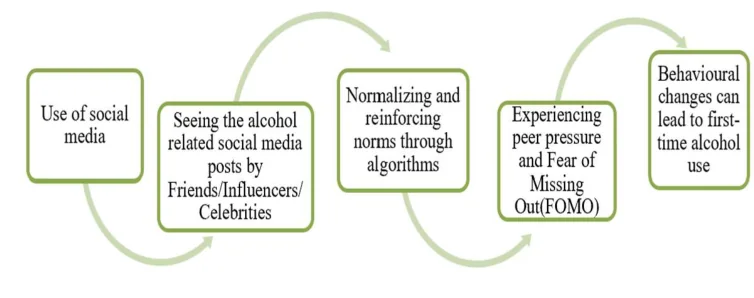
- Increased Exposure to Alcohol-Related Content: Social media can have a variety of interconnected effects on alcohol consumption. Using social media increases one's exposure to alcohol-related content, especially when friends, celebrities, or influencers post content that presents drinking as a desirable or typical habit. Such exposure helps normalise and encourage drinking habits through platform algorithms that repeatedly show similar information. Peer pressure and FOMO (fear of missing out) can put people under pressure to engage in similar behaviours. These social and psychological elements may eventually lead to behavioural changes that could lead to the first-time drinking of alcohol [3] [Figure 1].
- Online Display and Marketing of Alcohol: Online portrayals of drinking on personal pages and uncontrolled alcohol marketing on social media platforms that may reach minors expose young people to and exhibit pro-alcohol words and imagery. Excessive drinking and offline alcohol use have been connected to these online displays of alcohol usage.
- Manipulative Digital Marketing and Algorithmic Targeting: Social media's deliberate strategies systematically influence how adolescents perceive their relationships with alcohol. Alcohol marketing on these platforms employs humour, well-known memes, and celebrity endorsements as tools to promote drinking as desirable and socially acceptable. Many adolescents are unaware that social media constantly monitors their actions, including likes, follows, searches, and watching habits, creating intricate psychological profiles. Then, during times when adolescents are most susceptible and open, algorithms display tailored alcohol content. Fake advertising, which advertises soft drinks, events, or goods under alcohol brand names in defiance of advertising limitations, allows alcohol brands to maintain their brand presence. By standardising the brand and fostering visually appealing links, this ongoing visual reinforcement reduces barriers to the final introduction of alcohol.
- Peer Pressure, Group Norms, and FOMO: To make acceptance clear, friends set up group challenges and tag adolescents in posts about drinking. Adolescents always experience FOMO (fear of missing out) when they see carefully chosen pictures of their friends having fun. Due to this psychological chaos, some people feel compelled to begin drinking to avoid social rejection.
- Psychological Distress and Alcohol Use as Coping: High levels of social media use are associated with anxiety, depression, and trouble sleeping [4]. Exposure to digital alcohol marketing content on social media platforms has been associated with adolescent alcohol intake, binge drinking, and sensitivity to alcohol usage [5]. Studies show that alcohol is often used as a coping strategy by adolescents who suffer from psychological distress, family-related stress, or social rejection. Cyberbullying, social comparison, and concern over one's online presence all contribute to this being prone in the digital era.
- Strategic Alcohol Marketing Targeting Youth: Alcohol companies and brands can use social media platforms to target younger consumers. Through influencer partnerships, sponsored content, and advertisements that convey the idea that drinking alcohol is trendy, hip, or necessary for social success, they can use sophisticated strategies to draw in young adults [6].
- Long-Term Consequences of Early Alcohol Use: Future adult costs, such as increased risks of academic failure, mental health problems, antisocial conduct, physical sickness, hazardous sexual behaviour, STDs, early-onset dementia, and the formation of alcohol use disorders (AUDs), can be accurately predicted by early adolescent alcohol consumption [7].
Conclusion
In conclusion, the relationship between adolescent alcohol use and social media is an urgent issue that necessitates action, strategic planning, and involvement from stakeholders in all sectors, including families, educational institutions, governmental organisations, and medical professionals. Recent studies from India highlight the increasing trends of obsessive social media use and rising youth alcohol consumption, highlighting the complex implications and challenges associated with these phenomena. An integrated, multisectoral approach that includes evidence-based health initiatives, regulatory frameworks, and grassroots community mobilisation is required to address these interrelated issues. Communities might mitigate the negative consequences of excessive social media use and alcohol misuse, improving the physical and mental health of India's youth, by increasing awareness, encouraging healthy behaviours, and offering support services created especially for young people who are at risk. Establishing surveillance systems and long-term research projects will also improve comprehension of new trends and enable prompt, focused preventative measures. In the end, establishing safe spaces where adolescents can use social media responsibly and develop resilience against substance-related harms would require ongoing cooperation across research organisations, healthcare systems, and legislative agencies.
Ethical Approvals
We have obtained ethical approval from our institute (IEC-04/2024-3084).
Funding
This viewpoint is part of the research project titled “Social Marketing Intervention for Adverse Child–Family Relationships, Alcohol Usage, and Sexual Health Issues Attributable to Social Media Usage among Adolescents: A Multi-city Cluster Randomized Controlled Trial in North India” (Proposal ID: IIRPSG-2024-01-00221), funded by the Indian Council of Medical Research (ICMR), New Delhi.
Acknowledgements
We are thankful to the Indian Council of Medical Research (ICMR), New Delhi, for giving the aforementioned funding (Proposal ID: IIRPSG-2024-01-00221).
Conflict of Interest
None declared
References
- Lenhart A, Purcell K, Smith A, Zickuhr K. Social media and young adults. Pew Internet and American Life Project [Internet]. 2010 Feb 3. Available from: https://www.pewresearch.org/
- Moreno MA, Whitehill JM. Influence of social media on alcohol use in adolescents and young adults. Alcohol Res Curr Rev. 2014;36(1):91. [doi:10.35946/arcr.v36.1.09]
- Nadkarni A, Tu A, Garg A, Gupta D, Gupta S, Bhatia U, Tiwari N, Heath A, Wen K, Fernandes G, Velleman R. Alcohol use among adolescents in India: a systematic review. Glob Ment Health. 2022 Jan;9:1-25. [doi:10.1017/gmh.2021.48]
- Kumar S, Dwivedi A. Virtual realities and mental struggles: social media addiction among Indian youth. In: Khan L, editor. Oxford Intersections: Social Media in Society and Culture [Internet]. Oxford: Oxford Academic; 2025 Jun 26. Available from: https://oxford.universitypressscholarship.com/
- Donaldson SI, et al. Association between exposure to digital alcohol marketing and alcohol use: a systematic review and meta-analysis. Lancet Public Health. 2025;10(11):e912-e922. [doi:10.1016/s2468-2667(25)00219-1]
- Kashyap S. Social media and methomania: finding cause and effect of increasing alcoholism among adolescents in India. Int Res J Econ Manag Stud. 2023;2(3). [Google Scholar]
- Jaisoorya TS, Beena KV, Ravi GS, Thennarasu K, Benegal V. Alcohol harm to adolescents from others' drinking: a study from Kerala, India. Indian J Psychiatry. 2018;60(1):90-96. doi: 10.4103/psychiatry.IndianJPsychiatry_186_17\
Published
Article metrics
- Views
- 379
- Downloads
- 116
Based on this site's usage statistics.
Issue
Section
How to Cite
License
Copyright (c) 2025 Lakshay Jaglan, Tamanna Kumari, Divya Sharma, Ashrajdeep Singh, Jyoti Yadav, Tanvi Kiran

This work is licensed under a Creative Commons Attribution 4.0 International License.