Original Article Vol. 4 No. 3 (2020): International J Health Systems and Implementation Research
A Root Cause Analysis of Stillbirths Delivered in a Tertiary Care Hospital of India –Understanding the Gaps in Care Provided
Root cause analysis of stillbirths
Downloads
Topics
Keywords:
- Stillbirth, stillbirth rate, root cause analysis, Fish bone diagramme.
Abstract
Objective: To evaluate the stillbirths by Root cause analysis to address the causes in-depth, and understand the gaps in the accessibility to the existing health care system.
Methodology: A total of hundred cases of stillbirth were studied and Root cause analysis was performed and factors contributing to stillbirths were categorized mainly into the organization, personnel, equipment, barriers at the personal/family level in accessing health care, and underlying maternal and fatal causes.
Results: A total of 367stillbirths delivered (out of 8157 total birth) over a period of 18 months and root cause analysis was performed successfully in a hundred cases. Common causes for stillbirth were Hypertensive disorder of pregnancy, abruption, fetal growth retardation, prematurity, and congenital malformations. Lack of recognization or seriousness at the family level (49%) ranked number one as a contributory factor, closely followed by the health care provider level like failure to follow best practices (44%) and failure to recognize seriousness or judgemental error (35%). A poor system of sharing information and weak referral was observed in 23% of cases.
Conclusion: Root cause analysis has highlighted the various avoidable and modifiable factors during the contact of a pregnant woman with her family, health care provider, and facility which ultimately attributed to the adverse outcome. Development of a strong referral system with a timely referral with proper communication, following standard treatment protocols, guidelines, and a sufficient number of staff and resources at health care facilities can go a long way in reducing these preventable stillbirths.
Full text
This web version was prepared from the published PDF, which is the version of record. Please cite and quote from the PDF.
Background
Stillbirth is one of the adverse outcomes of pregnancy leading to a huge burden on society and India ranks top most in the world in terms of total number (592000) with estimated Stillbirth rate of 23 per 1000 births [1]. Out of world’s 2.6 million stillbirths each year, most of them (98%) occur in low middle-income countries [2]. Stillbirth rate is a marker of quality and equity of health care provided to a mother during pregnancy and at the time of delivery. Lack of skilled birth attendance is considered as an important contributor to SB [3]. In India as per National family health survey-4 (NFHS-40) 78.9% were institutional births, and 4.9% home deliveries were conducted by skilled health personnel [4]. In spite of high skilled birth attendance, the stillbirth rate is still very high and it means that there are other gaps in health care which need attention.
The stillbirths frequently go unrecognized, as there are challenges to collect data on stillbirths and their underlying causes [5]. The risk factors and cause for stillbirths are multifactorial due to inadequate antepartum and intrapartum care and need to be addressed accordingly [6]. Common factors in Antepartum stillbirths are infections, diabetes, hypertension which can be prevented by simple interventions and improving the quality of antenatal care provided [7]. Intra partum stillbirths can be minimised with high quality obstetric care which include regular fetal heart monitoring, judicial use of oxytocin and other medications during labour, charting various events during labour in a partograph and intervening at the earliest to deliver healthy baby either by caesarean section or instrumental delivery as per standard practice and guidelines [5].
However, for targeted interventions for stillbirth reduction, it is important to understand the bottlenecks in the given context locally. There is limited literature which focuses on cause of death, contributory factors related to care-providers, system and patient attributing to stillbirth. This study is an attempt to evaluate the stillbirths delivered in a tertiary care hospital of India using Root cause analysis framework modified from Farquhar et al and address the causes in depth, understand the gaps between the basic levels of management and understanding about deficiencies in care provided [8,9].
Methodology
It was hospital-based study done over a period of 18 months (January 2017- June 2018) in a tertiary care hospital after taking the approval from institutional ethics committee. Stillbirth identification was done from the labor room and emergency admission records on daily basis. WHO definition of stillbirth i.e. gestation of more than or equal to 28 weeks OR birth weight of >=1000 grams was followed to recruit the Stillbirth cases. The gestational age was calculated from last menstrual period or early ultrasound if not available. Comprehensive pre structured questionnaire was used to gather information from the case records and interview of family. Questionnaire included questions on socioeconomic status (using Kuppuswamy scale [10]), demographic profile, obstetrical & family history, routine antenatal investigations, clinical examination findings, maternal condition on admission and other intrapartum complications. Details of each fetus were noted which included birth weight, sex and description of congenital malformation. Data on various possible contributory factors at family level, transportation and referral level and health system’s level was captured primarily through interview of the family members or mother, supported by relevant case records.
Root cause analysis was initiated within 48 hours of enrollment and completed within 45 days. These stillbirths were divided into antepartum where fetal death occurred before the onset of labour and intrapartum where death happened during the labour. Each stillbirth was classified as per international classification of disease-Perinatal Mortality (ICD-PM) recommended by WHO [11].
Root cause analysis was mainly focussed on six factors which included Organization/system related, health care personnel related, equipment & supplies related, barriers at family level, maternal condition and fetal causes. RCA was done by asking question “why” until the last factor was explored and all the contributory factors along with secondary factors were plotted in fish bone diagram. For example a case of Stillbirth attributed to IUGR was analysed as shown in box 1. After completing RCA, cases were presented to the Stillbirth audit review team which included the investigators (BV,BS, NA),senior gynaecologist, neonatologist (SV), consultant from community health (AA) and hospital administration(PA) of the institute.
Root cause analysis was done separately for major causes of stillbirths: HDP, abruption and Eclampsia to understand the differentials in RCs in three different conditions.
| Why did stillbirth occur? | IUGR |
|---|---|
| Why did IUGR occur? | IUGR was missed |
| Why was IUGR missed? | Protocol not followed |
| Why protocol not followed? | There was no protocol available OR Lack of knowledge and skills about the protocol |
Results
Stillbirth rate was found to be 44.9/ 1000 births (367/8157). Complete RCA was done in total 100 cases. Table 1 shows the maternal demographic and obstetrics profile, primarily these were young (<35 years age), literate house wives from both rural an urban areas largely from lower middle to upper lower socio economic status, with BMI <25, and anaemia in 44%. Sixty-two percent from multigravida. Overall 80% women received ≥ 4 antenatal visits, 60% delivered before 34 weeks of gestation, 30% had previous history of abortion and 12% had previous stillbirth. Sixty-five percent SBs were antepartum and 30% had birth weight < 1000 grams. Total 18 stillbirths were found to have congenital malformation and maximum cases were of Neural tube defects. (Table 2)
| Maternal Characteristics | |
|---|---|
| Age | |
| <35 YRS | 93 |
| ≥35 YRS | 07 |
| Education | |
| Illiterate | 16 |
| Literate | 84 |
| Occupation | |
| Housewife | 85 |
| Working | 15 |
| Area | |
| Rural | 57 |
| Urban | 43 |
| Socioeconomic status | |
| Upper | 10 |
| Upper middle | 11 |
| Lower middle | 33 |
| Upper lower | 40 |
| Lower | 06 |
| BMI | |
| <18.5 Kg/m2 | 07 |
| 18.5-24.9 Kg/m2 | 64 |
| 25-29.9 Kg/m2 | 20 |
| >30 kg/m2 | 09 |
| Ethinicity | |
| Hindu | 60 |
| Sikh | 31 |
| Muslim | 09 |
| Intended Place of delivery | |
| Home | 03 |
| Hospital | 97 |
| Facilities available at intended place | |
| NICU | 27 |
| Operation theatre | 88 |
| Blood bank | 24 |
| Transport facilities available at home | |
| None | 71 |
| Two wheeler | 17 |
| four wheeler | 12 |
| Time taken to reach the intended place of delivery | |
| < 30 minutes | 39 |
| 30-60 minutes | 41 |
| >60 minutes | 20 |
| Time taken to reach the tertiary care | |
| <1 hour | 10 |
| 1-2 hours | 17 |
| 2-3 hours | 31 |
| ≥ 3 hours | 42 |
| Gravida | |
| Primigravida | 38 |
| Multigravida | 62 |
| Period of gestation | |
| ≤ 34 weeks | 60 |
| 34 – 41weeks | 38 |
| ≥ 41 weeks | 02 |
| Antenatal visits | |
| No ANC | 03 |
| <4 | 17 |
| ≥ 4 | 80 |
| Previous Obstetrics History | |
| Abortion | 30 |
| Still birth | 12 |
| Caesarean section | 12 |
| Hemoglobin (gm/dl) at admission | |
| 5.1 – 7 (Severe Anemia) | 03 |
| 7.1 – 9.5 (Moderate Anemia) | 23 |
| 9.6 – 10.5 (Mild Anemia) | 18 |
| ≥ 10.5 | 56 |
| Stillbirth Characteristics | Number = 100 |
|---|---|
| Type of stillbirth | |
| Antepartum | 65 |
| Intrapartum | 35 |
| Sex of Fetus | |
| Male | 56 |
| Female | 43 |
| Ambiguous/ Not identified | 01 |
| Weight of Stillbirths | |
| <1000gm | 30 |
| 1000-1500gm | 27 |
| 1501- 2500 gm | 31 |
| ≥2500gm | 12 |
| Mode of delivery | |
| Vaginal | 88 |
| Caesarean | 14 |
| Congenital malformation | |
| Yes | 18* |
| No | 82 |
* Congenital malformation : Neural tube defects=8, Cardiac defects=2, Pulmonary (CCAM)=1,Congenital diaphragmatic hernia=1, Genitourinary defects =6
As per ICD-PM system of classification, 30% of stillbirths were attributed to hypertensive disorder of pregnancy and 19% to abruption. In majority, SB had occurred by the time of admission except in 28 where it occurred after the admission. Only 13 % of mothers were healthy rest all were having complications of pregnancy or underlying medico-surgical disorders. Ante partum hypoxia (29%) was single largest factor in antepartum period, followed by disorders related to fetal growth both in antepartum and intrapartum period. Acute intrapartum events were reported in only 8% cases. (Table 3)
| Maternal Condition | M1 : complications of placenta , cord and membranes | M2: Maternal complications of pregnancy | M3: Other complications of labor and delivery | M4: maternal medical & surgical conditions | M5: no maternal conditions | Total |
|---|---|---|---|---|---|---|
| Antepartum still births = 65 | ||||||
| A1 Congenital malformation, deformation & chromosomal abnormalities | 0 | 1 | 0 | 1 | 3 | 5 |
| A2 infections | 0 | 0 | 0 | 0 | 0 | 0 |
| A3 Antepartum hypoxia | 8 | 1 | 0 | 20 | 0 | 29 |
| A4 Other specified antepartum disorders | 0 | 0 | 0 | 0 | 0 | 0 |
| A5 Disorders related to fetal growth | 3 | 0 | 0 | 23 | 1 | 27 |
| A6 Fetal death of unspecified cause | 0 | 1 | 1 | 1 | 1 | 4 |
| Intra partum still births=35 | ||||||
| I1 congenital malformations | 0 | 0 | 0 | 5 | 8 | 13 |
| I2 Birth trauma | 0 | 0 | 0 | 0 | 0 | 0 |
| I3 Acute intrapartum events | 5 | 1 | 1 | 1 | 0 | 8 |
| I4 Infections | 0 | 0 | 0 | 0 | 0 | 0 |
| I5 other specified intrapartum disorders | 0 | 0 | 0 | 0 | 0 | 0 |
| I6 Disorder related to fetal growth | 3 | 3 | 1 | 7 | 0 | 14 |
| I7 Intrapartum death of unspecified cause | 0 | 0 | 0 | 0 | 0 | 0 |
| Total | 19 | 7 | 3 | 58 | 13 | 100 |
Lack of recognization or seriousness at family level (49%) ranked number one as contributory factor, closely followed by the health system level factors like failure to follow best practices (44%) and failure to recognize seriousness or judgemental error (35%).Health care providers lacked in knowledge and skills (28%), and poor communication and poor referral was observed in 23% of stillbirths in the study. Financial constrains were major barrier in 29% cases at the part of patient. (Table 4)
| CONTRIBUTORY FACTORS | Proportion=100 |
|---|---|
| 1.Family level -Lack of recognition of seriousness(49) | 49% |
| 2.Failure to follow best practices(44) | 44% |
| 3.Failure to recognize seriousness(35) | 35% |
| 4.Financial problems(29) | 29% |
| 5.Lack of knowledge and skills(28) | 28% |
| 6.Non-compliance(28) | 28% |
| 7.Poor system/process for sharing information, poor referral(24) | 24% |
| 8.IUGR(24) | 24% |
| 9.Poor organization/management in primary and tertiary care (23) | 23% |
| 10.Failure to seek supervision/help(16) | 16% |
| 11.Lack of personal transport facility(16) | 16% |
| 12.Failure to respond in emergency(14) | 14% |
| 13.Birth defect(13) | 13% |
| 14.Poor communication(12) | 12% |
| 15.Non availability of NICU/ nursery(12) | 12% |
| 16.False customs/beliefs(11) | 11% |
| 17.Lack of policy/protocol/guidelines(9) | 9% |
| 18.Failure or delay in emergency response(9) | 9% |
| 19.Not willing for caesarean section for fetal indication(9) | 9% |
| 20.Maternal conditions where immediate delivery were fatal to mothers life(9) | 9% |
| 21.Lack of family support(8) | 8% |
| 22.Previous normal home delivery(7) | 7% |
| 23.Accompanying person not available at home(6) | 6% |
| 24. Deciding person not available at that time(4) | 4% |
| 25.Inadequate access to senior clinician(3) | 3% |
| 26.Delay in Access to Test Results/USG(2) | 2% |
| 27.Malfunction/failure(1) | 1% |
| 28.Non-availability of ventilator for mother(1) | 1% |
| 29.Previous bad experience at health facility(1) | 1% |
| 30. Fetal factor Hydrops(1) | 1% |
RCA of various contributory factors was done separately for major causes of SBs like HDP, abruption and eclampsia. It was seen that best practices were not followed in almost every second case for all three conditions. However, failure to recognise urgency for HDP was substantially higher both at Health care provider level (53%) and family level (70%). Health care providers lacked knowledge and skills to manage these conditions in almost 40% of the cases. Poor communication and referral was much more in abruption cases (43%) compared to HDP and eclampsia cases. Failure of delay in emergency response was much more in eclampsia(42.9%) and abruption(31.6%) than in HDP(10%). Further exploratory analysis showed that gaps at Health care provider level were much more in SBs with POG <=30 weeks. (Table 5)
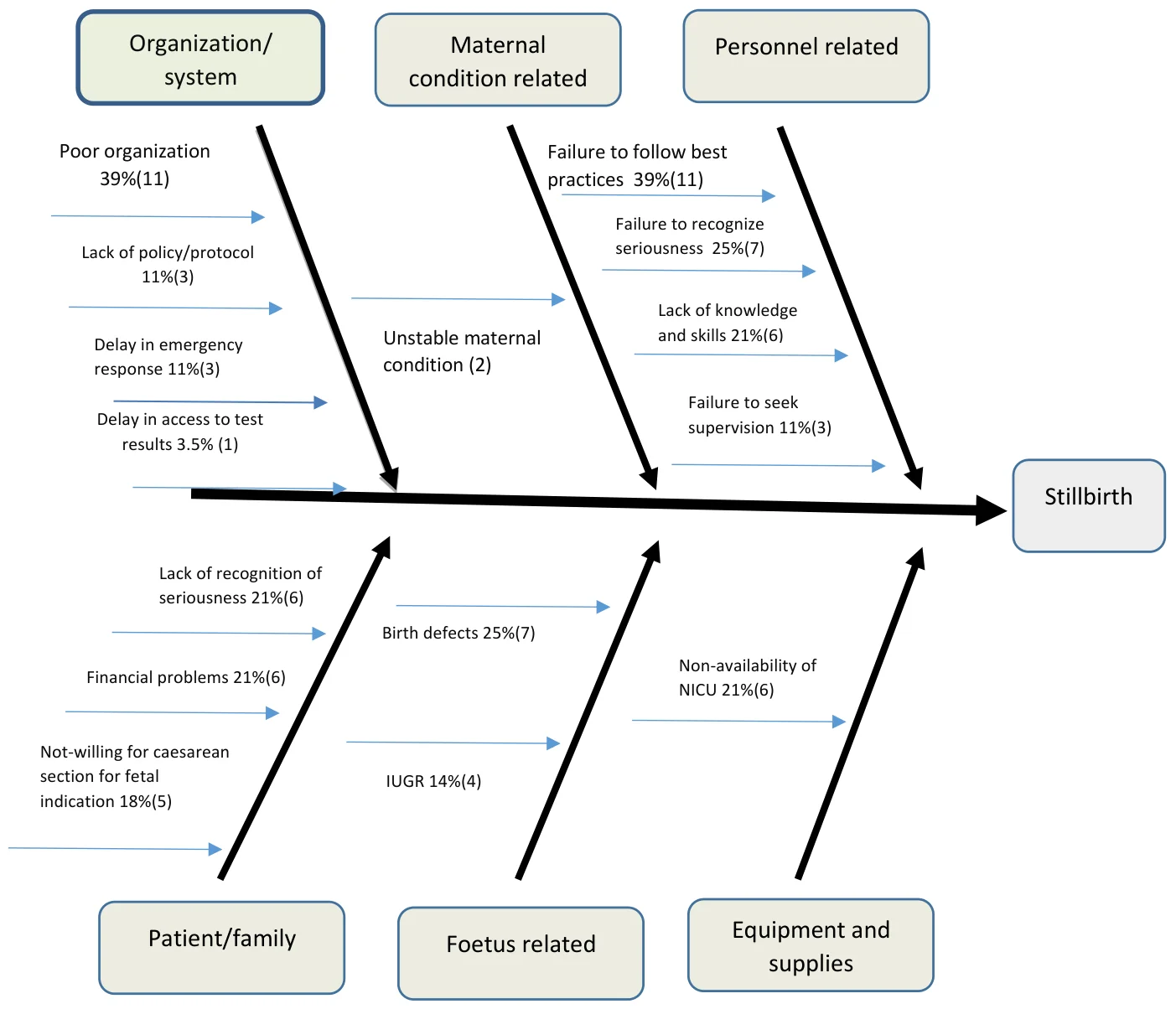
There were 28 cases of intramural stillbirth i.e. where fetus was alive at the time of admission were further reviewed separately and root cause analysis was performed. Obstetrics causes assigned for these intramural stillbirths were abruption (3), cord prolapse (1), rupture uterus (1), congenital malformation (9), Hypertensive disorder of pregnancy (7), Eclampsia(1), prematurity (5) and viral hepatitis (1). But after root cause analysis (figure 1) contributory factor were found at personnel and organization level which could have been avoided for better outcome.
Discussion
This hospital based study was done to understand the root cause of stillbirth at family level, transportation level and health systems level. This study was conducted in a tertiary care which caters a large proportion of the population of neighbouring states of northern India and gets referrals of high risk pregnancy and preterm for better neonatal care. We found that lack of recognition of the seriousness of the condition was most important contributor at family level. This was despite very high rate of antenatal coverage and literate population. Lack of knowledge and skills among health care providers, and lack of protocols and inability to assess the urgency even at the level of health care provider, explains that at the time of antenatal care, women are not explained about the possible complications and timely action.
Differentials in gaps with respect to cause of stillbirth, that is, eclampsia, abruption and HDP are significant for the program implementers. Poor communication/ referral and delay in emergency responses were important contributor for abruption that generally manifests with pain abdomen. Eclampia that can even lead to maternal death, lack of recognition of seriousness was almost universal. This was further compounded by delayed emergency response at health system level.
Delays at health facility level are generally attributed to high workload; quality of care is affected by overload [12]. In most of the health care facilities where these recruited mothers had visited during their pregnancy had no obstetrics triage or had poorly managed triaging facility due to shortage of staff. The objective of triaging is prioritize or categorize the patient according to the need for urgent or emergency care and has been shown to be an effective solution to identify the gravity of a situation [13]. To illustrate, in present study a woman who was referred with abruption had to wait in triage area as duty doctor was managing another obstetric emergency simultaneously. Although the woman was shifted for caesarean within 30 minutes of arrival but baby could not be saved. In high-risk cases, outcome cannot always be predicted but avoiding delay of few minutes could have prevented this adverse outcome.
Poor referral system and communication between health care facilities (contributed to 24 stillbirths). Lack of proper communication, inadequate documentation on referral, loss of previous reports during referral caused undue delay in many cases. A patient of severe pre-eclampsia with live fetus, was referred from private sector to one hospital to another without communication. This resulted in delay of 24 hours during which patient wandered from pillar to post and ultimately delivered a stillborn.
Another contributory factor at system level was inadequate access to doctors or specialists during night hours in many hospitals. Due to shortage of staff, some of primary centres are being looked after by paramedical staff instead of doctors. There were four mothers who did not receive the optimal care during night hours and diagnosed to have IUFD in the morning.
As this study relied on clinical records available and open-ended questions, shortage of supplies and malfunctions of the equipment from the referring centre could not be elicited. Most referrals as documented on referral slip were on account of non-availability of specialist, sub-optimal settings for adequate management of high-risk cases and non-availability of neonatal intensive care unit (NICU) for better care of low birth weight babies. Non-availability of NICU alone contributed to stillbirths in twelve cases, as decision to do CS in babies < 1000 grams was delayed till NICU care become available. In this study, 60% of the cases were early preterm and 57% were very low birth weight babies whose outcome could have been different if NICU care was available.
Inability of the Health care providers to gauze the urgency of the condition and respond appropriately has emerged as important factor. Literature also reports that health professionals may not be able to effectively assess the severity of the condition at times, or are not abreast with the latest practices, causing delays in providing care [14]. Most of the times best practices couldn’t be followed due to lack of standard treatment, protocols, guidelines, knowledge of current practices and sub-optimal resources to manage high-risk cases. These reasons for suboptimal care have also been noted in a RCA study done for maternal mortality in Botswana [15]. Guidance through supervision, mentoring, support and training motivates to improve patient safety[16].
Three patients of severe pre-eclampsia with imminent features were referred without giving prophylactic magnesium sulphate and landed up with eclampsia (seizures) resulting in IUFD. In two cases of pre-eclampsia, pregnancy was continued beyond 37 weeks, and not terminated as per current recommendations. A patient with gestational hypertension on anti-hypertensive drugs with increased liver enzymes was managed as obstetric chlolestasis rather than severe preeclampsia, and referred with abruption and IUFD at 38 weeks. The decision of timely delivery was crucial in these patients as in high-risk pregnancy elective termination is recommended as per standard protocols to prevent antepartum stillbirths. From referral documents it was evident that referring doctors were non-obstetricians, who lacked skills and knowledge to manage high-risk pregnancies. Though Government of India has provision to keep obstetrician at community health centre and higher centres above it, specialists are rarely found to be posted there [17]. Other contributory factors found were insufficient skills to diagnose IUGR clinically, failure to perform internal cephalic version for a 2nd twin etc.
Poor communication between care provider and patient contributed to stillbirths in twelve cases. A patient with fetal growth retardation with Doppler changes (absent end diastolic flow) was referred but was not told the urgency to visit higher centre; she came a day after with IUFD. A good communication skill, ability to provide adequate information about illness and its danger signs can reduce SBR.
Majority of the women were registered in a healthcare centre, 80% were supervised by skilled healthcare providers and had minimum four antenatal visits during pregnancy. Despite this, it has been noted that many women received sub-optimal care which give rise to a major concern for the quality of care. The causes for sub-optimal care highlighted in our study include lack of the knowledge to recognise seriousness of the problem, lack of knowledge and skills and failure to follow best practices.
Strengths & limitations
The modifiable factors which were recognised by root cause analysis would definitely help in recommending solutions to prevent these stillbirths. The limitation of present study was that the information used, was based on open ended history obtained from patient and her family members and referral slips with incomplete documentation. The information regarding health care facilities and provider were also made out from referral slips and investigations available with the patient only without any physical verification of facts.
Conclusion
Root cause analysis is a useful method to review the stillbirth completely and recognize the contributory factors in detail. This would definitely help in prioritizing the interventions to reduce the huge burden. It has also provided the evidence of lapses at various levels viz. patient and family, lack of optimal antenatal care at the local health-care level, poor referral system, organization/systems, lack of sufficient personnel, equipment, proper knowledge of treatment protocols etc. There is a need to sensitize the public regarding need of compliance to the treatment and capacity building at primary and community health levels to develop and improve the skills to recognize complications of pregnancy and provide optimal antenatal and intrapartum care. Timely referral and proper communication with referral institute and development of a strong referral system, availability of standard treatment protocols, guidelines and sufficient facilities at tertiary care can go a long way in reducing these preventable stillbirths.
Conflicts of interest
The authors declare that there is no financial or non financial conflict of interest.
Funding information
Nil
References
- Heazell AE, Siassakos D, Blencowe H, Burden C, Bhutta ZA, Cacciatore J, et al et al Stillbirths: economic and psychosocial consequences. Lancet. 2016;387(10018):604–16. [doi:10.1016/s0140-6736(15)00836-3]
- Lawn JE, Blencowe H, Waiswa P, Amouzou A, Mathers C, Hogan D, et al. Stillbirths: rates, risk factors, and acceleration towards 2030. Lancet. 2016;387(10018):587–603 [doi:10.1016/s0140-6736(15)00837-5]
- Yakoob MY, Ali MA, Ali MU, Imdad A, Lawn JE, Van Den Broek N, et al. The effect of providing skilled birth attendance and emergency obstetric care in preventing stillbirths. BMC public health. 2011 Dec;11(3):S7. [doi:10.1186/1471-2458-11-s3-s7]
- National family health survey -4 rchiips.org/nfhs/nfhs4.shtm
- Froen JF, Friberg IK, Lawn JE, Bhutta ZA, Pattinson RC, Allanson ER, et al. Stillbirths: progress and unfinished business. Lancet. 2016;387(10018):574–86. [doi:10.1016/s0140-6736(15)00818-1]
- Menezes E, Yakoob M, Soomro T, Haws R, Darmstadt G, Bhutta Z. Reducing stillbirths: prevention and management of medical disorders and infections during pregnancy. BMC Pregnancy and Childbirth. 2009;9(Suppl 1):S4. [doi:10.1186/1471-2393-9-s1-s4]
- Bhutta ZA, Das JK, Bahl R, Salam RA, Lawn JE, Blencowe H. What will it take to avert preventable newborn deaths and stillbirths and at what cost. Lancet. 2014;384:347-70. [Google Scholar]
- Farquhar C, Sadler L, Masson V, Bohn G, Haslan A. Beyond the numbers: classifying contributory factors and potentially avoidable maternal deaths in New Zealand, 2006 –2009. Am J Obstet Gynecol. 2011;205:331.e1-8. [doi:10.1016/j.ajog.2011.07.044]
- Buchmann EJ. Towards greater effectiveness of perinatal death audit in low- and middle-income countries. BJOG. 2014;121(Suppl 4):134–6. [doi:10.1111/1471-0528.12904]
- Gadhave S, Nagarkar A. Kuppuswamy scale for measuring socio-economic status : revised monthly income figures for 2015. Indian J Pediatr. 2015;82(12):1175–6. [doi:10.1007/s12098-015-1753-z]
- World Health Organization. The WHO application of ICD-10 to deaths during the perinatal period: ICD-PM. [Google Scholar]
- Elliott DJ, Young RS, Brice J, Aguiar R, Kolm P. Effect of hospitalist workload on the quality and efficiency of care. JAMA Intern Med. 2014 May;174(5):786-93. [doi:10.1001/jamainternmed.2014.300]
- American College of Obstetricians and Gynecologists. (2016). Hospital-based triage of obstetric patients (Committee Opinion No. 667). Obstetrics and Gyne-cology, 128(1), e16-e19. doi:10.1097/AOG.0000000000001524
- Souza JP, Gülmezoglu AM, Vogel J, Carroli G, Lumbiganon P, Qureshi Z, et alI. Moving beyond essential interventions for reduction of maternal mortality (the WHO Multicountry Survey on Maternal and Newborn Health): a cross-sectional study. The Lancet. 2013 May 18;381(9879):1747-55. [Google Scholar]
- Madzimbamuto FD, Ray SC, Mogobe KD, Ramogola-Masire D, Phillips R, Haverkamp M, et al. A root-cause analysis of maternal deaths in Botswana: towards developing a culture of patient safety and quality improvement. BMC pregnancy and childbirth. 2014 Dec;14(1):231. [doi:10.1186/1471-2393-14-231]
- Braithwaite J, Westbrook MT, Mallock NA, Travaglia JF, Iedema RA: Experiences of health professionals who conducted root cause analysis after undergoing a safety improvement program. QualSaf Health-care 2006, 15:393–399. [Google Scholar]
- National Health Policy 2017. Ministry of health and family welfare, government of India. https://www.nhp.gov.in//NHPfiles/national_health_policy_2017.pdf

Published
Article metrics
- Views
- 1,435
- Downloads
- 1,116
Based on this site's usage statistics.