Case Studies Vol. 1 No. 1 (2017): Int J Health Systems and Implementation Research
Tele-follow-up Empowers Anemic pregnant lady to create demand for therapeutic treatment of anemia and improve compliance: A Case Study
Tele follow up to Anemic Pregnant women
Downloads
Topics
Keywords:
- Tele followup
- Anaemia
- M-Health
- Pregnancy
Abstract
Introduction: Anemia prevalence during pregnancy is high. One of the reason is low compliance to consume IFA tablets and poor monitoring and prescription by health staff. M-health is an emerging and promising area. An operations research project was designed to use mobile phone to address this problem in rural area of Haryana.
Objectives: 1) to assess the feasibility of live telephonic call follow up of anaemic women, for compliance to anaemia treatment prescription, and 2) to assess the impact of this intervention on adherence to therapeutic treatment of anemia and severity of anemia. intervention on adherence to therapeutic treatment of anemia and severity of anemia.
Methods: A total of 135 anemic pregnant ladies (Hemoglobin < 11 gram %) were enrolled. There were 90 women in standard care group (control) and 45 in intervention group.
Results: This case study describs the success and challenges in getting treatment of anaemia during pregnancy.
Full text
This web version was prepared from the published PDF, which is the version of record. Please cite and quote from the PDF.
Introduction
Anemia is a major public health problem worldwide. Majority of anemia cases are present in the developing countries. Anemia during pregnancy is very high with prevalence of 56% in developing countries and 18% in developed countries.1 South Asia region still has one of the highest prevalence (52%) with India topping the list in this region.2 National Family Health Survey-3 (NFHS-3) conducted in India in 2005-06 shows that burden of anemia in pregnant women is 58.7%, of which 2.2% suffers from severe anemia.3
The etiology of anemia can be multifactorial with primary cause being the nutritional deficiency.4 Despite the provision of iron therapy and folic acid supplements free of cost under government initiative,5 prevalence of anemia is still high among pregnant ladies due to low adherence or compliance to the iron therapy.6–9
Reliable information and effective communication are the major elements in the field of public health practices. Information and communication technologies (ICTs) have shown a tremendous growth in recent times and have proved to be an accelerator of economic and social progress.10 Mobile Health (m-Health) is an area of electronic health (e-Health) where the provision of health services and information is via mobile technologies such as mobile phones and Personal Digital Assistants (PDAs).11
An operational study was done that employed the use of live calls on the telephones or mobile phones of pregnant ladies for the follow up of the anemia treatment, counseling and addressal of problems regarding adherence to treatment of anemia. The study was done taking in to account only the anemic pregnant ladies. The objective of this study was to assess whether these telephonic conversations can improve the adherence levels to the treatment and to explore whether there will be an improvement in Hb levels or severity of anemia.
In this paper, case study of one of the pregnant woman is described and the pathway of improving compliance is discussed using trans theoretical model of behavior change.
Intervention
After taking consent, an anemic pregnant lady was enrolled in the study in the intervention group during her 10th week of gestation and her Hb recorded from the ANC records during that time was 9.2 g/dl. Enrolment was done from the ANC records of new antenatal registrations available with the ANM of the area.
First Tele-follow up (at 11th week of gestation):
The first telephonic call was given to the lady during her 11th week of gestation in which she was inquired about the intake of IFA supplements, its dosage, whether dietary instructions were provided by any health care provider and whether they are facing any difficulty in adhering to the treatment plan for anemia.
Observations First Follow-up: The lady was taking IFA supplements, 1 tablet/day and was not aware of dietary instructions that need to be followed.
Actions taken at First Follow-up: During this first follow up she was given information and knowledge on correct dosage (2 tablets/day for anemic pregnant ladies as per govt. guidelines) and proper dietary instructions that need to be followed. She was asked to avoid tea/ coffee with food and also encouraged to take green leafy vegetables. She was given information to take lemon water with IFA tablets if possible.
Second Tele-follow up (at 18th week of gestation):
Observations at second Follow-up: Lady was asked questions to check the compliance levels after the first call and to see if she is following the advice. To this the lady responded that she has initiated taking two IFA tablets every day and following diet instructions but is not following this pattern on regular basis. So there was a partial compliance to the first telephonic call.
Actions taken at Second Follow-up: During the second follow up, there was again reinforcement of same messages. Lady was asked to take 2 tablets of IFA regularly and also follow dietary instructions.
Third Tele-follow up (at 22nd week of gestation):
Observations at Third Follow-up: During this call, we asked the questions related to the adherence using the MMAS-8 adherence tool. The score for the adherence to IFA supplements was: 3.50/8 (low compliance level). The major reasons for this low compliance were:
- Forgetfulness (sometimes)
- Not taking medicine when travelling or leaving home
- Difficulty in sticking to the treatment plan
- Apprehension that IFA stock will get exhausted and she may not get more supply from ANM.
Actions taken at Third Follow-up
She was motivated and empowered to talk to the ANM, that now she is aware of the need of 2 tablets for treatment of anemia. She was told to contact the first author, if there is any difficulty and resistance with ANM
Fourth follow up (at 26 week of gestation):
Observations at fourth follow up:
Lady was just skipping or forgetting to take her medicine as usual and there were no specific reasons like side effects for avoiding medication. She had not contacted the ANM also by this time.
Actions taken at Fourth Follow-up: There was again reinforcement of message but in a different way highlighting the importance of these IFA supplements, correct dosage and probable effects on delivery outcomes. Emphasis was given on the possible complications in form of high risk of maternal death as well as adverse fetal outcomes with immediate and long term implications. She was also suggested to visit the nearby health centre and get the Hb done from the health center.
Fifth follow up (at 30th week of gestation):
Observations at Fifth Follow-up:
- Firstly, she was asked whether she visited the health facility and got her Hb checked to which she replied that she visited the health facility 15 days back and her Hb was 6 gm/dl (as written on health facility card) and was prescribed two IFA tablets/day by the doctor.
- First author explained the severity of anemia and asked to report immediately next day to the health center and to talk to doctor regarding receiving parenteral iron sucrose preparation (as according to the guideline of Hb of 6 gm/dl)
- First author assured that she will be helped if health care facility does not respond to her.
- Next day when she was contacted, she told that she received the parenteral iron glucose preparation and that the second dose will be given next week.
Sixth Tele-follow up (at 32nd week of gestation):
Observations at Sixth Follow-up:
- Till this time, she had received a total of two iron sucrose preparation and also follow up Hb has been done which reported Hb to be 8.2 gm/dl.
- Now she started continuing with the oral dose of two IFA tablets every day and was told not to skip further again highlighting the importance of IFA.
Seventh Tele-follow up (at 38th week of gestation):
Observations at Seventh Follow-up:
- She reported that she is continuously taking medication as per the schedule.
- Final Adherence level reported through MMAS-8 adherence tool: 6.75/8 (medium level of adherence)
Eight Tele-follow up (after delivery):
Observations at Eighth Follow-up:
This call was for inquiring delivery outcomes:
- POG at delivery: 41 week of gestation
- Type of delivery: Normal
- Hb at delivery: 11.2 g/dl
- Weight of baby: 2.75 kg
- Delivered at PHC without complications, no referral needed.
Discussion
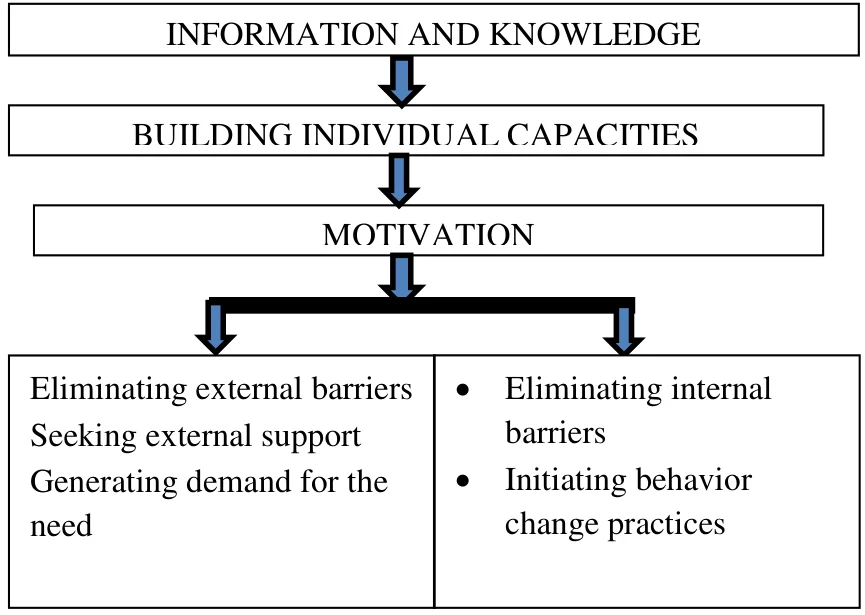
This case study demonstrates that interventions at various stages helped the lady to take different actions. (Figure 1) It not only motivated her to improve her compliance, but also empowered her to act on external barriers such as improper prescriptions We have applied Trans theoretical model or Stages of Change model to explain this behavior change (Figure 2). The TTM model is both an intervention and behavior model. This model firstly describes the stages through which the person passes in order to achieve the desired behavior. So the intervention that is being given to change the behavior must be according to the stage of change the person is experiencing.
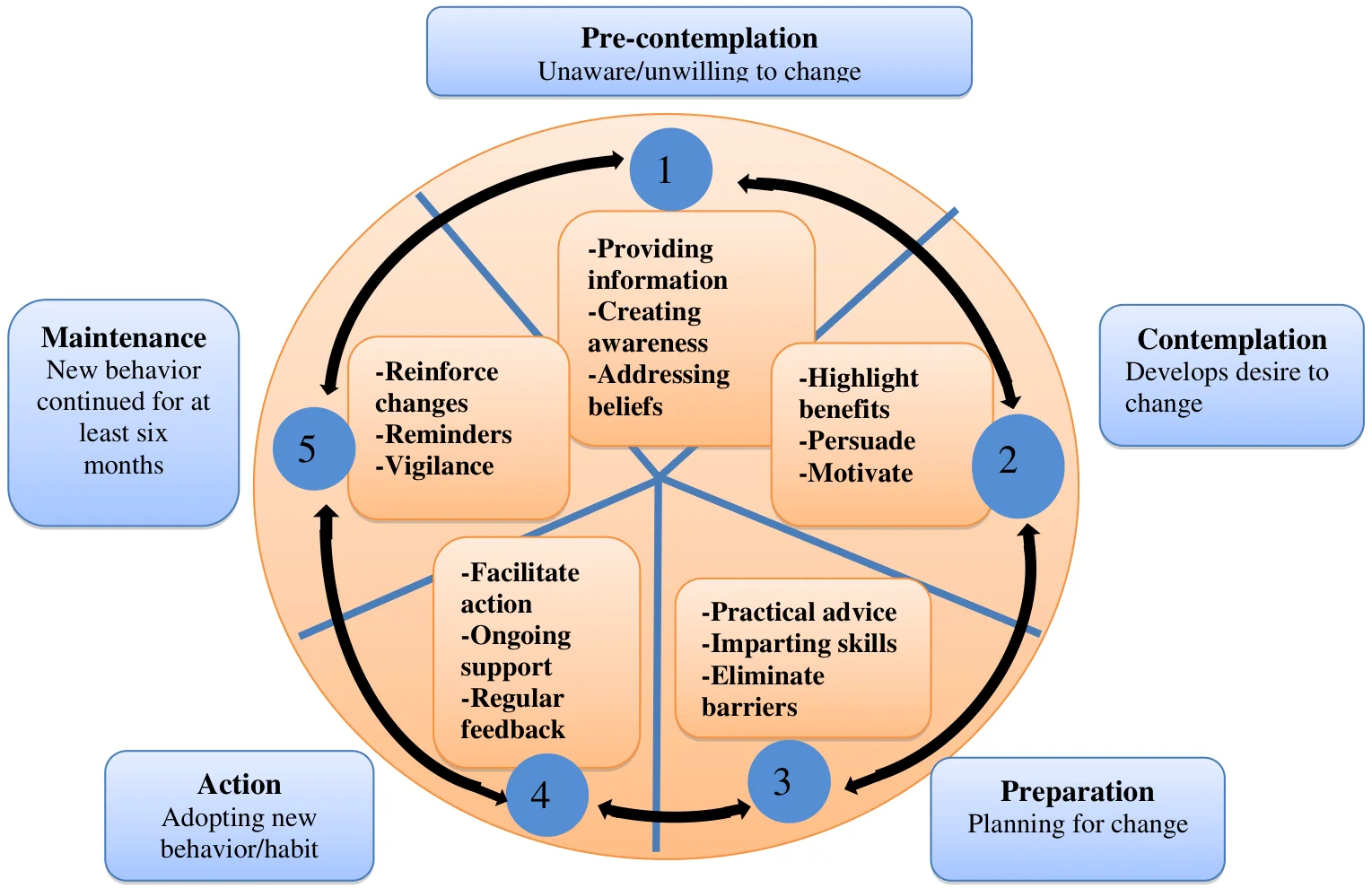
- Pre contemplation stage: The stage when person may not be aware of needing or wanting to change or may be unwilling or uninterested in the change. The pregnant lady was taking IFA supplement and aware of its use in just increasing Hb levels with no realization of its serious implications. The level of knowledge, awareness and motivation related to IFA supplements and dietary pattern was incomplete. This stage needs intervention focusing on creating awareness, providing complete knowledge and information, telling them the serious implications that she might face if she does not change the present practice.
- Contemplation stage: Person develops desire to change. The lady started taking the correct dosage in consequent follow ups but it was not on a regular basis and we came across a major reason behind this was the rigid behavior of health worker of giving tablets according to 1 tablet per day. So there was a fear of not getting the medicine again if she finishes them early. The intervention here focused on motivating and empowering the lady to talk to health worker of being aware of guidelines and creating demand for the supplements.
- Preparation stage: The person plan ways to change. The lady planned to talk to the health worker and also visited the health facility for getting her routine checkup and Hb levels done. Again, she rushed to the health facility the next day when she was told that her Hb is too low to be treated by oral dose and she needs to see the doctor immediately in order to get iron sucrose preparation.
- Action stage: The lady is actually getting checkup done regularly, taking therapeutic treatment according to the guidelines, not missing the doses, getting Hb done regularly, taking care of dietary instructions.
- Maintenance stage: Maintaining the behavior of action stage for at least a period of 6 months. The lady has shown commitment to follow the treatment plan till her delivery and even continued the IFA intake after delivery as per guidelines. Positive reinforcement and follow-up support help in maintaining the behavior.
- Relapse: This stage can occur between any two stages in which the person returns to the previous stage. This can be evidently seen in this case study where pregnant lady planned or desired to change her adherence levels to treatment but was not able to do it at various times due to external factors (health system factors) or internal factors (forgetfulness, less motivation, fear etc.).
References
- WHO. The prevalence of Anaemia in women: a tabulation of available information. Geneva: World Health Organization; 1992. [Google Scholar]
- Stevens GA, Finucane MM, De-Regil LM, Paciorek CJ, Flaxman SR, Branca F, et al. Global, regional, and national trends in haemoglobin concentration and prevalence of total and severe anaemia in children and pregnant and non-pregnant women for 1995–2011: a systematic analysis of population-representative data. Lancet Glob Health. 2013;1(1):e16–25. [Google Scholar]
- International Institute for Population Sciences (IIPS) and Macro International. 2007. National Family Health Survey (NFHS-3), 2005–06: India: Volume I. Mumbai: IIPS. [Internet]. [cited 2016 Nov 20]. Available from: http://rchiips.org/nfhs/NFHS-3%20Data/VOL-1/India_volume_I_corrected_17oct08.pdf
- Toteja GS, Singh P. Micronutrient profile of Indian population. Indian Council of Medical Research; 2004 [Google Scholar]
- MOHFW, Govt of India. Guidelines for control of Iron Deficiency Anaemia: National Iron + Initiative; 2013 [Internet]. [cited 2016 Nov 20]. Available from: http://www.pbnrhm.org/docs/iron_plus_guidelines.pdf
- Mithra P, Unnikrishnan B, Rekha T, Nithin K, Mohan K, Kulkarni V, et al. Compliance with iron-folic acid (IFA) therapy among pregnant women in an urban area of south India. Afr Health Sci. 2013;13(4):880–885. [Google Scholar]
- Sununtnasuk C, D’Agostino A, Fiedler JL. Iron+ folic acid distribution and consumption through antenatal care: identifying barriers across countries. Public Health Nutr. 2016;19(4):732–742. [Google Scholar]
- Mora JO. Iron supplementation: overcoming technical and practical barriers. J Nutr. 2002;132(4):853S–855S. [doi:10.1093/jn/132.4.853s]
- Galloway R, Dusch E, Elder L, Achadi E, Grajeda R, Hurtado E, et al. Women’s perceptions of iron deficiency and anemia prevention and control in eight developing countries. Soc Sci Med. 2002;55(4):529–544 [doi:10.1016/s0277-9536(01)00185-x]
- Chetley A, Davies J, Trude B, McConnell H, Ramirez R. Improving health, connecting people : the role of ICTs in the health sector of developing countries - a framework paper. InfoDev working paper ; Washington, DC: World Bank; 2006. [Google Scholar]
- Burney SMA, Mahmood N. Information and Communication Technology in Healthcare Management Systems: Prospects for Developing Countries. Int J Comput Appl. 2010;4(2):27–32. [doi:10.5120/801-1138]
Published
Article metrics
- Views
- 2,428
- Downloads
- 1,067
Based on this site's usage statistics.