Case Studies Vol. 1 No. 1 (2017): Int J Health Systems and Implementation Research
Pathway to Improve Data Usage at Sub-district level: Trainings & Onsite Mentorship: A success story from Haryana
Pathway for Data Usage
Downloads
Topics
Keywords:
- HMIS
- Data Usage
- Health System
Abstract
Role of routine data usage for decision making is increasingly emphasized. However, Pathway to make the routine health System use the data is unclear. This case study demonstrates the success story of a medical officer.
Full text
This web version was prepared from the published PDF, which is the version of record. Please cite and quote from the PDF.
Introduction
“Health System” can be described in terms of six “building blocks”, of which “Health Information System” (HIS) is one of the key building block (1). An effective HIS generate information which enables managers to identify the health problems and make evidence-based decisions for program improvements. Information should help “Governance”- another building block, to improve quality of service, and help administration in monitoring and evaluating programs. Health Management Information System (HMIS) aims to gather, aggregate, analyse and then use the information generate to take actions to improve performance of the health systems.
HMIS must provide accurate, timely and complete information in order to accomplish the long-term goal of optimising health care delivery and achieve health for all. Poor quality data can lead to incorrect analysis and inappropriate decisions. Thus to have confidence in the decisions one needs quality data that can be trusted. Data quality problem is a major barrier to the usability of data. Most health care providers equate information system with filling endless registers, compiling information on disease every month, and sending to higher authorities without any feedback or data usage even at their own level. Government of India has designed a computerized system of HMIS in which defined variables are entered. Haryana has launched additional web portals like District Health Information System (DHIS 2). As per this, all the health facilities of Haryana have started using integrated single reporting system. The data is uploaded online and compilation and analysis is done through the web portals.
Few interventional studies (2,3,4), have been done to improve data quality in terms of completeness, accuracy and internal consistency. Interventions were in form of trainings, monthly review of data, data audits or district level meetings. In some interventional studies (5,6), data usage improved because of data usage workshops held at the district level. Primarily the interventions were focused on how to review data, monthly reports, data usage and presentation in district level meetings to improve the skill of medical officers and partial success has achieved. Some observational studies (7,8) showed that data was of poor quality and there was lack of knowledge among health workforce. State officials in Haryana also felt that district officials are not adequately using the available data for program monitoring and improvement. It was hypothesized that non-use of the data is due to lack of knowledge and skills about the same. A need was felt for skill building of medical officers for data use. The intervention was planned and training was given to the medical officers. This case report documents the pathway of change in practices of one of the medical officer and the associated challenges.
Intervention
During one day training workshop at district level, relevant web portals used by Haryana Health Services, were demonstrated and participants were made to practice -how to extract, interpret the data and to think about actionable points. After the workshop, project technical officer did the follow up visits to the district, to mentor the medical officers on site, at their place of posting. As a part of postgraduate thesis work, first author also visited the health facilities of specific block and followed up to know the impact of the training. Study tools were designed to know if the medical officers retained their skills at their worksite?, whether they started using the skill for data retrieval and decision making?. Whether, the senior officers started asking them about the data usage?.
Results
Skill for data extraction improved significantly immediately after the workshop. Skills were retained to large extent at 1 month and at 6 month follow-up (data not shown)
During follow-up visit in a facility, it was found that medical officer incharge had not received the training. District training was attended by a dental surgeon. This MO in-charge was provided onsite training by project technical officer. After this training, he got transferred to another facility. Medical officer who joined against transfer was new and had not received the district training. So, no observation was made during this visit. An onsite training was arranged and a project technical officer gave him training at his own PHC.
Next month (March), first follow up visit after onsite training, was done during the monthly meeting of PHC. We noted that ANMs came to submit the reports. The LHV was checking the reports. There was no interaction between ANMs and Medical officer. When asked, medical officer said “I have really no time to extract the data from various portals. It was only during my training at the PHC, when I visited these portals. I am so busy with patients that I couldn’t get time for all this”. When asked to fill the questionnaire regarding data usage, he told that he is not confident to extract the data and need refresher training. He reported that he has been asked by district officers to retrieve the data and to submit the report on data usage.
During discussions, he expressed concern for IDSP program. He told that ANMS misreported some cases as ‘fever with rash’, whereas, these were allergic reactions.
Next month (April), he attended the district level meeting. Although very minimal discussion regarding data usage happened at meeting, it was a visual reminder to him about the need of data usage.
Next month (May) we again visited the facility during the PHC monthly meeting. Medical officer seemed to be motivated. He had his laptop with him. He requested us to help him in retrieving the data. He could open the DHIS2 web-portal and log in. We helped him in selecting the data elements and indicators. After retrieving the data, he could interpret the data. He discussed it with ANMs in monthly meeting on the same day. He also gave the feedback to his ANMs on their previous months reports.
Medical Officer expressed that “I could not extract the data as patients are my first priority”. He also told us that “I am new one in the job and I have to look after whole of administrative work. I have not even undergone induction training. I have to ask my seniors for various issues like procurement issues. So it takes more time to settle the various issues. Once I will learn all these administrative skills and procurement policies, it will save much of my time which I can devote to other activities”.
While filling the data usage questionnaire, he told us” SMOI/C has asked me neither to extract the data nor to submit the report on data usage. I have to mark YES on your questionnaires; otherwise they might take some action against me”. After taking him in confidence that at no place your identity will be disclosed, he told us that district has not taken any interest for data usage.
During follow up in June, he extracted the data from DHIS2 independently. He requested us again to help him to retrieve data from other data portal like ATM. He was self motivated for this. We helped him in this endeavor. He made the interpretations of the data himself. He discussed the data with his ANMs regarding how to improve antenatal registration, anaemia, deliveries at PHC. He also asked his ANMs to motivate people for institutional deliveries with the help of ASHAs. He also highlighted the patients of severe anaemia who had delivered and asked his ANMs to track them to atleast improve their postnatal status.
There was tremendous improvement in data usage during this follow up journey. When I told him that today is my last visit he said ” Abhi to hamne apki madad se data use karna shuru kiya tha par hum aapke baad bhi apni monthly meetings aise hi discuss karenge. Actually monthly meetings honi hi aise chaiye”.
While filling the data usage questionnaire, he gave the feedback that he is now confident to extract the data and there should be discussions in monthly meetings at district level regarding data usage and its application.
Discussion
The notable improvement in the knowledge and capacity of the Participants suggest that the training workshop strategy appeared to produce the desired capacity enhancement among the participating medical officers. Evidence that emerged from this intervention suggests that a training workshop can serve as mechanism towards improving the ability of medical officers for data usage.
This case study demonstrates three stages of behavior change:
At first visit, post onsite training, medical officer knew about the data portal but lacked ability to retrieve the data. However, he projected other reasons for not using the data portals. On site re-mentoring improved his skills and confidence. Second visit saw expression of his confidence and led to improved discussions with ANMs for one data portal. Third visit exemplifies achievement of full confidence for DHIS2 portal and strong desire to learn other portals. On site mentoring, helped to acquire this skill as well and led to marked improvement in discussions.
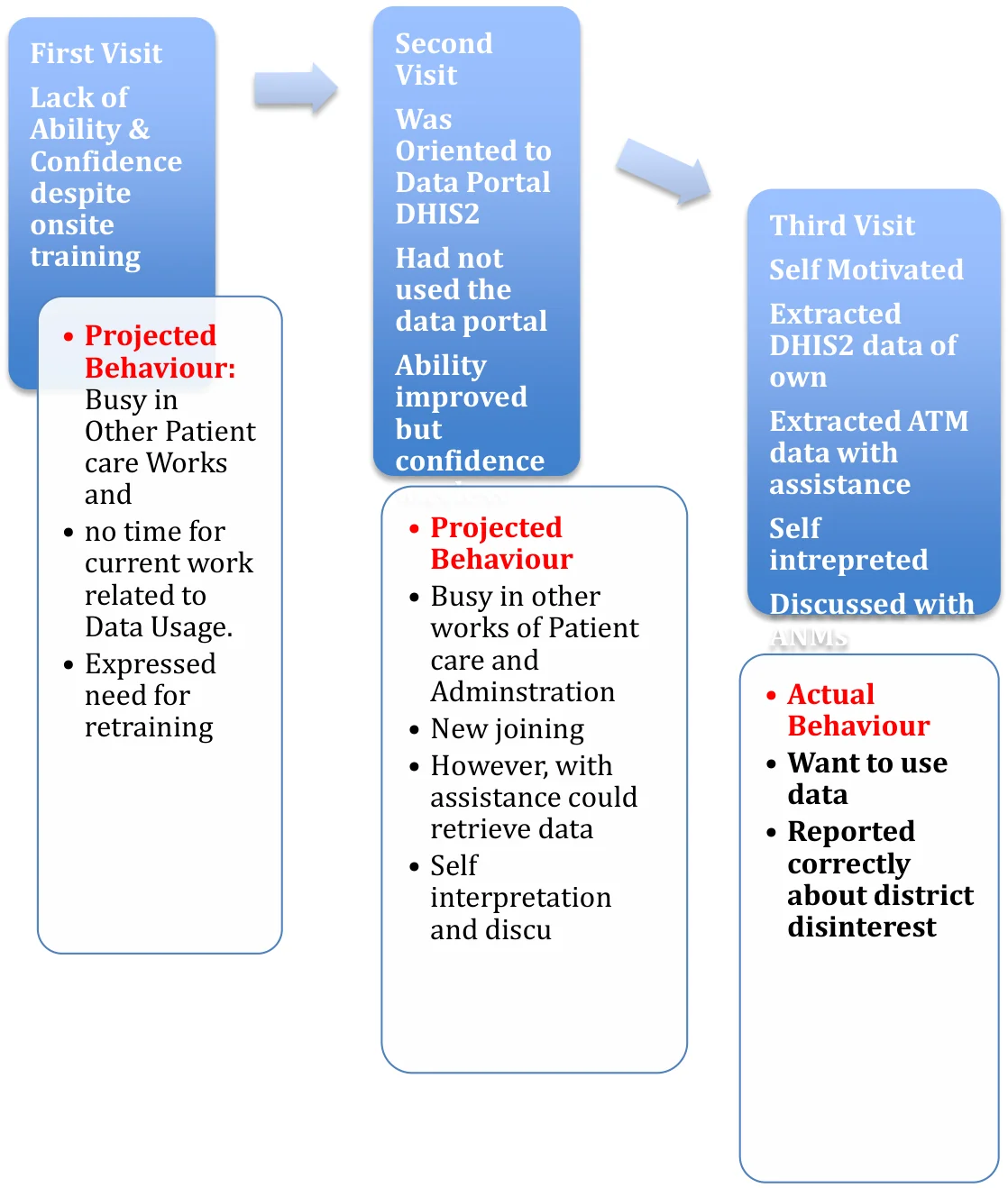
This change in behavior can be explained with Fogg Behavior Model (9). As per this model, a person with low level of ability requires very strong motivation to get triggered into action. As the ability improves, trigger can be successful even at the lower level of motivations.
The different levels of ability and motivation define whether triggers for behavior change will succeed or fail. As an example, trying to trigger behavior change through something difficult to do (low ability) will only succeed with very high motivation. In contrast, trying to trigger behavior change through something easy to do (high ability) may succeed even with average motivation.
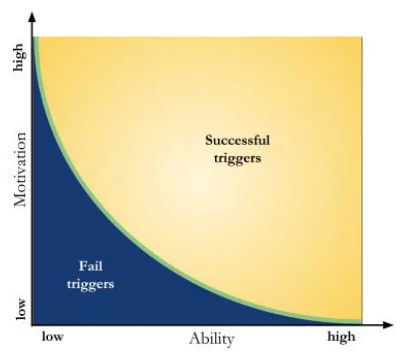
This case study demonstrates well that as the ability improved, investigators visit that acted as trigger was successful at moderate levels of motivation prevalent in the health systems. This happened despite almost total lack of interest in district health system about the data usage.
Conclusions
Data usage can be improved through on the job training and on job mentorship on data analysis, interpretation and continuous use of information at all levels. Regular monthly meetings can be used for trainings and to review the performance of facilities using monthly reports and comparing it with their peers. Single time training is not helpful to convert learnt skills into actions. Academic and research institutes can play an important role for this capacity building and onsite mentorship.
Acknowledgements
District and state trainings were conducted by the State with the help of project led by second author (AKA), funded by WHO Alliance for Health Policy and Research, Geneva. WHO team led by Dr. Abdul Ghaffar and Dr Nhan Tran, Dr Rajiv Gupta and Dr Rakesh Gupta, IAS, MD NHM at that time, were instrumental in giving insights to conduct the trainings. Third party evaluations would independently document the process. In this thesis work, independent efforts were done to do follow-up and mentorship to see if the trainings get translate into some actions. No project funding or project data was used for this work.
References
- WHO. Everybody’s business: strengthening health systems to improve health outcomes: WHO's framework for action. [Internet]. Geneva; 2007. Available from: http://www.who.int/healthsystems/strategy/everybodys_business.pdf Accessed on 08 June 2016
- Mphatswe W, Mate K, Bennett B, Ngidi H, Reddy J, Barker P, et al. Improving public health information: a data quality intervention in KwaZulu-Natal, South Africa. Bull World Health Organ [Internet]. 2012;90(3):176–82. Available from: http://www.ncbi.nlm.nih.gov/pubmed/22461712\nhttp://www.ncbi.nlm.nih.gov/pmc/articles/PMC3314204/pdf/BLT.11.092759.pdf Accessed on 25 Nov 2015
- Nisingizwe MP, Iyer HS, Gashayija M, Hirschhorn LR, Amoroso C, Wilson R, et al. Toward utilization of data for program management and evaluation: quality assessment of five years of health management information system data in Rwanda. Glob Health Action [Internet]. 2014 Jan [cited 2016 Jun 3];7:25829. Available from: http://www.pubmedcentral.nih.gov/articlerender.fcgi?artid=4238898&tool=pmcentrez&rendertype=abstract Accessed on 29 Nov 2015
- Wagenaar BH, Gimbel S, Hoek R, Pfeiffer J, Michel C, Manuel JL, et al. Effects of a health information system data quality intervention on concordance in Mozambique: time-series analyses from 2009-2012. Popul Health Metr [Internet]. 2015;13:9. Available from: http://www.pubmedcentral.nih.gov/articlerender.fcgi?artid=4377037&tool=pmcentrez&rendertype=abstract Accessed on 08 Feb 2016
- J. B, A. H, S. S. Improving quality and use of data through data-use workshops: Zanzibar, united republic of Tanzania . Bull World Health Organ [Internet]. 2012;90(5):379–84. Available from: http://www.scopus.com/inward/record.url?eid=2-s2.0-84860426655&partnerID=40&md5=05112ebc122f3918a20fc70259816e7c Accessed on 02 Feb 2016
- Nutley T, Gnassou L, Traore M, Bosso AE, Mullen S. Moving data offthe shelf and into action: An intervention to improve data-informed decision making in C?? te d’Ivoire. Glob Health Action. 2014;7. [Google Scholar]
- Sychareun V, Hansana V, Phengsavanh A, Chaleunvong K, Eunyoung K, Durham J.Data verification at health centers and district health offices in Xiengkhouang and Houaphanh Provinces, Lao PDR. BMC Health Serv Res [Internet]. 2014;14(1):255. Available from: http://www.scopus.com/inward/record.url?eid=2-s2.0-84902051181&partnerID=tZOtx3y1 Accessed on 01 Dec 2015
- Nyamtema A. Bridging the gaps in the Health Management Information System in the context of a changing health sector. BMC Med Inform Decis Mak. 2010;10:36. Accessed on 18 Nov 2015 [doi:10.1186/1472-6947-10-36]
- Fogg, BJ (2009-01-01). "A Behavior Model for Persuasive design". Proceedings of the 4th International Conference on Persuasive Technology. Persuasive '09. New York, NY, US: ACM: 40:1–40:7. doi:10.1145/1541948.1541999. ISBN 9781605583761
Published
Article metrics
- Views
- 2,137
- Downloads
- 1,064
Based on this site's usage statistics.
Issue
Section
How to Cite
More in this topic: Health information & digital health
View Point · 2024
Digitalization of ASHA Work: Challenges and Way Forward