Original Article Vol. 5 No. 2 (2021): International J Health Systems and Implementation Research
A Comparative Analysis of Exports and Imports of ‘Protective Garments and the Like’ in India
Trading of ‘Protective Garments and the like’ in India
Downloads
Topics
Keywords:
- COVID-19, compound growth rate, exports, imports, ‘protective garments and the like’
Abstract
Background: Procurement of COVID-19 related medical products was a chief concern for many countries to have uninterrupted health service delivery during pandemic. This necessitates to examine the changes in trade flows of COVID-19 related medical products across nations. Objectives: a) To Study the change in percentage share of exports and imports of the 'Protective garments and the like; b) To analyze the trends in exports and imports of 'Protective garments and the like' in India; c) To identify the top 10 trading countries of India of 'Protective garments and the like.' Methodology: Using the categorization by World Customs Organization and World Health Organization, monthly exports and imports data for the 'Protective garments and the like' was extracted from the portal of Indian Ministry of Commerce and Industry. The study time period pertains to pre- COVID (April 2019-March 2020) and during COVID (April 2020-March 2021) financial years. Compound Growth Rate was computed to analyse the trends in exports and imports of ‘protective garments and the like’ in India. Microsoft Excel, 2019, and SPSS version 25 were used for all the statistical analysis. Findings: For exports, the compound annual growth rate of gloves, face and eye protection as well as protective garments showed a positive growth, whereas the same commodities registered a negative growth rate with respect to imports by India. Further, the top trading partners of India were United States and China with respect to ‘protective garments and the like’. Conclusion: The study witnessed an increase in the growth rate in exports and a negative growth rate in imports of the ‘Protective garments and the like’. By and large, India as an emerging economy could find new opportunities in the export market out of the crisis situation. The study recommends for the optimization and maximization in the production of COVID-19 related medical goods in order to meet the domestic and international demand
Full text
This web version was prepared from the published PDF, which is the version of record. Please cite and quote from the PDF.
Introduction
The COVID-19 declared as a pandemic by the World Health Organisation (WHO) on March 11, 2020, sent shockwaves to the entire world and disrupted the international economic order. The transformation of COVID-19 from a health pandemic to an economic pandemic was rapid and unprecedented. Pandemic considered to be the prime reason for the demand and supply shock happened globally, which adversely hit the exports and imports across the countries as well as adversely affected the trade volume of all nations simultaneously [1]. Pandemic and the unprecedented challenges due to the lockdown and other preventive measures had adverse effect in trading and supply chains [2,3,4]. The pandemic unleashed the lacunae in healthcare system of even the largest economies in the world to adjust and tackle the problem of unprecedented changes in the demand and supply of pharmaceutical goods and medical supplies. Since the whole world relied upon prevention, containment and mitigation approach towards the pandemic [5], therefore the uninterrupted procurement of diagnostic and disinfectant medical products became the cause of concern for the many countries of the world. It necessitates to look at the changes in trade flows across nations with respect to COVID-19 related medical goods such as face masks, protective shield, sanitizers, diagnostic kits and the alike. It is imperative to effectively manage the supply chain of COVID-19 related pharmaceutical and medical products for the uninterrupted health service delivery during pandemic [6].
The vital role played during the pandemic by the health care workers and Accredited Social Health Activists (ASHA) were highly recognized and they were the backbone of the country in containing the pandemic. Health care and ASHA workers were in close physical proximity with the infected persons and in constant contact with the public, made them vulnerable to get infected with COVID 19. There was a parallel increase in the number of confirmed cases of COVID 19 among Healthcare workers, even some had died due to the deadly virus [7–9]. It is the government's responsibility and a public health priority to protect this human capital of the health system. The risk of getting infected with COVID-19 among healthcare workers can reduce through the available non-pharmaceutical interventions such as using Personal Protective Equipment (PPE), including gown, gloves, face mask, and face shield or goggles. Nevertheless, the supplies of this protective equipment were inadequate in most countries including India [7,10–12].
India, over the past many years has emerged as major exporter of certain pharmaceutical and medical products as well as equipment. However, the implementation of lockdown from 24th March 2020 till 30th June 2020, greatly affected the exports and imports of COVID-19 related products [13]. Most countries were not prepared for the unprecedented increase in the demand for medical products related to COVID-19. India was also affected like all other countries, so India initially started importing medical products related to COVID-19 from those countries less affected by COVID-19 in the beginning. To cope with the sudden demand and increased price, the Indian government motivated indigenous pharmaceutical companies to be self-resilient and increase the domestic production medical products related to COVID-19 production [14]. The present study makes a modest attempt to examine and compare India's percentage share of exports and imports of protective garments products related to COVID-19, during pre-COVID-19 and during COVID-19 period. The study also attempts to study the temporal growth rates of exports and imports of protective garments products and further identifies top trading partners of India during the study period.
Methodology
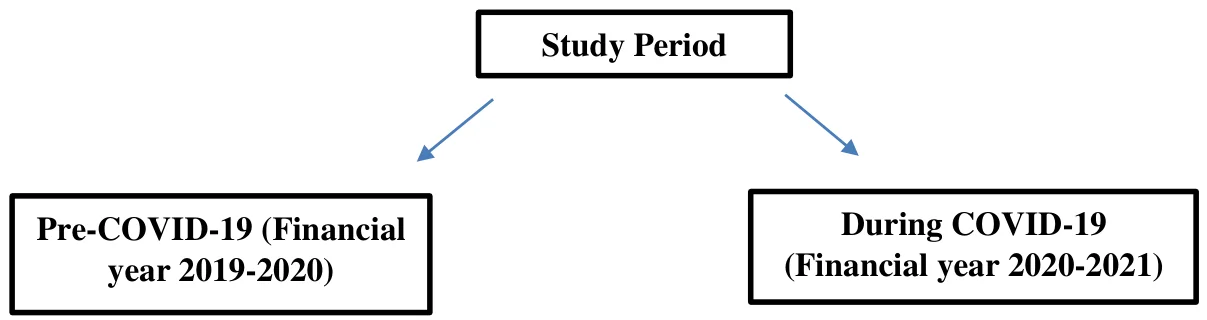
The present study design deals with time series analysis of secondary data, pertaining to trade of medical products related to COVID-19 across two different time periods, i.e., pre-COVID-19 and during COVID-19 period (Figure 1).
Using the categorization by World Customs Organization (WCO) and World Health Organization (WHO), the monthly exports and imports data for the 'Protective garments and the like' was extracted from the portal of Indian Ministry of Commerce and Industry. Each commodity as per WCO is coded with a specific description and coding known as Harmonised System (HS) code.
The medical products related to COVID-19 are classified into eight major groups, one of the groups is 'Protective garments and the like' group, which is studied in this paper. This group contained 13 commodities with their respective HS codes. In the present study, for convenience and to avoid confusion due to the repetition of some the commodity names in the classification, the commodities were merged into two commodities as depicted in Table 1.
The percentage share of both the commodities was calculated using Microsoft Excel, 2019 version for two set study periods. To analyse India's trading trends of 'Protective garments and the like,' the authors calculated Compound Growth Rate (CGR) using IBM SPSS version 26. One of the other objectives of the study was to identify India's top trading partners with respect for protective garments. The monthly data on trading of "Baltics countries" was not available in the Ministry of Commerce and Industry portal, so the Baltics countries were excluded from the present study.
| HS code of 13 commodities" | Description of all the commodities | New/Merged description |
|---|---|---|
| 392620 | Gloves, face and eye protection garments- plastic face shields, plastic gloves, protective unisex garments made of plastic. | 392620..to..900490 Gloves, Face and Eye protection (including disposables) |
| 401519 | Gloves- other rubber gloves | |
| 481850 | Disposable masks and garments | |
| 621600 | Gloves- textile gloves that are not knitted or crocheted | |
| 650500 | Others- disposable hair nets | |
| 902000 | Face and eye protection- gas masks with mechanical parts or replaceable filters for protection against biological agents, also includes masks incorporates eye protection or facial shield. | |
| 401511 | Gloves- surgical rubber gloves | |
| 401590 | Other- protective unisex garments made of rubber sheeting, textile reinforced rubber or textile backed rubber. | |
| 611610 | Gloves- knitted or crocheted gloves which have been impregnated or covered with plastics or rubber. | |
| 630790 | Face and eye protection- Textile face masks, without replaceable filter or mechanical parts, including surgical masks and disposable face masks of non-woven textile and N95 | |
| 900490 | Face and eye protection- protective spectacles and goggles. | |
| 621010 | Protective garments for surgical/ medical use made up of felt or non-woven whether or not impregnated, coated, covered or laminated | 621010 and 621050 Protective Garments |
| 621050 | Unisex protective garments for surgical/ medical use made of woven textiles of that are impregnated coated, covered or laminated with plastics. |
Findings
Trends in exports and imports of 'Protective garments and the like'
Table 3, depicts the compound growth rate of exports and imports of commodities of ‘protective garments and the like’ for the study period. Exponential change from a negative growth rate to positive growth rate in Q4 (-3.51%) of pre-COVID-19 to Q1 (37.10%) during COVID-19 period was witnessed in export growth rates of gloves, face and eye protection. Similarly, compound growth rate of imports of protective garments drastically changed from a negative growth in Q4 pre-COVID- (-3.42%) to a higher positive growth during Q1 (12.50%) of COVID-19 time period.
| Groups | HS code | Commodity name | Pre-COVID-19 (2019-20) | During COVID-19 (2020-21) | ||||||||
|---|---|---|---|---|---|---|---|---|---|---|---|---|
| Q1 (APR-JUN) | Q2 (JUL-SEP) | Q3 (OCT-DEC) | Q4 (JAN-MAR) | ANNUAL | Q1 (APR-JUN) | Q2 (JUL-SEP) | Q3 (OCT-DEC) | Q4 (JAN-MAR) | ANNUAL | |||
| Exports | 392620.. to.. 900490 | Gloves, face and eye protection | 2.53 | -14.35 | 7.65 | -3.51 | 0.23 | 37.10 | 6.99 | 16.39 | 0.00 | 9.72 |
| 621010 and 621050 | Protective garments | 57.62 | 1.64 | 25.49 | 495.67 | 19.20 | 399.90 | 72.04 | -48.16 | 27.76 | 24.79 | |
| Imports | 392620.. to.. 900490 | Gloves, face and eye protection | 7.84 | 59.43 | 23.80 | 24.21 | 2.92 | 20.93 | -17.00 | -10.46 | -8.00 | -13.82 |
| 621010 and 621050 | Protective garments | -0.59 | 1.32 | -4.45 | -3.42 | 0.85 | 12.50 | -16.78 | -4.62 | 4.78 | -1.04 | |
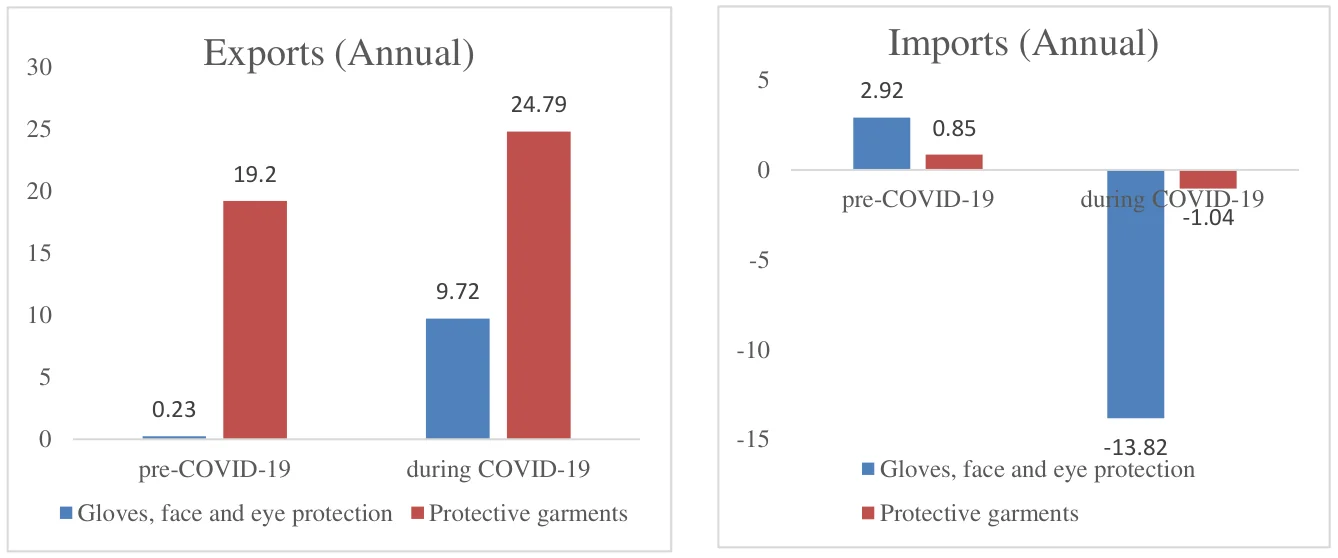
Figure 2 depicts the annual compound growth rate of both commodities' exports and imports during the given study period. The annual growth rate of exports of gloves, face, and eye protection substantially increased from pre-COVID-19 times (0.23%) to a higher growth rate during COVID-19 period (9.72%). Annual growth rate of exports of protective garments also showed a positive growth rate during both pre-COVID-19 period (19.20%) and during COVID-19 period (24.79%). Annual growth rate of imports of both gloves, face and eye protection as well as protective garments changed from positive growth rate in pre-COVID-19 times (2.92% and 0.85% respectively) to a negative growth rate in during COVID-19 period (-13.82% and -1.04% respectively).
Top trading partners of India with respect to 'Protective garments and the like' group
Table 4, represents India's top 10 trading partners for both commodities for the study period. The top exporting partners of India for glove, face, and eye-protection was United States of America for both the time periods (15.45% and 17.53%, respectively). For protective garments, China (17.46%) was the top exporting partner of India in pre-COVID-19, and USA, became top exporting country during COVID-19 period. Moreover, USA’s share exhibited a substantial increase from pre-COVID-19 times (11.90%) to during COVID-19 times (40.73%). The top importing partners of India for glove, face, and eye-protection was Malaysia (32.94%) during pre-COVID-19 and China (37.91%) during the COVID-19 period. Furthermore, China registered a considerable increase in percentage shares from pre-COVID19 period (26.08%) to during COVID-19 period (37.91%). The top importing partner of India for the protective garments was China (43.80% and 73.93% respectively) for both the study periods.
| Rankings | Exports | Imports | ||||||
|---|---|---|---|---|---|---|---|---|
| Gloves, face and eye protection | Protective garments | Gloves, face and eye protection | Protective garments | |||||
| Pre-COVID-19 | During COVID-19 | Pre-COVID-19 | During COVID-19 | Pre-COVID-19 | During COVID-19 | Pre-COVID-19 | During COVID-19 | |
| 1st | USA (15.45) | USA (17.53) | China (17.46) | USA (40.73) | Malaysia (32.94) | China (37.91) | China (43.80) | China (73.93) |
| 2nd | UArab Emts (13.22) | UArab Emts (16.32) | Hong Kong (12.68) | Saudi Arab (14.33) | China (26.08) | Malaysia (32.35) | Vietnam Soc Rep (26.34) | Vietnam Soc Rep (13.24) |
| 3rd | Nigeria (10.06) | UK (6.14) | USA (11.90) | Canada (13.09) | Sri Lanka (8.56) | Thailand (6.42) | USA (8.59) | USA (5.62) |
| 4th | UK (5.12) | Germany (4.54) | Singapore (10.43) | UArab Emts (4.73) | Thailand (4.88) | Singapore (3.95) | Spain (6.31) | Spain (2.05) |
| 5th | Bangladesh (3.82) | Nigeria (4.25) | Poland (7.65) | Poland (3.42) | USA (4.16) | Sri Lanka (3.08) | UK (3.19) | Hong Kong (1.14) |
| 6th | Germany (3.72) | Canada (2.76) | UArab Emts (6.29) | Czech Republic (2.78) | UArab Emts (3.29) | Hong Kong (3.04) | Ireland (2.27) | UArab Emts (0.77) |
| 7th | France (3.27) | France (2.54) | Nepal (5.66) | Qatar (2.16) | Germany (2.47) | USA (2.52) | Bangladesh (1.62) | Cambodia (0.75) |
| 8th | Netherland (2.17) | Togo (2.45) | Czech Republic (4.66) | France (2.06) | Indonesia (1.70) | Vietnam Soc Rep (1.69) | Cambodia (1.53) | Singapore (0.62) |
| 9th | Kenya (2.16) | Sri Lanka (2.07) | Saudi Arab (2.29) | UK (1.71) | Hong Kong (1.69) | Korea Rp (1.65) | Germany (1.34) | Korea Rp (0.57) |
| 10th | Saudi Arab (2.16) | Afghanistan (2.0) | Spain (2.19) | Netherland (1.64) | Singapore (1.59) | Indonesia (0.88) | Hong Kong (1.28) | Netherland (0.43) |
Discussion
Products under the ‘Protective garment products the like’ category contains plastic and rubber gloves, face shields, disposable masks and garments, N95 masks, surgical masks, protective unisex garments and protective spectacles and goggles. Protective garments are extremely important in the prevention and containment of COVID-19. The effective procurement of COVID-19 related medical products such as ‘protective garments and the like’ is considered to reflect the timely response of the governments to curb the pandemic. Against this backdrop, the present study estimated the percentage share and compound growth rate in the export and import of "protective garments and the likes" in India for both pre-COVID-19 and during COVID-19 period. Furthermore, it studied India's top ‘protective garments and the like’ exporting and importing partners. The study observed a reduction in the percentage share of India's exports of commodities, namely gloves, face and eye protection during the COVID-19 period. Moreover, the percentage share of imports of these commodities also witnessed a decline. The reason would be India announced strict measures like ban the exports of personal protective equipment[15]. Due to the announcement of export curbs by 54 governments in March 2020[16], the situation became worse. Top exports of Personal Protective Products (PPP-40%) in the world are China, followed by Germany and the United States [17], and the USA also imposed a ban on exports of N95, surgical masks.
The annual growth rate of exports of gloves, face and eye protection, and protective garments increased during COVID-19. The G20 summit had issued a notice not to create any unnecessary barriers in the trading or global supply chain, and G20 nations also committed to keeping their logistics network open[16]. Further, the SAARC nations and India had a meeting and agreed upon seamless cooperation in multilateral trade arrangements[14] between the nations. India’s exports growth rate had increased for protective garments and imports growth rate has reduced which is reflective of chances of increase in surplus and deficit reduction for protective garments.
Malaysia is one of the top exporters of rubber gloves in the world[16], and in the present study, India's top importing partner for gloves, face, and eye-protection was Malaysia in both the study period. The USA, followed by Germany, are the top importers globally, accounting for 22% share for PPE[17]. Similarly, in the present study USA was the top exports partner of India for both the commodities, and Germany was among the top 10 export partners in gloves, face, and eye-protection. China is the top exporter of face masks in the world (25%) and China followed by Germany and USA, are the top exporters of PPP[17]. In present study, China is top importing partner of India for both commodities, and the USA is among India's top 10 importing partners. The reduction in the growth rate of imports of ‘protective garment and the like’ commodities may be related to the Indian government’s initiative of ‘Atmanirbhar Bharat’ to increase domestic production to become a self -reliant nation.
The main strength of the present study are, that in most previous studies, only the percentage share of commodities have been calculated to analyse the trends in export and import. In contrast, the present study computed compound growth rates to identify the trends of India's exports and imports for both pre-COVID-19 and during COVID-19 period. The study analysed the trends in exports and imports of ‘protective garments and the like’ through the computation of Compound Growth Rate (CGR) of the products is a novel and suitable approach and new policy interventions actions can subsequently be undertaken by India. Limitation of the present study, there was total 13 commodities in the ‘Protective garments and the like’ group but the authors merged many commodities together into two commodities, due to common names of the commodities in the HS code classification. Another limitation was Baltics countries monthly data was unavailable in the Ministry of Commerce and Industry portal. So, in the present study Baltics countries were excluded.
To sum up, India witnessed an increase in the growth rate in exports and a negative growth rate in imports of the ‘Protective garments and the like’. By and large, India as an emerging economy could find new opportunities in the export market out of the crisis situation. The study recommends for the optimization and maximization in the indigenous production of COVID-19 related medical goods in order to meet the domestic and international demand. Further, the study suggests having bilateral trade deals and technology transfer agreements with the top trading partners of India, such as with the USA and China, to have smooth trading of these commodities to have uninterrupted supply flow of such lifesaving COVID-19 related medical commodities during such pandemic situations in the future.
Ethical Approval
The study is based on using the secondary data which is available in the public domain. This study does not involve the collection of primary data and therefore does not require interactions in any form with the participants/human subjects.
Conflict of Interest
None declared
Acknowledgement
None
References
- Baldwin R, Tomiura E. Thinking ahead of the trade impact of COVID-19. Economics in the Time of COVID-19. London: Centre for Economic Policy Research (CEPR) Press; 2020. 59–72 p. [Google Scholar]
- Reardon T, Bellmare MF, Zilberman D. How COVID-19 may disrupt food supply chains in developing countries. COVID-19 Glob food Secur. 2020;78–80. [doi:10.2499/p15738coll2.133762_17]
- Bonadio B, Huo Z, Levchenko AA, Nayar NP. Global Supply Chains in the Pandemic. Cambridge; 2020. (Working Paper 27224). [doi:10.3386/w27224]
- Baldwin R, Weder di Marauro B. Introduction. In: Economics in the Time of COVID-19. London: Centre for Economic Policy Research (CEPR) Press; 2020. p. 1–30. [Google Scholar]
- Boone L. Tackling the fallout from COVID-19. In: Economics in the Time of COVID-19. London: The Centre for Economic Policy Research (CEPR) press; 2020. p. 37–44. [Google Scholar]
- Guerin PJ, Singh-Phulgenda S, Strub-Wourgaft N. The consequence of COVID-19 on the global supply of medical products: Why Indian generics matter for the world? F1000Research. 2020;9:1–11. [doi:10.12688/f1000research.23057.1]
- Chersich MF, Gray G, Fairlie L, Eichbaum Q, Mayhew S, Allwood B, et al. Covid-19 in Africa: Care and protection for frontline healthcare workers. Global Health. 2020;16(1):1–6. [doi:10.1186/s12992-020-00574-3]
- Wang D, Hu B, Hu C, Zhu F, Liu X, Zhang J, et al. Clinical Characteristics of 138 Hospitalized Patients with 2019 Novel Coronavirus-Infected Pneumonia in Wuhan, China. JAMA - J Am Med Assoc. 2020;323(11):1061–9. [doi:10.1001/jama.2020.1585]
- Nguyen LH, Drew DA, Graham MS, Joshi AD, Guo CG, Ma W, et al. Risk of COVID-19 among front-line health-care workers and the general community: a prospective cohort study. Lancet Public Heal. 2020;5(9):e475–83. [doi:10.1101/2020.04.29.20084111]
- Mulu GB, Kebede WM, Worku SA, Mittiku YM, Ayelign B. <p>Preparedness and Responses of Healthcare Providers to Combat the Spread of COVID-19 Among North Shewa Zone Hospitals, Amhara, Ethiopia, 2020</p>. Infect Drug Resist. 2020;Volume 13:3171–8. [doi:10.2147/idr.s265829]
- Ağalar C, Öztürk Engin D. Protective measures for covid-19 for healthcare providers and laboratory personnel. Turkish J Med Sci. 2020;50(SI-1):578–84. [doi:10.3906/sag-2004-132]
- Kampf G, Scheithauer S, Lemmen S, Saliou P, Suchomel M. COVID-19-associated shortage of alcohol-based hand rubs, face masks, medical gloves, and gowns: proposal for a risk-adapted approach to ensure patient and healthcare worker safety. J Hosp Infect. 2020;105(3):424–7. [doi:10.1016/j.jhin.2020.04.041]
- Coronavirus: India to buy masks, ventilators from China to meet shortage. business today [Internet]. 2020; Available from: https://www.businesstoday.in/sectors/pharma/coronavirus-india-to-buy-masks-ventilators-from-china-to-meet-shortage/story/399721.html
- Awasthi Soumya. India and SAARC Combating COVID Pandemic Background. 2020;2507(1):1–9. Available from: 9789896540821 [Google Scholar]
- CEPAL NU. Restrictions on the export of medical products hamper efforts to contain coronavirus disease (COVID-19) in Latin America and the Caribbean. 2020;2019:1–9. Available from: https://repositorio.cepal.org/handle/11362/45511
- Ayub AJ. Trade During a Pandemic. ASAP/Journal. 2020;5(3):556–8. [Google Scholar]
- P, Acero, K. Cabas, C. Caycedo, P. Figueroa GP& MR, Aceh kue tradisional khas. Trade of medical goods in the context of tackling COVID-19. 2020;(September):92027. Available from: http://repositorio.unan.edu.ni/2986/1/5624.pdf

Published
Article metrics
- Views
- 1,019
- Downloads
- 888
Based on this site's usage statistics.