Original Article Vol. 7 No. 1 (2023): International J Health Systems and Implementation Research
Assessing Health Insurance Coverage and Sociodemographic Factors in Haryana: An Analysis of District-Level Data
Downloads
Topics
Keywords:
- Health insurance
- financing scheme
- universal health coverage
Abstract
Background: Health insurance has rapidly evolved into an essential tool for financial risk protection to achieve universal health coverage. Social security expenditure in India includes various schemes and programs aimed at providing financial and social protection through pensions, healthcare, and social assistance. Various types of health insurance are currently offered in India on a national and state level, as well as in the public and private sectors.
Objectives: To study the extent of Health insurance/financing scheme coverage in districts of Haryana and extent of various types of health insurance/financing schemes coverage in Haryana. To study the various sociodemographic variables affecting extent of health insurance coverage in Haryana.
Methodology: The present study is based on secondary data from the National Family Health Survey conducted in 2019–2021 (NFHS-5).
Results: The study conducted in Haryana revealed a health insurance coverage of 25.1%. Gurgaon had the highest coverage (34.6%) and Mewat had the lowest (11.8%). RBSY and CGHS were the most common schemes, while community health insurance had the least share (0.5%). Urban areas had slightly higher coverage (27.8%) than rural areas (23.8%). Health insurance coverage varied among different religious groups and caste/tribe categories. Wealth index also influenced coverage, with the richest having the highest coverage (27.7%) and the poorest the lowest (19.3%). Sociodemographic characteristics were significantly associated with health insurance coverage in Haryana.
Conclusion: It is evident that a significant portion of the population remains without adequate access to health insurance and related financing schemes. Disparities in coverage were observed across different districts of Haryana.
Keywords: Health Insurance, financing scheme, universal health coverage
Full text
This web version was prepared from the published PDF, which is the version of record. Please cite and quote from the PDF.
Introduction
For millions of people around the globe, health expenses are a significant financial burden. Therefore, financial risk protection is an important dimension of Universal Health Coverage[1]. In India, economy is expanding, and both urban and rural residents are now more educated and health conscious. These factors have raised people's living standards, which in turn has increased the demand for health insurance[2]. Health insurance has rapidly evolved into an essential tool for financial risk protection to achieve universal health coverage. Hence, development of health insurance initiatives has advanced significantly in many low to middle-income nations. Over the past few decades, developing nations have launched national and state level, community insurance programmes to safeguard the poor and marginalized[3–5]. The private health insurance schemes are increasing day by day[6]. According to a report by the Insurance Regulatory and Development Authority of India (IRDAI), the health insurance sector in India has witnessed significant growth in the past few years, with a compound annual growth rate (CAGR) of 17.8% over the last five years[7].
Social security expenditure in India includes various schemes and programs aimed at providing financial and social protection to vulnerable groups, including the elderly, disabled, and poor. The major components of social security expenditure in India are pensions, healthcare, and social assistance. The government has been increasing its social security spending over the years, with a focus on improving access and coverage for those in need[8]. Various types of health insurance are currently offered in India on a national and state level, as well as in the public and private sectors.
Public health insurance is provided by the government and is aimed at providing coverage to people who cannot afford private health insurance. The government-funded health insurance schemes are designed to provide financial assistance to the underprivileged and the marginalized sections of society. The RashtriyaSwasthyaBima Yojana (RSBY) is a national insurance programme introduced by the Indian government in 2008 with the goal of expanding covering for the underprivileged[9].Employer-sponsored health insurance is a benefit offered by employers to cover healthcare expenses for employees and dependents. The Employees' State Insurance (ESI) scheme in India provides medical care and cash benefits to eligible employees and is funded through contributions from employers and employees[10].
There are several state health insurance schemes aimed at providing affordable healthcare to its citizens in Haryana. These schemes provide financial assistance to beneficiaries for medical expenses incurred during hospitalization or treatment for specific illnesses. The government aims to increase the coverage and benefits of these schemes to provide better healthcare access to all. There are very few recent research studies related to extent of health insurance coverage in Haryana at district level. Conducting a detailed study on health insurance coverage in Haryana is vital for assessing the current state of the system and identifying gaps in health insurance coverage. The findings from such a study will serve as a roadmap for policymakers, insurance providers, and other stakeholders to develop targeted interventions and policies that ensure comprehensive and inclusive health insurance coverage for all residents of Haryana, fostering better health outcomes and improved well-being for the population.
Objectives
To measure the extent of the health insurance/financing schemes coverage in Haryana at the district level.
- To study the extent of coverage for different health insurance/Financing schemes in Haryana state.
- To study the various sociodemographic variables affecting extent of health insurance coverage in Haryana.
Materials and Methodology
Study design and data sources: The present study is a cross-sectional study and is primarily based on secondary data extracted from the National Family Health Survey conducted in 2019–2021 (NFHS-5). The DHS Program provides access to survey data files through registration to the academic researchers. Access to data was requested by email to DHS (archive@dhsprogram.com). The data offers the latest and complete information on various 33health insurance coverage options present in India at central and state level. For NFHS-5 household data, a total of 18,229 heads of households were interviewed out of which 5,745 are urban and 12,484 are rural representatives in 22 districts of Haryana state.
Data Analysis: The data analysis is done by IBM SPSS version 21 using frequencies, percentages, and crosstabs. The percentages of households covered by health insurance/financing scheme were calculated in association with sociodemographic factors under study. The factors under study are place of residence, religion of the household head, caste/tribe of the household head and wealth index. Chi-square tests were applied to check the association of different factors.
Results
Table 1 shows district wise percentage of households that have at least one member covered by any health insurance or financing scheme. The health insurance coverage in Haryana is 25.1% and among all the districts of Haryana state, Gurgaon 34.6%and Mewat 11.8% have maximum and minimum percentage of health insurance or finance scheme coverage respectively.
| Percentage of households with at least one usual member covered by any health insurance/ financing scheme (%) | |
|---|---|
| Haryana | 25.1 |
| Panchkula | 21.1 |
| Ambala | 19.4 |
| Yamunanagar | 20.4 |
| Kurukshetra | 19.7 |
| Kaithal | 29.0 |
| Karnal | 24.8 |
| Panipat | 26.1 |
| Sonipat | 21.4 |
| Jind | 24.0 |
| Fatehabad | 29.6 |
| Sirsa | 27.3 |
| Hisar | 27.4 |
| Rohtak | 24.6 |
| Jhajjar | 27.5 |
| Mahendragarh | 25.5 |
| Rewari | 26.3 |
| Gurgaon | 34.6 |
| Mewat | 11.8 |
| Faridabad | 32.0 |
| Palwal | 24.2 |
| Bhiwani | 28.8 |
| Charkhi Dadri | 29.4 |
Among those who were covered by any Health insurance/financing scheme 15.5% were enrolled for RBSY and 15.4% were enrolled for CGHS. The share of community health insurance programmes is least 0.5% (Figure 1).
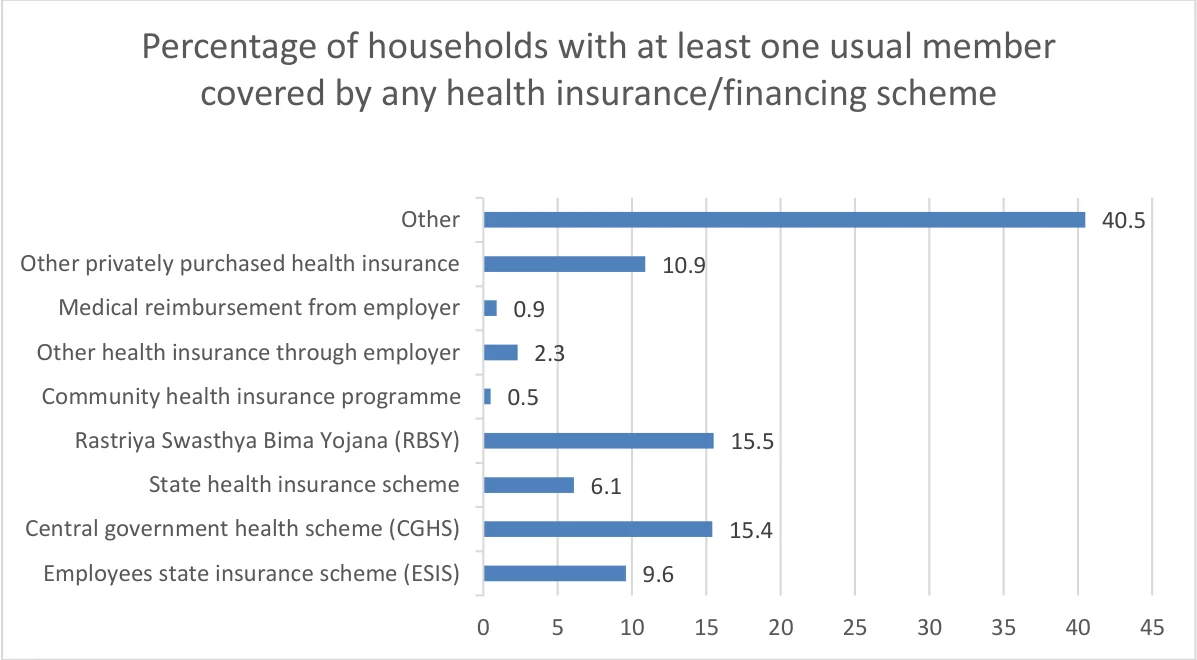
The health insurance coverage among urban population 27.8% is somewhat more than rural population 23.8%. The health insurance coverage is highest among Jains 41.7% followed by Hindu population 25.9%. Least among Muslim population 13.5%.Among, Caste/tribe of household head, households among scheduled caste have highest health insurance coverage i.e., 31.3% followed by scheduled tribe 27.1% and other backward classes 23%.
When comparing health insurance coverage among households with different wealth indexes, the study revealed that the richest segment had the highest coverage rate of 27.7%, whereas the poorest segment had the lowest coverage rate of 19.3%.The chi-square test results indicate a significant association between sociodemographic characteristics such as place of residence, religion of household head, caste/tribe of household head, and wealth index with the extent of health insurance coverage in Haryana, as depicted in Table 2.
| Sociodemographic Characteristics | Households with at least one usual member covered by any health insurance/financing scheme | Value of chi-square test | |
|---|---|---|---|
| Frequency (n) | Percentage (%) | ||
| Place of residence | 36.919* | ||
| Urban | 1597 | 27.8 | |
| Rural | 2971 | 23.8 | |
| Religion of household head | 110.936* | ||
| Hindu | 4252 | 25.9 | |
| Muslim | 155 | 13.5 | |
| Christian | 2 | 15.4 | |
| Sikh | 148 | 23.0 | |
| Buddhist/Neo-Buddhist | 1 | 20.0 | |
| Jain | 8 | 41.7 | |
| Other | 1 | 14.3 | |
| Caste/tribe of household head | 158.732* | ||
| Scheduled caste | 1649 | 31.3 | |
| Scheduled tribe | 51 | 27.1 | |
| Other backward classes | 1226 | 23 | |
| None of them | 1607 | 22.2 | |
| Don’t know | 17 | 15.5 | |
| Wealth Index | 121.441* | ||
| Poorest | 93 | 19.3 | |
| Poorer | 437 | 25 | |
| Middle | 728 | 23.9 | |
| Rich | 1033 | 21.9 | |
| Richest | 2277 | 27.7 | |
*Chi-square test results significant, p value=0.000(p value<0.05)
Discussion
To achieve universal health coverage as stated in sustainable developmental goals set in 2015, it is important to protect people from financial hardship due to paying for healthcare services out of their own pockets[1]. But in India despite of various health insurance/financing schemes, very less amount of population is covered by these financing schemes.
The present study aimed to investigate the health insurance coverage in the state of Haryana, India, and explore its association with various sociodemographic characteristics. The findings revealed that the overall health insurance coverage in Haryana was 25.1%. This indicates that a significant proportion of the population remains uninsured and lacks access to essential healthcare services. The results highlight the need for targeted interventions to improve health insurance coverage in the region.
Among the districts of Haryana, Gurgaon had the highest health insurance coverage at 34.6%, while Mewat had the lowest coverage at 11.8%. These disparities in coverage within the state suggest variations in access to health insurance schemes across different regions. It is essential to identify the underlying factors contributing to these discrepancies and develop strategies to address them effectively.
When examining the different health insurance or financing schemes, it was found that 15.5% of those covered by any health insurance scheme were enrolled in the RashtriyaSwasthyaBima Yojana (RBSY), while 15.4% were enrolled in the Central Government Health Scheme (CGHS). This indicates the presence of multiple insurance options available to the population, which can potentially lead to fragmentation of coverage and disparities in benefit packages. The low share of community health insurance programs suggests that such programs have limited penetration in Haryana. There is a need to assess the effectiveness and reach of these programs and explore opportunities to expand their coverage.
In terms of urban-rural disparities, the study found that health insurance coverage was slightly higher among the urban population (27.8%) compared to the rural population (23.8%). This could be attributed to factors such as better access to healthcare facilities and higher income levels in urban areas. Efforts should be made to bridge this gap by targeting rural populations with specific health insurance outreach programs and improving the accessibility of healthcare services in rural areas[11].
The study also examined the association between health insurance coverage and sociodemographic characteristics. Among religious groups, Jains and Hindus had the highest coverage. In contrast, the Muslim population had the lowest coverage at 13.5%. These findings suggest disparities in health insurance coverage based on religious affiliation, indicating a need for culturally sensitive strategies to ensure equitable access to healthcare services.
Furthermore, the study found that health insurance coverage varied among different caste/tribe groups. Scheduled caste households had the highest coverage at 31.3%, followed by scheduled tribe households at 27.1% and other backward classes at 23%. Similar results were found in a report by National Statistical office on Key indicators of social consumption in India[12]. These findings highlight the importance of considering social and cultural factors when designing health insurance programs, as certain vulnerable populations may require targeted interventions to address their specific needs.
Another significant factor associated with health insurance coverage was the wealth index. The study revealed that the richest strata had the highest coverage at 27.7%, while the poorest strata had the lowest coverage at 19.3%. This socioeconomic gradient in coverage indicates that individuals from lower-income households face barriers in accessing health insurance schemes. It is crucial to implement policies that ensure financial protection and reduce disparities based on wealth status[13,14].
Limitations of the study
The study is based on secondary data which is cross sectional in nature. Therefore, the study is not able to establish temporal relationships between health insurance coverage and socio-demographic variables as the present study being cross-sectional in nature, capturing data at a single point in time.
Strengths of the study
This study shed light on the current status of health insurance coverage in Haryana, revealing disparities based on geographic location, religion, caste/tribe, and wealth index.
Conclusion
It is evident that a significant portion of the population remains without adequate access to health insurance and related financing schemes. Disparities in coverage were observed across different districts. The study underscores the importance of developing comprehensive policies and interventions to ensure equitable access to healthcare services.
Addressing the gaps identified in this study will require collaborative efforts from policymakers, healthcare providers, and insurance providers. Implementing region-specific strategies, expanding community health insurance programs, and tailoring schemes to the needs of different sociodemographic groups can contribute to improving health insurance coverage in Haryana. Such interventions will not only enhance financial protection but also enable better access to essential healthcare services for all residents of the state.
Ethical approval
No ethical approval was needed for this study.
Conflicts of interest
None
Acknowledgement
None
Funding
None
References
- The WHO. Health systems financing: the path to universal coverage. The world health report. Geneva. 2010 May 29:1-28. [Google Scholar]
- Bhatia M, Mittal S, Bansal A, Dutta MM, Kumar R, Duggirala A, et al. Health insurance coverage and out-of pocket expenditure: A study among rural and urban households of Faridabad, Haryana. Pacific Bus Rev Int do [Internet]. 2020;7(2):1–2. Available from: https://www.actuariesindia.org/downloads/gcadata/10thGCA/Emerging Health Insurance in India-An overview_J Anitha.pdf
- Giedion U, Andrés Alfonso E, Díaz Y. The Impact of Health Insurance in the Developing World. Univers Heal Cover Stud Ser UNICO Stud Ser [Internet]. 2013;Series 25(25):151. Available from: http://documents.worldbank.org/curated/en/349621468158382497/pdf/753260NWP0Box30ewofExistingEvidence.pdf
- Hsiao WC, Shaw RP, Fraker A, Jowett M. Social Health Insurance for Developing Nations - World Bank Inst.Dev. studies. 2007. 1–184 p. [doi:10.1596/978-0-8213-6949-4]
- Ranson MK. Reduction of catastrophic health care expenditures by a community-based health insurance scheme in Gujarat, India: Current experiences and challenges. Bull. World Health Organ. 2002;80(8):613–21. [Google Scholar]
- Sekhri N, Savedoff W. Private health insurance: Implications for developing countries. Bull. World Health Organ. 2005;83(2):127–34. [Google Scholar]
- Guo X. Annual Report 2021. AIMS Microbiol. 2022;8(1):103–7. [doi:10.3934/microbiol.2022009]
- Union Budget. Union Budget 2021-22: Budget at a Glance. 2021;19. Available from: https://www.indiabudget.gov.in/doc/Budget_at_Glance/budget_at_a_glance.pdf%0A https://www.indiabudget.gov.in/
- Dror DM, Vellakkal S. Is RSBY India’s platform to implementing universal hospital insurance? Indian J Med Res. 2012;135(1):56–63. [doi:10.4103/0971-5916.93425]
- ESIC. The Employees’ State Insurance Act 1948. Gov India. 1948;(34):1–43. [Google Scholar]
- Singh M, Goyal P, Narang S, Singh A, Singal M. Health insurance coverage and out-of pocket expenditure : A study among rural and urban households of Faridabad , Haryana. 2022;110–4. [doi:10.4103/ijcfm.ijcfm_83_21]
- Office NS. Key Indicators of Social Consumption in India : Health NSS KI (75/25.0). [Google Scholar]
- Status W, Analysis AE. Wealth Status and Health Insurance Enrollment in India : An Empirical Analysis. 2023;1–38. [Google Scholar]
- Yellaiah J, Ramakrishna G. Socio economic determinants of health insurance in India : the case of Hyderabad city. 2012;1(2):111–9. [Google Scholar]

Published
Article metrics
- Views
- 1,209
- Downloads
- 517
Based on this site's usage statistics.
Issue
Section
How to Cite
More in this topic: Health financing
Original Article · 2024
Stakeholders' Perception of Digital Payment in a Public Hospital in India
Original Article · 2022
Health Insurance Scenario Among Street Vendors Of Chandigarh