Short Review Vol. 9 No. 1 (2025): International Journal of Health Systems and Implementation Research
Readiness of NCD Services at Ayushman Arogya Mandirs (AAMs) in India: A Review of Recent Studies
NCD Service Readiness at AAMs
Downloads
Topics
Keywords:
- Ayushman Bharat, Ayushman Arogya Mandir, CHOs, Community engagement, Health infrastructure, NCDs, Primary healthcare
Abstract
Introduction: The Ayushman Bharat Ayushman Arogya Mandirs (AAMs) initiative in India represents a significant shift toward comprehensive primary healthcare, with a major emphasis on non-communicable diseases (NCDs). Objective: This review consolidates findings from recent studies conducted across various Indian states to evaluate the readiness of AAMs in delivering NCD services. Methodology: Key dimensions assessed include human resources, infrastructure, training, community engagement, and referral mechanisms. Result: The review highlights areas of progress and provides evidence-based recommendations to improve the quality, equity, and efficiency of NCD services at the grassroots level.
Full text
This web version was prepared from the published PDF, which is the version of record. Please cite and quote from the PDF.
Introduction
Non-communicable diseases (NCDs) such as hypertension, diabetes, cardiovascular diseases, and cancers account for nearly 60% of deaths in India, posing a major public health challenge [1, 2]. In response, the Government of India launched the Ayushman Bharat Program in 2018 to transform 1.5 lakh sub-centres and primary health centres into Ayushman Arogya Mandirs (AAMs), equipped to provide comprehensive primary care, including robust NCD services.
However, the readiness of these centres varies widely across India due to disparities in infrastructure, workforce, logistics, and community mobilization. Evaluating the preparedness of AAMs to manage NCDs is essential for optimizing resource allocation, informing policy, and ensuring equitable service delivery. This review aims to synthesize findings from peer-reviewed studies and government assessments between 2020 and 2024 to examine the status of NCD service readiness at AAMs across different states.
Methodology
A desk-based literature review was conducted, sourcing peer-reviewed journals, government evaluation reports, and implementation assessments published between 2020 and 2024. Searches were conducted in PubMed, PMC, and Google Scholar using keywords such as “NCD readiness”, “Ayushman Bharat”, “Health and Wellness Centres”, and “primary healthcare India”.
Inclusion Criteria:
- Studies published between 2020 and 2024
- Indian studies
- Included assessments of infrastructure, human resources, logistics, training, or service delivery of NCD services at AAMs
Exclusion Criteria:
- Non-Indian studies
- Studies focused solely on secondary or tertiary hospital-based NCD care
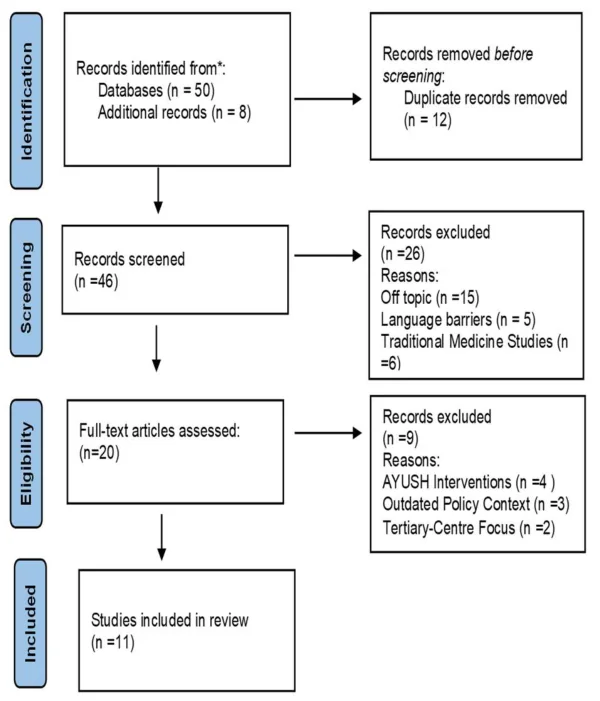
Figure 1 show a PRISMA flow diagram depicting the selection process of studies for the review.
Results
The Table 1 summarizes key findings from various states regarding the readiness of AAMs to deliver NCD services:
| State/Region | Author(s) | Year | Key Findings |
|---|---|---|---|
| Chhattisgarh | Lahariya C, et al. [3] | 2023 | 25% higher NCD identification; public facility use rose from 41.2% (2019) to 62.1% (2022) in AAM-covered areas. |
| Punjab | Singh S, et al. [4] | 2022 | Only 7 of 26 AAMs fully staffed; ~50% lacked glucometers and test strips; weak referral systems and community outreach. |
| Manipur | Devi A, et al. [5] | 2023 | Challenges included irregular CBAC form usage, lack of training, poor logistics, and weak awareness of NCD protocols. |
| Bihar (Patna) | Kumar R, et al. [6] | 2024 | Only 18.75% of AAMs conducted regular NCD screenings; immunization and OPD were strong, but mental health and NCD uptake remained weak. |
| Maharashtra | Patil A, et al. [7] | 2022 | High readiness with 1+ million screenings for hypertension and diabetes; digital reporting well integrated. |
| Tamil Nadu | Srinivasan R, et al. [8] | 2022 | High drug/equipment availability; issues with follow-up and referral tracking; Community Health Officers (CHOs) were adequately trained. |
| Karnataka | Desai V, et al. [9] | 2023 | Screenings were initiated across AAMs, but drug shortages, poor follow-up care, and low health promotion were reported. |
| Uttar Pradesh | Sharma R, et al. [10] | 2024 | Improved infrastructure, but CHOs undertrained; limited community engagement and convergence with other programs. |
| Rajasthan | Syed Intishab Ali [12] | 2025 | 20% of those aged 30+ suffer from diabetes/hypertension; only 10% seek regular care; gaps in community awareness and access persist. |
| Odisha (Western) | Bose, et al. [13] | 2023 | Only 66% of facilities were fully functional; essential medicines were available inconsistently; staff shortages and poor digital readiness were observed. |
| National (NNMS) | Krishnan, et al. [14] | 2021 | Most public PHCs were equipped with basic technology for NCDs, but many lacked essential medicines and trained HR; highlighting the need for standardized inventory protocols. |
Discussion
The review indicates wide variation in the readiness of AAMs to deliver NCD services, with southern and western states like Maharashtra and Tamil Nadu demonstrating relatively stronger systems. These states benefit from better training, infrastructure, and digitalization, contributing to higher NCD screening and treatment rates.
However, challenges persist across multiple states, especially in eastern, northern, and northeastern regions. Common cross-cutting issues include:
- Human Resource Gaps: High CHO vacancies, especially in rural and remote districts [3–10].
- Infrastructure Deficiencies: Shortages of glucometers, BP apparatus, and essential drugs are common in states like Bihar, Punjab, and Odisha [4, 6, 10].
- Training Needs: Community Health Officers (CHOs) often lack regular refresher training on NPCDCS protocols and mental health services [5, 15].
- Referral and Continuum of Care: Referral linkages between primary, secondary, and tertiary care are poorly structured and weakly monitored [5, 16].
- Community Engagement: Accredited Social Health Activists (ASHAs) and Village Health, Sanitation and Nutrition Committee (VHNSCs) are underutilized; low awareness and screening demand observed, particularly in states like Uttar Pradesh and Rajasthan [5, 17].
In response, states like Maharashtra have adopted IT integration for real-time data monitoring [6], while Tamil Nadu and Karnataka are attempting to scale digital health records and follow-up tracking [8, 9].
There is also an emerging emphasis on convergence, both horizontal (with local governance, education, and WCD departments) and vertical (between health system levels), to strengthen health promotion and continuity of care [18, 19].
Conclusion
Ayushman Arogya Mandirs are pivotal in India’s effort to address the growing burden of NCDs. However, the evidence reveals that certain challenges need to be addressed. To realise the full potential of AAMs, focused interventions are required, including: a) filling human resource gaps and reducing CHO vacancies; b) ensuring an uninterrupted supply of essential drugs and diagnostics; c) standardising CHO training, including refresher modules and mental health components; d) strengthening IT systems for referral tracking, reporting, and data use; and e) mobilising communities through ASHAs, SHGs, and local bodies to increase screening coverage.
Evidence-based investments, targeted support to underperforming states, and fostering cross-learning among better-performing states will be critical to strengthening India’s primary healthcare foundation and achieving equitable NCD care delivery.
References
- Government of India. National Health Policy 2017. Ministry of Health and Family Welfare, New Delhi. 2017. [Google Scholar]
- Dandona L, Dandona R, Kumar GA, Shukla DK, Paul VK, Balakrishnan K, Prabhakaran D, Tandon N, Salvi S, Dash AP, Nandakumar A. Nations within a nation: variations in epidemiological transition across the states of India, 1990–2016 in the Global Burden of Disease Study. The Lancet. 2017 Dec 2;390(10111):2437-60. [Google Scholar]
- Lahariya C, Kumar S, Ramaswami P, Choudhury M. Assessing the implementation of Health and Wellness Centres in Chhattisgarh under Ayushman Bharat. J Family Med Prim Care. 2023;12(4):745–52. [Google Scholar]
- Singh S, Kaur A, Kaur M, Gill P. Health system preparedness for non-communicable diseases in Punjab: A cross-sectional study. Int J Community Med Public Health. 2022;9(11):4123–7. [Google Scholar]
- Devi A, Singh RK, Rajkumari B. Barriers to NCD service delivery in Health and Wellness Centres in Manipur: A qualitative assessment. Indian J Public Health. 2023;67(2):123–8. [Google Scholar]
- Kumar R, Prasad R, Verma A. Readiness of Ayushman Arogya Mandirs for NCD services in Patna district: A facility-based assessment. Indian J Community Med. 2024;49(1):18–24. [Google Scholar]
- Patil A, Jadhav S, Deshmukh R. Readiness of primary healthcare system for NCD screening and management under NPCDCS in Maharashtra. J Pharm Res Int. 2022;34(46A):28–35. [Google Scholar]
- Srinivasan R, Rajendran V, Kumar S. Infrastructure and human resource assessment for NCD care in Health and Wellness Centres in Tamil Nadu. Indian J Public Health. 2022;66(3):289–94. [Google Scholar]
- Desai V, Kulkarni R, Rao S. Operational status and challenges of NCD service delivery through Health and Wellness Centres in Karnataka. Health Syst Res J. 2023;11(1):56–63. [Google Scholar]
- Sharma R, Gupta S, Mishra K. Primary healthcare strengthening under Ayushman Bharat in Uttar Pradesh: A readiness study. Indian Health Policy Rev. 2024;4(2):14–20. [Google Scholar]
- World Health Organization. Noncommunicable diseases country profiles 2022. Geneva: WHO; 2022. [Google Scholar]
- https://timesofindia.indiatimes.com/city/jaipur/20-people-above-30-yrs-have-diabetes-bp-or-both-govt/articleshow/121385363.cms
- Bose B, Cheng TC, Kalita A, Haakenstaad A, Yip W. Resource shortage in public health facilities and private pharmacy practices in Odisha, India. Health Policy Plan. 2024 Nov 14;39(10):1074-1086. doi: 10.1093/heapol/czae086. PMID: 39238224; PMCID: PMC11562114.
- Krishnan, A., Mathur, P., Kulothungan, V. et al. Preparedness of primary and secondary health facilities in India to address major noncommunicable diseases: results of a National Noncommunicable Disease Monitoring Survey (NNMS). BMC Health Serv Res 21, 757 (2021). https://doi.org/10.1186/s12913-021-06530-0
- Mishra SR, Neupane D, Preetham A, et al. Training and capacity building needs for NCD control in India: A systematic review. BMC Public Health. 2020;20(1):1175. [Google Scholar]
- Bhat R, Mavalankar D, Singh A. Strengthening referral systems for NCDs in India: Lessons from the field. Health Policy Plan. 2021;36(5):652–60. [Google Scholar]
- Pandey A, Sehgal M, Mahajan R. Role of community health workers in promoting NCD screening: A global review. Glob Health Action. 2019;12(1):1613703. [Google Scholar]
- Patel V, Jain S, Sharma K. National health reform and its impact on NCD service delivery: India’s experience under Ayushman Bharat. BMJ Glob Health. 2022;7(6):e008421. [Google Scholar]
- Basu S, Singh A, Sinha R. Health financing reforms and non-communicable disease outcomes in India: A systematic analysis. Health Syst Reform. 2021;7(3):e1923317. [Google Scholar]
Published
Article metrics
- Views
- 346
- Downloads
- 280
Based on this site's usage statistics.