Original Article Vol. 10 No. 1 (2026): International Journal of Health Systems and Implementation Research
Prevalence of Diabetic Macro and Microvascular Complications among Patients with Diabetic Retinopathy
Prevalence of Vascular Complications in Diabetic Retinopathy
Downloads
Topics
Keywords:
- Albuminuria, Diabetic retinopathy, Macrovascular complications, Microvascular complications, Peripheral arterial disease
Abstract
Diabetes mellitus is a major global health problem associated with both microvascular and macrovascular complications. Diabetic retinopathy (DR), a common microvascular complication, is increasingly recognized as a marker of systemic vascular damage and is strongly associated with cardiovascular morbidity and mortality. Methods: A hospital-based observational cross-sectional study was conducted at a tertiary care center in Kolkata. A total of 63 adult patients with confirmed diabetic retinopathy were included. Macrovascular complications were assessed using carotid Doppler, lower limb arterial Doppler with ankle-brachial pressure index (ABPI), and echocardiography. Microvascular complication was evaluated using the urine albumin–creatinine ratio (ACR). Data were analyzed using descriptive statistics, and associations were tested using Chi-square/Fisher’s exact test. Results: The mean age of participants was 57.9 years, with an average diabetes duration of 10.8 years. A high burden of macrovascular abnormalities was observed, including increased carotid intima-media thickness (58.73%) and lower limb arterial atherosclerosis (58.73%). Peripheral arterial disease was evident in over half of the patients based on ABPI findings. Most patients had preserved systolic cardiac function, although early diastolic dysfunction was present. Microvascular involvement was significant, with all patients showing elevated urine ACR and 52.38% having macroalbuminuria. Poor glycemic control and longer disease duration were associated with increased complication burden. Conclusion: Patients with diabetic retinopathy exhibit a high prevalence of both macrovascular and microvascular complications. DR serves as an important clinical marker of systemic vascular disease. Early comprehensive screening and integrated management strategies are essential to reduce morbidity and mortality.
Full text
This web version was prepared from the published PDF, which is the version of record. Please cite and quote from the PDF.
Introduction
Diabetes mellitus (DM) is a rapidly escalating global public health challenge characterized by chronic hyperglycemia and associated with widespread vascular complications affecting multiple organ systems. According to the International Diabetes Federation, approximately 590 million adults (11.1% of the global population) were living with diabetes in 2025, with projections reaching over 850 million by 2050 [1]. The burden is disproportionately higher in low- and middle-income countries, where healthcare access and early detection remain limited. Diabetes is a major contributor to global mortality, accounting for 1.6 million direct deaths annually, with nearly half occurring before the age of 70 years, and contributing to approximately 11% of cardiovascular deaths worldwide [2].
India represents one of the epicenters of this epidemic, harbouring the second-largest diabetic population globally, with approximately 77–90 million adults affected and a prevalence of around 10–10.5% [3]. Alarmingly, a substantial proportion of individuals remain undiagnosed, predisposing them to long-term complications. Diabetes significantly increases the risk of macrovascular events, with affected individuals having a two- to three-fold higher risk of cardiovascular disease, including myocardial infarction and stroke. Non-communicable diseases, including diabetes and its complications, account for nearly 60% of all deaths in India, underscoring the enormous health burden [4].
The complications of diabetes are broadly classified into microvascular and macrovascular complications, both of which share overlapping pathogenic mechanisms such as endothelial dysfunction, oxidative stress, and chronic inflammation. Microvascular complications include diabetic retinopathy (DR), nephropathy, and neuropathy, while macrovascular complications encompass coronary artery disease, cerebrovascular disease, and peripheral arterial disease [5]. Among these, diabetic retinopathy is one of the most common microvascular complications and a leading cause of preventable blindness among working-age adults worldwide. Importantly, DR is increasingly recognized not merely as an ocular condition but as a marker of systemic vascular damage, reflecting generalized microangiopathy and its association with macrovascular disease.
Accumulating evidence suggests that patients with diabetic retinopathy have a significantly higher burden of both microvascular and macrovascular complications compared to those without DR. Diabetes is associated with a 2–4 fold increased risk of cardiovascular disease, and cardiovascular causes account for the majority of excess mortality in diabetic patients [6]. Furthermore, the coexistence of microvascular complications has been shown to accelerate atherosclerosis, thereby increasing the risk of ischemic heart disease, stroke, and peripheral vascular disease. The concept of a “common soil” hypothesis highlights the shared pathophysiological pathways underlying both microvascular and macrovascular complications.
Despite the growing burden, there remains limited region-specific data evaluating the combined prevalence of macrovascular and microvascular complications among patients with diabetic retinopathy, particularly in tertiary care settings in India. Understanding this relationship is crucial for early risk stratification, targeted screening, and integrated management strategies. Therefore, the present study aims to determine the prevalence of diabetic macrovascular and microvascular complications among patients with diabetic retinopathy in a tertiary care hospital setting, thereby contributing to improved clinical outcomes and healthcare planning.
Methods
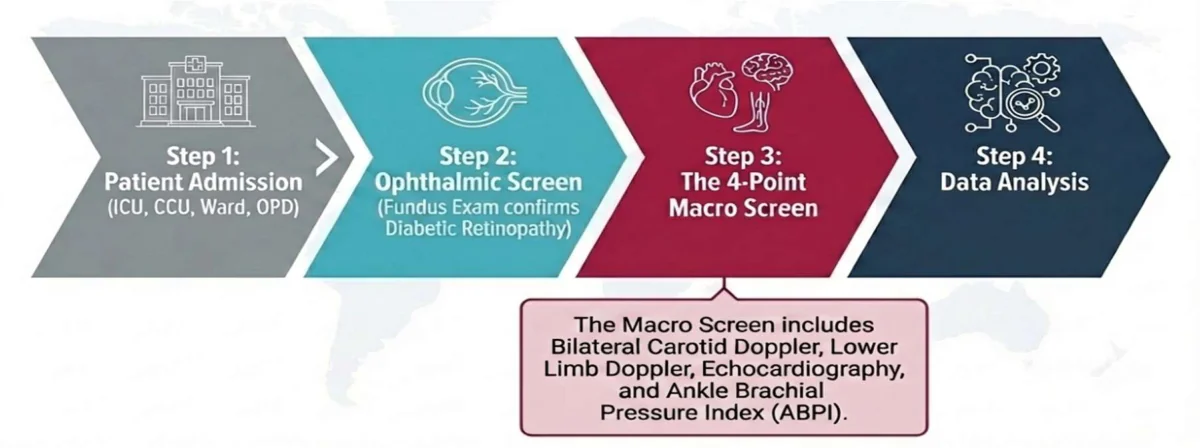
This study was conducted as a hospital-based observational cross-sectional study at a tertiary care center in Kolkata to determine the prevalence of diabetic macro and microvascular complications among patients with diabetic retinopathy. (Figure 1)
Study Population and Design
The study included adult patients (≥18 years) with a confirmed diagnosis of diabetes mellitus and diabetic retinopathy attending outpatient and inpatient services of the Department of General Medicine. Diabetic retinopathy was diagnosed based on ophthalmological evaluation. Patients with incomplete records or severe comorbid illnesses interfering with assessment were excluded.
Sample Size Calculation
The sample size was calculated using the standard formula for prevalence studies:
n = (Z² × p × q) / d²
Where:
- n = required sample size
- Z = standard normal variate (1.96 for 95% confidence interval)
- p = 28.5% expected prevalence of peripheral artery disease reported by Islam et al (2022) [7].
- q = (1 − p)
- d = absolute precision (typically 12.5%)
Based on available prevalence estimates of vascular complications in diabetic populations and considering feasibility within the 2.5 months study duration (15th August to 30th November 2021), the calculated sample size incorporating 15% nonresponse rate was approximately 60 participants. Accordingly, a total of 63 patients were included in the final analysis.
Data Collection and Variables
Data were collected using a structured proforma. Demographic details (age, sex), clinical characteristics (duration of diabetes, treatment history), and laboratory parameters (HbA1c, urine albumin-creatinine ratio) were recorded.
Macrovascular complications were assessed using the following standardized methods:
- Carotid Doppler: To assess intima-media thickness and atherosclerotic changes.
- Lower limb arterial Doppler and Ankle-Brachial Pressure Index (ABPI): To evaluate peripheral vascular disease.
- Echocardiography: To assess cardiac function including left ventricular ejection fraction and diastolic dysfunction.
Microvascular complications were assessed using Urine Albumin Creatinine Ratio (ACR) to evaluate associated renal involvement.
Outcome Measures
The primary outcome was the prevalence of macrovascular complications (cerebrovascular disease, and peripheral vascular disease) among patients with diabetic retinopathy. Secondary outcome was the prevalence of microvascular complication (diabetic nephropathy)
Statistical Analysis
Data were entered into Microsoft Excel and analysed using STATA 18 software. Continuous variables were expressed as mean ± standard deviation, while categorical variables were presented as frequencies and percentages. The prevalence of vascular complications was calculated as proportions. Association between categorical variables was assessed using the Chi-square test or Fisher’s exact test as appropriate. A p-value <0.05 was considered statistically significant.
Results
The study population had a mean age of 57.9 years with median 60. Diabetes duration averaged 10.8 years. Glycemic control showed HbA1C mean 7.0%. Urine ACR was high (mean 376). ABPI values indicated borderline perfusion (average 0.82). Echocardiography revealed preserved LVEF (mean 58%) with elevated filling pressures (E/e’ 12.3). Overall, findings suggest long-standing diabetes with vascular compromise and early diastolic dysfunction.
A total of 63 patients with diabetic retinopathy (DR) were included in the study. Most participants were aged 60–73 years (52.38%), followed by 45–59 years (39.68%) and 19–44 years (7.94%). Gender distribution was nearly equal with males (49.21%) and females (49.21%), and one transgender participant (1.59%).
Among retinal findings, non-proliferative diabetic retinopathy (NPDR) involving both eyes was the most common (58.73%), followed by NPDR in a single eye (34.92%). Proliferative diabetic retinopathy (PDR) and branch retinal vein occlusion (BRVO) were observed in 3.17% each
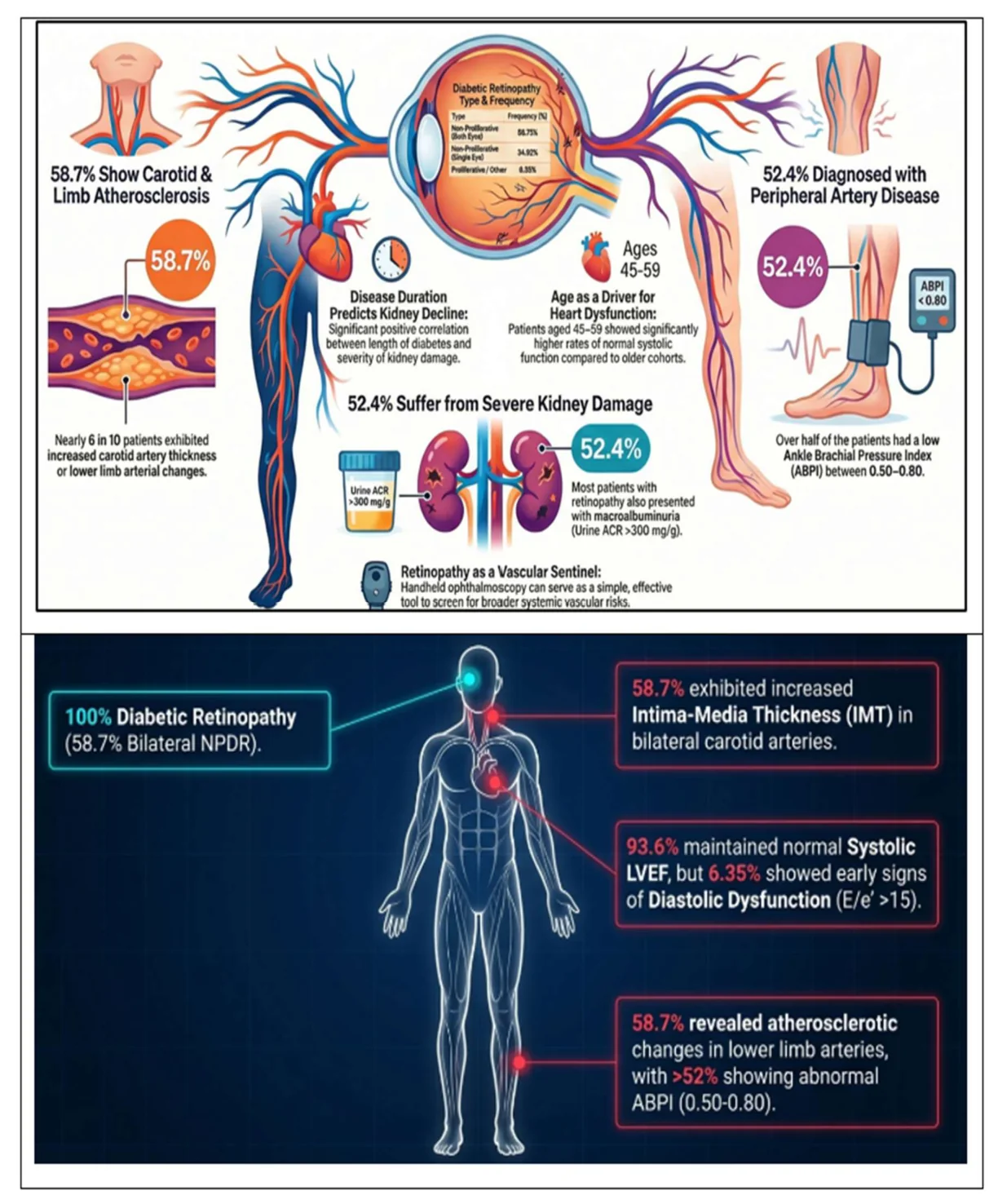
Macrovascular assessment revealed a high burden of subclinical vascular disease. Carotid Doppler showed increased intima-media thickness (IMT) in 58.73% of patients, while 9.52% had atherosclerotic changes and 1.59% had soft plaque formation; 30.16% had normal findings. Lower limb arterial Doppler demonstrated atherosclerotic changes in 58.73% of participants, with 41.27% showing normal findings.
Assessment of peripheral arterial disease using ankle-brachial pressure index (ABPI) showed that 52.38% had values between 0.50–0.80, indicating moderate arterial disease. Nearly 44.44% had values between 0.81–1.00, and only 3.17% had values >1.00. Right-sided ABPI was reduced (0.50–0.80) in 85.71% of cases, whereas left-sided ABPI showed relatively higher normal distribution (58.73% in 0.81–1.00 range).
Echocardiographic evaluation revealed preserved systolic function in most patients, with 93.65% having normal left ventricular ejection fraction (LVEF 50–70%). Mild systolic dysfunction was noted in 6.35% of patients. Diastolic dysfunction (E/e’ >15) was present in 6.35%. Microvascular renal involvement was also significant, with 52.38% of patients having urine albumin-creatinine ratio (ACR) >300 mg/g and 47.62% having ACR between 30–300 mg/g. Regarding disease duration, 50.79% had diabetes for 10–15 years, 41.27% for <10 years, and 7.94% for >15 years. Poor glycemic control was observed in 57.14% of patients (HbA1c >6.4%) (Table 1, Figure 2).
Age-wise comparison showed no statistically significant association between age groups and most macrovascular parameters, including carotid Doppler findings (p=0.908), lower Doppler findings (p=0.242), and echocardiographic parameters (p>0.05). However, left-sided ABPI demonstrated a statistically significant association with age (p=0.016), suggesting variation in peripheral vascular involvement across age groups (Table 2).
| Variable | Frequency (N=63) | Percentage (%) |
|---|---|---|
| Age group (years) | ||
| 19-44 | 5 | 7.94 |
| 45-59 | 25 | 39.68 |
| 60-73 | 33 | 52.38 |
| Gender | ||
| Female | 31 | 49.21 |
| Male | 31 | 49.21 |
| Transgender | 1 | 1.59 |
| Diabetic Retinopathy- Complications | ||
| Macrovascular complications | ||
| NPDR- Both eye | 37 | 58.73 |
| NPDR- Single eye | 22 | 34.92 |
| PDR-Right eye | 2 | 3.17 |
| BRVO- Right eye | 2 | 3.17 |
| B/l carotid artery doppler | ||
| Normal study | 19 | 30.16 |
| Atherosclerotic changes | 6 | 9.52 |
| Increased IMT b/l carotid | 37 | 58.73 |
| Soft plaque left carotid artery | 1 | 1.59 |
| B/l lower limb artery doppler | ||
| Normal study | 26 | 41.27 |
| Atherosclerotic changes | 37 | 58.73 |
| ABPI | ||
| Average ABPI | ||
| 0.50-0.80 | 33 | 52.38 |
| 0.81-1.00 | 28 | 44.44 |
| >1.00 | 2 | 3.17 |
| Right ABPI | ||
| 0.50-0.80 | 54 | 85.71 |
| 0.81-1.00 | 3 | 4.76 |
| >1.00 | 6 | 9.52 |
| Left ABPI | ||
| 0.50-0.80 | 26 | 41.27 |
| 0.81-1.00 | 37 | 58.73 |
| >1.00 | - | - |
| Echocardiography Finding | ||
| Systolic Heart failure: Left Ventricular Ejection Fraction | ||
| Severe dysfunction = LVEF <30% | - | - |
| Moderate dysfunction = LVEF 30- 39% | - | - |
| Mild dysfunction = LVEF 40-49% | 4 | 6.35 |
| Normal = LVEF 50-70% | 59 | 93.65 |
| Diastolic Heart Failure: E/e’ | ||
| ≥15 (Dysfunction) | 4 | 6.35 |
| <15 (Normal) | 59 | 93.65 |
| Microvascular finding | ||
| Urine ACR (mg/g) | ||
| >30 | - | - |
| 30-300 | 30 | 47.62 |
| >300 | 33 | 52.38 |
| Duration of disease (years) | ||
| <10 | 26 | 41.27 |
| 10-15 | 32 | 50.79 |
| >15 | 5 | 7.94 |
| Control of Diabetes: HbA1C (%) | ||
| <5.7 | 15 | 23.81 |
| 5.7-6.4 | 12 | 19.05 |
| >6.4 | 36 | 57.14 |
NPDR= Nonproliferative Diabetic Retinopathy, PDR= Proliferative Diabetic Retinopathy, BRVO= Branch Retinal Vein Occlusion. Source: Authors’ Calculation.
| Variable | Age group (Years) | p-value* | ||
|---|---|---|---|---|
| 19-44 | 45-59 | 60-73 | ||
| Macrovascular Complications | ||||
| Retina Finding | ||||
| NPDR- Both eye | 3 (60.00) | 17 (68.00) | 17 (51.52) | <0.509 |
| NPDR- Single eye | 2 (40.00) | 8 (32.00) | 13 (42.30) | |
| NPDR- Left eye | - | 3 (12.00) | 3 (12.00) | |
| NPDR- Right eye | 1 (20.00) | 5 (20.00) | 10 (30.30) | |
| PDR-Right eye | 1 (20.00) | - | 1 (3.03) | |
| BRVO- Right eye | - | - | 2 (6.06) | |
| B/l carotid artery doppler | ||||
| Normal study | 2 (40.00) | 8 (32.00) | 9 (27.27) | 0.908 |
| Atherosclerotic changes | - | 2 (8.00) | 4 (12.12) | |
| Increased IMT b/l carotid | 3 (60.00) | 14 (56.00) | 20 (60.61) | |
| Soft plaque left carotid artery | - | 1 (4.00) | - | |
| B/l lower limb artery doppler | ||||
| Normal study | 4 (80.00)) | 10 (40.00) | 12 (36.36) | 0.242 |
| Atherosclerotic changes | 1 (20.00) | 15 (60.00) | 21 (63.64) | |
| ABPI | ||||
| Average ABPI | ||||
| 0.50-0.80 | 4 (80.00) | 8 (32.00) | 21 (63.64) | 0.066 |
| 0.81-1.00 | 1 (20.00) | 16 (64.00) | 11 (33.33) | |
| >1.00 | - | 1 (4.00) | 1 (3.03) | |
| Right ABPI | ||||
| 0.50-0.80 | 5 (100.0) | 20 (80.00) | 29 (87.88) | 0.752 |
| 0.81-1.00 | - | 1 (4.00) | 2 (6.06) | |
| >1.00 | - | 4 (16.00) | 2 (6.06) | |
| Left ABPI | ||||
| 0.50-0.80 | 3 (60.00) | 5 (20.00) | 18 (54.55) | 0.016 |
| 0.81-1.00 | 2 (40.00) | 20 (80.00) | 15 (45.45) | |
| >1.00 | - | - | - | |
| Echocardiography Finding | ||||
| Systolic Heart failure: Left Ventricular Ejection Fraction | ||||
| Severe dysfunction = LVEF <30% | - | - | - | 0.378 |
| Moderate dysfunction = LVEF 30- 39% | - | - | - | |
| Mild dysfunction = LVEF 40-49% | 1 (20.00) | 1 (4.00) | 2 (6.06) | |
| Normal = LVEF 50-70% | 4 (80.00) | 24 (96.00) | 31 (93.94) | |
| Diastolic Heart Failure: E/e’ | ||||
| ≥15 (Dysfunction) | 5 (100.0) | 24 (96.00) | 30 (90.91) | 0.734 |
| <15 (Normal) | - | 1 (4.00) | 3 (9.09) | |
| Microvascular Complications | ||||
| Urine ACR (mg/g) | ||||
| 30-300 | 2 (40.00) | 15 (60.00) | 13 (39.39) | 0.256 |
| >300 | 3 (60.0) | 10 (40.00) | 20 (60.61) | |
*Fisher exact p-value, All the values are column percentage. Source: Authors’ Calculation
Discussion
The present study demonstrates a high prevalence of both macrovascular and microvascular complications among patients with diabetic retinopathy (DR), reinforcing the concept that DR represents a marker of systemic vascular pathology rather than an isolated ocular disease. These findings are consistent with growing global evidence that DR is strongly associated with increased cardiovascular morbidity and mortality [8].
Macrovascular Complications and Systemic Atherosclerosis
A major finding of this study is the high burden of subclinical macrovascular disease, evidenced by increased carotid intima-media thickness and lower limb arterial atherosclerosis in a substantial proportion of patients. This aligns with international studies showing that DR is independently associated with cardiovascular disease (CVD), even after adjusting for traditional risk factors [9]. Meta-analyses have demonstrated that patients with DR have a significantly increased risk of cardiovascular events and mortality compared to those without DR [10].
Furthermore, the association between DR severity and coronary artery disease (CAD) has been well established. A recent study reported CAD prevalence rising from 31.2% in patients without DR to 72.2% in proliferative DR, highlighting a dose–response relationship [11]. This supports our findings of increased macrovascular burden in patients with advanced retinal disease. The underlying explanation lies in the shared pathophysiological mechanisms, including endothelial dysfunction, oxidative stress, inflammation, and activation of AGE–RAGE pathways, which contribute to both microvascular damage and accelerated atherosclerosis [12]. Retinal microvascular changes thus mirror systemic vascular injury, making DR a surrogate marker of generalized vascular disease.
Peripheral Arterial Disease and ABPI Findings
The high prevalence of abnormal ankle-brachial pressure index (ABPI) in this study indicates a significant burden of peripheral arterial disease (PAD). This is consistent with global data showing PAD prevalence ranging from 1% to 40% in diabetic populations, particularly in low- and middle-income countries [8]. The higher prevalence observed in this study compared to general diabetic populations may be explained by the inclusion of patients with established DR, who represent a subgroup with advanced vascular damage. Additionally, the use of combined Doppler and ABPI assessment may have improved the detection of subclinical disease.
Cardiac Findings and Diabetic Cardiomyopathy
Despite the high burden of vascular disease, most patients in this study had preserved systolic function, with only a small proportion showing systolic dysfunction. However, evidence of diastolic dysfunction suggests early myocardial involvement. This pattern is well supported by literature indicating that diastolic dysfunction precedes systolic impairment in diabetic cardiomyopathy, reflecting early microvascular ischemia and myocardial fibrosis. Moreover, DR has been shown to predict cardiovascular mortality, with studies reporting a 1.8–2.3-fold increased risk of cardiovascular death in patients with DR [13] and even higher risk in severe DR [14]. These findings highlight the prognostic importance of DR in identifying high-risk cardiovascular patients.
Microvascular Complications and Nephropathy
The study also demonstrated a high prevalence of diabetic nephropathy, as reflected by elevated urine albumin-creatinine ratio (ACR) levels. This is consistent with global and Indian data indicating that microvascular complications frequently coexist due to shared pathogenic mechanisms. A systematic review reported nephropathy prevalence ranging from 7% to 35% in newly diagnosed diabetes, with higher rates in low-resource settings [8]. The coexistence of DR and nephropathy supports the concept of generalized microangiopathy, where similar pathological processes affect retinal, renal, and neural microcirculation. Chronic hyperglycemia leads to capillary basement membrane thickening, endothelial dysfunction, and microvascular occlusion, explaining the clustering of complications.
Role of Duration of Diabetes and Glycemic Control
The present study found that longer duration of diabetes and poor glycemic control were associated with increased prevalence of complications, which is consistent with global evidence. Meta-analyses have confirmed that duration of diabetes and elevated HbA1c are major determinants of DR and vascular complications [15]. Prolonged hyperglycemia promotes the accumulation of advanced glycation end products, oxidative stress, and vascular inflammation, leading to progressive vascular damage. This explains the higher complication rates observed in patients with disease duration exceeding 10 years in the present study [16].
Clinical Implications
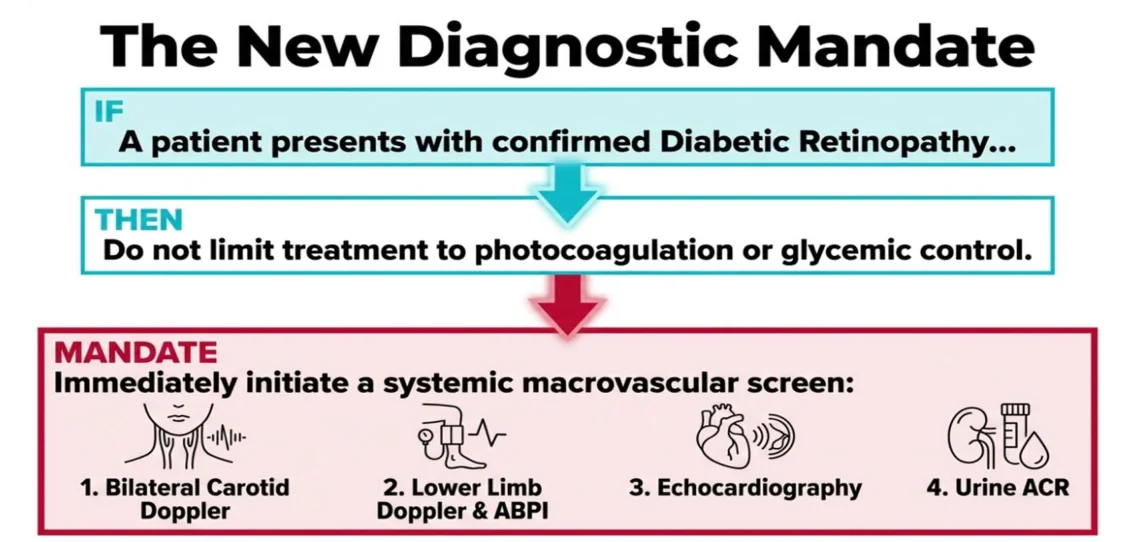
The findings of this study emphasize that patients with diabetic retinopathy constitute a high-risk group for systemic vascular disease. Retinal examination may serve as a non-invasive tool for cardiovascular risk stratification. Several studies have suggested that retinal microvascular imaging can predict future cardiovascular events [9]. Therefore, comprehensive screening strategies, including carotid Doppler, ABPI, echocardiography, and renal assessment, should be routinely implemented in patients with DR to enable early detection and intervention.
Strengths
This study provides a comprehensive evaluation of both macrovascular and microvascular complications in patients with diabetic retinopathy using objective diagnostic modalities, including Doppler studies, ABPI, echocardiography, and urine ACR. It contributes valuable real-world data from an Indian tertiary care setting, where integrated vascular assessment is limited. Additionally, the inclusion of subclinical markers such as carotid IMT enhances early detection of vascular disease.
Limitations
The study has several limitations. The cross-sectional design precludes causal inference between DR and vascular complications. The relatively small sample size and single-center setting limit generalizability. Selection bias may be present due to the inclusion of patients from a tertiary care hospital, who are likely to have more advanced diseases. Furthermore, the lack of multivariate analysis limits adjustment for confounding factors such as hypertension, dyslipidemia, and smoking.
Recommendations
In patients with confirmed diabetic retinopathy, management should extend beyond ocular treatment and glycemic control. A comprehensive systemic evaluation for macrovascular complications is essential. Routine screening should include bilateral carotid Doppler, lower limb Doppler with ABPI, echocardiography, and urine ACR to enable early detection, risk stratification, and timely intervention to reduce morbidity and mortality. (Figure 3)
Conclusion
Macrovascular complications are highly prevalent among patients with diabetic retinopathy. Cardiovascular disease is the most common, followed by cerebrovascular and peripheral vascular disease. Early detection and integrated management strategies are essential to reduce morbidity and mortality.
Ethical considerations
Institutional ethics committee approval was obtained (Reference number: CMC-IRC/078/079-021). Written informed consent was taken from all participants. Confidentiality was maintained throughout the study. This study was conducted as per Helsinki Declaration
Availability of data and materials
The corresponding author can provide the processed data upon reasonable requests.
Conflict of interest
None
Funding
No funding or financial grant was received to conduct the present study.
Acknowledgements
We express our sincere gratitude to the study participants
References
- International Diabetes Federation: Facts & figures [Internet]. [cited 2026 Apr 1]. Available from: https://idf.org/about-diabetes/diabetes-facts-figures/
- World Health Organization, Diabetes [Internet]. [cited 2026 Apr 1]. Available from: https://www.who.int/news-room/fact-sheets/detail/diabetes
- World Health Organization, Diabetes in India [Internet]. [cited 2026 Apr 1]. Available from: https://www.who.int/india/diabetes
- Chauhan S, Khatib MN, Ballal S, Bansal P, Bhopte K, Gaidhane AM, et al. The rising burden of diabetes and state-wise variations in India: insights from the Global Burden of Disease Study 1990–2021 and projections to 2031. Front Endocrinol. 2025 May 12;16:1505143. doi:10.3389/fendo.2025.1505143 PubMed PMID: 40421244.
- Zakir M, Ahuja N, Surksha MA, Sachdev R, Kalariya Y, Nasir M, et al. Cardiovascular Complications of Diabetes: From Microvascular to Macrovascular Pathways. Cureus. 15(9):e45835. doi:10.7759/cureus.45835 PubMed PMID: 37881393; PubMed Central PMCID: PMC10594042.
- Dal Canto E, Ceriello A, Rydén L, Ferrini M, Hansen TB, Schnell O, et al. Diabetes as a cardiovascular risk factor: An overview of global trends of macro and micro vascular complications. Eur J Prev Cardiol. 2019 Dec 1;26(2_suppl):25–32. doi:10.1177/2047487319878371
- Islam U ul, Din SU, Mumtaz A, Qasim M. Frequency of Peripheral Arterial Disease in Type-II Diabetic Patients presenting with Diabetic Retinopathy. Ann Punjab Med Coll. 2022;16(4):326–9. doi:10.29054/apmc/2022.940
- Aikaeli F, Njim T, Gissing S, Moyo F, Alam U, Mfinanga SG, et al. Prevalence of microvascular and macrovascular complications of diabetes in newly diagnosed type 2 diabetes in low-and-middle-income countries: A systematic review and meta-analysis. PLOS Glob Public Health. 2022 Jun 15;2(6):e0000599. doi:10.1371/journal.pgph.0000599 PubMed PMID: 36962416; PubMed Central PMCID: PMC10021817.
- Yu W, Yang B, Xu S, Gao Y, Huang Y, Wang Z. Diabetic Retinopathy and Cardiovascular Disease: A Literature Review. Diabetes Metab Syndr Obes. 2023 Dec 28;16:4247–61. doi:10.2147/DMSO.S438111 PubMed PMID: 38164419; PubMed Central PMCID: PMC10758178.
- Guo VY, Cao B, Wu X, Lee JJW, Zee BC ying. Prospective Association between Diabetic Retinopathy and Cardiovascular Disease—A Systematic Review and Meta-analysis of Cohort Studies. J Stroke Cerebrovasc Dis. 2016 Jul 1;25(7):1688–95. doi:10.1016/j.jstrokecerebrovasdis.2016.03.009
- Kotni SK, Ramakrishna VVS, Perala SK. Association Between Diabetic Retinopathy and Coronary Artery Disease in Patients with Type 2 Diabetes Mellitus. Eur J Cardiovasc Med. 2025 Sep 18;15:515–20. doi:10.61336/ejcm/25-09-83
- Wang T, Li H, Wang C, Li X, Deng A, Jiao X. Diabetic retinopathy as a sentinel of systemic vascular dysfunction: Shared molecular mechanisms with cardiovascular disease. Exp Eye Res. 2025 Dec 1;261:110644. doi:10.1016/j.exer.2025.110644
- Kha R, Kapucu Y, Indrakumar M, Burlutsky G, Thiagalingam A, Kovoor P, et al. Diabetic retinopathy further increases risk of cardiovascular disease mortality in a high-risk cohort. Sci Rep. 2025 Feb 9;15(1):4811
- Xu XH, Sun B, Zhong S, Wei DD, Hong Z, Dong AQ. Diabetic retinopathy predicts cardiovascular mortality in diabetes: a meta-analysis. BMC Cardiovasc Disord. 2020 Nov 4;20(1):478. doi:10.1186/s12872-020-01763-z PubMed PMID: 33148188; PubMed Central PMCID: PMC7643303.
- Azagew AW, Mekonnen CK, Lambie M, Shepherd T, Babatunde OO. Poor glycemic control and its predictors among people living with diabetes in low- and middle-income countries: a systematic review and meta-analysis. BMC Public Health. 2025 Feb 21;25:714.
- González P, Lozano P, Ros G, Solano F. Hyperglycemia and Oxidative Stress: An Integral, Updated and Critical Overview of Their Metabolic Interconnections. Int J Mol Sci. 2023 May 27;24(11):9352. doi:10.3390/ijms24119352 PubMed PMID: 37298303; PubMed Central PMCID: PMC10253853.

Published
Article metrics
- Views
- 85
- Downloads
- 49
Based on this site's usage statistics.
Issue
Section
How to Cite
License
Copyright (c) 2026 Abu Talha Purkait, Prabuddha Mukhopadhyay, Pritam Halder, Sujoy Roychowdhury

This work is licensed under a Creative Commons Attribution 4.0 International License.
More in this topic: NCDs & mental health
View Point · 2025
From Screens to Sips: Social Media's Impact on Adolescent Alcohol Use