View Point Vol. 3 No. 1 (2019): International J of Health Systems and Implementation Research
India aims to free itself of Anaemia by 2022. But, have we learnt enough before taking that leap?
Anaemia Free by 2022-Are We Prepared?
Downloads
Topics
Keywords:
- Measurement error
- Anaemia
- Anaemia Free
Abstract
India is moving towards freeing itself of Anemia by 2022 and envisages 3% annual reduction in prevalence. But are we getting the prevalence right? perhaps the point of care diagnostic devices being used in National Surveys are not good enough. Secondly, primary emphasis is being laid on Iron folic acid supplementation. Though diagnosis and treatment is gaining momentum, the strategy doesn't seem to be well articulated. Monitoring Framework doesn't encompass all the nutrition-specific and sensitive determinants. Its time India has its Anemia Control index. Lets prepare well before taking that giant leap.
Full text
This web version was prepared from the published PDF, which is the version of record. Please cite and quote from the PDF.
India is a multi-cultural, multi-ethnic country, with diverse lifestyles. There are wide variations across its states in terms of the distribution of health and disease, as brought out in a recently released report on state-level disease burden in India.[1] The findings provide crucial inputs to invest scarce resources where most needed.
In 2016, dietary iron deficiency was the leading cause of disability in all ages in India.[2] Particularly among children (5–14 y), iron deficiency anaemia (IDA) accounted for 17·7% (13·98%-21·87%) of total DALYs.[3] All-age DALY rates of IDA were higher among Indian states with low epidemiological transition level (ETL).[1] Recently, National Family Health Survey 4 (NFHS) provided age and sex specific estimates of anaemia prevalence using the ‘Hemocue’ system, a point of care testing device (POCT). It showed that children, and women of reproductive age group (15-49y) had higher prevalence of anaemia, at 58.6% and 53.1% respectively.[4]
Figure 1 is about problem tree (conceptual framework) of anaemia in India. As per various national levels surveys, the proportion of people with anaemia is higher than those without.[4] The underlying causes of anaemia are both nutrition-sensitive and nutrition-specific. We still do not know as to what proportion of these anaemia cases can be actually attributed to nutritional factors, particularly iron deficiency; and what proportion can be attributed to non-nutritional factors like infections, chronic conditions or synthesis disorders. The spectrum of causes may vary according to geographical location, age, sex, socio-economic gradient, etc. To reduce the pool of anaemic individuals at a faster pace, early detection and cause specific treatment will be needed. Preventing anaemia in healthy individuals will require dietary (food diversity measures, iron supplementation, food fortification etc.), as well as non-dietary interventions (WASH strategy, infection prevention and control, robust reproductive and child health services, poverty alleviation, social security measures, Health systems strengthening, behaviour change communication etc.).
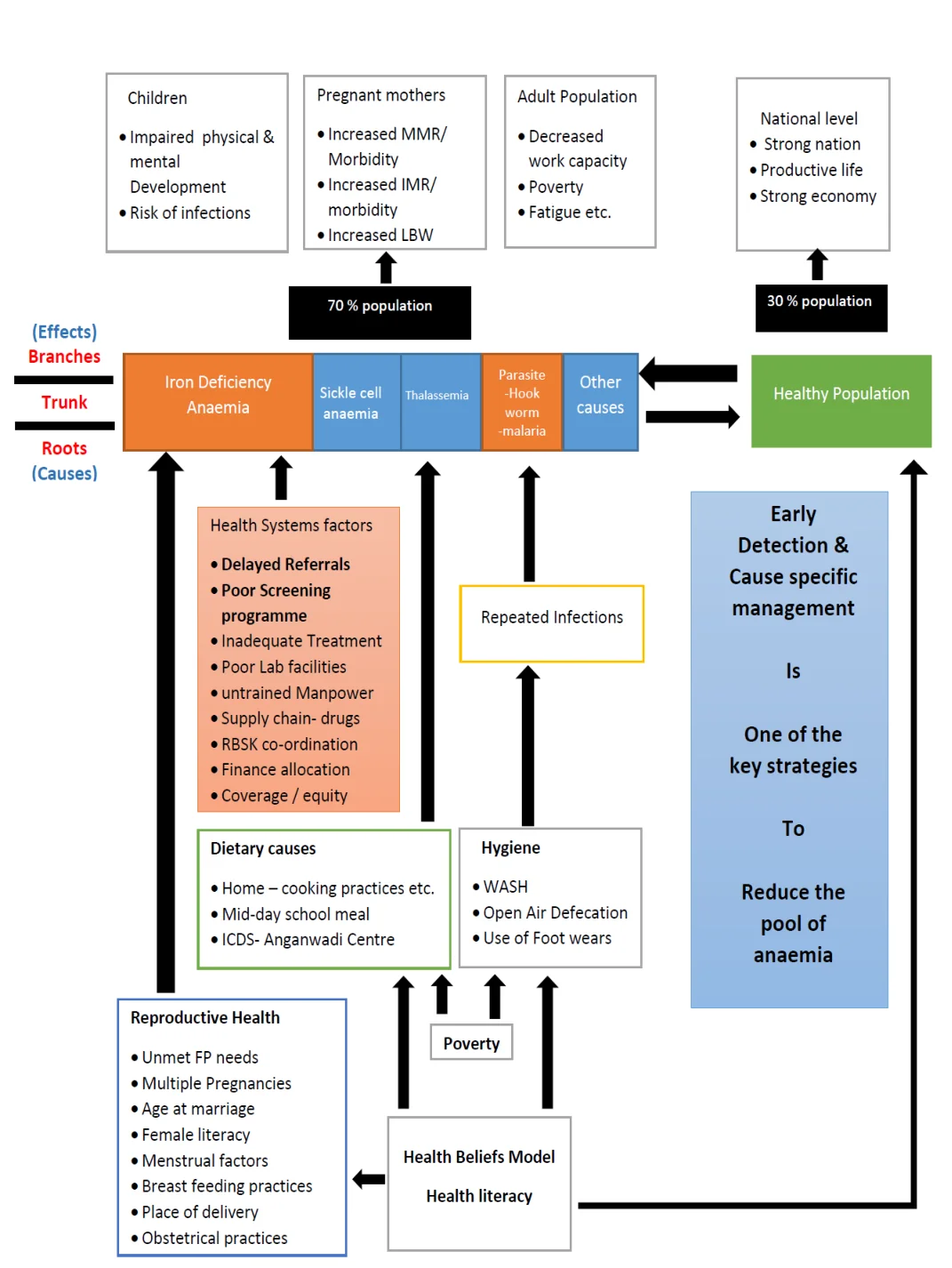
India’s commitment towards anaemia reduction is evident from a recent launch of its ambitious ‘Anemia Mukt Bharat’ (AMB), which literally translates to an anaemia free India. The AMB is an intensified iron plus initiative to reduce the prevalence of anaemia in India by 3 percentage points every year, until 2022.[5]
However, two major challenges await India in ‘freeing’ itself of anaemia. Firstly, rolling out burden specific control interventions and monitoring progress require that we obtain accurate estimates of prevalence. Earlier research has shown that we might be either over- or under-estimating the prevalence in different states, as this would depend upon the accuracy parameters of the POCTs used for its measurement.[6] This in turn would vary depending upon the underlying distribution of true haemoglobin values across different population subgroups.[7] It is therefore time to revisit methodologies used to carry out earlier large scale haematological surveys that used less than perfect POCTs, more so considering the fact that India is gearing up for its next large scale demographic survey (NFHS 5) in coming few months.
Also, the over-reliance on POCTs alone is unlikely to provide true picture. Incorporating gold standard measurements in a subsample to get region specific accuracy estimates could be one way forward. Recently, a mobile app has been developed to provide corrected estimates based on POCT reported prevalence, and its accuracy statistics.[8]
Secondly, since anaemia is multi-factorial (figure 1), it would be unwise to overemphasize Iron and Folic acid (IFA) supplementation alone as a primary control strategy. Unless we lay more emphasis on treatment by setting up anaemia clinics, it would be impossible to arrest and reverse the trends in anaemia across the country. The World Health Organisation in its latest guidelines mentions the use of blood cell indices to identify different causative mechanisms.[9] If this recommendation is gainfully utilised to promote proper diagnosis and treatment of anaemia, it could fasten anaemia reduction in a similar manner as to what diagnosis and treatment strategy did in controlling tuberculosis in India over the last two decades.
Sadly, not much is mentioned about setting up anaemia clinics at primary health care level in the AMB operational guidelines. Also, there is no clear recommendation on choice of POCT to be used in community settings for early diagnosis, an area of huge research potential.[6] There is paucity of research on the spectrum of anaemia across different states in the country, and the possible role of test and treat strategy versus supplementation or fortification programmes in reducing anaemia. Very recently, a report highlighting various programmatic issues in implementation of iron plus initiative in an eastern state of India was released,[10] but its findings couldn’t be generalised to a culturally diverse nation like ours. Even though there is some mention about treatment of anaemia cases in the AMB guidelines, it is mostly focused around correcting iron deficiency. In fact, the proposed Key Performance Indicators primarily monitor supplementation interventions. It is well accepted that something which is not measured, is unlikely to be done. Further, the monitoring and evaluation framework requires to be redesigned to measure both nutrition-specific and nutrition-sensitive interventions, besides other determinants of anaemia burden. What India needs is an ‘Anaemia Control Index’ that encompasses all the important drivers of anaemia, something that can be used to compare state-wise progress and put anaemia control on the agenda of national health priority. We should celebrate a National Anemia Reversal Intervention (NARI) day.
Finally, we feel that there is urgent need to rethink the most suitable approach to reduce anaemia backed by credible, locally-generated data; to devise mechanisms to effectively monitor the progress through frequent anaemia prevalence measurements; and to build frameworks within the AMB initiative to promote implementation research that continuously guides anaemia control efforts. Without this, freeing India of anaemia will remain an illusion and a directionless leap. It is time to back our intentions with credible actions.
Authors Contribution: First Author wrote the comment and carried out literature search
Conflicts of interest: None declared
Funding support: None declared
Ethics committee approval: Not applicable.
References
- India State-Level Disease Burden Initiative Collaborators L, Dandona R, Kumar GA, Shukla DK, Paul VK, Balakrishnan K, et al. Nations within a nation: variations in epidemiological transition across the states of India, 1990-2016 in the Global Burden of Disease Study. Lancet (London, England) [Internet]. 2017 Dec 2 [cited 2018 Nov 24];390(10111):2437–60. Available from: http://www.ncbi.nlm.nih.gov/pubmed/29150201
- India | Institute for Health Metrics and Evaluation [Internet]. [cited 2018 Nov 24]. Available from: http://www.healthdata.org/india
- GBD India Compare | IHME Viz Hub [Internet]. [cited 2018 Nov 24]. Available from: https://gbd2016.healthdata.org/gbd-compare/india
- National Family Health Survey 4 [Internet]. 2015 [cited 2018 Nov 24]. Available from: http://rchiips.org/nfhs/factsheet_NFHS-4.shtml
- Anemia Mukt Bharat [Internet]. [cited 2018 Nov 24]. Available from: https://anemiamuktbharat.info/dashboard/#/
- Mahajan Preetam, Newtonraj A, Bazroy Joy, Sinha Anju, Kapil Umesh, Purty Anil. Choice of point of Care diagnostic device in anemia prevalence surveys: policy-level Implications in monitoring progress and guiding further action. Indian J Community Heal [Internet]. 2018 [cited 2018 Nov 24];30((Supp)):80–5. Available from: https://www.iapsmupuk.org/journal/index.php/IJCH/article/view/817
- Mahajan PB, Mukherjee S. Role of point of care Hb diagnostic devices in getting the right picture of anemia control: Tangi Rural Anemia Diagnostic Accuracy Study. J Drug Assess [Internet]. 2018 Jan 21 [cited 2018 Nov 24];7(1):34–42. Available from: https://www.tandfonline.com/doi/full/10.1080/21556660.2018.1487446
- PIMS ANEMIA Prevalence Calculator - Apps on Google Play [Internet]. [cited 2018 Nov 24]. Available from: https://play.google.com/store/apps/details?id=com.pimsmmm.pap_cal&hl=en
- WHO | Nutritional anaemias: tools for effective prevention and control [Internet]. WHO. World Health Organization; 2018 [cited 2018 Nov 24]. Available from: http://www.who.int/nutrition/publications/micronutrients/anaemias-tools-prevention-control/en/
- Bhatia V, Mahajan P, Parida S, Bhattacharjee S, Sharma S, Rah JH, et al. Process Documentation on National Iron Plus Initiative (NIPI) towards an anaemia-free Odisha [Internet]. Bhubaneswar; 2017 [cited 2018 Nov 24]. Available from: http://unicef.in/Uploads/Publications/Resources/pub_doc10159.pdf
Published
Article metrics
- Views
- 2,181
- Downloads
- 1,516
Based on this site's usage statistics.