Editorial Vol. 3 No. 1 (2019): International J of Health Systems and Implementation Research
Learnings of STHITI have potential to boost NITI: Could it prove a quantum leap towards NEW INDIA 2022?
Can Learnings of STHITI boost NITI?
Downloads
Topics
Keywords:
- NITI Aayog
- Health Systems Research
- New India 2022
- Health System Strengthening
Abstract
There is a missing link between Academia and State Health implementers. There is lack of credible public health research where it is most needed. NITI Aayog is Premier Think Tank of Government of India, striving towards NEW INDIA 2022. we propose creation of STHITI ( State Health Intelligence & Incubation Cell) to assist NITI in developing evidence based policy and ensure its implementation.
Full text
This web version was prepared from the published PDF, which is the version of record. Please cite and quote from the PDF.
STHITI, an Indian word for status or ground reality is an acronym for the STate Health Intelligence and Incubation Cells for Transforming India. We know that NITI (Indian word for policy or management) stands for National Institution for Transforming India.[1] In this editorial, an attempt is made to introduce an IDEA (based on the author’s experience at All India Institute of Medical Sciences, Bhubaneswar - AIIMS BBSR during 2012-2018) about operational mechanisms that could be adopted to boost efforts in health systems research in India and provide a necessary evidence base to formulate evidence-informed health policies that have the potential to realize aspirations of every countrymen to live in NEW INDIA by 2022.
India is a multi-cultured, multi-lingual federal state, inhabited by world’s second largest population, and has witnessed heterogenous growth in its economy in past few decades. Most health-related planning occurs at the center. Since, health is a State subject; implementation is left to the states through partial (around 60%) central financial support. Predictably, there are wide variations across different states with respect to health achievements and disease distribution due to varying health system issues. [2]
It’s interesting to note that by 2003, India as a whole had witnessed the infamous epidemiological transition with triple burden of diseases. Health systems had been gasping for a long time to cope with an unprecedented rise in burden due to cardiovascular diseases, cancers, diabetes, infectious diseases, nutritional deficiencies, sanitation & hygiene issues etc. History is replete with evolutionary health care reforms, changing focus but unchanged realities. In spite of launch of the ambitious National Health Mission (erstwhile NRHM) in 2005, we still have huge infrastructural gaps, financial constraints, implementation issues, and poor utilization of services. [3] Recent initiatives like the Ayushman Bharat hold great promise and addresses aspirations of millions among marginalized sections of the society.
In a bid to fast-track the progress and consolidate the gains, Government of India conceptualized the NITI Aayog (National Institution for Transforming India), a premier think tank that has been doing phenomenal work in guiding and framing national policies, engaging states in planning and implementation to achieve a New India by 2022. [4]
Since every Indian state has its unique system issues, it is well appreciated that there cannot be “one size fits all” solution. So far, a number of studies, surveys, and reports have highlighted, “What is the problem?”; the logical next step would be to find, “Why there is a problem?” and “What can we do about it?” or “What will work?”. Our lack of understanding of this precisely has often resulted in a state of policy paralysis, and gaps in implementation. Gathering field level intelligence (under the ambit of health systems research, as described in figure 1) is what is continuously needed as has been happening in some states, though partially. To make it possible either health management information systems or community-based researches are required. Former has huge issues in terms of timeliness, quality, comprehensiveness, needs reforms, and evaluations; nevertheless there are some examples of successful models [5] that could be adopted. Most credible research projects in the past, have been either carried out based on agreed agendas of different developmental partners, international funding agencies; or were studies commissioned by the Indian government.[6] However, these efforts need to upgrade from being agenda-driven, to system-driven so that there is a continuous flow of information to allow situation-specific and timely public health actions.
Research driven policy formulation is an Achilles’ heel in Indian scenario. Since most public health departments are manned by clinicians, there is lack of public health skills essential to unravel the mysteries of health systems. These gaps can be filled by turning towards a huge pool of interested researchers from academia, particularly Medical Colleges that have been contributing 50% of public health research output. [7] However, even they have their own sets of challenges. Some of these include: lack of understanding in - choosing the most relevant, high impact research question; designing research studies and implementing projects; lack of opportunities to collaborate with non-health sectors to find innovative, cost-effective solutions; and most importantly, struggling to get timely funding for their research, that can be so frustrating that very few ideas eventually reach a stage of successful implementation and meaningful outcome.[8–10]
High quality, disease-burden-specific public health research output from India is far less than what is needed. [6,7,11] Research in human resources, health policy, health finance and economics are most under-represented, thus limiting the potential of improvement in health systems performance. [12] Moreover, most research has emerged from select states like Delhi, Maharashtra, Karnataka, and Tamil Nadu.[12] The poorly performing, ‘empowered action group’ states are the most under-researched; this is a cause of concern. [11] It is expected that with the start of new AIIMS institutes, these trends might reverse in the future and address issues of health inequity. Strengthening health research capacity is believed to be critical to eliminate inequity.[13] However, there are also concerns whether there is any real evidence for the same. [14] So, while we understand research is important, [8] the exact manner of executing it however needs careful thought and is thus the subject dealt in this editorial.
Currently, health implementers (State health system) aren’t contributing much to the research, are often oblivious towards implementation issues and hence are not successful in getting desired outcomes. Academia (Government and Private Medical Colleges) in spite of challenges like inadequate research capacities, inadequate and/or delayed funds; are still able to produce some research outputs. However, these often fail to demonstrate the immediate translational value or fail to achieve larger health gains with minimal interventions as there is often a disconnect between actual research needs (of policy makers/implementers) and the ones that are being carried out. So, there is a missing link.
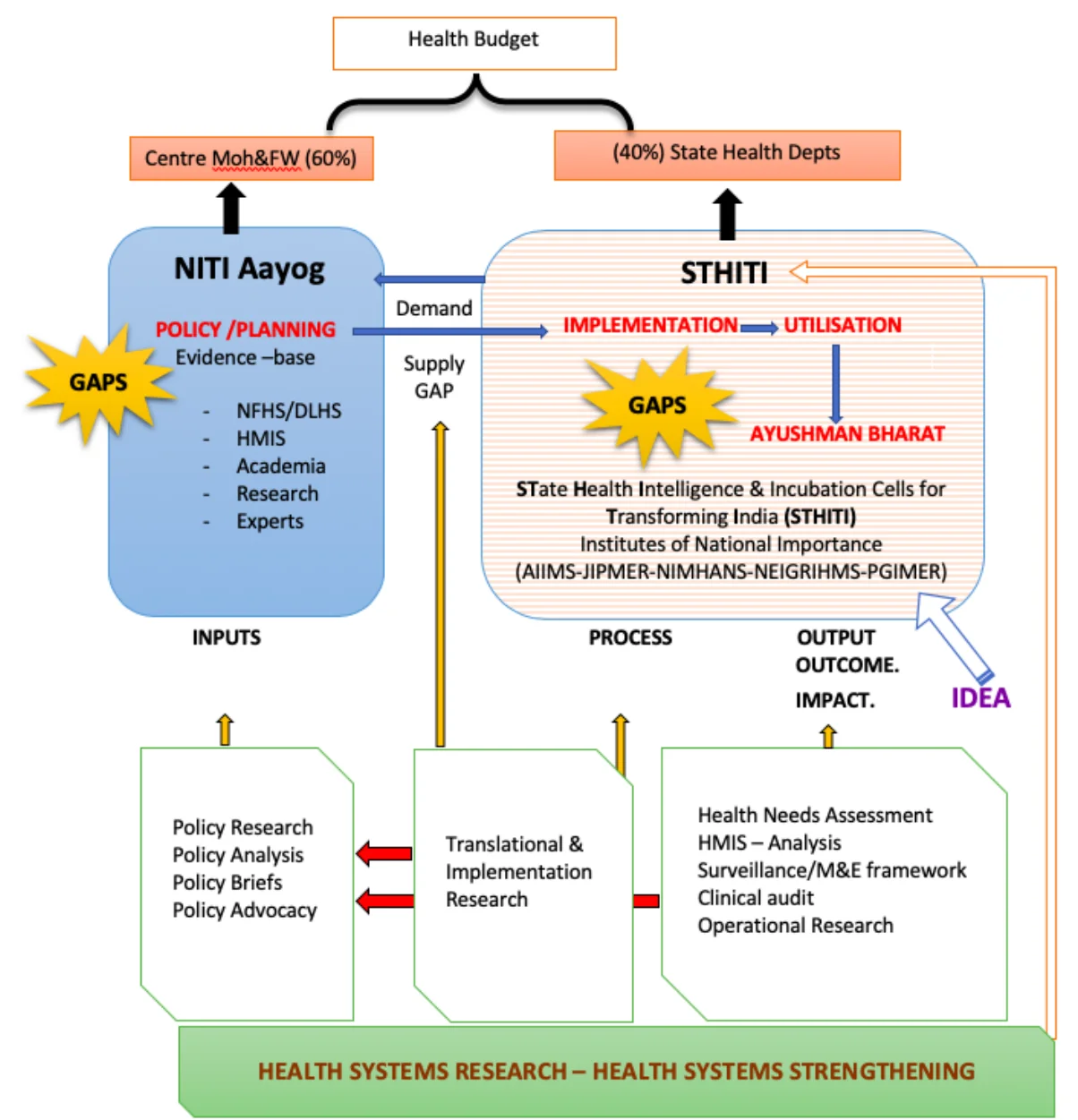
Therefore, we propose creation of STHITI (Figure 1), in every state to create this link, wherein policy makers, researchers, service providers and clients could share one umbrella and work collaboratively for larger gains. [15] STHITI will have two arms- 1) Health intelligence unit, and 2) Incubation cell, which will primarily champion in context-specific and evidence-based public health practice guidance, policy advocacy, and implementation research.
Health intelligence arm would have expertise in reviewing evidence and have access to literature through its state of art library and National Knowledge Networks. It would actively engage with state health officials to identify the research priorities within the health systems for various target health conditions, surf available evidence and propose interventions (if available); or along with incubation cell help design one and test whether it gives desired benefits. It would also engage with state health departments and help them use their Health Management Information Systems in a more timely and efficient manner. It would sequentially help them build capacity to improve the way data is collected, interpreted and used for public health action (back bone of any health system).
Incubation cell would form the most vital component of STHITI. They will have expertise in designing epidemiological studies (like Mixed Methods, Complex intervention trials, Cost-effectiveness studies) surveys, performing advance level statistics, health economics, mathematical modelling, big data analysis, etc. Two major barriers among researchers are inadequate research capabilities/infrastructure and lack of timely funding. There are certain models that have been found to be useful in fostering research skills with some impact on policy implementation. [16,17]
Incubation cell will eliminate all the barriers right from the time an action-oriented idea is generated, until it becomes a reality and starts translating into health gains in most cost-effective way. The primary purpose will be to bring together researchers from different specialities within the health system and also technical partners from other health related fields like environmental sciences, management sciences, bio technology, engineering etc.; and form teams, offer them space, resources, networks to incubate their ideas and transform these ideas into reality i.e. fostering collaboration, innovation, and demonstrating outcomes. STHITI should be accessible to researchers from both public and private sector to work in teams in non-competitive and productive environment with access to knowledge hubs and central research laboratories for solving health system problems in respective states.
Operationally, STHITI should be a centrally sponsored unit, housed in Institutes of National importance like the All India Institute of Medical Sciences, JIPMER, NIMHANS, NEIGHRIMS, PGIMER, etc. with an MOU with state health ministry for collaborative action. AIIMS is gradually making its presence felt throughout the country and nothing can be timelier. Additionally, STHITI could have representatives from regional IITS, IIMs, NISER, CSIRs, NHSRC, ICMR/RMRC [institutes for technology, management and research], developmental partners, international funding agencies, Civil Society, NGOs, corporates/industries etc. to design technology driven, cost-effective public health solutions ranging from diagnostics to holistic care across the age spectrum in our communities and also reduce the time taken to fund these ideas. Further, this would provide an appropriate mix of academia, policy makers/implementers, and funders to drive evidence-based policy formulation and implementation in the timeliest manner one could imagine.
We have reasons to believe [15] that this could have a major impact on solving health problems using innovative and cost-effective technology, and creating context-specific models of optimum health care delivery for those most in need; and could further the vision of universal health coverage and NEW INDIA 2022.
References
- Home | (National Institution for Transforming India), Government of India | NITI AAYOG [Internet]. [cited 2019 May 31]. Available from: https://niti.gov.in/
- Dandona L, Dandona R, Kumar GA, Shukla DK, Paul VK, Balakrishnan K, et al. Nations within a nation: variations in epidemiological transition across the states of India, 1990–2016 in the Global Burden of Disease Study. Lancet [Internet]. 2017 Dec 2 [cited 2019 May 27];390(10111):2437–60. Available from: http://www.ncbi.nlm.nih.gov/pubmed/29150201
- Gupta RP. Health care reforms in India : making up for the lost decades. 455 p. [doi:10.1093/oso/9780199482160.003.0003]
- Strategy for New India @ 75 [Internet]. 2018 [cited 2019 May 29]. Available from: https://niti.gov.in/writereaddata/files/Strategy_for_New_India.pdf
- Healthcare (Digital India Corporation) [Internet]. [cited 2019 May 31]. Available from: https://www.medialabasia.in/index.php/research/projects/healthcare
- Dandona L, Raban MZ, Guggilla RK, Bhatnagar A, Dandona R. Trends of public health research output from India during 2001-2008. BMC Med [Internet]. 2009 Dec 14 [cited 2019 May 30];7(1):59. Available from: http://www.ncbi.nlm.nih.gov/pubmed/19828017
- Dandona L, Sivan YS, Jyothi MN, Bhaskar VSU, Dandona R. The lack of public health research output from India. BMC Public Health [Internet]. 2004 Nov 25 [cited 2019 May 30];4:55. Available from: http://www.ncbi.nlm.nih.gov/pubmed/15563377
- Sadana R, D’Souza C, Hyder AA, Chowdhury AMR. Importance of health research in South Asia. BMJ [Internet]. 2004 Apr 3 [cited 2019 May 30];328(7443):826–30. Available from: http://www.ncbi.nlm.nih.gov/pubmed/15070643
- Alamdari A, Venkatesh S, Roozbehi A, Kannan A. Health research barriers in the faculties of two medical institutions in India. J Multidiscip Healthc [Internet]. 2012 [cited 2019 May 30];5:187–94. Available from: http://www.ncbi.nlm.nih.gov/pubmed/22973109
- Bagcchi S. Nearly six in 10 medical colleges in India did not publish any research in past 10 years. BMJ [Internet]. 2016 Apr 25 [cited 2019 May 30];353:i2352. Available from: http://www.ncbi.nlm.nih.gov/pubmed/27112643
- Kalita A, Shinde S, Patel V. Public health research in India in the new millennium: a bibliometric analysis. Glob Health Action [Internet]. 2015 [cited 2019 May 30];8:27576. Available from: http://www.ncbi.nlm.nih.gov/pubmed/26282573
- Rao KD, Arora R, Ghaffar A. Health systems research in the time of health system reform in India: a review. Heal Res policy Syst [Internet]. 2014 Aug 9 [cited 2019 May 30];12:37. Available from: http://www.ncbi.nlm.nih.gov/pubmed/25106759
- Sitthi-Amorn C, Somrongthong R. Strengthening health research capacity in developing countries: a critical element for achieving health equity. BMJ [Internet]. 2000 Sep 30 [cited 2019 May 30];321(7264):813–7. Available from: http://www.ncbi.nlm.nih.gov/pubmed/11009525
- J S. Commentary: Does strengthening research capacity improve health equity? BMJ Br Med J [Internet]. 2000 [cited 2019 May 30];321(7264):816–7. Available from: https://www.popline.org/node/171404
- Davis P, Howden-Chapman P. Translating research findings into health policy. Soc Sci Med [Internet]. 1996 Sep [cited 2019 May 30];43(5):865–72. Available from: http://www.ncbi.nlm.nih.gov/pubmed/8870150
- Zachariah R, Guillerm N, Berger S, Kumar AM V., Satyanarayana S, Bissell K, et al. Research to policy and practice change: is capacity building in operational research delivering the goods? Trop Med Int Heal [Internet]. 2014 Sep [cited 2019 May 30];19(9):1068–75. Available from: http://www.ncbi.nlm.nih.gov/pubmed/24909292
- Decroo T, Van den Bergh R, Kumar AM V., Zachariah R, Schillberg E, Owiti P, et al. Blended SORT-IT for operational research capacity building: the model, its successes and challenges. Glob Health Action [Internet]. 2018 Jan 10 [cited 2019 May 30];11(1):1469215. Available from: http://www.ncbi.nlm.nih.gov/pubmed/29745782
Published
Article metrics
- Views
- 1,958
- Downloads
- 1,145
Based on this site's usage statistics.