Original Article Vol. 3 No. 2 (2019): Int J Health Systems & Implementation Research
Active Case Finding for Pulmonary Tuberculosis in High Risk Situation May not Yield Positive Case but Reassures: Experience from a Tsunami Quarters in Puducherry, India
Active Case Finding of TB in Puducherry
Downloads
Topics
Keywords:
- Active case finding
- tuberculosis
- RNTCP
- india
Abstract
Introduction: India reports the highest incidence of Tuberculosis(TB) cases in the world. Apart from other countries, India has the highest responsibility to the international set goals in Sustainable Developmental Goals(SDG) and END TB strategies, towards elimination of TB. Active case finding (ACF) is one of the key strategies to achieve these goals. We planned an ACF activity in one of the largest Tsunami Quarters.
Methods: Following mapping of the village, a house to house active case ACF of tuberculosis has been carried out in one of the Tsunami quarters in Puducherry, based on the WHO and RNTCP guideline, with the support of Revised National Tuberculosis Control Programme, Puducherry. ACF was carried out in January 2018. Forty three students, two PGs and two faculties were involved in this activity, which was done as a part of teaching training programme for third year MBBS students under the programme named ROME (Reorientation of Medical Education).
Results: 2766 individuals were screened, in 791 families. There were about 31 presumptive cases were line listed. Among 31, sputum tested for 23 and among the 23 Xray was done among 18. No cases were identified with tuberculosis.
Conclusion: After spending huge manpower for about a month and screening the vulnerable population, the yield was not encouraging. More researches needed in this field to carryout ACF in resource poor setting like India, without which attaining SDG and END TB goals would be very difficult.
Full text
This web version was prepared from the published PDF, which is the version of record. Please cite and quote from the PDF.
Introduction
Tuberculosis (TB) is one of the top 10 causes of morbidity and mortality worldwide. It is estimated that 10.4 million new TB cases occur every year. In 2016 itself, 6.1 million cases were notified, while 4.3 million cases were missed (including 600,000 children). In 2017, another 10 million cases were notified, and 1.7 million deaths occurred [1–3]. Over 95% of TB deaths occur in low and middle income countries. Seven countries account for 65% of the total TB cases over the world; India leads the count followed by Indonesia, China, Philippines, Pakistan, Nigeria and South Africa [1, 4]. In general, it has been estimated that each year 27% cases are missed in India, 9-10% each in China and Indonesia, 5% each in Nigeria, Pakistan and South Africa [1, 5].
Important reasons for missing TB cases are under-diagnosis, especially in countries with major geographic or financial barrier; under-reporting of detected cases especially in countries with large private sector, inadequate access to health services especially among vulnerable populations, health systems and surveillance gaps and weaknesses, inadequate linkage with private practitioners, hospitals, laboratories, or Non-Government Organization (NGO) services; absence of mandatory case notification, or lack of its enforcement, contact tracing not being routinely implemented; inadequate integration or linkage with other programmes (Maternal and Child Health, HIV, nutrition, etc).[6] Additionally, many individuals delay in seeking health care for their illnesses, this leads to worse health outcomes, increase in financial burden on these patients and their families, and higher transmission of the disease (TB) in the community [6]. Therefore, intensifying efforts to increase early case detection is a key component of improving TB care and preventing the disease [7].
In 2013, the World Health Organization (WHO) rolled out an ‘ACF guideline’ to involve its member states to adopt a better strategy to find out new cases at an early stage in high-risk areas. In response to this guideline, India also started implementing ACF in all its districts in a phased manner. In December 2016, India published its guideline on ACF in line with the WHO guideline. By the end of 2017, India declared that it had covered around 55 million population through ACF and diagnosed an additional 26,781 cases.[3] Being a medical college working towards elimination of TB, in response to the ACF guidelines we planned ACF in our service area among vulnerable population (Tsunami affected and relocated population) through pre-final year MBBS (Bachelor of Medicine and Bachelor of Surgery) students. This exercise was also used to impart them training, and improve their epidemiological knowledge and skill.
Methodology
ACF was carried out with the help of forty-three third year MBBS students, two Community Medicine post-graduates, two faculty members and a Medical Social Worker (MSW), as a part of ROME (Reorientation of Medical Education Programme) by Pondicherry Institute of Medical Sciences between 2nd January to 31st January 2018. The programme was carried out in one of the biggest Tsunami Quarters in Puducherry. This was built after the Tsunami in 2004 and consists of families of fishermen from four Tsunami affected coastal villages.
This is a community based cross-sectional study. All the available and willing participants were included in this screening. A two day training was imparted to the students based on WHO-ACF guideline and CTD (Central TB Division - India) guideline on ACF [6, 8]. Epi-collect app Version 1.1.3 was used to collect the data using smart phone; which is a paperless, less time consuming and an efficient method of data collection. Students were familiar with smart phone usage. Permission and support from State Tuberculosis Officer-RNTCP, local authorities, village leaders and Medical Officer at local PHC were obtained before carrying out the programme. In the first two days, mapping of the area was done, this was followed by house to house screening of the participants. All the households willing to participate were included in the survey. If a household was missed during the first visit, a minimum of three visits were ensured to enrol members from such household.
Presumptive TB cases were line listed based on the history of symptoms (Table 1). Presumptive TB cases were operationally defined as, “the presence of one or more of the following symptoms: cough for more than 2 weeks, fever, recent weight loss, hemoptysis, chest pain, and loss of appetite”, as per the WHO criteria [6]. Two samples of sputum (spot sample and early morning sample) were collected from persons willing for further testing. Samples were collected by the trained students. Clear instructions were given to patients on the previous day while providing sputum cups. The sputum samples were collected on the next day by visiting participants’ houses. Chest X-rays were taken to the presumptive patients after shifting them to the hospital in a separate vehicle, which is three kilometres away from the study area.
| Variables | N | (%) |
|---|---|---|
| Age | ||
| 0-40 | 2150 | (78) |
| 41 and above | 616 | (22) |
| Sex | ||
| Male | 1426 | (52) |
| Female | 1340 | (48) |
| Education | ||
| Graduate | 357 | (13) |
| High School | 603 | (22) |
| Illiterate | 540 | (20) |
| Middle School | 725 | (25) |
| Primary School | 541 | (20) |
| Occupation | ||
| Employed | 1037 | (38) |
| Housewives | 671 | (24) |
| Retired | 19 | (01) |
| Student | 753 | (27) |
| Un-employed | 286 | (10) |
| Morbidities | ||
| No illness | 2549 | (92) |
| Hypertension | 113 | (04) |
| Diabetes mellitus | 106 | (04) |
| Asthma | 40 | (01) |
| Coronary artery disease | 6 | (01) |
| Cardio vascular disease | 3 | (0.1) |
| Chronic obstructive pulmonary disease | 2 | (0.1) |
Results
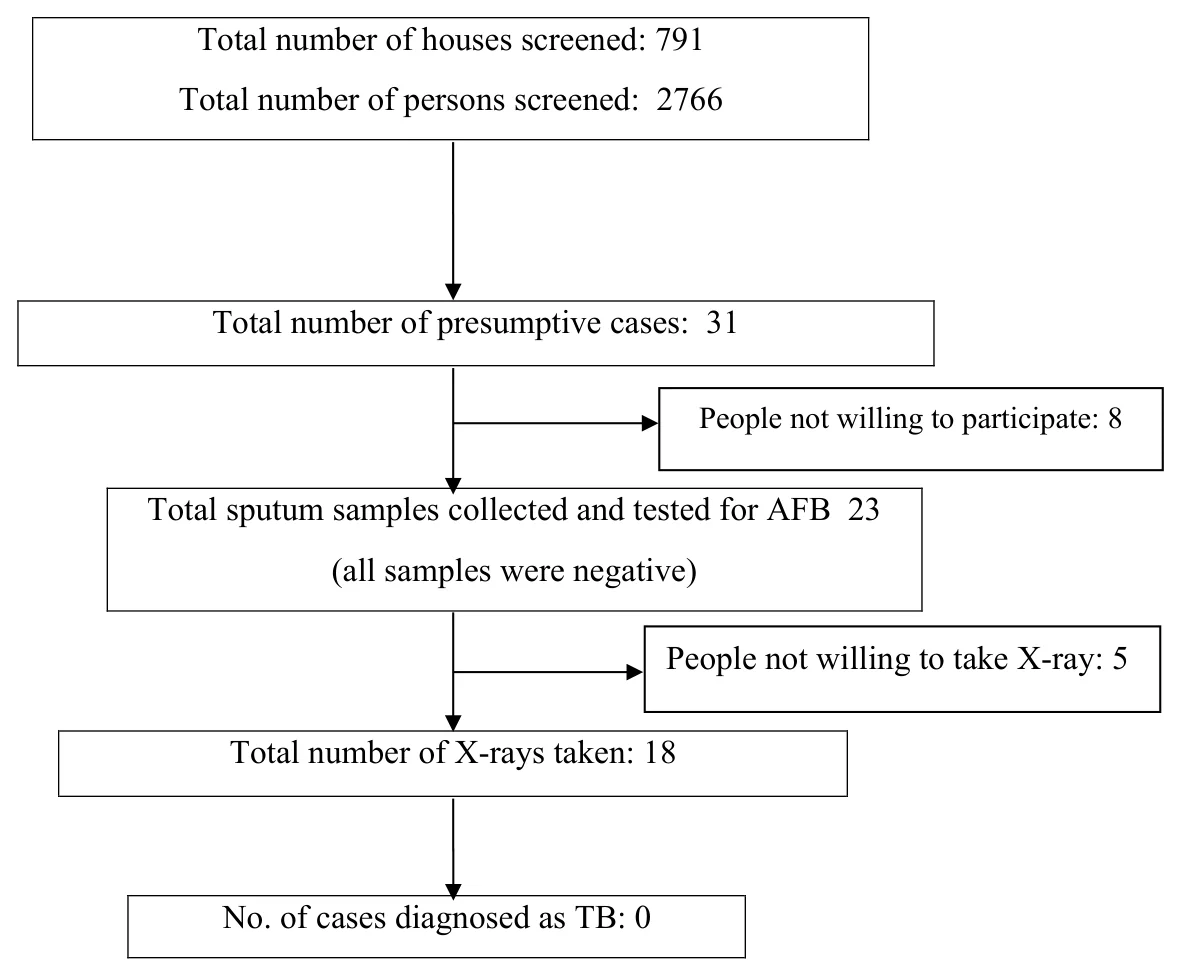
Among 791 houses, with a population of around 3100, we were able to contact 2766 (89%) of individuals. Rest of the participants could not be contacted even after three visits, either they were out of station or having had relocated to another area. As these people were relocated from sea shore, some of them still hold a house near shore for fishing purpose. Most of the people were in the age group of less than 40 years (78%), gender distribution was equal among the screened individuals. Socio-demographic details are shown in Table 1. Among the screened, 31 were found to be presumptive cases. Among these 31, 23 (74%) agreed to give two sputum samples and were tested further; while 8 were not willing to participate and were not be tested further. Among the tested (23), no new microbiologically confirmed cases/ clinically confirmed cases were found during the survey. The cascade of evaluation and outcome of screening programme presented in Figure 1 & Table 2.
| Variables (N=2766) | N | (%) |
|---|---|---|
| Total number of presumptive | 31 | (01.1) |
| Symptoms n=31 | ||
| Cough for more than 2 weeks | 31 | (100) |
| Fever for more than 2 weeks | 3 | (09.6) |
| Significant weight loss | 11 | (35.0) |
| Presence of blood in sputum | 3 | (09.6) |
| Chest pain | 4 | (13.0) |
| History of anti-TB treatment | 0 | (0) |
| Diabetes mellitus with current cough | 0 | (0) |
| Contact with known case of TB | 0 | (0) |
| Known case of TB | 0 | (0) |
| Diagnostic methods | ||
| Number of sputum samples tested | ||
| Two | 22 | (71.0) |
| Single | 1 | (03.2) |
| Not taken | 8 | (25.8) |
| X-ray | ||
| Taken | 18 | (58.0) |
| Not taken | 13 | (42.0) |
| CBNAAT | 0 | (0) |
| Age distribution among PC | ||
| 0-30 | 6 | (19.3) |
| 31-60 | 17 | (54.9) |
| >60 | 8 | (25.8) |
| Sex distribution among PC | ||
| Male | 14 | (45.0) |
| Female | 17 | (55.0) |
Resources spent on ACF: To carry out this programme two faculty members from Community Medicine, one Medical Social Worker, 43 undergraduate students and two postgraduates were involved. Approximately 2700 man-hours were spent on this programme. For a period of 10 days, a bus and a six-seater van were used for conveyance, quality check and shifting the patients to the hospital for x-ray.
Discussion
As per National TB report 2018, incidence of TB per lakh population in Puducherry was 114. As per WHO, the estimation of ‘number needed to screen’ (NNS) to find one TB case in a general population with ‘medium incidence’ of TB (an incidence rate of 100-300 per lakh population) is 603 [3, 6]. We thus expected to identify a minimum of 4-5 new smear positive TB cases in our study based on the population we screened [6]. However, we couldn’t find a single case. We were thus unable to calculate number needed to screen based on our experience. This raises a question of implementing ACF as a mass campaign with huge resource.
It has been mentioned in TB India 2018 report that India has screened 55 million people through RNTCP – ACF programme and diagnosed 26781 cases; however the evidence is low, there is no separate detailed report available on this activity to arrive at a conclusion, moreover this hasn’t been published as evidence in any journal.[3] Through project ‘Axshya’ about 20 million people were screened and 14,447 new cases were reported; again this is a field report [9]. A well planned intervention study by Government of Odisha in 8 districts covering around 6 million population, showed that the case notification was nearly doubled in the intervention arm [10]. In this study ASHAs (Accredited Social Health Activist) were imparted training and then utilised for screening, as well as mass campaign and medical camp approach. This study demonstrated ACF using a different strategy with an existing manpower within the health system. Studies done at national and international level show varying evidence regarding effectiveness of screening programme [6]. It is however evident that a screening programme should target the right persons, through the right strategy. Being a medium prevalence country, with highest burden of TB in world, a population based active screening is justifiable in India, however ‘which’ strategy to adopt is an interesting research area to explore and answer [6]. Available evidence also shows that even in case ACF does not influence total notification, it may still help in early notification of disease, at a less severe stage, thus preventing transmission of disease [6]. A study by Prasad BM et al has shown 0.29% of sputum positives among a total population of 5 million [9]. Another study done in South India showed 0.115% of sputum positives among a total population of 71,874 [11]. Another study conducted in Mumbai found 0.005% sputum positives among a total population of 5,29,452 [12]. Another study conducted in Agra found 0.032% of sputum positives among a total population of 21,870 [13]. Accordingly, number needed to screen varies among each study.
Another issue is the willingness to getting screened. In our study among the 31 presumptive cases identified, only 23 (74%) were willing to participate in giving their sputum for examination and 8 were not (26%). Among the 23 who gave sputum for examination only 18 (58%) were willing to undergo X-ray examination despite provision of free pickup and drop facility to the hospital. Reasons for non-participation were lack of awareness about the importance of testing or going out for job. Prasad BM et al in a large sample reported that in India, presumptive cases show poor response towards getting tested after referral. Therefore, there is a need for an assisted testing system [9].
In this study, a total of 18 (58%) X-rays were taken, while 5 people were not willing to undergo X-ray due to various reasons. X-rays were read by qualified radiologists. As per X-ray findings, no case was suspected of having TB. One of the studies done in Mumbai observed that 0.001% of chest X rays were positive for tuberculosis among a total population of 5,29,452 [12]. Another study done in West China reported 0.186% chest X rays suggestive of TB, among a total population of 19,334 [14].
In our study, a total of 2766 persons were screened, of which the total number of presumptive cases were 31 (1.12%). Number of presumptive cases reported from India has shown variability. Percentage of presumptive cases close to the current study was identified in similar studies done in Mumbai and Agra [12, 13]. Whereas other studies reported higher (Prasad BM et al, 7.05%) [9, 12, 13].
One of the limitations of our study was low sample size. Without an external support, we could only screen 2766 persons (791 households). Few strengths of this study were that, this was a house to house active survey, willing presumptive TB patients underwent complete screening at community level and further investigations were done to rule out tuberculosis. Also, this created awareness about government schemes on tuberculosis amongst the community. As the data were collected and updated using epi-collect app., it was a learning experience for students. Students also got familiarised to community related activities and Government programmes. This learning would further enhance the students’ interest towards public health practice. As the second most populous country and the first in absolute number of tuberculosis incidence, India needs to work on the best possible and feasible method for ACF screening in near future since ACF is one of the key components for achieving Sustainable Development Goals and END TB goals [1].
Conclusion
After spending huge resources in terms of manpower and time, and screening the vulnerable population, the yield was not encouraging. At the same time ACF is considered as one of the key components to identify missing cases and eliminate TB from India. Further research is needed to find out the best possible, effective way in carrying out ACF in a resource poor setting like India.
Funding
This work was supported by Pondicherry Institute of Medical Sciences & RNTCP – Puducherry.
Conflict of Interest
The authors have none to declare.
References
- World Health Organization. Global Tuberculosis Report 2018. 2018. [Google Scholar]
- Revised national tuberculosis control programme (RNTCP); Central TB division; Ministry of Health and Family Welfare; Government of India. Technical and operational guidlines for tuberculosis control in India. New Delhi; 2016. [Google Scholar]
- Revised national tuberculosis control programme (RNTCP); Central TB division; Ministry of Health and Family Welfare; Government of India. India TB Report 2018. New Delhi; 2018. https://tbcindia.gov.in/showfile.php?lid=3314.
- WHO. Tuberculosis. http://www.who.int/mediacentre/factsheets/fs104/en/. Accessed 24 Jan 2018.
- WHO; Geneva. finding the missing TB cases. http://www.who.int/tb/areas-of-work/children/missing_childhoodtb_cases.pdf. Accessed 24 Jan 2018.
- WHO; Geneva. Systematic Screening for Active Tuberculosis. http://www.who.int/tb/publications/Final_TB_Screening_guidelines.pdf. Accessed 24 Jan 2018.
- World Health Organization (WHO). Global Tuberculosis Report 2016. Geneva, Switzerland; 2016. doi:ISBN 978 92 4 156539 4. [Google Scholar]
- Revised national tuberculosis control programme (RNTCP); Central TB division; Ministry of Health and Family Welfare; Government of India. Active TB Case Finding, Guidance Document. 2016. [Google Scholar]
- Prasad BM, Satyanarayana S, Chadha SS, Das A, Thapa B, Mohanty S, et al. Experience of active tuberculosis case finding in nearly 5 million households in India. Public Heal action. 2016;6:15–8. doi:10.5588/pha.15.0035.
- Parija D, Patra TK, Kumar AM V, Swain BK, Satyanarayana S, Sreenivas A, et al. Impact of awareness drives and community-based active tuberculosis case finding in Odisha, India. Int J Tuberc Lung Dis. 2014;18:1105–7. doi:10.5588/ijtld.13.0918.
- Chadha VK, Kumar P, Anjinappa SM, Singh S, Narasimhaiah S, Joshi M V, et al. Prevalence of pulmonary tuberculosis among adults in a rural sub-district of South India. PLoS One. 2012;7:e42625. doi:10.1371/journal.pone.0042625.
- Shrivastava SR, Shrivastava PS. Tuberculosis: active case finding survey in an urban area of India, in 2012. J Res Health Sci. 2013;13:19–23. http://www.ncbi.nlm.nih.gov/pubmed/23772012. Accessed 24 Jan 2018.
- Prasad BM, Satyanarayana S, Chadha SS. Lessons learnt from active tuberculosis case finding in an urban slum setting of Agra city, India. Indian J Tuberc. 2016;63:199–202. doi:10.1016/j.ijtb.2016.08.006.
- Chen C, Yang C-G, Gao X, Lu Z-Z, Tang F-X, Cheng J, et al. Community-based active case finding for tuberculosis in rural western China: a cross-sectional study. Int J Tuberc Lung Dis. 2017;21:1134–9. doi:10.5588/ijtld.17.0123.

Published
Article metrics
- Views
- 1,300
- Downloads
- 973
Based on this site's usage statistics.