View Point Vol. 5 No. 1 (2021): International J Health Systems and Implementation Research
Ten years Trend in Adult Tuberculosis Diagnosis in a Southern Union Territory of India. A Public Health view.
Downloads
Topics
Keywords:
- TB
- Tuberculosis
- NTEP
- RNTCP
- TB Trend
- india
Abstract
India is striving hard to eliminate Tuberculosis by 2025. One of the steps is the introduction of modern diagnostic tools in public health to improve the total tuberculosis notification. In our observation of 10 years in the National Tuberculosis Elimination Programme in a union territory of south India, after the introduction of modern diagnostic techniques, total adult TB notification remained same, but the clinically diagnosed TB decreased a lot. This means, modern techniques have significantly contributed in increasing microbiologically confirmed TB and decreased the clinically diagnosed TB, whereas the total adult TB notification remained the same.
Full text
This web version was prepared from the published PDF, which is the version of record. Please cite and quote from the PDF.
India has the highest number of Tuberculosis patients, globally [1–3]. The nation is committed to eliminate Tuberculosis (TB) by 2025 [4]. An important strategy to eliminate TB involves improving the notification rate of TB in India. In 2018, India notified 21.5 lakh cases, while the World Health Organization (WHO) estimates were at 27 lakhs [4]. Few strategies were adopted recently to improve the notification – public private partnership where private medical practitioners and private diagnostic labs were sensitized to notify Tuberculosis to the public health system; introduction of modern diagnostic tools, the latest being the Cartridge Based Nucleic Acid Amplification Test (CbNAAT) and True-NAT; and the active case finding of Tuberculosis in the community [3,5,6]. As a part of studying the impact of CbNAAT on the national health programme, the principal investigator (PI) analysed ten years of Tuberculosis notification data (2010 to 2019) of a Union Territory (UT) in southern India having a population of nearly 14 lakhs. After ethics clearance (Ref No – RC 17/98), Ethics Advisory Group of The Union, Paris, France (No 94/17), and the National Tuberculosis Elimination Programme (NTEP) office of State Government (PSHM/RNTCP/acc/S2/2017-18/239) data were retrieved from the programme office. An important finding was a drastic decrease in trend of clinically diagnosed Tuberculosis among adults. The trend of total TB notification remained same for ten years even after the introduction of newer tools, however, the clinically diagnosed TB notification among adults reduced from 21% (CI 19%-23%) to 3% (CI 2%-4%) (Figure 1: Adapted and modified from the original source by the PI) [8].
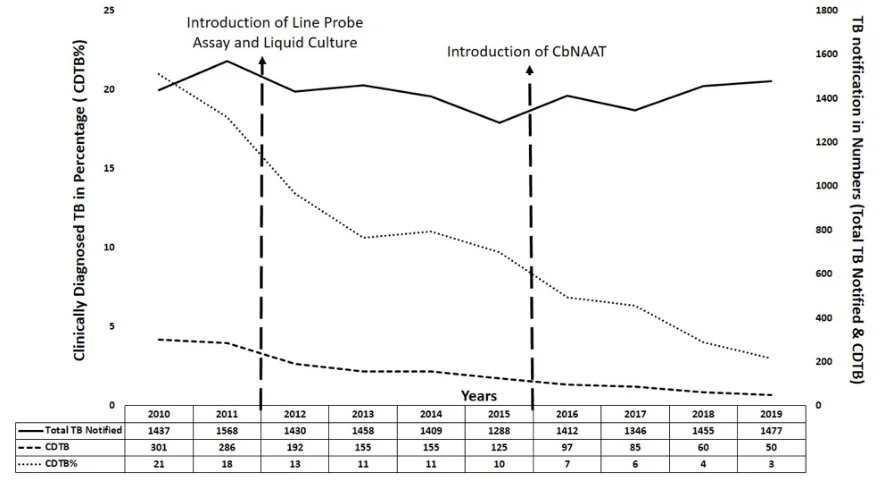
The reasons for this drastic decline in clinically diagnosed TB could be – in the recent years there has been a stress on microbiologically confirmation of Tuberculosis. On these lines, initially, a liquid culture followed by Line Probe Assay (LPA) was introduced in 2012. Later, the CbNAAT was introduced in 2016 in the UT under study, this may have increased the microbiologically confirmed cases and helped reducing the clinically confirmed cases [2,3,7,8]. Even though newer techniques have lot of advantages in diagnosing TB faster, on the other hand it also has few limitations. While interpreting the CbNAAT, physicians should note the following things – CbNAAT is highly sensitive for sputum positive cases but its sensitivity decreases when it comes to sputum negative but culture confirmed TB (68%) and for extrapulmonary TB (44% to 85%) [9]. Few physicians may falsely interpret 'CbNAAT negative means no TB’, this has been noticed in certain studies [8,10]. Ideally, after the introduction of modern diagnostic tools, the total TB notification should have been increased but it remained stationary [4]. This shows that modern techniques just replaced the clinical confirmation at present stage.
A lesson from this trend is that physicians should be cautious before ruling out TB among symptomatic patients. They should interpret the results in the light of sensitivity and specificity of that particular test and the site of sample collection, and at any point of time their clinical diagnosis is still valuable as per the Revised National Tuberculosis Control Programme – Technical Operational Guideline (RNTCP TOG guideline) - TB Diagnostic Algorithm [11].
References
- World Health Organization (WHO). Global Tuberculosis Report 2016 [Internet]. Cdc 2016. Geneva; 2016. Available from: http://scholar.google.com/scholar?hl=en&btnG=Search&q=intitle:No+Title#0%0Ahttp://scholar.google.com/scholar?hl=en&btnG=Search&q=intitle:No+title%230
- Revised national tuberculosis control programme (RNTCP); Central TB division; Ministry of Health and Family Welfare; Government of India. TB India 2017 [Internet]. New Delhi; 2017. Available from: http://www.tbcindia.nic.in/WriteReadData/TB India 2017.pdf
- Central TB Division of Ministry of Health and Family Welfare under Government of India, Central TB Division - New Delhi. India TB report 2019 [Internet]. 2019 [cited 2019 Jan 3]. Available from: https://tbcindia.gov.in/WriteReadData/India
- Central TB Division of Ministry of Health and Family Welfare under Government of India. National Strategic Plan for Tuberculosis: 2017-2025, Elimination by 2025 [Internet]. 2017 [cited 2020 Jan 3]. Available from: https://tbcindia.gov.in/WriteReadData/National Strategic Plan 2017-25.pdf
- Newtonraj A, Natesan M, Vasudevan J, Sundar B. Active Case Finding for Pulmonary Tuberculosis in High Risk Situation May not Yield Positive Case but Reassures: Experience from a Tsunami Quarters in Puducherry, India. Int J Heal Syst Implement Res. 2019;3:16–24. [Google Scholar]
- Chatla C, Jaju J, Achanta S, Samyuktha R, Chakramahanti S, Purad C, et al. Active case finding of rifampicin sensitive and resistant TB among household contacts of drug resistant TB patients in Andhra Pradesh and Telangana states of India - A systematic screening intervention. Indian J Tuberc [Internet]. 2018 [cited 2018 Dec 29];65:218–24. Available from: https://linkinghub.elsevier.com/retrieve/pii/S0019570717301580
- Revised national tuberculosis control programme (RNTCP); Central TB division; Ministry of Health and Family Welfare; Government of India. India TB Report 2018 [Internet]. New Delhi; 2018. Available from: https://tbcindia.gov.in/showfile.php?lid=3314
- Newtonraj A, Venables E, Selvaraj K, Kundu D, Purty A, Manikandan M, et al. Xpert negative means no TB: A mixed-methods study into early implementation of Xpert in Puducherry, India. J Fam Med Prim Care. Medknow; 2019;8:1379. [doi:10.4103/jfmpc.jfmpc_421_18]
- World Health Organization (WHO). Automated Real-Time Nucleic Acid Amplification Technology for Rapid and Simultaneous Detection of Tuberculosis and Rifampicin Resistance: Xpert MTB/RIF Assay for the Diagnosis of Pulmonary and Extrapulmonary TB in Adults and Children: Policy update [Internet]. World Heal. Organ. Geneva, Switzerland; 2013. Available from: http://www.ncbi.nlm.nih.gov/pubmed/25473701
- McDowell A, Raizada N, Khaparde SD, Rao R, Sarin S, Kalra A, et al. “Before Xpert I only had my expertise”: A qualitative study on the utilization and effects of Xpert technology among pediatricians in 4 Indian cities. Isaakidis P, editor. PLoS One [Internet]. 2018 [cited 2018 Jun 11];13:e0193656. Available from: http://dx.plos.org/10.1371/journal.pone.0193656
- Revised national tuberculosis control programme (RNTCP); Central TB division; Ministry of Health and Family Welfare; Government of India. Technical and operational guidlines for tuberculosis control in India. www.Tbindia.Gov.in. New Delhi; 2016. [doi:10.5005/jp/books/10992_63]

Published
Article metrics
- Views
- 987
- Downloads
- 618
Based on this site's usage statistics.