Case Studies Vol. 4 No. 3 (2020): International J Health Systems and Implementation Research
Home Quarantine Policy, Community Rejection and Application of Organizational Behaviour Principles to Manage Sanitation Worker during Covid-19: A Case study from a Tertiary Care Hospital, North India, 2020
Downloads
Topics
Keywords:
- Health care worker
- COVID-19
- Johari window
Abstract
This is one of the thousand stories which are going to eventually come up in the medical services, which will later become folklores and will motivate thousands hopefully. In a Junior Resident’s academic career, it is of immense pleasure if one of his/her classroom lecture/teaching will unfold in front of his/her eyes. This is a story of a Health care worker and the experience he gave to all of us. In the heat of a pandemic and shortage of health work force, a health care works was being stigmatized for his health status regarding COVID-19. We, the management workforce, took some unconventional decision to put him under our supervision and service. This led us to a situation where we experienced his untapped potential and learnt a very famous concept of “Johari Window”. This is a story of that health care worker and of our experience of converting an emergency into an opportunity leading to a lifelong lesson.
Full text
This web version was prepared from the published PDF, which is the version of record. Please cite and quote from the PDF.
Introduction
Corona Virus Disease 2019 (COVID-19) has led to tremendous policy changes at global, national, state and local institute levels [1]. The situation was full of uncertainties and volatility (PUCA) [2]. At the beginning of the pandemic, varying guidelines were followed in various medical institutes [3]. Largely, health care workers were provided lodging, boarding and travel facilities while doing the COVID duty. After the duty, they were kept in quarantine for varying periods, generally 2 weeks. They were tested for COVID-19 during or after the quarantine period.
As there was a situation of lockdown in the entire city of Chandigarh, it was difficult for anyone to travel outside, even to work. There were strict checkpoints and vigilance in the city due to effective lockdown. The institution understood this problem of the employees and provided a place to stay while they were on duty and later on getting them quarantined for 14 days to prevent any impending outbreak. They were staying in a facility with all basic amenities like food, water, linen, washing and entertainment facilities in the form of unlimited wifi.
This facility was a quarantine facility for the health care workers. However, as the case load increased, knowledge about epidemiology of the disease increased, and health systems learnt to meet the challenges, there was change in the policy guidelines. Quarantine post duty was dependent on the risk assessment. As there was no need of quarantine, we converted one part of our quarantine facility to guest house so as to meet the needs of our workers. As the sanitation workers who live in crowded slums, with many persons living in single room, our institute adopted a flexible approach and a policy was framed giving an option to the workers to either stay in the guest house/ quarantine facility or go back home and do home quarantine, to return 14 days after for the COVID-19 test. Two Junior Residents (GS and YKA), were posted as nodal officers under the supervision of other authors, to co-ordinate with the guest house/quarantine centre staff for the smooth functioning of the facility. Apart from the regular duties of maintaining and running a quarantine center, day to day issues of the health care workers were also taken care of.
This case study pertains to a sanitation worker who has chosen to go back home after the COVID-19 duties, but faced many problems at community level, and the management lessons learnt in such situation.
Issue
Mr. Ramesh (original name changed) was a contractual employee working as a Sanitary attendant in a reputed tertiary care medical institute of North India. He was living in a nearby colony, approximately 5 kilometers from the institute. He belonged to an upper-lower socio-economic class, and his family was solely dependent on his salary. He liked to sing and occasionally took part in the religious ceremonies in nearby areas in the city. He was first posted in the COVID-19 suspect area in Advance Pediatrics Center.
During Mr. Ramesh’s duty duration in the Advance Pediatric Center, no patient came positive for COVID-19. As per the institution policy, we asked his option and he accepted home quarantine. We allowed check-out from the guest house with proper risk assessment and gave standard instructions of COVID-19 preventive measures. When he reached his home, instead of receiving a warm welcome and praise of being a COVID WARRIOR, his neighbours started asking him all sorts of questions like, Why you came home without COVID test report, How are you sure that you are not infected and commenting on his actions and behaviour as a health care worker. They kept stigmatizing him in the area where he was living and protested every time he wanted to go inside his home. As the information about the pandemic was scarce and most of the sources were all sham, some of them even abused him verbally and asked him, “why were you not quarantined after your duties in the COVID suspect ward”. His neighbors threatened him and his family.
He escaped from his colony and came back to the guest house. When we saw him, he was terrified, tense, anxious, and was feeling demoralized. He was saying “Kindly quarantine me and keep me here even though he didn’t fully understand the meaning of the word Quarantine. He was repeatedly requesting us to do his COVID test. In his verbatim,“Sir main nahin jaunga ghar, aap mujhe yahin rakh lo. Agar aap mujhe bina test k ghar bhejoge to main bhag jaunga lekin ghar nahin jaunga.” In the times of early COVID days, where people were terrified to work for the health institution, this person voluntarily chose to give his service for mankind. Keeping this in mind, we thought for a while and discussed this issue with our seniors.
Solution
At our level, we tried to intervene among his peers and tried to gather the knowledge to assess the depth of the situation. As it was difficult for us to intervene at the community level to convince the crowd nearby his place, we finally discussed this case with our team superiors with a solution in mind. In our guest house cum quarantine center we were always short of staff to maintain the services. We immediately thought of putting him in-charge of few duties which were not fulfilled in proper fashion. The basic reason of this solution was that we always admired his compassion and commitment towards other health care workers in the guest house/ quarantine centre, when he was doing his COVID duties, which was a rare quality we had seen in a long while in our careers. The team superiors gave a positive response and permitted him to work in the quarantine center. His supervisor also adjusted his duties in the ward for 10-15 days. He started staying in the guest house and started providing duties.
Output
The first time we assessed his duties secretly walking into the premises, we were in awe watching him working with the staff in the best possible manner. All the health care workers were confined in small rooms for weeks which is not a normal routine in anybody’s life. They often feel bored, sad, which led them to quarrels, substance abuse (occasional that came to our notice) and sometimes even leaving the guest house willingly, knowing all the risks. They give us a hard time in managing the guest house with these types of problems arising on a daily basis. To our rescue, came our comrade, Mr. Ramesh. He was a local religious and folk singer. The first time we saw him, he was boosting up the morale of the health care workers, going on their duties. It gave us the goosebumps, and we just wished, we can re-live that moment again. The song from the movie KARMA, Dil Diya hai, Jaan bhi denge, felt so in position with the timeline and feelings, it gave us a moment of happiness and proud for our country. ( https://youtu.be/9U1saLiUE_8) From that day to the end of his duties, he entertained and motivated his peers with religious and motivational songs.
Outcome
Mr. Ramesh worked in the quarantine center with us for two weeks. We sent him home after 14 days. Words got spread by mouth as well as the tens of videos in the form of Whatsapp messages and Tiktok statuses. Top executives of the institute like the Director and the Dean and others also appreciated him. People in his colony saw all those videos and finally appreciated him for his commitment. He completed his quarantine period, and was tested negative. Nonetheless, we communicated with Municipal counsellor and local police body for his safety. In the end, when he reached his home, his neighbors welcomed him with garlands.
Discussion
As we look back and revise these events in our minds, we can think of a very well-known phenomenon, Johari window [4] (figure 1), that can be applied in this scenario. His talent and his ability, to engage people while he was singing a phrase or a part of a song in a religious gathering, was known to him. Still, it was hidden from the intellectual community and his employer. Finally, when it came into the light, we recommended him further in the other departments for his talent. Later, he showed his interest in working as an attendant, which was considered and he was one of our valuable employee which we will cherish in the years to come.
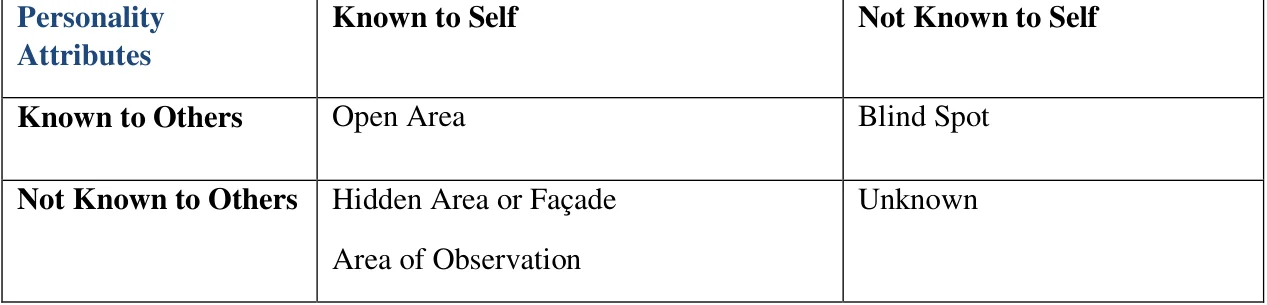
In simpler terms we can explain this phenomenon in two examples. First, in reality shows we see people coming from marginal society and performing outstandingly in various areas of competitions. Their hidden talent is unknown to the world until they are given enough spotlights to be seen. Second, in our Indian marriage functions, we see a lot of task happening at the same time but in perfect synchrony and harmony. Individuals never been involved in any of the tasks related to catering or hospitality will soon become expert in that. The same example can be seen in college cultural festivals in our country where a new group of individuals come together and generate something very blissful and charming event. Likewise, this COVID situation is like a group task where everybody has to come together like a family arranging a function, or a group of college students organizing an annual festival. In this Pandemic, we had and we have to work like them. From quarantine centers to the testing facilities, from regular medical services to preventive and health promotion services, everything has to be in synchronize in order to make an orchestra playing the tone and making the music of perfect health and keep us away from the maladies of life. This case study also demonstrates many other management concepts and organizational behavior. First and foremost is human dignity and concern for the others in addition to the concern for the task (9x9 type of leadership). When Mr. Ramesh first came back to us in terrified condition, we could have ignored by saying that what can we do? It is your problem. However, demonstration of compassion and concern was in line with organization behavior principles. Team approach was well demonstrated. There was positive supportive environment where juniors can communicate freely and discuss the novel ideas with the seniors. This approach added to the community-based health care experience that our specialty aspires for.
Whereas, there are so many positives and management lessons applied; this case study also exposed the gap between the policy decisions and the community awareness. The gap between the decision of not doing a COVID test after the COVID duty, and the perceptions of the community got unfolded. Therefore, it is very important to involve all the stakeholders and look into the context as well. Sanitation workers who come from the overcrowded slums with single room accommodation and many persons living in the same building with shared common areas like toilets and roof tops; their fears are not totally unfounded when all of them have been forced to sit at home, and the income generating activities have been shut off.
References
- Aggarwal AK. From First Reported COVID-19 Case to Lockdown: Was Response of Govt. of India Evidence Based or Reactive? International J Health Systems and Implementation Research, 2020; Vol 4 (2): 1-9 Accessed from https://ijhsir.ahsas-pgichd.org/index.php/ijhsir/article/view/95/88
- Murugan S, Rajavel S, Aggarwal AK, Singh A.Volatility, Uncertainty, Complexity and Ambiguity (VUCA) in Context of the COVID-19 Pandemic: Challenges and Way Forward. International J Health Systems and Implementation Research, 2020; Vol 4 (2): 10-16. Accessed from https://ijhsir.ahsas-pgichd.org/index.php/ijhsir/article/view/93/89
- Sharma D, Sharma A, Monga D, Aggarwal AK. A Narrative Review of Testing Recommendations for COVID-19: The Changing Scenarios. International J Health Systems and Implementation Research, 2020; Vol 4 (2): 70-79. Accessed from https://ijhsir.ahsas-pgichd.org/index.php/ijhsir/article/view/100/96
- Verklan MT. Johari window: A model for communicating to each other. J Perinat Neonatal Nurs. 2007;21(2):173–4. [Google Scholar]

Published
Article metrics
- Views
- 1,104
- Downloads
- 824
Based on this site's usage statistics.