Case Studies Vol. 1 No. 1 (2017): Int J Health Systems and Implementation Research
Challenges for Community Based Management of Uncomplicated Severe Acute Malnutrition: A Case Study in a Village of District Panchkula, Haryana
Community based management of SAM
Downloads
Topics
Keywords:
- Severe Acute Malnutrition
- Under five Children
- Nutrition
- Community Based Management
- Wasting
- Underweight
- Stunting
Abstract
Severe acute malnutrition (SAM) is one of the preventable causes of mortality and morbidity in Under 5 children. As per NFHS 4 report, 7.5% of the under 5 children are severely wasted, 38.4 % are stunted and 35.7% are underweight. Despite being a focus in MDGs and now in SDGs, there is no significant decline in these indicators. We present a case study of SAM child in rural area and how the challenges were overcome. Case selection: A 4 year old male diagnosed as SAM in Anganwadi was selected. Methods: 1) Clinical assessment: As per clinical examination child had uncomplicated SAM as per WHO Criteria 2) Dietary assessment: There was deficit of 600 kcal of energy and 6 gms of protein. 3) Psychosocial Assessment: Mother thought that it is due to some “Jaadu” “Opri Hawa” and had taken some black thread from a faith healer. AWW believed that such families do not cooperate and such poor people cannot be treated. Intervention: Home based recipes from Ministry of Human Resource Development were introduced. This included milk based recipes, halwa and khichidi etc. Family was motivated and support environment was created by involving local health worker , Anganwadi worker and ASHA. Measurements: Daily food intake and weekly weight monitoring was done. Subjective impressions of the family as well as health worker/ Anganwad workers and ASHA were documented.
Results: 1) The child gained 800 gms of weight in 5 weeks and moved from severe malnutrition grade to moderate malnutrition grade. 2) The family behavior changed from resistant to co operative mode after looking at positive progress in child. 3) Anganwadi workers started giving special diet recommended for Severe Acute Malnourished children. However, still she is not able to believe that malnutrition can be treated among this poor segment Conclusion: Pathway of success in management of SAM lies in persistent practice of Public Health Approach.
Full text
This web version was prepared from the published PDF, which is the version of record. Please cite and quote from the PDF.
Introduction
Prevalence of malnutrition is very high in the country. As per NFHS4 data, 21% are moderately malnourished and 7.5% are severely malnourished. Although many states and districts have established nutritional rehabilitation centres and special provisions are there under ICDS program to manage SAM babies, but still it is common observation that SAM babies are not managed well. At national and international level several goals and targets have been framed. In millennium developmental goal 2000, Goal 1, Target 2, Indicator 4 was prevalence of underweight children3. In sustainable developmental goal 2015, goal 2, target 2.1,2.2 and indicator 2.1.1, 2.2.1,2.2.2 were focused on the nutrition status of the children4. Beside these two major global commitments by the participant countries of the world, several country level programs and policies are also initiated by the different countries. India is one such country to adopt both MDG and SDG. Other nutrition programs are also being run at anganwadi, and school level. As per the NFHS data for last 3 surveys all the three forms of malnutrition has shown slight decline. Malnutrition still remain unaddressed ( Table 1).
| s. no. | Indicators | NFHS 4( 2015-16)5 | NFHS 3 ( 2005-06)6 | NFHS 2( 1998-99)7 | ||||||
|---|---|---|---|---|---|---|---|---|---|---|
| Urban | Rural | Total | Urban | Rural | Total | Urban | Rural | Total | ||
| 1 | Children Stunted (Height for age) % | 31 | 41.2 | 38 | 37.4 | 47.2 | 44.9 | 41.1 | 54 | 51 |
| 2 | Children Wasted (Weight for height ) % | 20 | 21.5 | 21 | 19 | 24.1 | 22.9 | 16.3 | 20.7 | 19.7 |
| 3 | Children Underweight (Weight for age)% | 29.1 | 38.3 | 35.7 | 30.1 | 43.7 | 40.4 | 34.1 | 45.3 | 42.7 |
| 4 | Children severely wasted (weight for height )% | 7.5 | 7.4 | 7.5 | ||||||
As a part of psychosocial case presentation, it was decided to select a SAM baby and understand the psycho-socio-demographic factors contributing to SAM and do intervention to restore the nutritional health of the baby.
Identification of SAM baby
Anganwari worker of the village was approached to know if there is any SAM baby in her record. She reported that there was a case sometimes back, but now child has stopped coming to the centre. She was not aware about the current status of the baby. A team of first author and local health worker visited the family. Family was also not very co-operative. Child was examined. Height, weight, mid-upper arm circumference were taken. The child was still in Severe Acute Malnutrition Grade as per WHO criteria. He also had mild pallor.
Risk Factors for Severe Acute Malnutrition:
It is known that place of residence, household wealth, birth weight, age of child, awareness regarding diarrheal disease and acute respiratory tract infection control, maternal education, number of under 5 years children and source of drinking water are strong predictors of child nutritional status in developing countries1. Beside that other factors such as antenatal history of mother, feeding practices, hand hygiene, quantity of food intake behavior of the child as well as mother, immunization status of the child and role of community persons meant for the health of the under 5 children (ASHA , ANM, Anganwadi worker) also play an important role in the growth and development of the child.
With this conceptual framework, the selected case was worked upon those risk factors. The intention was to search the underlying cause contributing to his health and to correct it.
Detailed history and examination elicited the following:
- Place of residence: The family belongs to a rural area of Panchkula district in Haryana.
- Socioeconomic status :As per Udai Pareek Scale, the family belongs to lower middle class of socioeconomic class.
- Housing and environment: The house was a semi pucca house with uncemented walls and floor but cemented roof. The room has no natural ventilation and illumination. There was no window to the rooms. The kitchen was semi pucca kitchen similar to rooms. The food was stored in old tins - some without lids. Solid fuel was used for cooking food. The house didn’t have any latrine except for bathroom. House waste is disposed off in the form of heap near house and taken to fields every morning.
- Maternal education: the mother was illiterate.
- Number of under 5 children: There are two under-five children in the family. This child is elder.
- Source of drinking water: The family uses the water from the tubewell supply, which supplies the whole village.
- Antenatal history: During her antenatal period, the mother was registered in first trimester, and was supervised by ANM at sub center. She was followed throughout her pregnancy. Four ANC visits were done, 2 in first trimester, 1 each in second and third trimester. She had consumed 60 tablets of iron folic acid and tablet calcium during pregnancy. The mother told she had anaemia during her antenatal period and she took some injectables to increase the hemoglobin level from a private clinic in a nearby town. The mother had, normal vaginal delivery in institution with three days uncomplicated post partum stay.
- Birth weight: The birth weight of the child was around 2300 grams.
- Feeding practices: the child was started on breast feed after one hour of birth and was exclusively breast fed for 6 months. The Supplementary feeding was started at around 8th month of life and was started on the liquid diet “ daal ka paani and chawalon ka paani” (legume water and rice water) and was fed on that. Initially the child used to refuse the feeds and the family members thought it as child’s dislike for food and didn’t insisted on feeding the child more. The family members developed the habit of giving less food to the baby. He used to take home based solid food and liquid food, 4 times a day. The food was given in katoris. Half katori liquid food, two katoris solid food, 1-2 fruits a day, one serving of anganwadi food. The food was given to the child at his own and not supervised while eating. The child was short of 600 kcal and 6 gms of proteins per day.
- Hand hygiene: Mother did not use to wash hands before giving food to child and there was no habit of washing hands in child.
- Food intake behavior of the child and the mother. Both the mother and child had reluctant behavior regarding food intake. The child usually had outside food in the form of chips and other snacks. The cereal based meals were low in number and quantity. The mother didn’t make any effort to feed the child and child’s feeding was not supervised by anyone.
- Immunization status of the child: The child was fully immunized to all the vaccine preventable disease till age.
- Illnesses: the child has a history of severe acute malnutrition at 2 years of his age and was told by male health worker of our health post, about the illness. They took the child to medical officer of nearby PHC and then to CHC. The child was found to be infested with worms and deworming was done at PHC. At both the health centers, the family members were told to increase the diet of the child and were given some medicines (records not available) and were asked to purchase some medicines from market. The family members didn’t comply and took the child to a traditional healer. He gave some unknown medicine and the child gained weight within 2 weeks. After 3 weeks the child’s built started improving. They stopped the medicine and again the child was given only home based food.
- Awareness regarding control of diarreheal disease and acute respiratory illness: the mother had no knowledge about the above said diseases and their management at home level
- Other factors: in addition to above factors, other indirect factors also were responsible for the health of the child.
- Anganwadi registration: The child was registered in the anganwadi and is a non frequent visitor there. On some days he used to go there just to have the food, and other days he used to come from there without having his supplemental food.
- AWW worker’s Perception: The anganwadi worker believed that the child is uncooperative and so is his family members. The anganwadi worker working there had her own views for this child such as:
“Yeah lower caste ke loug hain, inka weight nahi badh sakta” [these are lower caste people. Their weight cannot increase]
“Doctor sahib aap jitni marzi koshish kar lo, lekin iska weight nahi badh sakta”[Doctor, you may do all your efforts, but his weight will not increase]
“Maine apne ghar se bahut kuch la k khilaya( kheera) lekin fir b iska weight nahi badha”[ I gave him lot of food from my house, but his weight did not increase]
“Yeh shuru se hi kamzor tha aur fir bimaar b raha, is wazh se iska weight nahi badh sakta”[He was weak from beginning, and then he remained ill. That is the reason his weight could not increase]
“Iska to khandaan hi aisa hai, sab kamzor he, iska dada b kamzor tha, papa b kamzorhai to yeah kahan se sahihonge yeah b kamzor hi rahenge”[ His entire family is like that. All are weak. His grandfather, and father were also weak. So, how can he be good/ He will also remain weak.]
“Hum to bahut koshsish karte hain lekin iski family bilkul b supportive nahi hai, khana lene b nai aate”[ We do lot of effort but his family is not supportive. They don’t come even to take meals.]
“Aap nein isko sir pe chadha rakha hai, bas isi bachee k peeche ghumte rehte ho aap, inhone to jeena mushkil kar diya hai hamara.”[ You have given them undue importance. You are just after them. They have made our life difficult]
“Jab yeh ghar se aata hai to iska weight bahut kam hota hai, lekin jab yeah yahan anganwadi main khana khata hai tab iska weight badh jata hai”[ When he comes from home, his weight is generally less. But when he eats in the anganwari, his weight increases]
- Attitude and behavior of child: The child loves to stay at home rather than going to anganwadi on most of the days. When asked for the reason for not going to anganwadi, the child replied “wahan pankha nahi laga hai, mujhe garmi lagti hai”. Further the child pressed upon his parents to go to a private school. The child loves to stay alone even when he goes to anganwadi.
- Knowledge of anganwadi worker regarding calorie intake in SAM child: when the AWW was asked about the recommended calorie intake and quantity of food in SAM child, she didn’t have the knowledge regarding that. They were feeding the SAM child same food as to the normal children.
Intervention:
Following interventions were given:
Diet Improvement: From the booklet by Food and Nutrition Board, Ministry of Women and Child Health, Govt of India2 some selected homemade recipes suitable to family were selected. The focus was not to put the family under economic burden. So, a detail history of the eating habits of the child was elicited from the mother. A detailed probing of food items was done, such as what the child likes to eat and what not. The quantity of food and the frequency of food intake were also asked from the mother. On the basis of these information some food recipes were selected from the above mentioned booklet and recipe number 8 and 10 were advised as snacks and recipe number 24,45,55,57,58 were advised as the main dishes, which can be prepared by the mother on different days on the basis of availability of food items at home. The mother adopted almost all the recipes as these can be made from food items available at home, and nothing has to be purchased specially, so as to pose any financial burden on the family. The mother was told to take care of the composition of the different ingredients in a particular recipe. The mother was sensitized about the quantity of food actually required by the child against his daily routine. The number of meals per day and the quantity of food in each meal was also told.
Uptake of the recipes: The mother started cooking the recipes told to her. The ‘halwa’ used to be prepared quite often as told to her along with ‘prantha’, though not a part of recipes told to her, its very common in their breakfast. The quantity was increased and also the quality (stuffed prantha ). Other recipes were also cooked with modified composition of the ingredients as told.
Threats for disease: the mother was told about the increased future threats to the health of the child as compared with the children of normal weight.
Benefits: the benefits of turning a child into a healthy child were explained to the mother.
Supplements: Supplements in the form of IFA syrup and tablet zinc and calcium, multivitamin syrup were given to the family member for the target child. They were explained about the doses and duration of the supplements.
Motivation to family members, AWW and to the child for going to anganwadi. All the associated people were sensitized and importance of anganwadi in the development of a child was told. The anganwadi worker was told about the special status of the child and calorie intake of such child.
Monitoring indicators: The monitoring was done to keep watch on the hand hygiene of the child, his attendance in anganwadi, servings of food served and his weekly weight record.
Outcomes: The child has an increasing trend in his weight gain. His appetite increased and he starting eating more food. The calorie assessment made at the start of the intervention reveled that he used to consume around 680 kcal of energy ( 24 hr recall method). After a month of start of intervention, another similar dietary assessment was done, which revealed that his calorie intake increased to around 1120 kcal.
His physical appearance started changing after one month of starting intervention. Figure 1 shows the interrupted time series analysis of weekly weight gain before and after the intervention. Child since his birth till 49 months of his age, remained in SAM zone for most of the months ( not shown in graph). The dip in 8th week post intervention, was due to fever as told by the mother, But after 3 days again the child was put on his interventional diet and again there was increasing trend. The parents of the child were happy to see their child. Their behavior has changed from un-cooperative to cooperative one. After about 2 months of intervention the AWW said “ humen to lagta tha, iska weight kabhi nahi badh sakta, lekin aapne bahut mehnat ki is bachhe pe and iska weight badha diya”.[We all were of the belief that this child cant gain weight but you did lot of effort and now his weight has increased.]
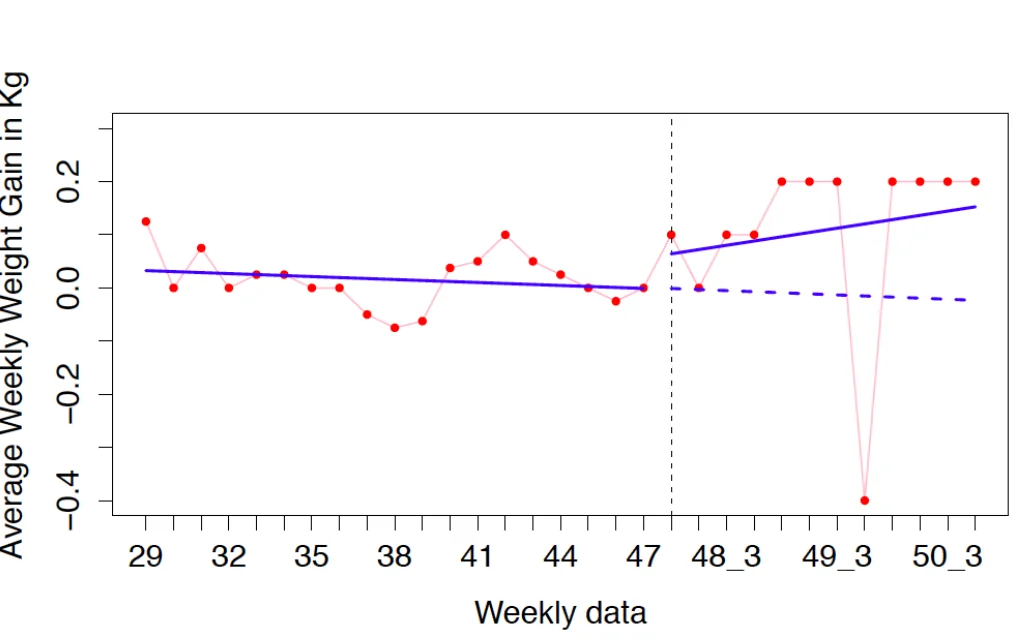
Interrupted time series analysis, as shown in Figure 1, shows that had the intervention not being there, there were chances of continued decline in weekly weight. Gain with increase in age. However, with intervention, not only there was increase in the level of weight gain, but there was increasing trend in weight gain. However, this gain in weight was not statistically significant.
Discussion
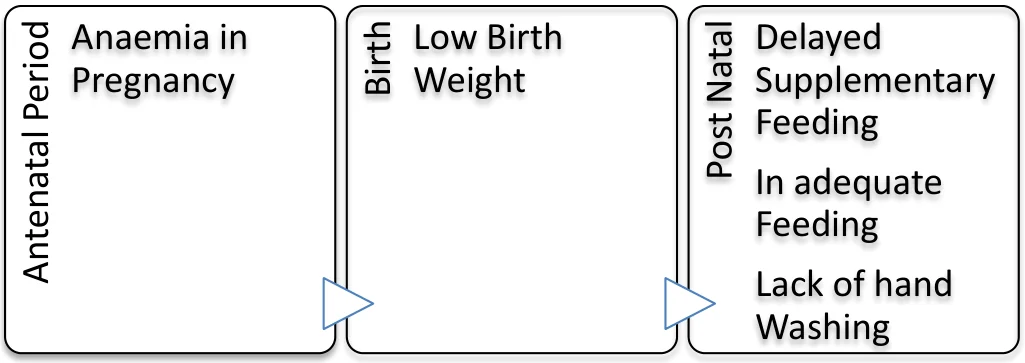
This case study of SAM baby shows that baby developed malnutrition following classical pathway that has been well documented in literature. Mother had anaemia during pregnancy, she delivered low birth weight baby and started supplementary nutrition late. The quantity and quality of supplementary nutrition was not sufficient. (Figure 2)
However, the story is unusual in terms of health seeking behavior during pregnancy and childbirth. Mother got registered early in pregnancy, got four ANC checkups done, and consumed IFA tablets. She even took injectable from private practitioner. She got delivered in institution. She initiated breast feed within one hour and also gave exclusive breast feed. Baby was also registered in aanganwari. Thus mother seemed to be fully compliant despite illiteracy and lower middle socioeconomic status.( Figure 3)
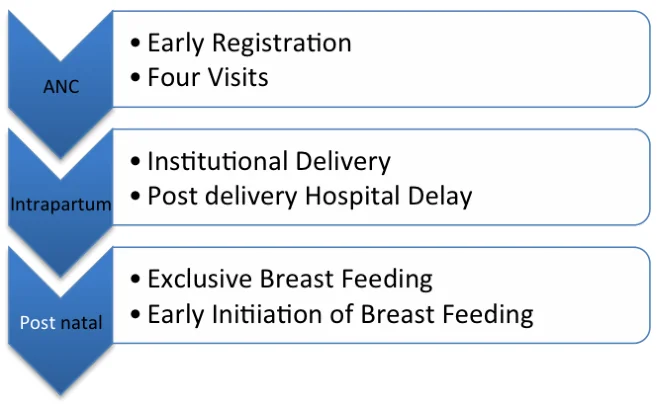
Despite high compliance, if baby could not come out of malnourished track, it may be because mother did not have enough instructions to give the type and quantity of supplementary nutrition.
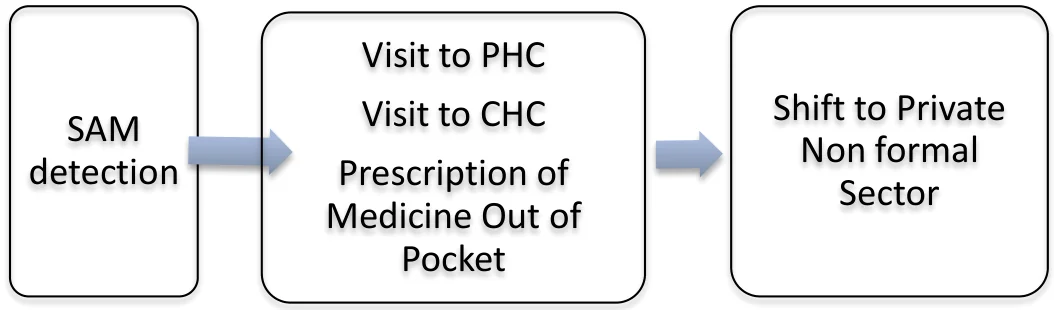
Faith in public sector continued even when baby was detected with malnutrition at the anganwari and was referred to medical officer at PHC. Mother kept her patience even when baby was referred to CHC. However, when medicines were prescribed at CHC, that had to be purchased from outside market, mother lost patience and shifted to private informal sector. With the treatment here, she got the feeling that baby has improved. ( Figure 4)
During the entire journey, family developed the feeling that nothing can be done in the health sector. Baby is weak due to some superstitial effects. At the same time, anganwari worker developed the feeling that family is non-cooperative. Attendance of the baby at anganwari was further impacted by lack of fan at the AWC, that the child pointed out.
When the intervention was initiated, mother was not convinced and did not cooperate. Lot of effort was done by the first author to convince the mother. She was helped to introduce the recipe prepared by the first author. When child showed gain in weight after one week and the baby started looking good, then the mother developed confidence and started cooperating. However, anganwari worker was still not convinced. Child showed persistent increase in weight. However, when child had gone to relatives, he developed fever and there was sharp decline in weight. But, as the child was on supplementary diet, weight recovered. (Figure 1).
This lead us to think that more needed to be done to make our policies robust so that the problem of malnutrition can be overcome more swiftly and effectively.
Acknowledgements
Mrs. Jagdeep Rana, Female Multipurpose worker, PGIMER supported by giving a school bag, school uniform, and some edible things from her home in order to develop faith and motivate the child for anganwadi.
References
- Sahu SK, Kumar SG, Bhat BV, Premarajan KC, Sarkar S, Roy G, et al. Malnutrition among under-five children in India and strategies for control. J Nat Sci Biol Med [Internet]. Medknow Publications; 2015 [cited 2016 Aug 11];6(1):18–23. Available from: http://www.ncbi.nlm.nih.gov/pubmed/25810629
- No P. Nutritious Recipes for Complementary Feeding of Infants and Young. 2008; [Google Scholar]
- Goals MD, Declaration M. Effective 8 September 2003. Ratio. 2005;(September 2003):7–8. [Google Scholar]
- Inter-Agency and Expert Group in Sustainable Development Goal Indicators. Final list of proposed Sustainable Development Goal indicators. Rep Inter-Agency Expert Gr Sustain Dev Goal Indic [Internet]. 2016;Annex IV. Available from: https://sustainabledevelopment.un.org/content/documents/11803Official-List-of-Proposed-SDG-Indicators.pdf
- Welfare) I (Health & F. National Family Health Survey - 4 - 2015-16: India Fact Sheet. 2015;8. [Google Scholar]
- International Institute for Population Sciences. National Family Health Survey 3- Key Indicators. Natl Fam Heal Surv 3. 2006;18:29–29. [Google Scholar]
- Division SS, Office CS. Achieving Millennium Development Goals Target Year Factsheet - India India at a Glance. [Google Scholar]
Published
Article metrics
- Views
- 2,953
- Downloads
- 1,147
Based on this site's usage statistics.