Original Article Vol. 2 No. 1 (2018): International J Health Systems and Implementation Research
Treatment Seeking Practices for Diarrhea and Acute Respiratory Infections in Haryana: Need to Curb High Antibiotic Use
Downloads
Topics
Keywords:
- Treatment Seeking
- Diarrhoea
- Pneumonia
- ARI
- Under-Five Children
- Antibiotic Use
Abstract
Background: Acute Respiratory Infection and Diarrheal infection are two life threatening but preventable diseases. In India, 30-35% hospital admissions are for ARI. A similar trend is seen in case of diarrheal diseases accounting to nearly one third of pediatric admissions and 17% of deaths. Objectives: To assess the treatment seeking practices, especially antibiotic and ORS use for ARI and diarrhea. Methodology: A descriptive study was conducted in various subcentres of 10 districts (Faridabad, Palwal, Mewat, Rewari, Bhiwani, Narnaul, Ambala, Fatehabad, Panipat and Kaithal) of the state of Haryana aimed at covering 25 children per sub centre randomly selected and spatially separated. A total of 2914 children were assessed during this study. Field workers interviewed caretakers of children in various villages of each sub centre to collect information from 5 children per village on an average. Results: A total of 36% children reported of an acute respiratory infection, diarrhea was observed in a total of 9% cases and both ARI as well as diarrhea were found in 2%. Out of all the ARI cases surveyed, 27.1% caretakers had resorted to home care, antibiotics were given by 41.7% caretakers & 13.3% caretakers took the children to seek medical advice. In case of diarrhea, 10.4% caretakers gave home care, 50% gave ORS, 8.8% gave antibiotics and medical advice was sought by 7.6% of the caretakers. Conclusions: There seems to be very high antibiotic use for ARI and low ORS use for diarrhea.
Full text
This web version was prepared from the published PDF, which is the version of record. Please cite and quote from the PDF.
Introduction
Under-five mortality has declined from 91 per 1000 live births in 1990 to 41 /1000 live births in 2016.[1] This still amounts to 5.6 million child deaths. At 1-59 months, the mortality rate from pneumonia declined by 63% from 11·2 ( in 2000) to 4.2 (in 2015) per 1000 live-births and the rate for diarrhoea fell by 66% from 9·4 (in 2000) to 3·2 ( in 2015) per 1000 live-births.[2] Despite this decline, mortality due to diarrhea and ARI(pneumonia) is still high.
Deaths due to Acute Diarrhoeal Disease (ADD) and Acute Respiratory Infections (ARI) are largely preventable.[3–4] 90% of deaths due to diarrhoea and pneumonia are reported from Asia and Africa, from which, India has been observed to be the home of the maximum cases ~28% in 2010.[5]
Over the past few decades several programs have been launched in India to monitor and check the childhood mortality in the country, such as, Diarrhoeal Diseases Control (DCC) Program, 1978, National Oral Rehydration Therapy Program, 1985-1986 and ARI control program, 1989-1990. These programs became a part of the Child Survival and Safe Motherhood Program in 1992 and Reproductive and Child Health (RCH) in 1997. Subsequently, an Integrated Management of Neonatal and Childhood Illnesses (IMNCI) Program was proposed by WHO in 2005 under the RCH-2. Under the aeges of all these programs, there has been significant decline in the childhood mortality rate. But morbidity remained high. It was found during the National Family Health Survey-2 (NFHS-2), that within a period of two weeks before the survey, nearly 19% children under the age of 3 years had suffered from respiratory infections and diarrhea.[6] It remained around the same during subsequent surveys.
Implementation of correct treatment practices may reduce the mortality rates of under 5 children by a great extent. In the State of Haryana, these two components of IMNCI vis Diarrhoea Management and ARI management were targeted through training programs and systems strengthening. This study was conducted, to assess the extent of diarrhoeal and respiratory infection incidents among children under the age of 5 years and to study mainly the treatment seeking practices of caretakers of children that reported of diarrhea and respiratory infections in 10 districts of the state of Haryana.
During this study, data pertaining to 2914 children from 121 subcentres of 10 Districts who were spatially and regionally separated from each other within the district was collected. From the study we aimed to document to what extent care is sought for ARI and diarrhea and what percent of ARI and diarrhea cases get antibiotics and ORS respectively.
Methodology
A descriptive study was conducted in various subcentres of 10 districts (Faridabad, Palwal, Mewat, Rewari, Bhiwani, Narnaul, Ambala, Fatehabad, Panipat and Kaithal) of the state of Haryana aimed at covering 25 children per subcentre randomly selected and spatially separated. These 10 districts were chosen as state wanted to have interventions in these high priority districts (except one district that was not high priority but included). A total of 2914 children were assessed during this study. Field workers interviewed caretakers of children in various villages of each subcentre to collect information from 5 children per village on an average. Each village was virtually divided into 5 strata (4 corners- east, west, north, south and 1 centre); and thereafter 1 child from each stratum was conveniently chosen from one household. If no child was available in the first household, then the next household was chosen and so forth.
Age of child in months was recorded. History of respiratory infection and/or diarrheal disease and action taken were noted in the last two weeks of conducting the interview. A recall period of two weeks was selected as per National Family Health Survey (NFHS) guidelines to ensure that recall errors are minimum. The participants were surveyed over a span of 6 months between October 2013 and April 2014.
The mothers or caretakers of the children were asked about their treatment practices which included, giving oral rehydration solution (ORS), or some antibiotics, or some other home based fluids/remedies. Further medical advice sought by mothers/caretakers was also noted.
Criteria for inclusion: Children who had not completed 5 years of age (i.e. upto 4 years and 364 days were included in the study). It was important to randomly select participants and include them even if they had not experienced any diarrheal or respiratory infection in the past two weeks and to select participants that were spatially separated and not concentrated in only one area of the village.
Definitions for Diarrheal and Respiratory Infection : Diarrheal Infection: Three or more bouts of loose watery motions or a single large watery motion with or without blood in stools.[6]
Respiratory Infection: Running nose (cold), cough, breathing difficulty or rapid breathing with/without fever, chest in-drawing etc.[6]
Statistical Analysis: Calculations for various treatment practices resorted to were done by means and percentages. Data represented in form of column graphs has been depicted with means of percentages + Standard error mean (SEM).
Results
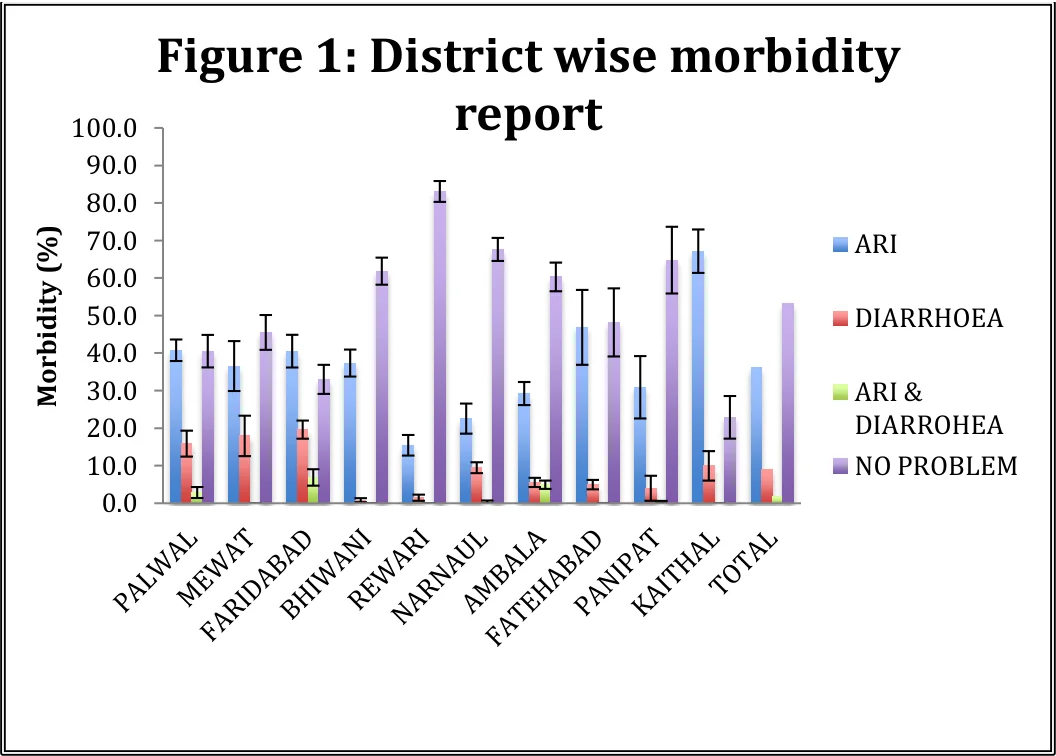
Acute respiratory infection was reported in 36% children (~1050 children) and diarrhea in a total of 9% cases (~262 children). Cases that reported both ARI as well as diarrhea, were found to be 2% (~58 children). In 53% of the children no problem was reported. There was wide district-wise variation in the morbidity profile: ARI only cases were between 12-68%, those of diarrhea were 1-20%, ARI as well as diarrhea were between 0.5-2% (Figure 1).
Treatment Seeking Practices for ARI: Out of children with ARI, 41.7% were given antibiotics and 27.1% took to home care, 7% were given Oral rehydration solution (ORS), 10.9% were given a combination of ORS as well as antibiotics and 13.3% resorted to other practices which included seeking medical advice (Table 1). district wise, the percentage of cases that took to home care varied between 0 – 100%. Bhiwani and Narnaul recorded zero percent and Ambala had 100%. In case of Antibiotics, use varied from 0-93.5 % with maximum use in Narnaul and minimum in Ambala. Medical advice was sought by 0-48.9% cases with 48.9% cases observed in Kaithal.
| Disease | Percent | ORS (%) | Antibiotic (%) | Home Care (%) | Shown to Health Care Provider (%) | (ors+antibiotic) |
|---|---|---|---|---|---|---|
| ARI | 36%(1050) [12-68%] | 7 | 41.7 | 27.1 | 13.3 | 10.9 |
| Diarrhoea | 9% (262) [1-20%] | 50 | 8.8 | 10.4 | 23.2 | |
| ARI and Diarrhoea | 2%(58) [0.5-2%] | 31.3 | 27.4 | 1.96 | 1.96 | 37.2 |
Treatment Seeking Practices for Diarrhoea : Out of children that reported of diarrhea in the past two weeks in the state, 10.4% of the cases were given home care, 50% were given ORS, 8.8% were administered antibiotics, 23.2% were given a combination of ORS as well as antibiotics (Table 1).
District wise, the percentage of cases that took to home care varied between 0 – 61.5%. Faridabad, Bhiwani, Rewari, Narnaul, Ambala and Kaithal recorded no home care and maximum home care was observed in Mewat (61.5%). ORS was given to between 0 – 100% of cases with maximum number of cases observed in Rewari and Ambala (100%), and minimum observed in Faridabad, Palwal and Bhiwani (0%). Antibiotics were given to 0-26.9 % cases. Antibiotics use was found to be high in Narnaul (26.9%), while Palwal, Bhiwani, Rewari, Fatehabad and Ambala reported 0% antibiotics use. A combination of ORS and antibiotics administered together was noted for between 0 – 86.7% children, with 86.7% use in Faridabad district, 9% in Palwal district, while all other districts reported 0% cases. Medical advice was sought by 0-100% cases with 100% cases observed in Bhiwani.
Treatment Seeking Practices for ARI as well as Diarrhea : Two percent children suffered both ARI as well as diarrhea. From these, 1.9% was subjected to home care, 31.3% were given ORS, 27.4% were administered antibiotics, 37.2% were given both ORS and antibiotics and 1.96% went for seeking medical advice.
District-wise, the percentage of children given home care varied between 0 – 8.33% where, the maximum home care was given in Palwal (8.33%). ORS was given to between 0 – 100% of cases with 100% being in Ambala while all others had 0% cases. Antibiotics were given to 0-91.6% cases, 91.67% in Palwal, 9.5% in Faridabad, 100% in Narnaul and 0% in all other districts specifically. Treatment with combining ORS and antibiotics was given to 0 – 90.4% cases, 90.4% in Faridabad while all others depicted 0% of this treatment practice. 100% of children went for seeking medical advice in Panipat, on the other hand all other districts showed 0% cases seeking medical help.
Discussion
This study was done primarily to understand treatment seeking practices for ARI and diarrhea in this area. We found that 36% babies had ARI and 9% had diarrhea. Whereas, two weekly prevalence of diarrhea was equivalent to that reported in various NFHS surveys[7] (Table 2), the prevalence of ARI was much higher in our study. This may be because our study was done primarily during winter months.
| Sr.No. | Prevalence and Health Care seeking | India | Haryana | ||
|---|---|---|---|---|---|
| NFHS4 | NFHS3 | NFHS4 | NFHS3 | ||
| 1 | Prevalence of diarrhoea (reported) in the last 2 weeks preceding the survey | 9.2 | 9.0 | 7.7 | 10.3 |
| 2 | Children with diarrhoea in the last 2 weeks who received oral rehydration salts | 50.6 | 26.0 | 60.6 | 24.3 |
| 3 | Children with diarrhoea in the last 2 weeks taken to a health facility | 67.9 | 61.3 | 77.3 | 81.7 |
| 4 | Prevalence of symptoms of acute respiratory infection (ARI) in the last 2 weeks preceding the survey | 2.7 | 5.8 | 3.2 | 2.7 |
| 5 | Children with fever or symptoms of ARI in the last 2 weeks preceding the survey taken to a health facility | 73.2 | 69.6 | 80.1 | 88.9 |
Other authors have also reported variable prevalence of diarrhea and Pneumonia among under-five children. In Kenya, of 1,679 children aged less than five years, 233 (14%) had diarrhoea, and 736 (44%) had fever during the past two weeks; and 64 (4%) had Pneumonia in the past year.[8] In urban slum of Trans-Yamuna, New Delhi, 191 (14.6 %) of 1307 children surveyed, had an attack of ARI in the preceding two weeks. The common symptoms of ARI cases were mild running nose (78%), cough (76.4%) and/or fever (45.5%). Only 8 (4%) had fast breathing. The attack rate of Acute Diarrheal Diseases was 7.7%.[6]
ARI and diarrhea are important causes of death among under-five. In rural areas of 16 districts from eight states across India, a total of 1,488 verbal autopsies were done. Neonatal etiologies, acute respiratory infection (ARI), and diarrhea accounted for approximately 63.1% of all deaths in the under-five age group. In children aged 29 days to 59 months, ARI and diarrhea accounted for 54.3% of deaths.[9]
Disease burden, of ARI and diarrhea can be reduced with interventions in domain of many non-health sectors like safe drinking water, sanitation, nutrition, environment, hygiene etc., but once child suffers from an illness, mortality can be prevented through appropriate case management.
Effective early management at home level and health seeking behavior in case of appearance of danger signs are key strategies in Acute respiratory Infections (ARI) and Acute Diarrheal Diseases (ADD) where majority of episodes are self-limiting and viral in origin. Integrated Management of Childhood illnesses (IMNCI) also envisages that family and community health practices especially health care seeking behaviors are to be improved to reduce childhood morbidity, mortality and cost of admissions to hospitals
As per Integrated Management of Neonatal and Childhood illnesses guidelines, country wide evidenced based trainings were done to assess, classify and treat children as per the severity of the group of symptoms. Children who were classified to be having mild illness were classified in green colour grade and home based care was advocated with strong communication on when to return. IMNCI was very strongly dependent on the prerequisite of strong health systems. However, IMNCI could never take off in its true scale and spirit. Some authors have argued that mild illnesses can be treated at home, without consulting for health care providers. They have even labeled consultation for mild illnesses as inappropriate. Due to poor access of qualified and trained HCPs in rural areas and slums, HCPs follow their own protocols and rely on excessive use of antibiotics. On the other hand, community gradually has become more aware and apprehensive about their children, and do contact HCPs for mild illnesses.
In our study antibiotic was used in 41.7% of ARI cases, 8.8% of diarrhea cases and 27.4% of children who had both ARI and diarrhea. NFHS surveys did not document use of antibiotics. However, about 50% diarrhea cases used ORS, the finding similar to our study. Consultation with Health Care Provider (HCP) in our study was very less compared to NFHS surveys. This is possible that reported illnesses in our study were milder than that in NFHS surveys. Thus, low use of ORS, low consultation with HCPs, and high use of antibiotics amounts to inappropriate care.
Many studies have documented inappropriate care for ARI and diarrhea. Care providers of 52.6% of the neonates and 21.7% of infants and under-five children did not seek any medical care before the death of the child for ARI and diarrhea.[9] In Kenya, Care at health facilities was sought for one-third of these diarrhoeal episodes, and 88% sought healthcare at any health facility and 48% at hospitals.[8]
In a study, 80% mothers sought treatment for ARI. Nearly three-fourth of mothers (71.3%) sought medical advice and 38.6% used ORS. Home available fluids (HAF) use rate was 42% and continued feeding was 50% during the ADD episode.[6] Though aware of danger signs of ARI, care takers were still seeking medical advice for mild cases of ARI and doctors were prescribing drugs. Correct home based management e.g. use of ORS, continued feeding etc. was deficient in the community. Knowledge of danger symptoms was low and medical advice was being sought and drugs were being prescribed for ADD, too.[6]
A systematic analysis of the coverage of six key child-health interventions in 29 African and Asian countries was done. More than half of the countries had no significant improvement in the coverage of oral rehydration therapy (ORT) for diarrhoea (17/29) and care-seeking for acute respiratory infection (ARI) (16/29) or a significant reduction in these illnesses.[10]
In a study, the symptoms of the most recent illness were consistent with mild ARI in 79% of cases, and antibiotics were used in 71% of these. During the 28-day period, 62% of children had been given antibiotics and 63% of antibiotic courses were used for mild ARIs. One-half of the mild ARI episodes and 63% of the children with mild ARIs were treated with antibiotics. Most of the unnecessary antibiotic treatment was recommended by healthcare providers (82%). Most of the children had been administered antibiotics for common colds, although most caregivers believed that antibiotics were not required. Antibiotics were unnecessarily recommended at health facilities in the area.[11]
In another study, out of the 200 households, most ARI cases 107 (53.5%) were inappropriately managed. The prevalence of antibiotic use in ARI was 43%. Antibiotics use was associated with pneumonia symptoms and access to antibiotics.[12]
HCPs due to their own interests and under patient pressure, and due to their own peer based trainings, prescribe antibiotics without indication. In a study to explore the prescribing practices, knowledge, and attitudes of primary care doctors and community pharmacists, regarding antibiotic use in acute upper respiratory tract infections (URTI) and diarrhea in children, all groups admitted to overusing antibiotics, General Practitioners appeared to use more antibiotics than Govt. Doctors and pediatricians for URTI and diarrhea in children. Pharmacists copy the prescribing of neighborhood doctors. Causes for prescribing antibiotics were patient pressure, profit motive, lack of follow-up and in addition for GDs, workload, no diagnostic facility, and pressure to use near-expiry medicines.[13]
Antibiotic use in acute, uncomplicated Respiratory Tract Infections consisting of common cold/sore throat/cough for not more than five days was surveyed in the community (December 2007-November 2008) using patient exit interviews at public and private facilities from 10 public sector facilities and 20 private clinics over one year. At public and private facilities, 45% (746/1646) and 57% (259/457) of acute, uncomplicated RTI patients were prescribed at least one antibiotic, respectively. Study showed overuse and inappropriate choice of antibiotics for the treatment of acute, uncomplicated RTIs which are mainly due to virus and do not require antibiotic treatment.[14]
Another study examined the differences in antibiotic prescribing rates of public and private primary care clinics in Malaysia. Data from the National Medical Care Survey (NMCS), a nationwide cluster sample of Malaysian 129 public and 416 private primary care clinics in 2014, was used. Five thousand eight hundred ten encounters were prescribed antibiotics; antibiotic prescribing rate was 21.1 % (public clinics 6.8 %, private clinics 30.8 %). Upper respiratory tract infection (URTI) was the most frequent diagnosis in patients receiving antibiotic therapy and accounted or 49.2 % of prescriptions. Of the patients diagnosed with URTI, 46.2 % received antibiotic treatment (public 16.8 %, private 57.7 %).[15]
Antibiotics are being prescribed even though the bacterial infection is very less even among children hospitalized with ARI. Of 165 infected and hospitalized babies, Streptococcus pneumoniae was the most frequently isolated bacterial pathogen (9%), whereas Klebsiella pneumaniae, Streptococcus spp., Enterobacter agglomerans, and Haemophilus influenzae were 5.5%, 5%, 2%, and 1.5%, respectively.[16]
It leads to not only antibiotic resistance but huge out of pocket expenditure for treatment. A prospective study in urban health centres in India, was done over one year period, to find out health expenditure in public and private sector consultations for common childhood (under 5) morbidities. Overall, there were 625 episodes of respiratory infection, out of which 377 (60.3%) were treated by private doctors, 158 (25.3%) were treated by government doctors and remaining 90 (14.4%) were treated at home. Average total expenditure on treatment of child morbidity was 189 INR (10% of total household income). Private providers are preferred for the treatment of acute illnesses where both direct and indirect cost of treatment was high.[17]
The practice to prescribe antibiotics for mild ARI cannot be changed by improving the knowledge alone. In a study, after the interventions only 44% of HCPs refrained from antibiotic use for mild ARI.[18] There can be many other factors influencing antibiotic use. Prescription practice is influenced by many factors.[19-21] Knowledge and practical competence are just one of these. This may be influenced by financial incentives to prescribe, and pressure of the patients. Changing prescribing behaviour may require more than one intervention as suggested by Prochaska’s ‘Stages of Change’ model.[22] Predisposing, enabling and reinforcing factors of ‘Precede/Proceed’ model’s also explain method sustainable behaviour change.[23]
Conclusions:
This study was done as a part of baseline assessment for an intervention to improve skills of HCPs in public sector for management of ARI and diarrhea. There is high use of antibiotics for management of these illnesses and the use of ORS and home care is low.
Acknowledgements:
The study was part of an interventional project to build skills for management of ARI and Diarrhoea and infant death reviews and stillbirth review in Haryana. Project was funded by National Health Mission Haryana. We acknowledge the contributions of Dr Rakesh Gupta, PhD, and IAS, then MD NHM for supporting this work.
References
- United Nations Inter-agency Group for Child Mortality Estimation (UN IGME). https://data.unicef.org/topic/child-survival/under-five-mortality/ (accessed on 8.6.2018)
- Fadel SA, Rasaily R, Awasthi S, Begum R, Black RE, Gelband H, etal. Changes in cause-specific neonatal and 1-59-month child mortality in India from 2000 to 2015: a nationally representative survey. Lancet. 2017; Oct 28;390(10106):1972-1980. doi: 10.1016/S0140-6736(17)32162-1. Epub 2017 Sep 19.
- WHO/UNICEF. Ending preventable child deaths from pneumonia and diarrhoea by 2025: The integrated Global Action Plan for Pneumonia and Diarrhoea (GAPPD), WHO Press, World Health Organization, Geneva. ISBN: 9789241505239. Accessed on 23rd December 2013. Available at http://apps.who.int/iris/bitstream/10665/79200/1/9789241505239_eng.pdf
- Walker CL, Rudan I, Liu L, Nair H, Theodoratou E, Bhutta ZA, etal. Global burden of childhood pneumonia and diarrhoea. Lancet 2013. 381(9875):1405-16. doi: 10.1016/S0140-6736(13)60222-6
- Black, Robert E., Simon Cousens, Hope L. Johnson, Igor Rudan, etal, for the Child Health Epidemiology Reference Group of WHO and UNICEF, (2010) .Global, Regional, and National Causes of Child Mortality in 2008: A Systematic Analysis, www.thelancet.com, Published Online, May 12, DOI: 10.1016/S0140-6736(10)60549-1.
- Gupta N, Jain SK, Ratnesh, Chawla U, Hossain S and Venkatesh S. An evaluation of diarrhoeal diseases and acute respiratory infections control programmes in a Delhi slum. Indian Journal of Pediatrics 2007; 74: 471-476. [Google Scholar]
- International Institute of Medical Sciences. National Family Health Survey-4, 2015-16. IIPS, Mumbai, Ministry of Health and Family Welfare, Govt. of India. http://rchiips.org/NFHS/pdf/NFHS4/India.pdf (accessed on 10.6.2018)
- Burton DC, Flannery B, Onyango B, Larson C, Alaii J, Zhang X, Hamel MJ, etal. Healthcare-seeking behaviour for common infectious disease-related illnesses in rural Kenya: a community-based house-to-house survey. J Health Popul Nutr. 2011 Feb; 29(1):61-70. [doi:10.3329/jhpn.v29i1.7567]
- Deshmukh V, Lahariya C, Krishnamurthy S, Das MK, Pandey RM, Arora NK.Taken to Health Care Provider or Not, Under-Five Children Die of Preventable Causes: Findings from Cross-Sectional Survey and Social Autopsy in Rural India. Indian J Community Med. 2016 Apr-Jun; 41(2):108-19. doi: 10.4103/0970 [doi:10.4103/0970-0218.177527]
- Boschi-Pinto C1, Bahl R, Martines J. Limited progress in increasing coverage of neonatal and child-health interventions in Africa and Asia. J Health Popul Nutr. 2009 Dec; 27(6):755-62. [Google Scholar]
- Nguyen Quynh Hoa, Nguyen Thi Kim Chuc, Ho Dang Phuc, Mattias Larsson, Bo Eriksson, Cecilia Stålsby Lundborg. Unnecessary antibiotic use for mild acute respiratory infections during 28-day follow-up of 823 children under five in rural Vietnam, Transactions of The Royal Society of Tropical Medicine and Hygiene, Volume 105, Issue 11, 1 November 2011, Pages 628–636, https://doi.org/10.1016/j.trstmh.2011.07.015
- Dan Kibuule, Harriet Rachel Kagoya & Brian Godman (2016) Antibiotic use in acute respiratory infections in under-fives in Uganda: findings and implications, Expert Review of Anti-infective Therapy, 14:9, 863-872, DOI: 10.1080/14787210.2016.1206468
- Kotwani A, Joshi PC, Jhamb U, Holloway K. Prescriber and dispenser perceptions about antibiotic use in acute uncomplicated childhood diarrhea and upper respiratory tract infection in New Delhi: Qualitative study. Indian J Pharmacol. 2017 Nov-Dec; 49(6):419-431. doi: 10.4103/ijp.IJP_508_17.
- Kotwani A, Holloway K. Antibiotic prescribing practice for acute, uncomplicated respiratory tract infections in primary care settings in New Delhi, India. Trop Med Int Health. 2014 Jul; 19(7):761-8. doi: 10.1111/tmi.12327. Epub 2014 Apr 22.
- Ab Rahman N, Teng CL, Sivasampu S. Antibiotic prescribing in public and private practice: a cross-sectional study in primary care clinics in Malaysia. BMC Infect Dis. 2016 May 17; 16:208. doi: 10.1186/s12879-016-1530-2
- Bhuyan GS, Hossain MA, Sarker SK, et al. Bacterial and viral pathogen spectra of acute respiratory infections in under-5 children in hospital settings in Dhaka city. Schildgen O, ed. PLoS ONE. 2017; 12(3):e0174488. doi:10.1371/journal.pone.0174488.
- Dongre AR1, Deshmukh PR, Garg BS. Health expenditure and care seeking on acute child morbidities in peri-urban Wardha: a prospective study. Indian J Pediatr. 2010 May;77(5):503-7. doi: 10.1007/s12098-010-0063-8. Epub 2010 Apr 17.
- Hoa NQ, Thi Lan P, Phuc HD, Chuc NTK, Stalsby Lundborg C. Antibiotic prescribing and dispensing for acute respiratory infections in children: effectiveness of a multi-faceted intervention for health-care providers in Vietnam. Global Health Action. 2017;10(1):1327638. doi:10.1080/16549716.2017.1327638.
- Reynolds L, McKee M. Factors influencing antibiotic prescribing in China: an exploratory analysis. Health Policy. 2009;90(1):32–36. [doi:10.1016/j.healthpol.2008.09.002]
- Sterky G, Tomson G, Diwan VK, et al. Drug use and the role of patients and prescribers. J Clin Epidemiol. 1991;44(Suppl 2):67S–72S [doi:10.1016/0895-4356(91)90115-p]
- Stalsby Lundborg C, Tamhankar AJ. Understanding and changing human behaviour–antibiotic mainstreaming as an approach to facilitate modification of provider and consumer behaviour. Ups J Med Sci. 2014;119(2):125–133 [doi:10.3109/03009734.2014.905664]
- Prochaska JO, Velicer WF. The transtheoretical model of health behavior change. Am J Health Promot. 1997;12(1):38–48. [doi:10.4278/0890-1171-12.1.38]
- Lundborg CS, Wahlstrom R, Oke T, et al. Influencing prescribing for urinary tract infection and asthma in primary care in Sweden: a randomized controlled trial of an interactive educational intervention. J Clin Epidemiol. 1999;52(8):801–812. [doi:10.1016/s0895-4356(99)00036-0]
Published
Article metrics
- Views
- 2,301
- Downloads
- 1,093
Based on this site's usage statistics.