Original Article Vol. 6 No. 1 (2022): International J Health Systems and Implementation Research
Health Insurance Scenario Among Street Vendors Of Chandigarh
Downloads
Topics
Keywords:
- Health insurance, street vendors, coverage, awareness
Abstract
Introduction- Health insurance can become one of the important pillars in strengthening health care delivery system of India as health insurance provides umbrella of protection from catastrophic health care expenses to people belonging to vulnerable sections of society for example, street vendors. Thus, it becomes imperative to estimate coverage and awareness of health insurance among street vendors. Objectives- Catalogue the various schemes available for street vendors of Chandigarh pertaining to health insurance, ascertain the extent and pattern of coverage of street vendors of Chandigarh by various health insurance schemes with respect to street vendors perspective and to document the various health insurance schemes related awareness level and experiences of the concerned street vendors of Chandigarh. Methodology- This cross sectional study conducted on two fifty street vendors, randomly selected from the list of street vendors registered under Municipal Corporation of Chandigarh. MS Excel Workbook 2019 was used for statistical analysis. Results- Most of the street vendors were married, males educated up to 12th class, earning INR 5000-10000 as monthly income, less than INR 3000 as per capita income, having four to six family members and living in urban area. Most of the street vendors fell ill in last six months needed medical treatment. About two-third of 250 street vendors heard and knew about health insurance. Twenty-seven street vendors were covered under health insurance scheme. Conclusion- The study witnessed low coverage of street vendors under any health insurance scheme. Two-third of street vendors heard and knew about health insurance. Recommendation- The study recommends maximizing and optimizing the strategies to increase awareness and coverage of health insurance among street vendors.
Full text
This web version was prepared from the published PDF, which is the version of record. Please cite and quote from the PDF.
Introduction
Medical care in India is in a condition of tremendous transition: expanded pay and wellbeing awareness among most of the classes, cost advancement, decrease in administration, and the presentation of private medical care supporting drive the change [1]. As health plays a crucial role in lives of an individual, family and society as a whole. It is a duty of medical care delivery framework to furnish medical care to all with equity. Government raises funds through taxes to provide health care to all without any disparity and inequity. Additionally, directly administered health care services are supported by public financing [2].
Furthermore, health care accessibility and affordability have to be ensured [1]. The accessibility of health care services, just as obstacles to get to, should be considered with regards to varied populations’ perspectives, wellbeing needs, and material and social context. Out-of-pocket spending accounts for around 62.6% of overall health spending in India, making it one of the greatest in the world. High out-of-pocket health care expenses can be attributed to a lack of health insurance coverage or inadequate coverage [3]. This obviously demonstrates that the Indian market for health insurance products is yet unexplored. Out of pocket health expenditures can have impoverishing effects on the economic status of people, especially among the poorer socioeconomic strata. For example, people in the lowest income quintile and/or with higher inpatient expenses are more likely to borrow or sell assets in order to cope with health care expenses [4].
A healthy India is essential for the country's economic progress to prevail [5]. Government focuses on underprivileged people (for example, street vendors, below poverty line people, minorities) for health care services through their health care delivery system. Street vendors form an essential part of urban informal economy of India [6] and give sense of vibrancy to city [7] as they offer goods and services to people at affordable prices on daily basis. At the same time, street vendors are the vulnerable group of our society and mostly can’t afford quality health care services.
Thus, health insurance can provide these people with quality health care services. Health insurance can protect them from uncertain and emergency health care expenses.
Objectives
- To catalogue the various schemes available for street vendors of Chandigarh pertaining to health insurance.
- To ascertain the extent and pattern of coverage of street vendors of Chandigarh by various health insurance schemes with respect to street vendors perspective.
- To document the various health insurance schemes related awareness level and experiences of the concerned street vendors of Chandigarh.
Materials and Methodology
The present study followed a cross-sectional study design, where the street vendors of Chandigarh (sampling unit) were surveyed over a single period of time. Data was collected in the form of questionnaire from the street vending zones as allotted to the street vendors having street vending license as issued by Municipal Corporation of Chandigarh [7]. The street vending zones of sector 22, 15, 19, 23, 29, 35 and others (sector 44, 46, 49, 28, 34, 38, 52) were included in the study. Inclusion criteria was the street vendors registered under Municipal Corporation of Chandigarh and gave their consent for survey. Street vendors not registered under Municipal Corporation of Chandigarh and denied to give their consent were not included in the study.
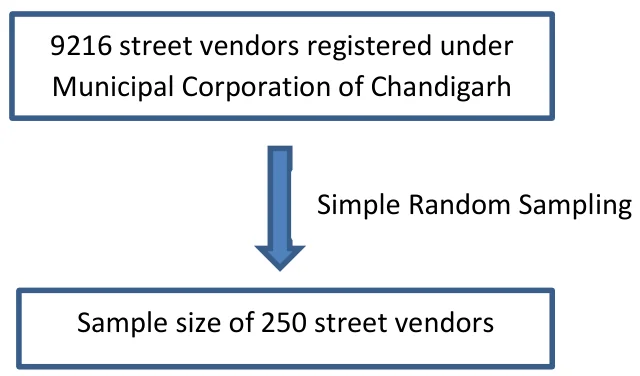
Simple Random Sampling technique was used. The street vendors were randomly selected from the list of street vendors registered under Municipal Corporation of Chandigarh. Sample size calculated according to formula (Z1-α/22 *P(1-P)/d2)[8] where Z1-α/2 is standard normal variate and at 5% type I error and p<0.05, Z1-α/2 is 1.96, P is prevalence of health insurance coverage among street vendors according to previous study, d is precision. The number of registered street vendors in Chandigarh according to Municipal Corporation of Chandigarh are 9216 [9]. The prevalence of health insurance coverage among street vendors of Delhi was 16.4% [10]. Therefore, P is 16.4%, 1-P is 83.6% and d is 5%. Then, sample size as calculated according to above formula was approximately 250 (including 10% non-response rate).
The data was collected between 15 May to 30 June, 2021. A pre-tested, semi-structured, interviewer-administered, questionnaire and checklist was used to collect data to document barriers, legal aspects, about health insurance policy claims, defaulters and understanding mechanisms of street vendors of Chandigarh after taking informed consent from the participants. The street vendors were contacted physically. Socio-demographics, health related quality of life and health insurance seeking behavior data was collected utilizing standardized tools and techniques. The tool was initially developed in English language and then translated into Hindi language. A pilot study was conducted to check for any feasibility issues and for any changes required for the questionnaire. Secondary data was also collected through Google search features which includes data about health insurance schemes and the data of Municipal Corporation of Chandigarh.
For statistical analysis, all data was entered in MS Excel Workbook 2019, followed by data analysis. Use of appropriate statistical techniques such as percentages, pie charts, bar graphs etc. has been used.
Results
Age sex distribution of street vendors
Most of the street vendors were males (91.2%) above the age of 25 years in young productive age group of 25 to 54 years; 8.8% of street vendors were females above the age of 25 years as depicted in table 1.
| Age (years) | Male | Female | % |
|---|---|---|---|
| 15 -24 | 11 (4.4%) | 0 | 4.4 |
| 25-34 | 49 (19.6%) | 3 (1.2%) | 20.8 |
| 35-44 | 86 (34.4%) | 8 (3.2%) | 37.6 |
| 45-54 | 47 (18.8%) | 5 (2%) | 20.8 |
| ≥55 | 35 (14%) | 6 (2.4%) | 16.4 |
| Total | 228 (91.2%) | 22 (8.8%) | 100 |
Socio-demographic profile of street vendors
As indicated in table 2, most (90.4%) of street vendors included in this study were married (including divorced, widow). 13.6% street vendors were uneducated, 4% had studied less than class 5th, 34.8% had studied class 5th -9th, 38.8% had studied class 10th- 12th and 8.8% were graduates and post graduates. 1.2% street vendors earned < Rs 5000, 56.4% earned Rs 5000- Rs 10000, 42.4% earned ≥ Rs 10000 as total monthly income. 60.8% street vendors had < Rs 3000, 34.4% had Rs 3000- Rs 5000, 4.8% had ≥ Rs 5000 as per capita monthly income. 24.8% street vendors had ≤ 3 family members, 66.8% had 4-6 family members and 8.4% had ≥ 7 family members in their households. Almost all (98.4%) street vendors lived in urban areas and rest (1.6%) lived in rural areas. This study shows that 9.2% street vendors had elderly (above 60 years) and 38% street vendors had 1-2 children (≤ 18yrs of age) and 19.6% street vendors had 3 and above number of children (≤ 18yrs of age) in their households.
| Marital status | Number | (%) |
|---|---|---|
| Married | 226 | 90.4 |
| Unmarried | 24 | 9.6 |
| Highest education level | Number | (%) |
| Uneducated | 34 | 13.6 |
| <5th Class | 10 | 4 |
| 5th - 9th Class | 87 | 34.8 |
| 10th – 12th Class | 97 | 38.8 |
| Graduation and above | 22 | 8.8 |
| Total monthly income (Rs) | Number | (%) |
| <5000 | 3 | 1.2 |
| 5000-10000 | 141 | 56.4 |
| ≥10000 | 106 | 42.4 |
| Per capita monthly income (Rs) | Number | (%) |
| <3000 | 152 | 60.8 |
| 3000-5000 | 86 | 34.4 |
| ≥5000 | 12 | 4.8 |
| Number of family members | Number | (%) |
| ≤3 | 62 | 24.8 |
| 4-6 | 167 | 66.8 |
| ≥7 | 21 | 8.4 |
| Place of living | Number | (%) |
| Rural | 4 | 1.6 |
| Urban | 246 | 98.4 |
Health insurance seeking behaviour of street vendors
As indicated in table 4, 62.8% street vendors knew and had heard about health insurance scheme (Ayushman Bharat-PMJAY[11]), 0.4% street vendors knew about ICICI Lombard[12] health insurance scheme and none of the street vendor knew about other health insurance schemes (Corona Kavach Policy[13], Individual Health Insurance Policy[14], Family Medicare Policy[15], Arogya Sanjeevani Policy[16], Super Top up Medicare Policy[17], UNI Criticare[18] or any other health insurance scheme).
| Health insurance seeking behaviour | Number | (%) |
|---|---|---|
| Heard and knew about health insurance schemes | 158 | 63.2 |
| Knew about Ayushman Bharat-Pradhan Mantri Jan Arogya Yojana | 157 | 62.8 |
| Knew about other health insurance scheme (ICICI Lombard) | 1 | 0.4 |
Health insurance coverage among street vendors
Twenty-seven out of two fifty street vendors were covered under any health insurance scheme. Of twenty-seven street vendors, mostly (96.3%) had heard about and were using the health insurance scheme of Ayushman Bharat-PMJAY. 3.7% street vendors had heard and were using the health insurance scheme of ICICI Lombard; 88.9% street vendors were told about the scheme of Ayushman Bharat-PMJAY and 3.7% were told about ICICI Lombard health insurance scheme while taking the scheme and 7.4% were not told anything about scheme of Ayushman Bharat-PMJAY while taking the scheme; 96.3% street vendors had health insurance scheme under government sector and 3.7% had their health insurance under private sector; 3.7% street vendors availed health care expenses from the Ayushman Bharat-PMJAY health insurance scheme and 92.6% covered under Ayushman Bharat-PMJAY scheme and 3.7% covered under ICICI Lombard did not avail any health care expenses from their health insurance scheme; 22.2% street vendors felt very much secured through their health insurance, 70.4% felt much secured and 3.7% felt not secured financially through Ayushman Bharat-PMJAY health insurance scheme, 3.7% street vendors felt much secured financially under ICICI Lombard health insurance scheme. 92.6% street vendors were satisfied and 3.7% were not satisfied with Ayushman Bharat-PMJAY scheme health insurance scheme, 3.7% street vendors were satisfied with ICICI Lombard health insurance scheme.
Discussion
Street vending is a major economic activity in informal sector of urban areas of India. There are various schemes launched by Government of India to support street vendors for example, Deendayal Antyodaya Yojana-National Urban Livelihood Mission (DAY-NULM), scheme sponsored by the Government of India is giving "Support to Urban Street Vendors (SUSV)" [7], PM-SVANidhi (PM Street Vendor’s AtmaNirbhar Nidhi) [19].
In the present study, most of the street vendors were males, married and that too in young productive age group, very few were females mostly in the age group of 35 to 44 years. This indicates that street vending is male dominant and youth driven as mostly street vendors belongs to productive age group. Only 8.8% street vendors were educated up to graduation and above. This indicates that literacy level is low among street vendors. A study reported most of the street vendors were males, married and in young reproductive age group of 26 to 45 years educated upto tenth standard [10].
The secondary data of this study indicated that various government and private health insurance schemes are available for street vendors which include Ayushman Bharat-Pradhan Mantri Jan Arogya Yojana [11], Individual Health Insurance Policy [14], Family Medicare Policy [15], Arogya Sanjeevani Policy [16], Corona Kavach Policy [13], Super Top Up Medicare Policy [17], UNI Criticare [18] and others (ICICI Lombard) [12]. Majority of street vendors of Chandigarh, i.e., 157 street vendors (62.8%) knew and heard about Ayushman Bharat-PMJAY and however, only one street vendor of Chandigarh (0.4%) knew and heard about ICICI Lombard health insurance scheme.
Health insurance was not known by one-third of street vendors. Substantially small number of street vendors (10.8%) were covered under any health insurance. A study implicated that health insurance was unheard by 46% street vendors in Delhi and 34.7% street vendors in Hyderabad and only 16.4% street vendors were covered under health insurance in Delhi [10]. One of the reasons could be due to lack of awareness campaigns about health insurance by the government. This indicates low coverage of street vendors under health insurance schemes which might be due to some apprehension, fear and less knowledge and awareness about health insurance among people of low socio-economic status such as the street vendors. It might be due to difficult procedures for enrollment under health insurance schemes.
The Government is the major insurer in health sector and health insurance coverage is low under private sector as street vendors were not able to buy expensive health insurance schemes from private health insurance companies, implicating that private sector is yet to come up in health insurance sector. Some of the street vendors covered under health insurance were not told anything about benefits of health insurance scheme while enrolling them under health insurance scheme. Almost all of the street vendors did not avail any monetary benefits from health insurance scheme. Almost all the street vendors had their total monthly income above Rs. 5000 but per capita income of majority of street vendors was below Rs. 3000 that indicates their poor socio-economic status.
Majority of street vendors felt much secured financially and one of the street vendors felt not secured financially for any urgent circumstances through health insurance schemes for their health care treatment expenses. The satisfaction level of beneficiaries was almost same in both government and private health insurance schemes. Majority of policyholders were unaware of the health insurance scheme's terms and conditions at the time of enrollment. As a result, claim settlements may not always satisfy them [20].
Limitation
All street vendors of Chandigarh (including street vendors not registered under Municipal Corporation of Chandigarh) were not included as data was not available with Municipal Corporation of Chandigarh for street vendors not registered under Municipal Corporation of Chandigarh. However, the findings from the present study can be utilized for developing strategies to increase awareness and coverage among street vendors of Chandigarh.
Conclusion
At present, health insurance coverage is low among street vendors of Chandigarh. There can be many tools in form of welfare schemes for upliftment of vulnerable sections of Indian society, health insurance can become one of the important tool and backbone for social and economic development of people belonging to low socio-economic status as health insurance can save these people from catastrophic out-of-pocket health care expenses and can become a mediator in providing good healthcare services to these people.
Recommendation
Periodical awareness campaigns, celebrating health insurance weeks, seminars and workshops about benefits and access to health insurance among vulnerable and low socio-economic groups of society can increase coverage of street vendors of Chandigarh under health insurance.
Ethical Approval
Ethical clearance was taken from Ethics Committee of PGIMER, Chandigarh. Individual written consent was taken from eligible participating street vendors. As the study involves collection of primary data and therefore require interactions in form of questionnaire with participants/human subjects. This study is also based on secondary data which is present in public domain. This study does not implicate or harm any kind of religious, emotional or personal sentiments of any community to the best of my knowledge.
Conflict of Interest
No conflict of interest exists among the authors
Acknowledgement
None
Source of funding
None
References
- Anita J. Emerging Health Insurance in India – An overview n.d. [Google Scholar]
- Century I of M (US) C on A the H of the P in the 21st. The Health Care Delivery System 2002. [Google Scholar]
- Sriram S, Khan MM. Effect of health insurance program for the poor on out-of-pocket inpatient care cost in India: Evidence from a nationally representative cross-sectional survey. BMC Health Services Research 2020;20:1–21. https://doi.org/10.1186/s12913-020-05692-7
- Kumar K, Singh A, Kumar S, Ram F, Singh A, Ram U, et al. Socio-Economic Differentials in Impoverishment Effects of Out-of-Pocket Health Expenditure in China and India: Evidence from WHO SAGE. PLOS ONE 2015;10:e0135051. https://doi.org/10.1371/JOURNAL.PONE.0135051
- healthcare agenda for indian government citation. Indian J Med Res 141 2015:151–3. [Google Scholar]
- Koley S, Chakraborty P. Socio-Economic View on Street Vendors: A Study of a Daily Market at Jamshedpur 2018. https://doi.org/10.24321/2349.2872.201804
- Singh Ishwarpreet Kaur Kumar Pushkar Anil Kumar Garg Vivek Trivedi Divya Sharma A. Developing Chandigarh as a Safe Street Food Town-An Intersectoral Initiative (Capacity building and training of street vendors under DAY-NULM). n.d. [Google Scholar]
- Charan J, Biswas T. How to Calculate Sample Size for Different Study Designs in Medical Research? Indian Journal of Psychological Medicine 2013;35:121. https://doi.org/10.4103/0253-7176.116232
- Service N. LIST OF 9216 STREET VENDORS n.d. [Google Scholar]
- Singh S, Student MPH, Sciences M. Occupational Health and Safety of Street Vendors of Delhi and Hyderabad: A case for Universal Health Coverage 2019. [Google Scholar]
- Angell BJ, Prinja S, Gupt A, Jha V, Jan S. The Ayushman Bharat Pradhan Mantri Jan Arogya Yojana and the path to universal health coverage in India: Overcoming the challenges of stewardship and governance. PLOS Medicine 2019;16:e1002759. https://doi.org/10.1371/JOURNAL.PMED.1002759
- Health Insurance: Compare Medical Insurance Plans in India n.d. https://www.policybazaar.com/health-insurance/health-insurance-india/
- Health | UIIC. Corona-Kavach-Policy n.d. https://uiic.co.in/en/product/health/Corona-Kavach-Policy#pills-tabContent
- Health | UIIC. Individual-Health-Insurance-Policy n.d. https://uiic.co.in/en/product/health/Individual-Health-Insurance-Policy#pills-tabContent
- Health | UIIC. Revised-Family-Medicare-Policy n.d. https://uiic.co.in/en/product/health/Revised-Family-Medicare-Policy#pills-tabContent
- Health | UIIC. Arogya-Sanjeevani-Policy n.d. https://uiic.co.in/en/product/health/Arogya-Sanjeevani-Policy#pills-tabContent
- Health | UIIC. Revised-Super-Top-Up-Medicare-Policy n.d. https://uiic.co.in/en/product/health/Revised-Super-Top-Up-Medicare-Policy#pills-tabContent
- Health | UIIC. UNI-Criticare n.d. https://uiic.co.in/en/product/health/UNI-Criticare#pills-tabContent
- View of Study of perceptions among street vendors of Ahmedabad on “Pradhan Mantri Street vendor’s Atmanirbhar Nidhi Scheme 2020(PM-SVA Nidhi Yojana)” -Special micro-credit program for street vendors n.d. https://www.journalppw.com/index.php/jpsp/article/view/2364/1477
- Chapter-7 Conclusions Testing of Hypothesis Problems Suggestion Conclusions n.d.:209–22. [Google Scholar]

Published
Article metrics
- Views
- 957
- Downloads
- 798
Based on this site's usage statistics.
Issue
Section
How to Cite
More in this topic: Health financing
Original Article · 2024
Stakeholders' Perception of Digital Payment in a Public Hospital in India