Original Article Vol. 8 No. 1 (2024): International J Health Systems and Implementation Research
An Epidemiological Investigation of Acute Diarrhoeal Disease Outbreak in Saloni Village of Balodabazar District, Chhattisgarh
Acute Diarrhoeal Disease Outbreak Investigation
Downloads
Topics
Keywords:
- Acute Diarrhoeal Disease, Drinking Water, Outbreak Investigation
Abstract
Background: Every year in India, acute diarrheal disease (ADD) causes 12 million infections and 1216 fatalities. On May 6, 2024, an Acute Diarrhoeal Disease(ADD) outbreak was reported from Saloni village in Balodabazar district, Chhattisgarh. Objective: to investigate the outbreak, determine the source of infection, and implement immediate control and preventive measures. Methods: A case was defined as a person experiencing at least three or more loose watery stools in 24 hours in Saloni village between May 6, 2024, and May 19, 2024. We collected stool samples for bacterial culture and tested water from multiple water sources for faecal coniform. Results: A total of 26 cases were identified, with 80% female, and 10 hospitalizations (38%). The median age was 35 years (range 1 month to above 60 years). Cases started on May2, 2024. District authorities started chlorination of water sources on May 6, 2024, and cases declined soon after. Two stool samples were taken for culture, which were found to be negative. Two, out of the five water samples collected from pipelines and hand pumps were positive for Escherichia coli. Conclusions: This ADD outbreak was likely associated with the consumption of contaminated drinking water from the leaked water pipeline supply. We recommend the government to supply chlorinated drinking water and to promote good hygienic practices among the people.
Full text
This web version was prepared from the published PDF, which is the version of record. Please cite and quote from the PDF.
Introduction
Diarrheal illness is the third most common cause of death among under-five children, accounting for about 443,832 deaths annually[1]. Every year in India, acute diarrheal disease (ADD) causes 12 million infections and 1216 fatalities[2]. ADD is known to be associated with certain risk factors, such as contaminated food or water, person-to-person transmission, and neglect of cleanliness and hygiene[3]. According to Integrated Disease Surveillance Programme (IDSP) reports, in Chhattisgarh, there were 126 outbreaks in 2023, of which 55 (or 43.7%) were associated with ADD [4]. The unexpected incidence of a disease, a certain health-related behavior, or health-related occurrences that manifestly exceed "expected occurrence" in a community or region is referred to as an outbreak [5]. An ADD outbreak was reported to the District Surveillance Unit IDSP on May 6, 2024, at Saloni hamlet in Balodabazar taluka, Balodabazar-Bhatapara District. Saloni village is 12 miles from Balodabazar City and inhabits 2036 people. Reports indicated that four cases of severe diarrhea from Saloni village were admitted to the District Hospital in Balodabazar. Based on these details, the impacted community was visited, and those who had reported cases of acute diarrhea were interviewed. They also revealed that there were further cases of the patient’s age, gender, and date of illness onset this kind in the area. Based on the preliminary fieldwork, it was determined that there was an acute diarrhea outbreak. Investigations were done to determine the source of infection and to put preventative and control measures in place right away. Dehydration is the most serious risk associated with diarrhea[1]. Dehydration is the primary cause of death in acute diarrheal disease [6].
Materials and Methods
Setting: The gram panchayat village of Saloni has 2036 residents overall, out of which 1036 (50.8%) are male and 1000 are female (49.1%). Approximately, 54% population of Saloni village is literate. The community of Saloni has roughly 387 houses. It takes five kilometres to get to the closest medical facilityfor the village’s population.
Case finding: A case was classified as three or more loose watery stools in 24 hours in a Saloni village resident on May 6, 2024. To look for cases, we surveyed every home in Saloni, gathering data on symptoms, age, gender, date of sickness onset, and past medical history.
Stool Sample investigation: We collected stool samples from cases presenting with watery stools and sent them for stool culture in Cary-Blairtransport medium to the District Public Health Laboratory (DPHL) Lab of the District Hospital.
Water Sample investigation: We collected 5 water samples in sterile containers from the handpumps and piped water which were sent to DPHL, Balodabazar. DPHL performed microbiological testing of water using a PA Coliform kit and cultured for Vibrio cholerae, Escherichia coli, Salmonella, Shigella and techniques used for chlorination.
Data Analysis: Basic demographic information about household members was gathered, and cases were identified by using a questionnaire designed for a quick household survey. It contained the epidemiological case sheet of cases, which included information on, symptoms, and treatment plans. Microsoft Excel was utilized to compile the data. The disease’s attack rates specific to age and sex were calculated. To make conclusions, an epidemic curve was created and the data was examined.
Action taken: A preliminary assessment of the area was conducted on May 6, 2024, by a team of District Surveillance officers, a District Epidemiologist, a District Microbiologist, a Block Medical Officer, and community and rural health officers. The local panchayat employees were given instructions to temporarily arrange for alternative drinking water sources and to cease the water supply through the pipelines. They were also instructed to send the water samples to microbiologists for examination. Public awareness was initiated to highlight the need to consume clean water and practice good hygiene. Patients with a history of acute diarrhea were given oral rehydration salts, tab zinc, and metronidazole by the medical staff of Sub-Health Centers.
Results
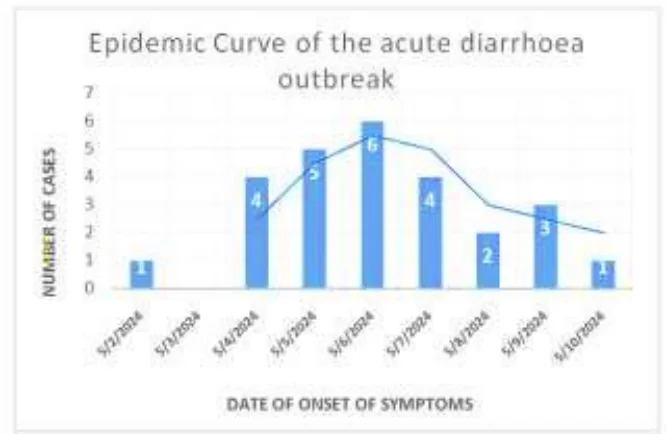
Descriptive epidemiology: In the affected population of 2036, there were 26 cases of Acute Diarrhoeal Disease with an attack rate of 1.3% and 10 of them were hospitalized. Of the 26 cases, there were more females (80.7%) compared to males (19%). The median age was 35 years (range: 1–65 years) [Table 1]. The first case was reported by healthcare workers on May 2, 2024. The maximum number of cases was reported on May 6, 2024. Chlorine solution for drinking water was distributed within 24 hours of outbreak detection to households for chlorination at the household level. The outbreak diminished soon after. Cases then decreased until the last case was reported onMay 10, 2024 [Figure 1]. Among 26 cases, 10 (38%) cases were treated as inpatients at District Hospital: the most reported symptoms were vomiting, watery diarrhea, and abdominal pain (50%), followed by only watery diarrhea (38%), watery diarrhea with vomiting (12%). The most common source of water consumption was Pipeline water (73%), Hand pump (15%), and bore well water (11.5%)[Table 2].
| Variables | Frequency (n=26) | Percentage (%) | |
|---|---|---|---|
| Age (In Years) | 0-5 | 2 | 7.7 |
| 06-10 Years | 0 | 0.0 | |
| 11-19 Years | 4 | 15.4 | |
| 20-45 Years | 9 | 34.6 | |
| 45-60 Years | 6 | 23.1 | |
| Above 60 Years | 4 | 15.4 | |
| Sex | Male | 5 | 19.2 |
| Female | 21 | 80.8 | |
| Occupation | Farmer | 4 | 15.4 |
| Student | 8 | 30.8 | |
| Housewife | 9 | 34.6 | |
| Unemployed | 2 | 7.7 | |
| Daily wages | 3 | 11.5 | |
| Variables | Frequency (n=26) | % | |
|---|---|---|---|
| Symptoms | Watery Diarrhoea | 10 | 38.5 |
| Vomiting and Watery Diarrhoea | 3 | 11.5 | |
| Vomiting, Watery Diarrhoea and abdominal pain | 13 | 50.0 | |
| Whether treatment received | Yes | 26 | 100.0 |
| No | 0 | 0.0 | |
| Consumption of water | Handpump | 4 | 15.4 |
| Borwell | 3 | 11.5 | |
| Piped water | 19 | 73.1 | |
Stool and Water Sample Investigation: Drinking water to Saloni village was supplied from overhead tanks through pipelines. Villagers had complained of water supply pipeline leakage a few days ago and supply water was without treatment. Few houses used hand pumps and own bore wells for water. Water samples were collected from the 2 consumer pipelines, 2 handpumps and 1 bore well. 2 Pipeline water samples tested positive for Escherichia coli which is a major microbial water contaminant coliform, and were found unfit for drinking. The rest of the water samples were negative for fecal coliforms, but the water storage handpumps and bore wells had just been chlorinated by the district rapid response Team.
Control measures: After the outbreak onset, the villagers’ council stopped the use of piped water supply and cleaned the overhead tank. Chlorine tablets were distributed, and public announcements through Kotwar were made to consume water after treatment. Cases declined after these interventions (Figure 1).
| Sex | Total | Cases | Attack Rate |
|---|---|---|---|
| Male | 1036 | 5 | 0.5 |
| Female | 1000 | 21 | 2.1 |
Table 3 displays the sex specific attack rate, wherein females have registered higher attack rate for ADD as compared to males.
Discussion
Diarrheal disease is epidemic in India and is a major public health problem in India and outbreaks of ADD continue to occur in different parts of the country [7]. In the present study, a great number of individuals in the age group of 11-60 were affected as compared to other age groups. The attack rate in each age group was almost the same (1.2, 1.2,1.1, 2.1, and 1.5 among the age groups 0-5, 11-19, 20-45, 45-60, and >60 years respectively) [Table 4]. No one in the age group of 6-10 years was having any complaints. This is similar to the studies conducted by Verma et al and Bhandari et al in which the age groups of >15 years were affected more commonly [7–8]. In the present study, the attack rate in females (2.1%) was more as compared to males (0.5%) which is nearly similar to the finding of a study by Patil, et al which had a greater number of male sufferers [9]. This outbreak of ADD is possibly due to the consumption of contaminated drinking water from a leaked pipeline. Contamination may have occurred because of drain water passing over pipelines. Timely intervention within 24 hours by the district RRT and Block RRT ensured quick control of the outbreak. In India, diarrhea outbreaks associated with the consumption of contaminated drinking water have been reported repeatedly [5]. Lack of safe drinking water availability is a major public health concern in India [10]. Ineffective water treatment at water sources and the household level exposes residents to contaminated water and commonly leads to outbreaks [11]. Patel et al. found bacteriological pollution of drinking water supply, due to infiltration of contaminated water through cross connection, leaking points and back siphoning cause diarrhoeal illness. The significant risk factor was water transportation and poor handling of water at household levels [12]. In the present outbreak, a cluster of cases was seen in a short time which is also evident from the epidemiological curve, (Figure 1), which shows one peak only, suggesting a single point- source exposure as a likely transmission route for this outbreak. After the stoppage of water supplied through pipelines, the number of cases declined rapidly and the situation was under control.
| Age Group (In Years) | Total | Cases | Attack Rate |
|---|---|---|---|
| 0-5 | 162 | 2 | 1.2 |
| 06-10 Years | 192 | 0 | 0.0 |
| 11-19 Years | 305 | 4 | 1.3 |
| 20-45 Years | 818 | 9 | 1.1 |
| 45-60 Years | 292 | 6 | 2.1 |
| Above 60 Years | 267 | 4 | 1.5 |
Conclusion & Recommendations
A rapid epidemiological investigation of an acute diarrheal disease outbreak identified the consumption of contaminated drinking water from the leaked water pipeline supply which is the leading cause for this outbreak. To prevent similar outbreaks of waterborne diseases in the future, the provision of an adequate supply of potable water and the promotion of good hygienic practices should remain the mainstay for prevention efforts. Tostop epidemics, all water sources must be effectively chlorinated. Distributing chlorine tablets in affected and unaffected households can reduce the incidence of cases. Continuous observation and pertinent health education are essential. Appropriate monitoring and timely intervention can reduce the mortality and disease burden. Periodic inspections of all affected houses by the concerned authority should be done to maintain hygienic practices. Maintenance and repair of water pipes should be done periodically to achieve the mission of “Piped water supply to every house.”
Ethical consideration
Ethical approval is not applicable as a part of public health response.
Acknowledgment
We would like to acknowledge the contribution of Dr. Sashi Jaiswal, Medical officer, all officials, health workers, and Mitanin (ASHA’s) working at Sub Health Centre who helped us.
References
- World Health Organization. Diarrhoeal disease [Internet]. Geneva: World Health Organization; 2023 [cited 2024 Jun 5]. Available from: https://www.who.int/news-room/fact-sheets/detail/diarrhoeal-disease
- Sheoran P, Rammayyan A, Shukla HK, Dikid T, Yadav R, Sodha SV. An outbreak investigation of acute Diarrheal Disease, Nagpur District, Maharashtra, India. Indian Journal of Public Health. 2021 Jan 1;65(5):14-7. https://pubmed.ncbi.nlm.nih.gov/33753586/
- Gupta G, Singh A, Dikid T, Saroha E, Sodha SV. Acute diarrheal disease outbreak in Muzaffarpur Village, Chandauli District, Uttar Pradesh, India. Indian Journal of Public Health. 2021 Jan 1; 65(5): 34-40. https://pubmed.ncbi.nlm.nih.gov/33753590/
- Ministry of Health and Family Welfare, Government of India. Integrated Disease Surveillance Program (IDSP) [Internet]. New Delhi: Ministry of Health and Family Welfare; 2024 [cited 2024 Jun 5]. Available from: https://ihip.mohfw.gov.in/idsp/#!/home
- Vishwas G, Ravishankar SL. Investigation of acute diarrhoea outbreak at Narasapura, Kolar. Int J Community Med Public Health [Internet]. 2019 Jun 28 [cited 2024 Jun 4];6(7):3029-32. Available from: https://www.ijcmph.com/index.php/ijcmph/article/view/4815
- Drancourt M. Acute diarrhea. Infectious Diseases. 2010:381. https://www.ncbi.nlm.nih.gov/pmc/articles/PMC7152011/
- Verma R, Singh B, Bhalla K, Kamal M, Officer DI. Epidemiological Lesson Learnt: Diarrhea Outbreak Investigation in a Remote Village of District Rewari (Haryana). India. 2015;5(1):103-7. [Google Scholar]
- Bhandari GP, Maskey MK, Dixit SM, Ghimire U. Outbreak investigation of diarrheal disease in Jajarkot. https://www.researchgate.net/publication/236953367_Outbreak_Investigation_of_Diarrheal_Diseases_in_Jajarkot
- Gupta A, Reddy BV, Bali S, Kokane AM. Outbreak of gastroenteritis among medical students, Madhya Pradesh, Central India. Journal of natural science, biology, and medicine. 2015 Aug;6(Suppl 1):S25. https://www.ncbi.nlm.nih.gov/pmc/articles/PMC4630758/.
- Saxena D, Bajpai PK, Srivastava DK, Shukla SK, Jain PK, Takhelchangbam N, Srivastava D, Shukla S, Jain P. Estimation of Access to Safe Drinking Water to Households in Etawah District: A Cross-Sectional Study. Cureus. 2023 Oct 16;15(10). https://www.ncbi.nlm.nih.gov/pmc/articles/PMC10652157/
- Deepthi R, Sandeep SR, Rajini M, Rajeshwari H, Shetty A. Cholera outbreak in a village in south India-Timely action saved lives. Journal of infection and public healtj 2013 Feb 1;6(1):35-40. https://pubmed.ncbi.nlm.nih.gov/23290091/#:~:text=A%20total%20of%2073%20cases,to%20cholera%20in%20the%20village.
- Nirav Patel NP, Akash Patel AP, Rahul Patel RP, Lakshmi N, Sekar NR, Rajshree Bhatt RB. An Epidemiological investigation of acute diarrhoeal disease outbreak in Sojitra Village of Anand District by Rapid Response Team of BJ Medical College, Ahmedabad. https://www.healthlinejournal.org/journal/28.

Published
Article metrics
- Views
- 768
- Downloads
- 363
Based on this site's usage statistics.