View Point Vol. 4 No. 1 (2020): International J Health Systems and Implementation Research
Unsung Heroes in Managing COVID 19 Pandemic in India: the Changed Role of Security Guards in Hospitals
Role of security guards in mitigating COVID-19
Downloads
Topics
Keywords:
- COVID-19
- Pandemic
- India
- Security Guard
- Screening
Abstract
Security guards or officers are employed to protect and prevent the people, property, equipment, money and others from nearly all type of hazards in each setting. Hospitals especially with emergency services i.e., secondary and tertiary healthcare facilities are now staffed with security guards. The security guards are responsible primarily for protecting the doctors, nurses and other staffs from violence against them, interpersonal violence and property of a hospital round the clock. They control and manage the movement of people and vehicles, restrict the number of accompanying people, enforce anti-smoking measures and other policies in a hospital. They are mainly posted at the entry points of the hospital buildings, registration counters, different wards, OPDs, and at main entry and exit gate of an institute. In times of outbreaks and pandemics, the security personnel can be an important helping hand in mitigating the spread of infection. This manuscript discusses the extended and expanded role of security guards in control of COVID-19 in hospital settings.
Full text
This web version was prepared from the published PDF, which is the version of record. Please cite and quote from the PDF.
Introduction
Security guards or security officers are employed to protect the people, property, equipment, money and other valuables from nearly all types of hazards in a specified setting. Provision of safe and secure environment reflects positively on the productivity, quality of work, and satisfaction of an employee. Security guards are the first point of contact in most settings such as banks, hotels, colleges, schools, hospitals and other institutions. As they are categorized among essential support service, they indirectly reflect the standards followed by an institution [1]. The roles and responsibilities of security guards vary within an organization, as well as from one organization to another. Their skill level varies by the type of protection needed by an institute. They may be armed (as in banks) or simply help people navigate through festivals and other gatherings. Government or private companies recruit them either on a regular or contractual basis. Generally, the security staff is recruited through an outsourcing company which ensures compliance with terms and conditions laid down by the recruiting organization. The security personnel are often less educated, belong to lower socioeconomic groups, and are paid lowest in comparison to a similar cadre of workers [2]. Secondary and tertiary level healthcare facilities (both government and private), especially those with emergency services, are now staffed with security guards. The security guards are primarily responsible for protecting the doctors, nurses and other staff from interpersonal violence, and protecting the property of a hospital around the clock. They control and manage the movement of people and vehicles:- restrict the number of accompanying people; enforce anti-smoking measures and other policies in a hospital. They are mainly posted at entry points of hospital blocks, registration counters, inpatient and outpatient departments (OPDs), and at the main entry and exit gate of an institute. In times of outbreaks and pandemics, the security personnel can be an important helping hand in mitigating the spread of infection.
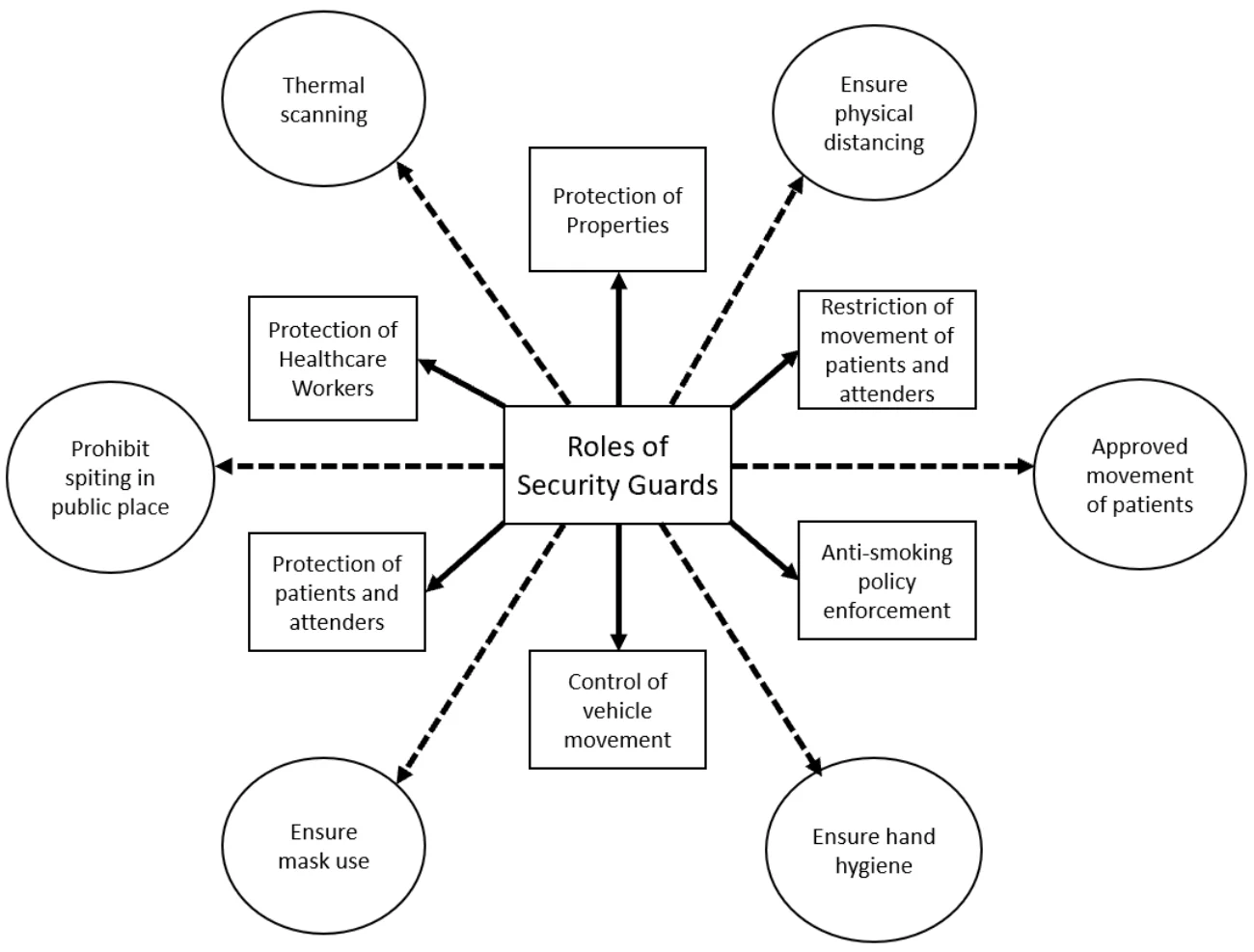
During the current coronavirus disease 2019 (COVID-19) pandemic, in addition to their routine places of duty, security guards are being placed at: triage areas, suspected COVID-19 wards, severe acute respiratory illness (SARI) wards, confirmed COVID-19 wards namely – isolation/communicable disease wards and intensive care units. Use of mask, the prohibition of spitting in public places, maintaining hand hygiene, and maintaining physical distance are listed as important infection preventive and control (IPC) measures for controlling COVID-19 [3,4]. In this pandemic situation, the security guards are acting as invisible health promoters, or health promotion champions- or behaviour change communicators, by actively promoting the important aforementioned practices. Through enforcement and practice, security guards are promoting and ensuring the following preventive measures:
- Physical distancing: A physical distance of more than one meter among people is being ensured by them. Surveillance of entry points, registrations counters, waiting halls, canteens, corridors is periodically done to ensure physical distancing.
- Hand hygiene: At the entry points in hospitals or wards, they are ensuring that everyone is (hand) sanitized before entering. Alcohol-based hand sanitizers are provided at all places of entry and at different places of the building to ensure adherence.
- Use of masks: Security guards are ensuring that everyone in the hospital premises wears a mask (in correct manner). They are provided with an adequate number of masks to be distributed among individuals who are not wearing one, especially at the entry points of hospital/specific buildings.
- Prohibition of people from spiting: Through regular surveillance (including electronic), they are prohibiting people from spitting in public places. They are making people aware of the legal aspects of spitting in hospitals. If needed, they can be provided with authority to challan people spitting in hospital premises.
- Reduction and restriction of movement in the hospitals: They are ensuring reduced and restricted movement of patients and their attendants through the infectious areas (designated as a red zone in some places) within the hospital, which helps in reducing the infection spread. Furthermore, using technologies such as closed-circuit television (CCTV), they are restricting the number of people entering any hospital building. This in turn ensures physical distancing and reduces the chances of infection spread. In addition, they are helping healthcare workers in quick and safe movement, without undue obstruction by patients/attendants.
- Thermal screening and linkage with screening OPD: Importantly, they are also involved in early identification of suspected COVID-19 cases through thermal screening. Security guards are conducting thermal scan of all people entering hospitals. Individuals found febrile are not allowed to enter the building and are linked with screening OPDs, which are staffed by medical doctors. Further, they can be easily trained to enquire about symptoms such as cough, fever, and breathlessness; and help in quick linkage and mobilization (escorting) of suspected COVID-19 cases to designated areas. In some hospitals, robot-assisted or tele-medicine kiosks have been placed to screen for symptoms and the process is being facilitated and monitored by security guards [5].
Figure 1 provides a schematic representation of the extended roles of a security guard serving in a hospital during the COVID-19 pandemic in addition to their routine responsibilities.
If all the above measures are ensured properly, the chances of infection within the hospital are significantly reduced and this breaks the chain of transmission not only for COVID-19 but for most of the communicable diseases.
Several challenges are being faced by security guards in ensuring the measures stated above. These challenges are specific to the COVID-19 situation and are over and above the pre-existing challenges of job insecurity, poor monetary remuneration, loss of pay for leave, and others being faced by the security guards. The various challenges are as under:
- Poor capacity building: The security guards are being asked to immediately start the enforcing activities in various places of hospitals without provision of adequate information about the disease, and the standard operating procedures (SOP) to ensure implementation of IPC measures. The security guards should be well trained before being assigned tasks. Further, customization of the training session as per the level of understanding of each staff, and sharing the SOP in the local language is also important for improving adherence. A special and separate training session should also be held regarding how to conduct thermal scanning.
- Self-protection: During the enforcement, there are high chances that they may face violence. This can be reduced by placing appropriate hoardings with all the messages (restricted entry, use of mask, and others) at important places in the hospital premises, especially at the points of enforcement. Further, quick linkage with police for support should also be arranged.
- Non/low provision of personal protective equipment (PPE): At times, security guards are refused even routine surgical masks to prevent themselves from getting infected. As per the guidelines, PPEs need to be provided based on the area of work and procedures performed [6]. Due to their nature of employment (mostly contractual, considered lower most cadre), at times they are not provided appropriate PPE as per the area of work. This is also due to non-provision of adequate and appropriate PPE to the parent security department. The exposure of COVID-19 infection from patients/attendants to security guards working in the emergency area is no less than that to any other healthcare worker (hospital attendant or sanitary attendant). Moreover, in situations where they are also involved in informal assistance to the emergency team for mobilization of patients and related activities, the need for the provision of PPE becomes even more important.
- Non-linkage of febrile patients with screening OPD: Though the security guards are identifying febrile individuals, the latter are not always properly linked with COVID-19 screening OPD. This may either be due to long distance to the OPD or due to security guards being poorly informed regarding the linkage protocols. To avoid such instances of non-linkage, it is important to provide contact details including timings of the OPD to all the security guards. Additionally, mobilization services may be arranged if the screening OPD is situated at a considerable distance.
- Non-provision of self-screening for COVID-19: Though the security guards are screening all people entering the hospital using thermal scanners or other modes, there are no SOPs available to screen security guards for COVID-19. It is important for them to get screened at regular intervals (or daily), in line with all other healthcare workers, and be provided with quarantine facility accordingly.
- Incentives and insurance coverage: In the background of the novel and deadly nature of COVID-19, the security guards are providing their services around the clock. Considering their low salary, each security guard needs to be provided with a special incentive for serving in COVID-19 related areas. Though the insurance scheme announced for healthcare personnel working for COVID-19 clearly mentions its inclusion of all types of workers, still the security guards are not convinced with their inclusion [7,8]. They can be provided with information and clarification for the same through hospital administrators.
- Low provision of logistics and maintenance: As the logistics like masks and hand sanitizers (for people) are provided by department or section other than security department, the former mostly underestimate the need and issue low quantity to the security guards. For improving adherence to standard IPC measures, an adequate quantity of logistics and its maintenance should be ensured.
- Leaving the job or vacating the house: Like other healthcare workers, the security staffs working in the hospitals are also undergoing discrimination within the community due to COVID-19. Due to this, some of them are being forced to vacate their houses or resign from their job. In addition to educating the community, the security guards need to be provided with proper accommodation facilities if they face such discrimination.
In conclusion, security guards are one of the important frontline healthcare workers providing extended services in the control of COVID-19. They reflect a hospital’s strictness in implementation of IPC measures. Directly or indirectly, they can act as health promotion champions, or behaviour change communicators; either through self-practice, or through enforcement. The infection spread can be reduced to a great extent if the IPC measures enforced by the security guards are adequately adhered to. With adequate training and with the provision of appropriate PPE, they can also be used as reserve health workforce. Finally, the contribution of these unsung heroes in the fight against COVID-19 needs to be recognized and appropriately incentivized. This will motivate them and improve their efficiency.
References
- World Health Organisation. Hospital Preparedness for Epidemics [Internet]. 2014. p. 71. Available from: http://apps.who.int/iris/bitstream/10665/151281/1/9789241548939_eng.pdf
- Maahs JR, Hemmens C. Guarding the public: A statutory analysis of state regulation of security guards. J Crime Justice. 1998;21(1):119–34. [doi:10.1080/0735648x.1998.9721069]
- Ministry of Health and Family Welfare (Government of India). Guidelines to be followed on detection of suspect/confirmed COVID-19 case in a nonCOVID Health Facility [Internet]. [cited 2020 May 3]. Available from: https://www.mohfw.gov.in/pdf/GuidelinestobefollowedondetectionofsuspectorconfirmedCOVID19case.pdf
- Ministry of Health and Family Welfare (Government of India). National guidelines for infection prevention and control in healthcare facilities [Internet]. [cited 2020 May 3]. Available from: https://www.mohfw.gov.in/pdf//National Guidelines for IPC in HCF - final%281%29.pdf [Google Scholar]
- Pinto N. Covid-19: Bengaluru hospital introduces robots to screen people to protect doctors from being infected [Internet]. India Today. Bengaluru; Available from: https://www.indiatoday.in/india/story/covid-19-bengaluru-hospital-introduces-robots-screen-people-protect-doctors-being-infected-1673067-2020-05-01
- Ministry of Health and Family Welfare (Government of India). Novel Coronavirus Disease 2019 (COVID-19): Guidelines on rational use of Personal Protective Equipment [Internet]. [cited 2020 May 3]. Available from: https://www.mohfw.gov.in/pdf/GuidelinesonrationaluseofPersonalProtectiveEquipment.pdf
- Ministry of Health and Family Welfare (Government of India). Pradhan Mantri Garib Kalyan Package: Insurance Scheme for Health Workers Fighting COVID-I9 [Internet]. [cited 2020 May 3]. Available from: https://www.mohfw.gov.in/pdf/pdfjoiner.pdf
- Ministry of Health and Family Welfare (Government of India). Pradhan Mantri Garib Kalyan Package: Insurance Scheme for Health Workers Fighting COVID-19. FAQs [Internet]. [cited 2020 May 3]. Available from: https://www.mohfw.gov.in/pdf/FAQPradhanMantriGaribKalyanPackageInsuranceSchemeforHealthWorkersFightingCOVID19.pdf [Google Scholar]
Published
Article metrics
- Views
- 1,649
- Downloads
- 1,108
Based on this site's usage statistics.